Summer Biochem Exam 5
 Call Kai
 Learn
Learn Practice Test
 Spaced Repetition
 Match
Match Flashcards
 Knowt Play
1/34

There's no tags or description
Looks like no tags are added yet.
Name | Mastery | Learn | Test | Matching | Spaced | Call with Kai |
|---|
No analytics yet
Send a link to your students to track their progress
35 Terms
Origin of Replication in prokaryotes
single point on circular chromosome, built for speed
Origin of Replication in eukaryotes
thousands of points as it would take too long if there was only a single one
Meselson and Stahl experiment
demonstrated that DNA replication was semiconservative
two DNA each made of one old strand and one new
Function of DnaA
wider, base pairs not right in middle
Function of DnaB
most common form of DNA helix
base pairs in middle
Function of Single Strand Binding Protein,
protein that binds to single strand DNA to prevent reforming of double-strands
Function of helicases
separation and unwinding of DNA helix
Function of Topoisomerases,
relieve topological stress caused by local unwinding of double helix
Function of primase
enzyme which makes a short base-paired region called RNA primer with free 3” OH group for DNA pol to add first DNA nucleotide
Function of telomerase
add nucleotides to end of telomeres to maintain length and protect genetic info in chromosomes
Function of beta-Clamp
keeps DNA pol from falling off DNA template strand
Function of PCNA
acts as sliding clamp, keeps polymerase on DNA
more processive than beta clamp
enzymatic function of DNA Pol I
replace RNA primers with DNA on okazaki fragments
exonuclease activity 5’ to 3’ (clip out bases)
proofreads activity in 3’ to 5’ direction
synthetic activity in 5’ to 3’ direction
enzymatic function of DNA pol III
main replicative polymerase, high processivity
proofreads activity in 3’ to 5’ direction
synthetic activity in 5’ to 3’ direction
DNA Pol
must work from a 3’ OH
synthesize from 5’ to 3’
needs a primer (short RNAs that must be removed after)
leading strand synthesis
continuous replication (synthesis) as DNA unwinds
lagging strand synthesis
lagging strand synthesized in fragments opposite of leading strand
synthesizes in 5’ to 3’
okazaki fragments
fragments of synthesized DNA on lagging strand
base excision repair vs nucleotide excision repair
NER- first cut phosphodiester backbone around error, refilled by DNA pol and ligase reseals backbone
BER- first clip off base, THEN phosphodiester backbone is broken then DNA pol and ligase fix
homologous recombination vs non-homologous end joining
both fix double strand breaks
homologous recombination- use one strand as guide, requires sequences to match. Leads to Holliday junction (can transfer from one chromosome to another and cause rearrangements)
non-homologous end joining- error prone, last ditch effort, no template to copy
operators
promoters
TATA box
TATA Binding protein
RNA polymerase subunits
termination via stem loop structures or Rho proteins
Eukaryotic RNA polymerases and functions
delta and epsilon are most important
e on leading strand
d on lagging strand
intron vs exons
DNA SYNTHESIS
RNA SYNTHESIS
RIBOSOME READING DIRECTION
5’ TO 3’
DNA ligase
seals phosphodiester backbone
differences in prokaryote vs eukaryote replication
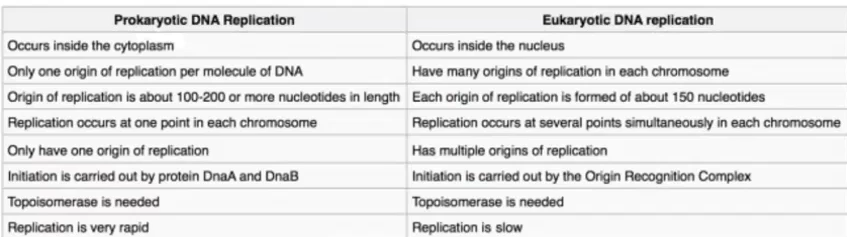
prokaryotes compact DNA by using
supercoiling
eukaryotes compact DNA using
histones
terminator sequence and tus proteins
SOS system