Moral Psychology
 Call Kai
 Learn
Learn Practice Test
 Spaced Repetition
 Match
Match Flashcards
 Knowt Play
1/24

There's no tags or description
Looks like no tags are added yet.
Name | Mastery | Learn | Test | Matching | Spaced | Call with Kai |
|---|
No analytics yet
Send a link to your students to track their progress
25 Terms
Immanuel Kant
Rationalism
Categorical imperative
Rationalism
through human reasoning, we can discover eternal truths about the world/ what it means to make a morally-correct decision
Categorical Imperative
the principle that acts should be chosen based on their moral worth, rather than on their ability to achieve a particular goal or outcome
Moral principles should be based on reason rather than subjective desires or feelings
Ex: Lying could not be considered a universal principle because it would undermine the trust and communication necessary for human society to function -> lying would be morally wrong
Piaget’s Perspective
Piaget thought that proper development meant that children needed to proceed through a set of stages that marked moral shift in their behavior
Universal, invariant sequence
Focused on observables (outcomes) more than underlying properties (intentions)
Young children focus on outcomes
Older, more morally-mature children focus on intentions
Egocentric, heteronomous, autonomous
Piaget’s evidence
A child who knocks over one glass while trying to steal a cookie deserves more blame than a child who knocks over five glasses trying to help their parent
Egocentric
I can play however I want
Heteronomous
There’s one right way to play, it has been the same forever
Autonomous
There’s an agreed upon way to play, but we could change it through consenseus
Kohlberg
Heinz’s Dilemma
Pre-conventional, conventional, post-conventional levels
**This stage theory doesn’t account for cultural differences
Moral reasoning:
Kohlberg presented hypothetical moral dilemmas to 10- to 16-year-old boys and then followed the participants longitudinally over the next 20 years.
Moral maturity is determined by the way an individual reasons about the dilemma, not the content of the response.
Heinz’s Dilemma
Heinz's wife is dying of cancer
The only drug that can save her costs $1,000, which he cannot afford
Heinz asks the pharmacist if he can pay for the drug later, but the pharmacist refuses
Desperate to save his wife, Heinz breaks into the pharmacy and steals the drug
Are Heinz's actions morally right or wrong?
Often used to assess a person's level of moral reasoning and to understand how they think about right and wrong
Pre-conventional level
values based on external events
Stage 1: acting to avoid punishment (ages 5-7)
Stage 2: acting to further one’s own interest (ages 8-10)
Conventional level
assessing personal consequences
Stage 3: decisions based on the approval of others (ages 10-12)
Stage 4: judgments based on the relative rules and laws of society (ages 12-14)
Post-conventional level
shared standards- rights, duties, and principles
Stage 5: social contract rules and laws of social good (ages 17-20)
Stage 6: guided by moral principle of justice (ages 21+)
Social Domain Theory
the idea that all of the rules we see as existing in the social world can be divided into 2 domains: moral and conventional
Moral rules
intrinsic and universal, applying no matter what
Physical harm
Emotional harm
Violations of fairness
Conventional rules
created by individual cultures and only applied when there are explicit rules or norms dictating them
Foods
Dress
Manners
Social domain theory vs, piaget & kohlberg
No stages (there’s developmental continuity)
Both morality and convention are present from birth
Convention doesn’t precede morality
Helps us navigate the world and make sense of things
More evidence suggests that this theory is true, helper and hinder experiment
Hume’s Perspective
Rival to Kant
Argued we should have a moral imperative
Famous for sentimentalism
Similar to contemporary John Height’s argument
Linked to trolley dilemmas
Trolley Dilemmas: Classic scenario
You’re in a trolley on a track that would hit 5 people, do you pull the lever to switch to a track where one person would get hit?
7/10 people would pull the lever
Utilitarianism
Utilitarianism
the morally correct decision is the one that maximizes wellbeing
Trolley dilemmas: bridge scenario
What if you’re on a footbridge and pushing one person off would stop the trolley from hitting five others?
9/10 would not push the person
Our instincts tell us that deliberately causing someone’s death is different than allowing them to be collateral damage; pushing someone activates an emotional aversion
Social Intuitionist Model of Morality
Jonathan Haidt
The social intuitionist model is presented as an alternative to rationalist models.
The model is a social model in that it deemphasizes the private reasoning done by individuals and emphasizes instead the importance of social and cultural influences.
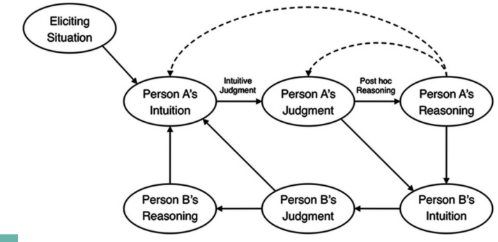
Social transmission of morality
Relationship between emotions and moral judgement
There are many ways that emotions help or hinder us from making “moral” decisions
Moral Contagion Hypothesis
Moral Contagion Hypthesis
moral attitudes and behaviors can be spread from one individual to another through social interactions
Examples: protests, social media, online, etc.
Sentimentalism
Prioritizing feelings over reasoning