Physiology of Exercise Everything you need to know in the whole freaking slides
 Call Kai
 Learn
Learn Practice Test
 Spaced Repetition
 Match
Match Flashcards
 Knowt Play
1/145

There's no tags or description
Looks like no tags are added yet.
Name | Mastery | Learn | Test | Matching | Spaced | Call with Kai | Chat |
|---|
No analytics yet
Send a link to your students to track their progress
146 Terms
Barometric pressure (Pb) at sea
~760 mmHg at
sea level
Partial pressure of oxygen (PO2)
~159 mmHg at sea level
◦ Reduced PO2 at altitude limits exercise
performance
Define hypoxia.
Low O2 in tissues
Define hypoxemia.
Low O2 in arterial blood
Effects of low altitude and what is it?
(500-2,000m; approx. 1,600'-6,500')
No effects on well-being
◦ Performance may be decrease, restored by
acclimation
Effects on well being in moderate atltitude
(2,000-3,000m; ~6,500'-9,800')
◦ May cause health issues in unacclimated
people
◦ Performance and aerobic capacity decrease
◦ Performance may or may not be restored
by acclimation
Effects on well being in high altitude
3,000-5,500 m; approx. 9,800'-18,000')
◦ Acute mountain sickness; HAPE; HACE
◦ Performance decrease, not restored by acclimation
what happens to well being at extreme high altitude
(>5,500 m)
◦ Severe hypoxic effects
◦ Highest settlements: 5,200 to 5,800 m
Mt. Everest Pb:
250 mmHg
Why does oxygen availability decrease at high altitude?
Even though oxygen remains ~20.93% of air, total barometric pressure drops (e.g., 760 mmHg at sea level vs. ~250 mmHg on Mt. Everest), so the partial pressure of oxygen (PO₂) also drops, reducing oxygen delivery to the body.
how is air temperature affected at altitude
Temperature decreases 1°C per 150m ascent
(about 20F per 500')
◦ Contributes to risk of cold-related disorders
◦Cold air holds …water
◦ Air at altitude is …
◦ Dry air is…
very little ,
very cold and dry
quick dehydration via skin and lungs
Solar radiation… at high altitude because…(3 reasons)
increases
UV rays travel through less atmosphere
Water normally absorbs sun radiation, but
low PH2O at altitude can’t
Snow reflects/amplifies solar radiation
pulmonary ventilation… in acute altitude exposure
increases immediated
Ventilation…at rest and submaximal exercise
increases
but not at maximum exercise
decrease in PO2 stimulates
chemoreceptors in aortic arch, carotids
– increase Tidal volume for several hours,
days
What happens to breathing and CO₂ levels during acute exposure to high altitude?
The body hyperventilates (breathes faster), which lowers CO₂ levels (↓ PCO₂), increases the CO₂ gradient, and can lead to respiratory alkalosis.
What is respiratory alkalosis?
blood pH is elevated due to low CO₂ levels.
How does respiratory alkalosis affect the oxyhemoglobin dissociation curve?
It shifts the curve to the left, meaning hemoglobin holds onto oxygen more tightly. Decreased oxygen release to tissues.
How does respiratory alkalosis influence hyperventilation at altitude?
It helps prevent excessive hypoxia-driven hyperventilation.
How do the kidneys respond to respiratory alkalosis?
They excrete more bicarbonate (HCO₃⁻). It reduces blood buffering capacity and lowers blood pH back toward normal.
Hypoxemia a direct reflection of
low alveolar
PO2
low Alveolar PO2 means
low O2 hemoglobin
saturation
Diagram of Alveolar PO2
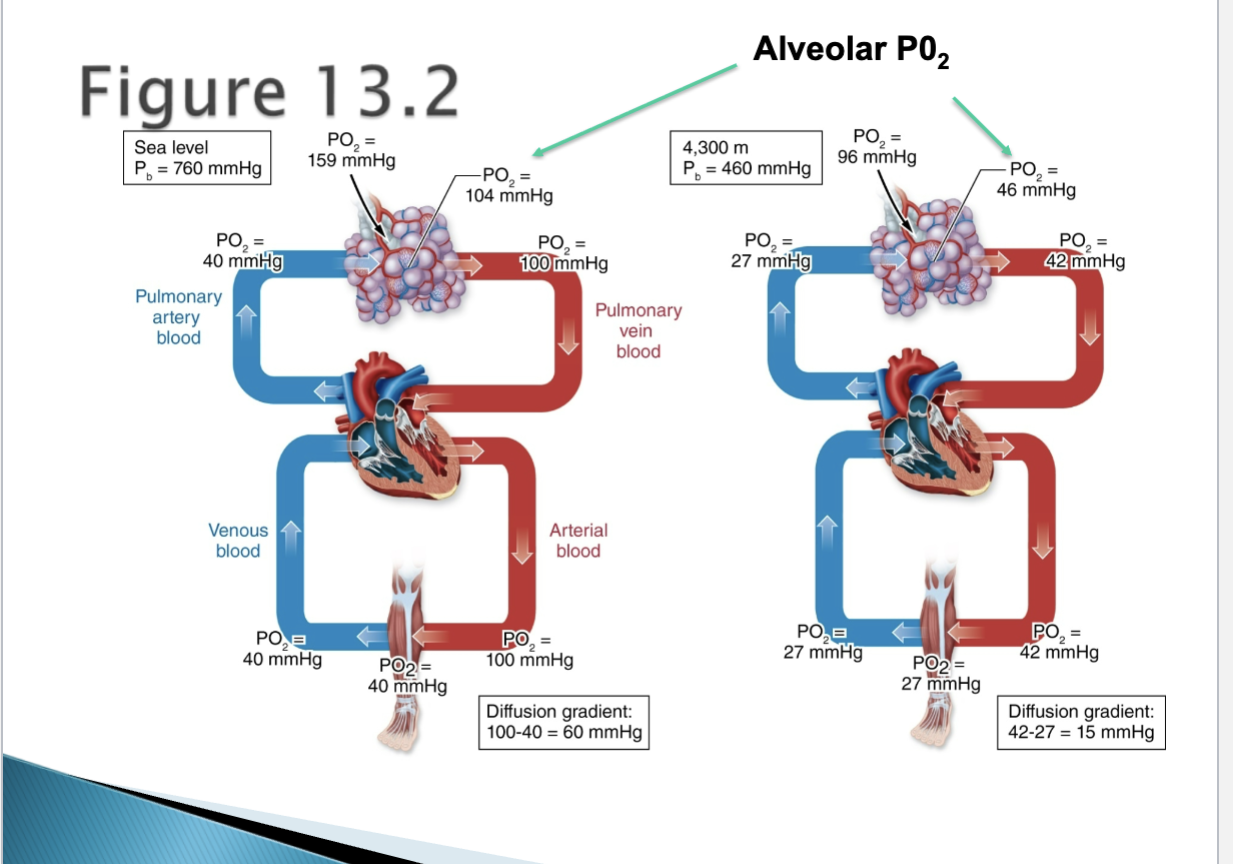
O2 diffusion, exercise capacity, Gas exchange and PO2 gradient at muscles both… at acute altitude exposure
decrease
Gradient at sea level vs 4,3000m altitude
Sea level: 100 – 40 = 60 mmHg gradient
◦ 4,300 m altitude: 42 – 27 = 15 mmHg gradient
What happens to plasma volume, respiratory waterloss and hematocrit at acute altitude exposure?
Short term: plasma volume decreases
within few hours
◦ Respiratory water loss, increase urine
production
◦ Lose up to 25% plasma volume
◦ Short-term increase in hematocrit, O2 density
RBC count…after weeks/months
increases
Hypoxemia triggers EPO release from
kidneys
– increase Red blood cell production in bone
marrow
◦ Long-term increase in hematocrit
Cardiac output…in acute altitude exposure
increases despite decrease in plasma volume and stroke volume
At rest and submaximal exercise (not maximal)
◦ Delivers more O2 to tissues per minute
What happens ti the sympathetic nervous system activitry
it increases, so does HR
Inefficient, short-term adaptation (6-10 days)
After a few days, muscles…O2
extract more
increase in (a-v) O2 difference
reduces demand for cardiac output
Basal metabolic rate, Thyroxine, actecholamione all…in acute altitude exposure
increase
must increase food intake to maintain body mass
Dehydration occurs…must consume how much fluid/day
faster
Water loss through skin, kidneys/ urine,
sweating
Must consume ~3 to 5+ L fluid/day
what happens to appitite in acute altitude exposure, Maintain … intake to support to increase in hematocrit?
declines
Paired with increase metabolism >500
kcal/day deficit
◦ Athletes/climbers must be educated
about eating at altitude
Maintain iron intake to support to increase
in hematocrit
VO2max as altitude past …and why
decreases, past 1,500m
Due to decreased arterial PO₂ and reduced maximal cardiac output (Qmax).
What happens to atmospheric PO₂ at ~5,000 ft?
It drops below ~131 mmHg.
How much does VO₂ max decrease with increasing altitude?
About 8–11% per 1,000 m ascent.
Is aneribuc performance effected in acute atitude?
no
ATP-PCr and anaerobic glycolytic metabolism
◦ Minimal O2 requirements
Thinner air means…
less air resistance
Improved swim and run times (up to 400m)
◦ Improved jump distances
◦ Throwing events, varied effects
Know graph
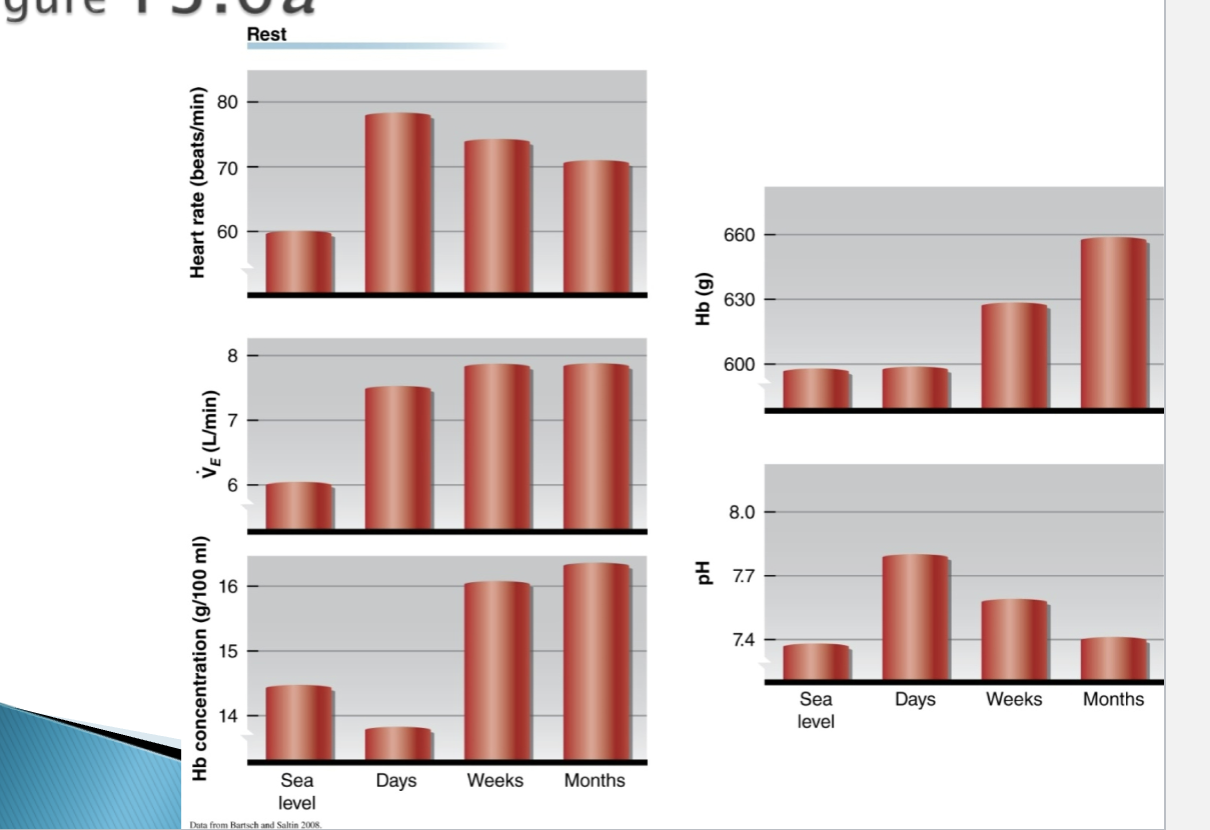
know graph
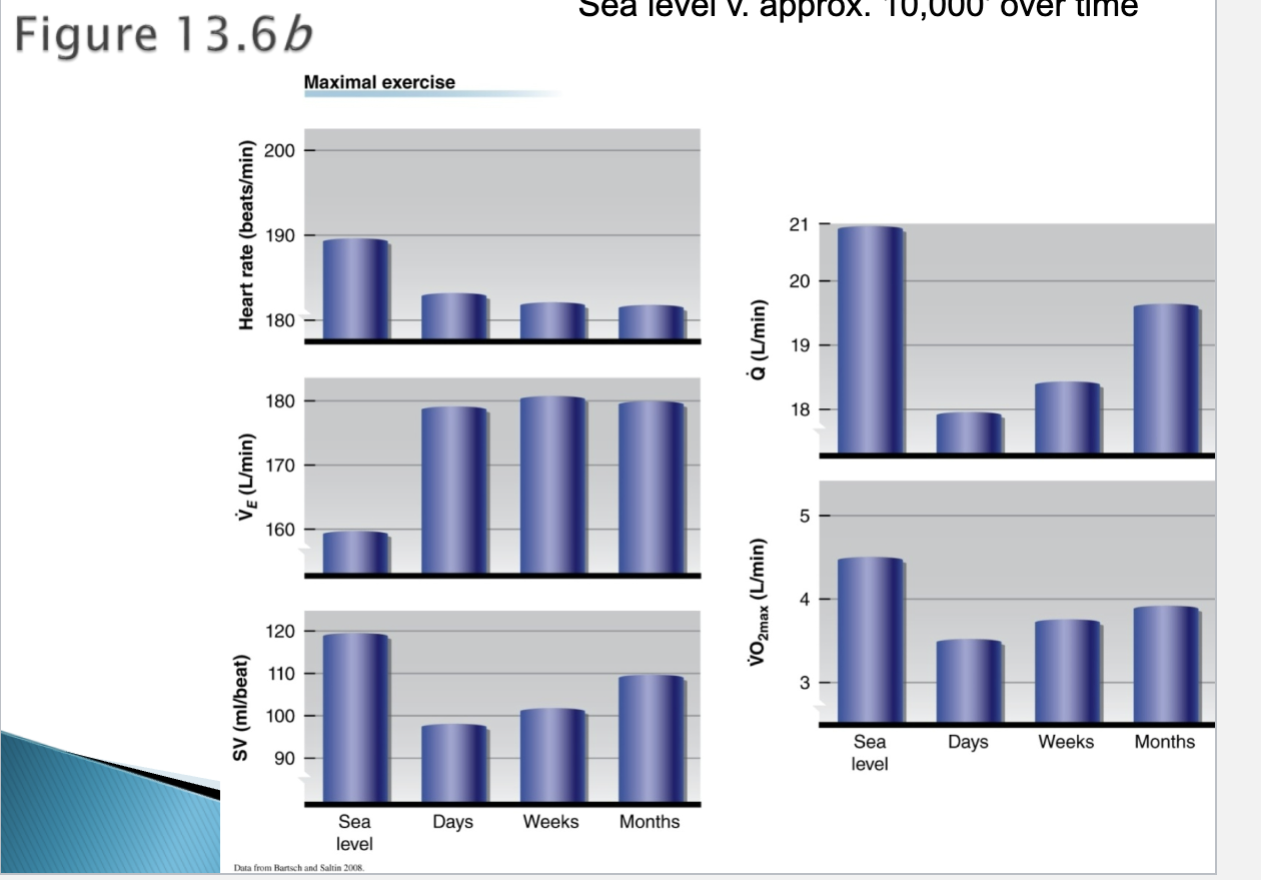
How does ventilation change with altitude acclimation?
increases at rest and during exercise.
How much does resting ventilation increase after a few days at altitude?
About 40% higher than at sea level (within 3–4 days).
How does submaximal ventilation change at altitude?
It increases by about 50%.
What hormone increases early during altitude exposure? what does it do
Erythropoietin (EPO).Stimulates polycythemia (increased red blood cell count and hematocrit).
How long does EPO increase after altitude exposure?
About 2–3 days.
How long can red blood cell levels remain elevated?
3+ months.
What is normal hematocrit at sea level?
~45%.
What can hematocrit reach at ~4,500 m altitude?
~60%
How does hemoglobin change with altitude?
: It increases proportional to elevation.
How does plasma volume change during acclimation?
Decreases initially, then increases later.
Why does hematocrit increase early in altitude exposure?
Due to plasma volume loss.
What is the benefit of later plasma volume increase?
Improves stroke volume and cardiac output (Q).
How does muscle cross-sectional area change at altitude?How does capillary density change at altitude?
decreases, increases
Why does muscle mass decrease at altitude?
Weight loss and possible protein wasting.
How does muscle metabolic potential change at altitude?What happens to mitochondrial function and glycolytic enzymes?What happens to oxidative capacity at altitude?
decrease
What happens to inspiratory muscle function?
increase
Do elite athletes gain aerobic capacity after long altitude exposure?
No significant increase in aerobic capacity.
Why might aerobic capacity not improve at altitude?
Reduced atmospheric PO₂ limits training intensity.
What is a major limitation of training at high altitude?
Hypoxia prevents high-intensity aerobic training.
What are negative effects of living and training high?
Dehydration, low blood volume, and reduced muscle mass.
What are common altitude training strategies?
Train high, compete low
Train high, compete high
Train low, compete high
Live high, train low
What is the benefit of “live high, train low”?
Allows acclimation while maintaining high training intensity.
Which training strategy shows the best performance improvements?
Live high, train low.
What is the main challenge of exercise in extreme environments?
he stress of physical exertion is complicated by environmental thermal conditions.
What does it mean that humans are homeothermic?
They maintain a nearly constant internal body temperature despite environmental changes.
What is thermoregulation?
Regulation of body temperature around a physiological set point (~37°C / 98.6°F).
What is metabolic heat production (M)?
Heat generated from ATP breakdown.
How is ATP energy distributed?
<25% → cellular work (W), >75% → heat.
How does heat move within the body?
From core to skin via blood.
What happens when heat reaches the skin?
It dissipates via conduction, convection, radiation, or evaporation.
What is conduction (K)?
Heat transfer through direct contact between solids.
What is convection (C)?
Heat transfer via movement of air or fluid across the skin; ↑ movement → ↑ heat exchange.
What is radiation (R)?
Heat transfer via infrared rays; body can gain or lose heat.
What is evaporation (E)?
Heat loss via liquid → gas (sweat evaporation).
What is dry heat exchange?
Conduction + convection + radiation.
What is insulation (I)?
Resistance to dry heat exchange; still air/water acts as an insulator.
What is the primary heat loss mechanism during exercise?
Evaporation (~80%).
How does humidity affect evaporation?
↑ Humidity → ↓ evaporation; ↓ humidity → ↑ evaporation.
What is a consequence of prolonged sweating?
Dehydration.
What happens when air temperature ≥ skin temperature?
Conduction/convection/radiation fail → rely on evaporation.
How much heat is lost per liter of sweat evaporated per hour?
~680 W.
What is the heat balance equation?
M – W ± R ± C ± K – E = 0
What does M – W ± R ± C ± K – E > 0 mean?
Heat gain.
What does M – W ± R ± C ± K – E < 0 mean?
Heat loss.
What are critical core temperature limits?
<35°C or >41°C (95–105.8°F).
What happens when core temperature exceeds 40°C?
Physiological function is impaired.
What controls thermoregulation?
Preoptic anterior hypothalamus (POAH).
What triggers thermoregulatory responses?
Input from thermoreceptors detecting temperature changes.
How does the SNS control heat loss?
Vasoconstriction → ↓ heat loss
Vasodilation → ↑ heat loss
How do sweat glands contribute to heat loss?
SNS stimulates eccrine glands → sweating → evaporation.
What neurotransmitter stimulates sweating?
Acetylcholine (sympathetic cholinergic).
Are sweat glands more sensitive to core or skin temperature?
Core temperature.
How do skeletal muscles help thermoregulation?
Shivering produces heat without useful work.
How do endocrine glands affect temperature?
↑ metabolism → ↑ heat production (thyroxine, catecholamines).
Why does exercise disrupt thermal homeostasis?
Increased metabolic heat production.
What happens to skin blood flow in heat?
Vasodilation increases heat loss but requires more blood flow.
How does the heart respond to heat stress?
↑ cardiac output via ↑ HR and contractility; vasoconstriction to nonessential tissues.
What causes cardiovascular drift?
↓ blood volume → ↓ stroke volume → ↑ heart rate.