Cardiovascular and Respiratory System Review
 Call Kai
 Learn
Learn Practice Test
 Spaced Repetition
 Match
Match Flashcards
 Knowt Play
1/132

Earn XP
Description and Tags
133 flashcards covering cardiovascular system basics, heart structure, blood vessels, and the respiratory system based on the lecture transcript.
Name | Mastery | Learn | Test | Matching | Spaced | Call with Kai |
|---|
No analytics yet
Send a link to your students to track their progress
133 Terms
What is the main function of the cardiovascular system?
Transport substances around the body.
What does the cardiovascular system transport?
O2, nutrients, hormones, wastes, heat, immune cells, and CO2.
What are the 3 major components of the cardiovascular system?
Blood, heart, and blood vessels.
What is the function of the heart?
To pump blood through blood vessels.
What do arteries do?
Carry blood AWAY from the heart.
What do veins do?
Return blood TOWARD the heart.
What is the role of capillaries?
Exchange gases, nutrients, and wastes with tissues.
What are the two main circulations of the cardiovascular system?
Pulmonary circulation and systemic circulation.
What does the right side of the heart pump?
Blood through the pulmonary circuit to the lungs.
What does the left side of the heart pump?
Blood through the systemic circuit to the body.
Where is the heart located?
In the mediastinum of the thorax.
What is the mediastinum?
The central compartment of the thorax between the lungs. This is where the heart is
What is the pericardium?
A connective tissue sac surrounding the heart.
What are the functions of the pericardium?
Holds heart in place, prevents overfilling, and reduces friction.
What are the two major layers of the pericardium?
Fibrous pericardium and serous pericardium.
What are the two layers of the serous pericardium?
Parietal layer and visceral layer.
What is another name for the visceral serous pericardium?
Epicardium.
What is found between serous membrane layers?
Serous fluid.
Why is serous fluid important?
It reduces friction during heart movement.
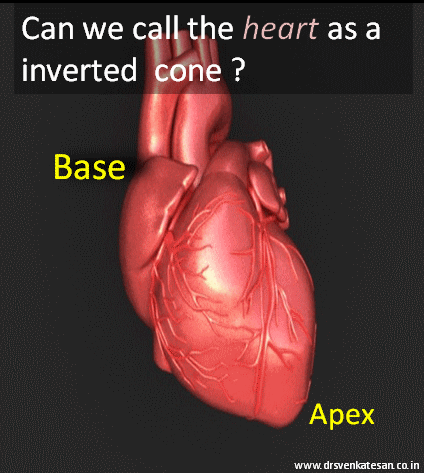
What is the apex of the heart?
The pointed inferior tip.
Which direction does the apex point?
Inferiorly and to the left.
What is the base of the heart?
The broad superior region where great vessels attach.
How many chambers does the heart have?
4.
What are the four chambers?
Right atrium, left atrium, right ventricle, and left ventricle.
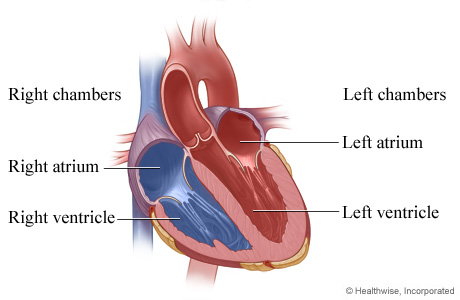
What do atria mainly do?
Receive blood.
What do ventricles mainly do?
Pump blood.
Why is the left ventricle thicker than the right ventricle?
It pumps blood through the entire body at higher pressure.
What is the fibrous skeleton of the heart?
Dense connective tissue supporting the valves and separating atria from ventricles.
What is the endocardium?
Smooth inner lining of the heart.
What type of epithelium forms the endocardium?
Simple squamous epithelium.
Why is the endocardium smooth?
To reduce friction as blood flows.
What is the myocardium?
The cardiac muscle layer.
Which layer is the thickest part of the heart wall?
Myocardium.
What is the epicardium?
The outer layer of the heart wall.
What type of muscle is found in the heart?
Cardiac muscle.
Is cardiac muscle striated?
Yes.
Are cardiac muscle fibres branched?
Yes.
What are intercalated discs?
Specialized connections between cardiac muscle cells.
What do intercalated discs allow?
Rapid electrical communication and simultaneous contraction.
Why is coordinated contraction important?
The heart must pump as one unit efficiently.
Can cardiac muscle regenerate well?
No, it is mostly non-mitotic.
What happens if cardiac muscle dies?
It is poorly replaced, often by scar tissue.
What is the pathway of blood through the heart?
Body → vena cavae → right atrium → tricuspid valve → right ventricle → pulmonary valve → pulmonary trunk → pulmonary arteries → lungs → pulmonary veins → left atrium → mitral valve → left ventricle → aortic valve → aorta → body
Which side of the heart contains deoxygenated blood?
Right side.
Which side contains oxygenated blood?
Left side.
Which vessels carry blood to the lungs?
Pulmonary arteries.
Why are pulmonary arteries unusual?
They carry deoxygenated blood.
Which vessels return blood from the lungs?
Pulmonary veins.
Why are pulmonary veins unusual?
They carry oxygenated blood.
What is the function of heart valves?
Prevent backflow of blood.
What causes heart valves to open and close?
Pressure differences.
What are the three layers of most blood vessels?
Tunica intima, tunica media, and tunica externa.
Which layer contains endothelium?
Tunica intima.
What is endothelium?
Simple squamous epithelium lining vessels.
Which layer contains smooth muscle?
Tunica media.
Which layer mainly contains connective tissue?
Tunica externa.
Which vessels only have tunica intima?
Capillaries.
Why are capillary walls thin?
To allow exchange of substances.
Which has thicker walls: arteries or veins?
Arteries.
Why do arteries need thick walls?
They withstand high pressure from the heart.
Which has a larger lumen: arteries or veins?
Veins.
Why do veins have larger lumens?
Blood pressure is lower.
Which vessels contain more smooth muscle?
Arteries.
Which vessels contain valves?
Small and medium veins.
What is the function of venous valves?
Prevent backflow of blood.
Why are valves especially important in the legs?
Blood must move upward against gravity.
What helps push venous blood back to the heart?
Skeletal muscle contractions.
What are varicose veins?
Dilated veins with faulty valves.
Why do varicose veins occur?
Blood pools when valves fail.
What are elastic arteries?
Large arteries rich in elastic fibres.
Give examples of elastic arteries.
Aorta, pulmonary trunk, and common carotid arteries.
Why are elastic arteries important?
They stretch and recoil to handle high pressure.
What is recoil?
Elastic return after stretching.
Why is recoil useful in arteries?
It helps maintain blood flow between heartbeats.
What are muscular arteries?
Medium arteries with more smooth muscle.
What is the role of muscular arteries?
Distribute blood to organs.
What is vasoconstriction?
Narrowing of blood vessels.
What causes vasoconstriction?
Smooth muscle contraction.
What is vasodilation?
Widening of blood vessels.
Why does vasodilation occur?
To increase blood flow.
What pumps blood into the pulmonary trunk?
Right ventricle.
How many pulmonary arteries are there?
2.
How many pulmonary veins are there?
4.
Why is pulmonary circulation considered low pressure?
The lungs are delicate and close to the heart.
What is pulmonary ventilation?
Movement of air in and out of lungs.
What is gas exchange?
Exchange of O2 and CO2.
Where does gas exchange occur?
Respiratory surfaces in the lungs.
Besides gas exchange, what else does the respiratory system do?
Acid-base balance, vocalisation, olfaction, and protection from pathogens.
Why does the respiratory system help control pH?
CO2 levels affect blood acidity.
What structures are in the upper respiratory tract?
Nose, nasal cavity, pharynx, and sometimes larynx.
What structures are in the lower respiratory tract?
Trachea, bronchi, bronchioles, and lungs.
What is the conducting zone?
Airways that transport air.
What are functions of the conducting zone?
Warm air, humidify air, and filter air.
What is the respiratory zone?
Site of gas exchange.
Which structures mainly make up the respiratory zone?
Alveoli.
What are the paranasal sinuses?
Air-filled spaces in skull bones.
Which bones contain paranasal sinuses?
Frontal, ethmoid, sphenoid, and maxillary.
Functions of paranasal sinuses?
Lighten skull, produce mucus, warm/humidify air, and add resonance.
What is the nasal septum?
Wall dividing nasal cavity into left and right sides.
What structures increase surface area in the nasal cavity?
Nasal conchae.