Lecture 6 Infantile Amnesia
 Call Kai
 Learn
Learn Practice Test
 Spaced Repetition
 Match
Match Flashcards
 Knowt Play
1/14

There's no tags or description
Looks like no tags are added yet.
Name | Mastery | Learn | Test | Matching | Spaced | Call with Kai |
|---|
No analytics yet
Send a link to your students to track their progress
15 Terms
Can infantile amnesia in rate be observed with different types?
Observed with simple non-associated learning
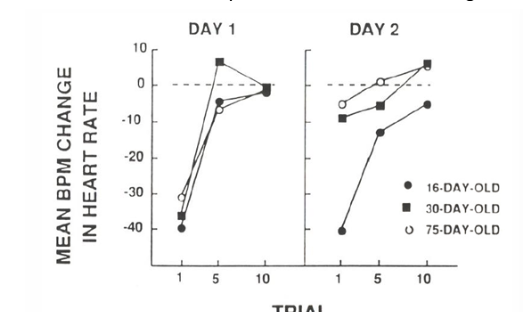
Campbell– orientating response habituation
Description
DV - Measured heart rate in response to habituated stimulus – as a function of memory – OVER TWO DAYS
IV - did these measures across different ages.- 16 day old, 30 day old and 75 day old.
Results
Found that the older animals demonstrated more memory as they showed a less substantial drop in heart rate - indicating recall of memory.
Storage deficit or Retrieval deficit?
Whether loss of memory is due to storage deficit vs. retrieval deficit
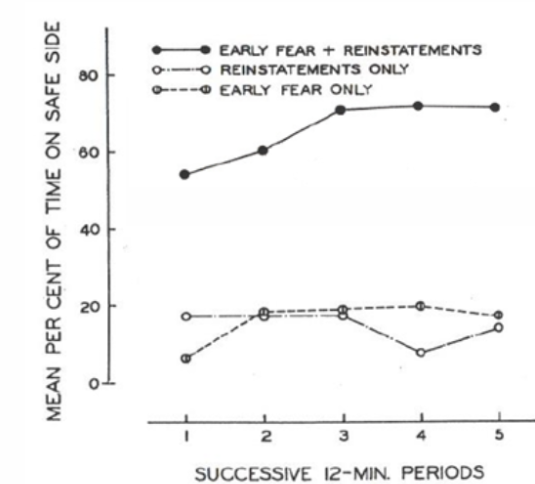
Description: animals are trained in a passive avoidance task - and then are put back into the box 4 weeks later.
IV -
From post natal 25 days were trained and placed into the box once a week for the 3 weeks in between - (when back into the shutter box)
From post natal 25 days, they were trained and were placed into the box and were shocked with less intensity every time they went into the dark box.
From post natal 25 days, just placed into the box once a week for the 3 memories and shocked.
DV - time spent on the safe side of the box.
RESULTS: - needs both reinstatement and initial training
Retrieval failure is suggested
Storage deficit or Retrieval deficit? Humans - https://pubmed.ncbi.nlm.nih.gov/7375924/
Whether loss of memory is due to storage deficit vs. retrieval deficit → humans
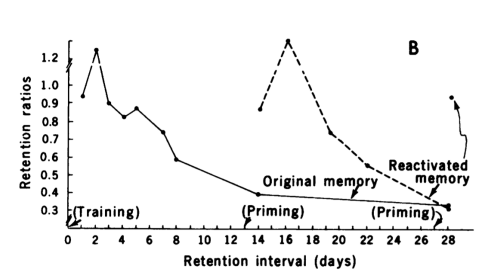
Description: using the mobile task - initially trained 3 month olds to associated moving their foot with movement of fun mobile. Some infants’ memories are reactivated using exposure to mobile
IV: Reactivation or NOT
DV: Retention Ratio = aka movement of foot in comparison to before
Result - Reactivated infants experienced better memory
How can we explain infantile amnesia?
Sexual repression? (Freud)
State dependency? (Tulving)
Language/theory of mind development?
Immaturity of the brain’s memory system.
What is the immature brain hypothesis?
that infantile amnesia occurs because key structures for memory formation and storage are insufficiently mature at the time of memory formation to process these memories
Brain continues to develop post-natally → white matter
Does the immature brain hypothesis hold for other species?
Depends at what type of animal — altricial animals (not really developed- shorter gestational period), and precocial (more fully developed - longer gestational period)
If the immature brain hypothesis is true - then precocial animals should retain memory longer.
Description - Guinea pigs vs. Rats in the T-maze Escape
Results - Finds that Guinea pigs possess less infantile amnesia.
SUPPORTS THE IMMATURE BRAIN ACCOUNT.
What is the neurogenic hypothesis
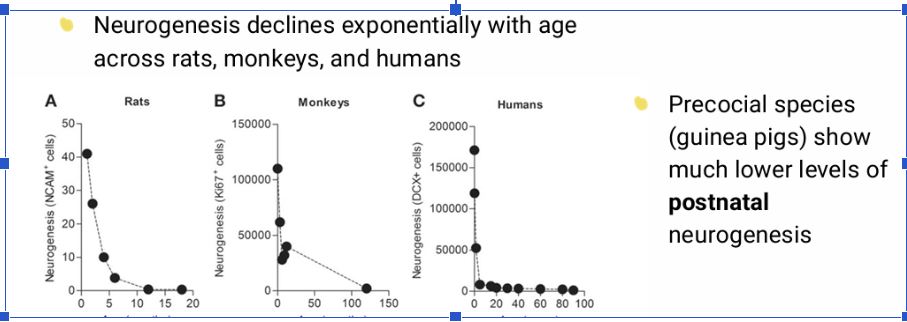
The process of maturation interferes with the encoding of memory, that is, high neurogenesis = low memory.
Evidence for the neurogenic hypothesis?
Precocial species (guinea pigs) show much lower levels of postnatal neurogenesis and have less infantile anemeisa
What is the immediate shock deficit?
States that the immediate shock in a completely new conditioning environment means that there isn’t a formation of the CS-US formation
This can be overcome if they were exposed to context before and then shocked.
Does blocking neurogenesis in infant mice help block infantile amnesia?
Used a neurogenesis blocker in the context of the immediate shock deficit.
Description
- All groups were pre-exposed to a new context, Neurogenesis is blocked for some groups. Participants are then Shocked and tested
Results
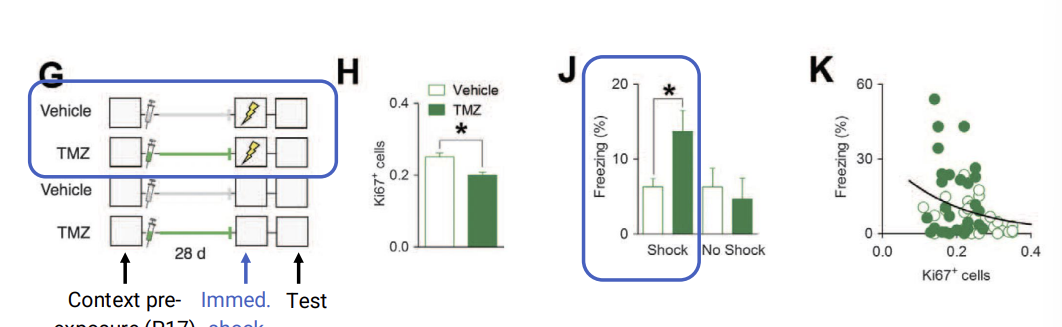
Found that those who were blocked with the neurogenesis - significantly better memory at test. — demostrates that neurogensesis may be reason for why infantile amnesia occurs .
Does boosting neurogenesis in adult mice help increase infantile amnesia?
Used the finding the exercises increases neurogenesis →
Description - Contextual fear conditioning - Some get exposure to the running wheel - Tested
Results
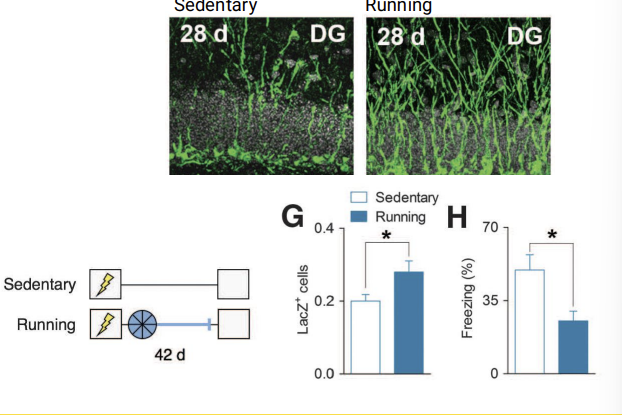
Found that those who did more exercise displayed memory loss.
INTERPRETATION - suggest that the hypothesis is accurate.
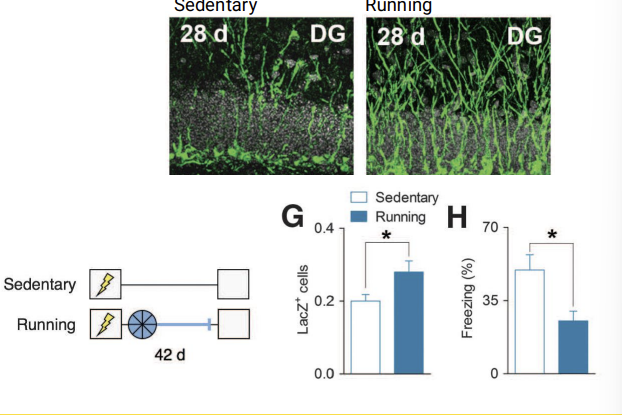
Does boosting neurogenesis in adults using drugs support the neurogenic hypothesis
Description - Contextual fear conditioning - Some exposure to drugs Tested - 42 days later
Results
Found that those who did drugs displayed memory loss.
INTERPRETATION - suggest that the hypothesis is accurate and that nuerogensis leads to a degradation of memory
Precocial animal evidence?
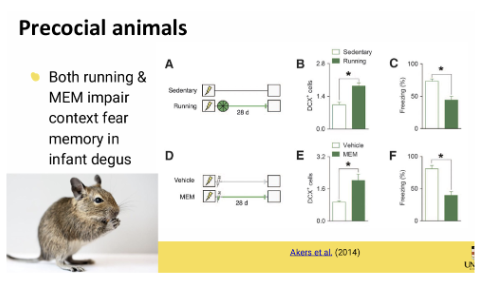
How might neurogenesis disrupt memory
as neurogenesis occurs, the integrity of the memory is degraded over time. This can be considered both a storage and retrieval deficit
But don’t exercise & neurogenesis improve memory?
Argument that exercise might help future memories be stronger as clears out brains matter/connections that no longer matter.