The Philippine National Budget and the Power of the Purse
 Call Kai
 Learn
Learn Practice Test
 Spaced Repetition
 Match
Match Flashcards
 Knowt Play
1/13

There's no tags or description
Looks like no tags are added yet.
Name | Mastery | Learn | Test | Matching | Spaced | Call with Kai |
|---|
No analytics yet
Send a link to your students to track their progress
14 Terms
3 Basic Principles of Public Finance Management
Aggregate Fiscal Discipline - Spending within Means
Allocative Efficiency - Investing in the Right Priorities
Operational Efficiency - Delivering the Measurable Results
The National Budget as an Instrument of Development
Political Tool – a tool for exercising power and for decision making (Budget Politics)
Socio-economic tool – raising resources and allocating them to achieve socio-economic goals (Budgets and the Economy)
Human Development Tool – financing public goods and services that enhance human development (Budget and Human Development)
What is Government Budgeting?
a financial plan for a given period (usually one year) which shows what its resources are, how they will be generated, and used over the fiscal period
What is National Government Budget?
also known simply as the budget, refers to the totality of the budgets of various departments of the national government aligned to the NDP, including the NG support to LGUs, SUCs, and GOCCs.
2 Importance of the Budget
Administrative Tool – assignment of authorities and responsibilities to government units to perform budgeted tasks
Performance measurement tool – exacting desired results from authorized expenditures
Step 1: the Development Budget Coordinating Committee (DBCC)
made up of the DBM, Department of Finance, Department of Economy, Planning and Development (DEPDev), and the Bangko Sentral ng Pilipinas — sets the economic targets, expenditure ceilings and revenue projections to make up the NEP.
→ In the first half of the year, agencies prepare their proposals and submit them to the DBM for review.
→ The DBCC then approves, consolidates and packages these into the NEP for the president and Cabinet.
Step 2: The President’s Budget
The President submits a budget of expenditure and sources of financing within 30 days from the opening of every regular session of Congress.
→ The President’s Budget includes: (a) BESF, (b) NEP, © Budget Message, and (d) Staffing Summary
→ it should have undergone about 7 months of budget preparation by the Executive Branch
Step 3: Budget Hearing
The BESF will be scrutinized by the Congress who has the power of the purse. Review, debate, authorize.
The Congress is composed of: 24 senators (upper house) and up to 250 representatives (lower house)
→ House of Representatives hearings - The appropriations committee reviews big items and last year’s performance. Hearings are public and usually livestreamed.
→ Senate hearings (parallel review) - The Senate finance committee conducts its own review. Both chambers may revise the plan.
Step 4: GAB
→ Each chamber approves a budget bill. Differences must be settled.
→ Bicameral conference committee - House and Senate teams merge the two versions. Their report becomes the General Appropriations Bill (GAB). Meetings are often closed-door.
Step 5: Final Say
The President may sign, veto items, or return the bill to Congress.
If no new budget is signed by year-end, the previous year’s budget is used (reenacted budget). New projects and positions cannot start without funding.
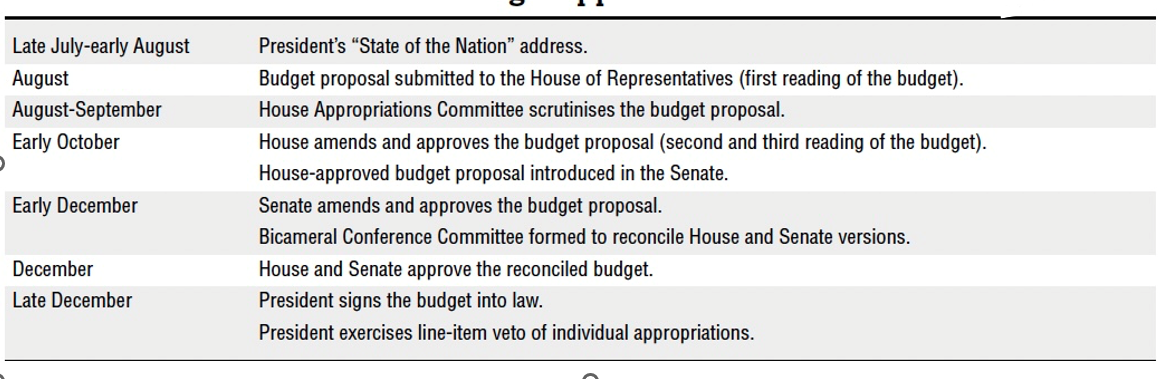
Budget Approval Timetable
Note: After half-month of creating the BESF.
3 Other Committees related to 131
Committee on Ways and Means
Committee on Public Accounts
Committe on Accounts
Two Major Legislative Offices for Budgetart Reviews
CPBRD - Congressional Policy and Budget Research Department
SEPO - Senate Economic Planning Office
Fiscal Policy
the use of government spending and tax policies to influence economic conditions, especially macroeconomic conditions.