Particle Physics - A Level Physics Edexcel
 Call Kai
 Learn
Learn Practice Test
 Spaced Repetition
 Match
Match Flashcards
 Knowt Play
1/119

There's no tags or description
Looks like no tags are added yet.
Name | Mastery | Learn | Test | Matching | Spaced | Call with Kai |
|---|
No analytics yet
Send a link to your students to track their progress
120 Terms
What is the order of the scientists in the history of the atom?
1) Thomson 2) Rutherford 3) Bohr 4) Chadwick
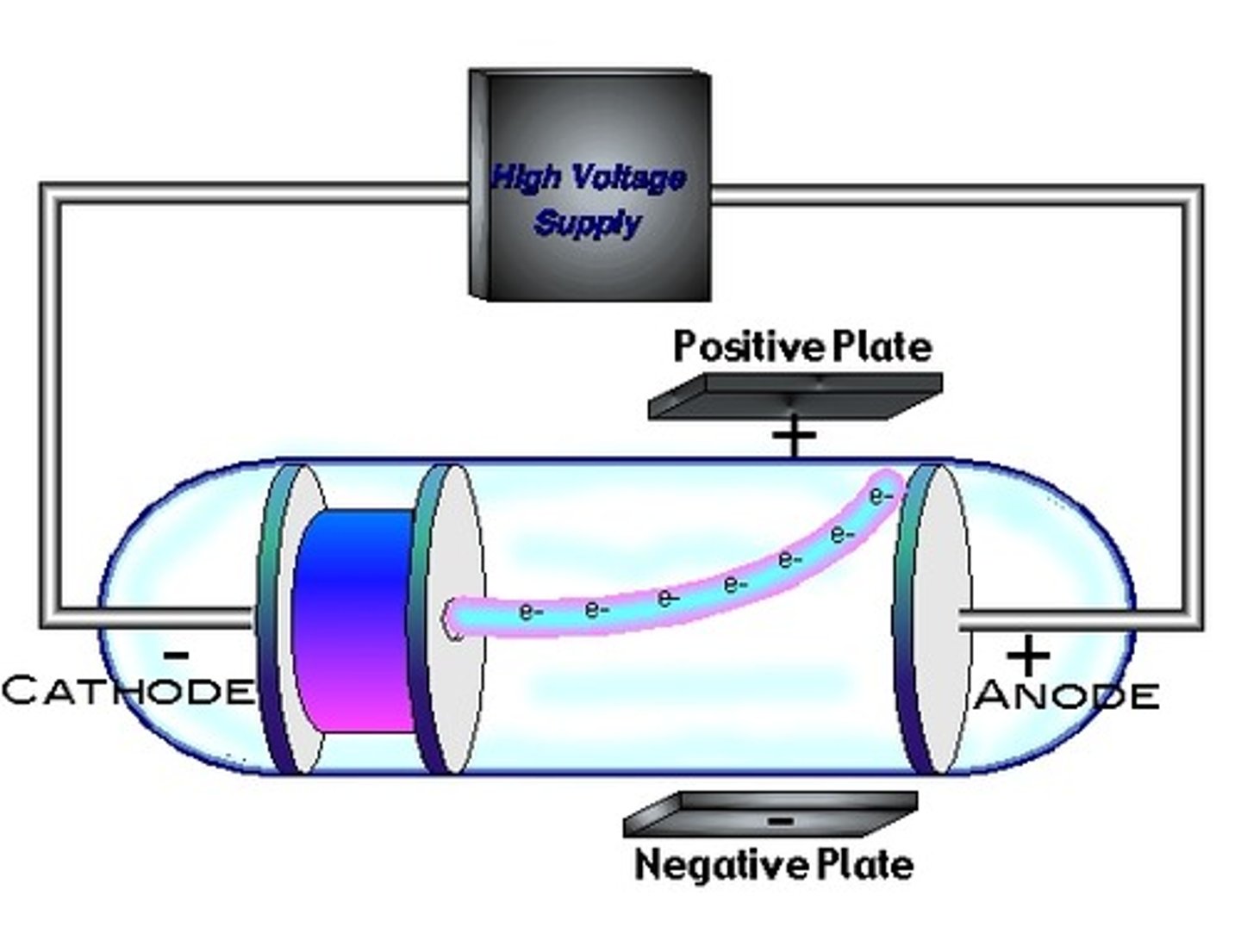
What did Thomson discover about particles?
He used cathode rays to theorise the plum pudding. (sphere of positive charge with electrons in it)

Cathode ray experiment
A high p.d. between two plates, where the cathode rays (ray of light) are attracted to the positive plate, and deflected away from the negative plate, detected on a fluorescent screen.
Discovering the electron.
Rutherford experiments
The Geiger Marsden experiment (or gold foil experiment) is where alpha particles are fired at a thin sheet of gold foil, and detected on a fluorescent screen
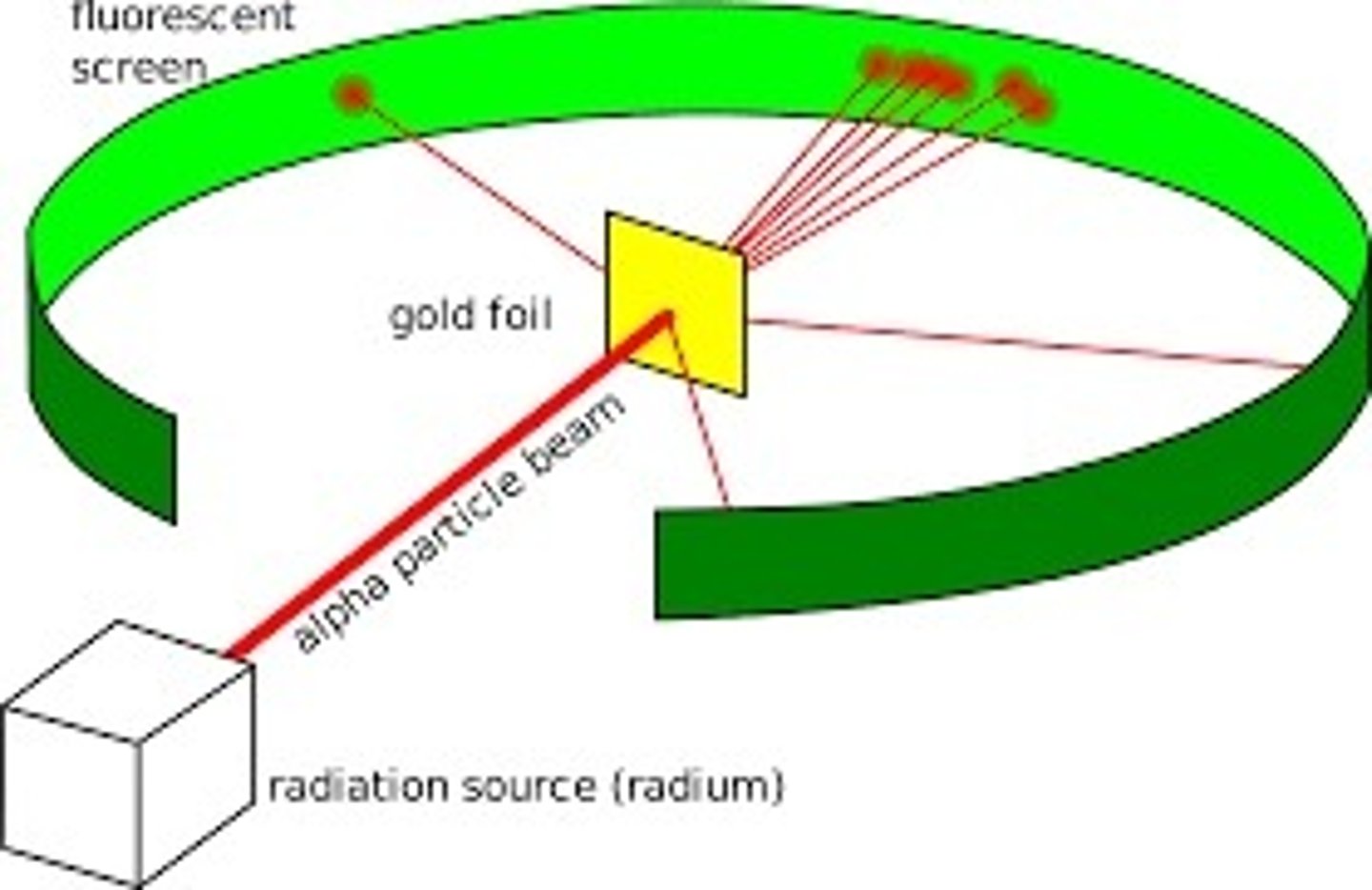
Gold foil experiment findings (Geiger Marsden)
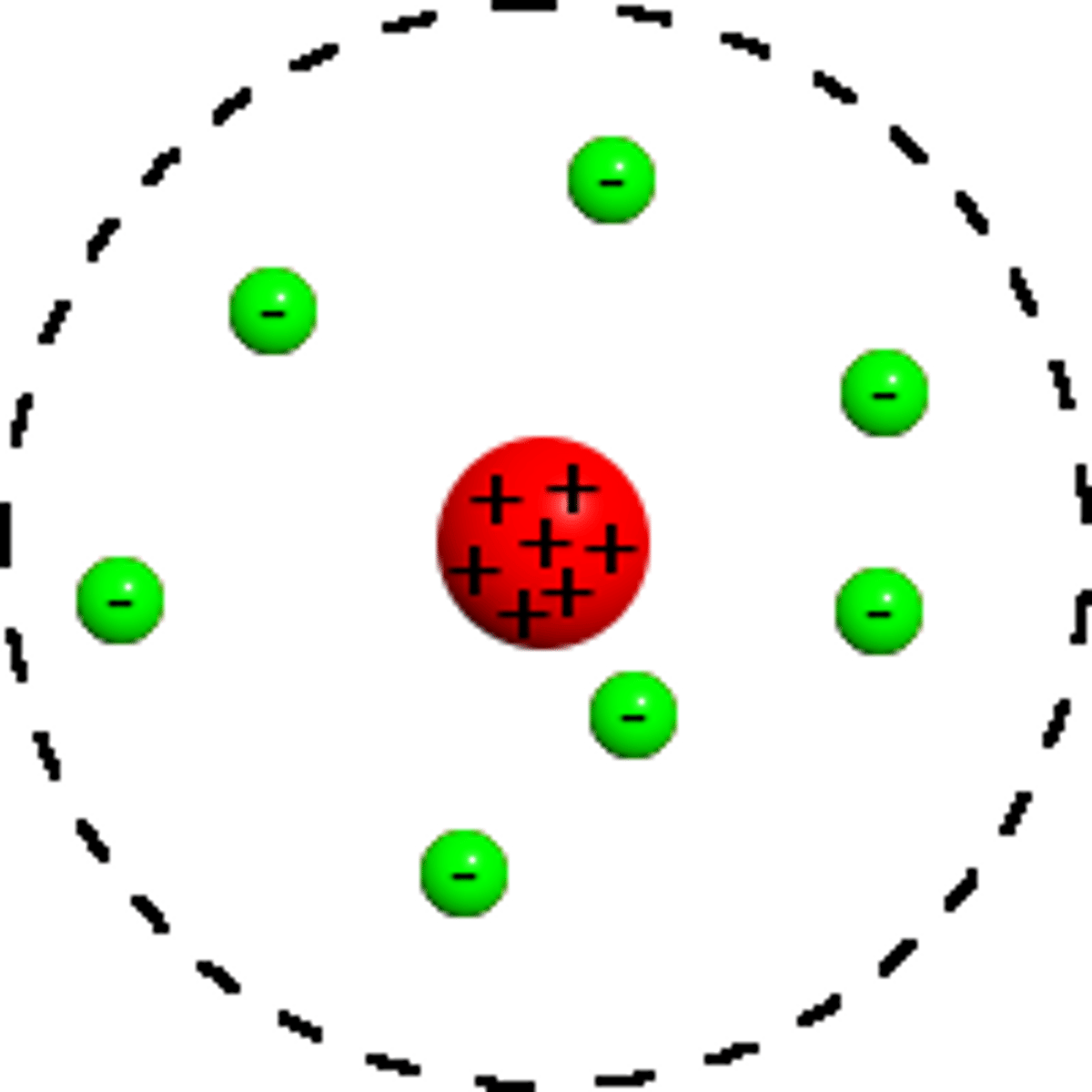
Nuclear Model
Most particles passed straight through (atom mostly empty space)
Some deflected back at small angles (nucleus is positively charged)
Very few deflected right back
(nucleus is in the centre and most of the mass of an atom)
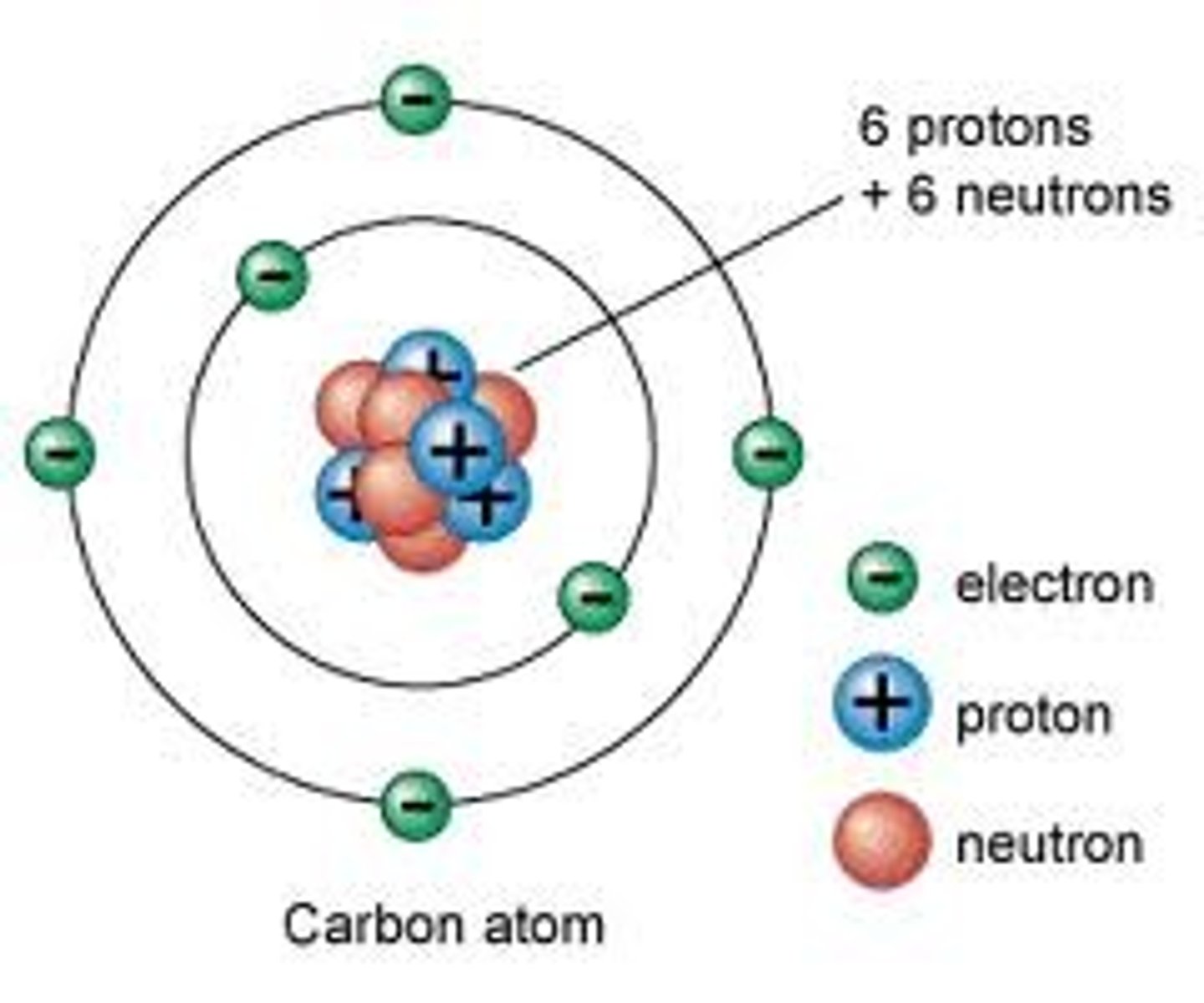
What did Bohr discover about particles?
Planetary Model
Electrons in orbitals, electrons have discrete energy levels, evidenced by emission line spectra
Chadwicks experiments
Alpha particles fired at Beryllium, a highly penetrating uncharged radiation is emitted which knocked out hugh energy protons from paraffiin wax.
Chadwicks Findings
Atomic Model
to knock out protons, the alpha radiation must contain a similar size (mass) but neutral particle
The neutron is discovered.
point of closest approach
R0, the closest a particle can get to the nucleus before being deflected
Combine Kinetic energy and Electric potential energy (work done by field) equations.
1/2mv^2 = qV
V is (electric potential)
1/2mv^2 = kqQ/r
then solve for r, which is R0
What must occur for the alpha particle to be deflected
The radius of nucleus must be smaller than r0
When work is done on the alpha particle to deflect it,what is gained
Electric potential energy
Work done by electric field of gold nucleus =
Electric potential energy stored + Original kinettic energy of the particle
What does ε0 represent?
permittivity of free space
Electric potential definition
Work done per unit of positive charge to make it from a point r metres away from Q
Work done equation in terms of charge and velocity
Work done = Q x V
4 important equations for work done on particles
V=E/Q
K=1/4(pi)ε0
V=kQ/r
V inversely proportional to r
Work one on particle significant equation involving charges and ε0
W=Q(gold)Q(alpha particle)/4(pi)ε0r0
thermionic emission
the release of electrons from a heated filament
(Energy absorbed by electrons from heat, so electrons escape valence band and enter conducting band)
How does a vacuum allow for electrons to behave
No collisions with oxygen molecules, meaning they can leave their trajectory untouched
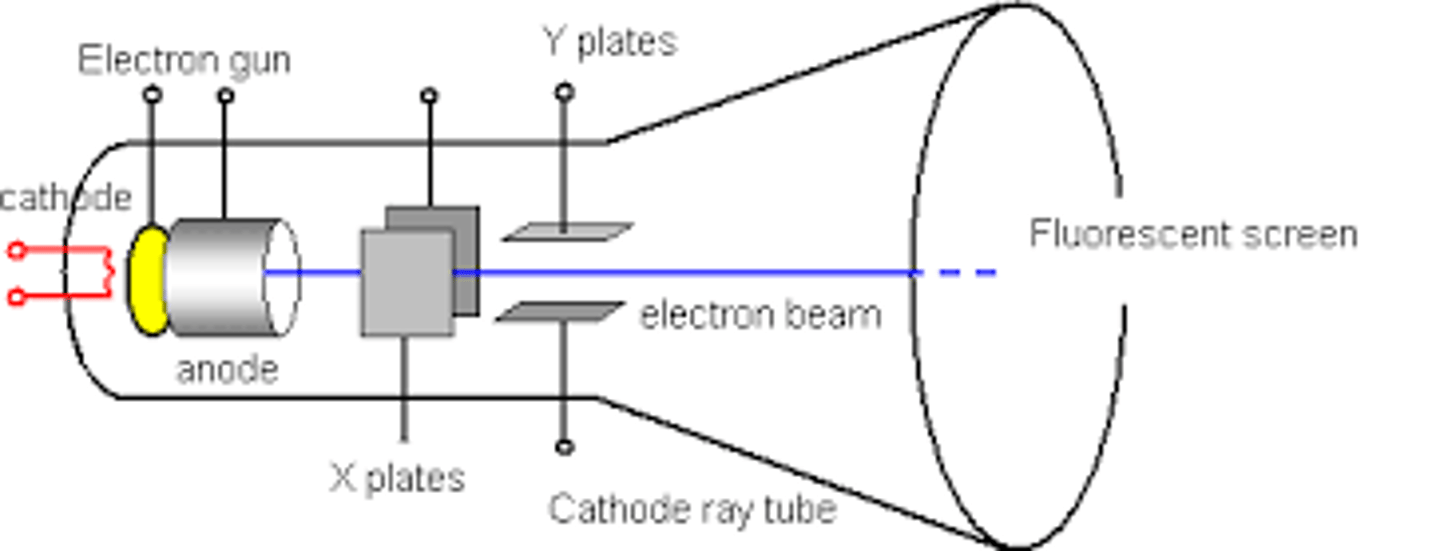
How does an electron gun work
small metal filament is heated by a current in a vacuum, providing electrons with kinetic energy, which will cause some to escape from the surface of the metal, which are then attracted to an anode, causing a narrow beam of electrons to accelerate towards a small gap in the anode, creating a beam of electrons
How do calculate electron volt in an electron gun
Vq= 1/2 mv ^2
Vq=p^2/2m
How are electrons accelerated in an electron gun
The electric field working in the opposite direction
Fields travel in what direction
Positive to Negative
Electrons travel in what direction
Negative to positive
Va (voltage and electron charge) represent what
Electronvolt
What direction is the force of the magnetic field in relation to the current
Perpendicular
Conventional current
Current that flows in opposition to electrons
What is the difference between F=BQV and F=BqV
Q= Big/multiple particles
q= 1 small particle
When the electron is fired into the magnetic field, what force does the magnetic field act on the electron
a Centripetal force
equation for r of the fired particle into the magnetic field
r= P/BQ
Electron gun diagram
A coil used for thermionic emission-cathode-anode-magnetic field
How to calculate m of the electron fired from the electron gun
m=V^2B^2q/2V
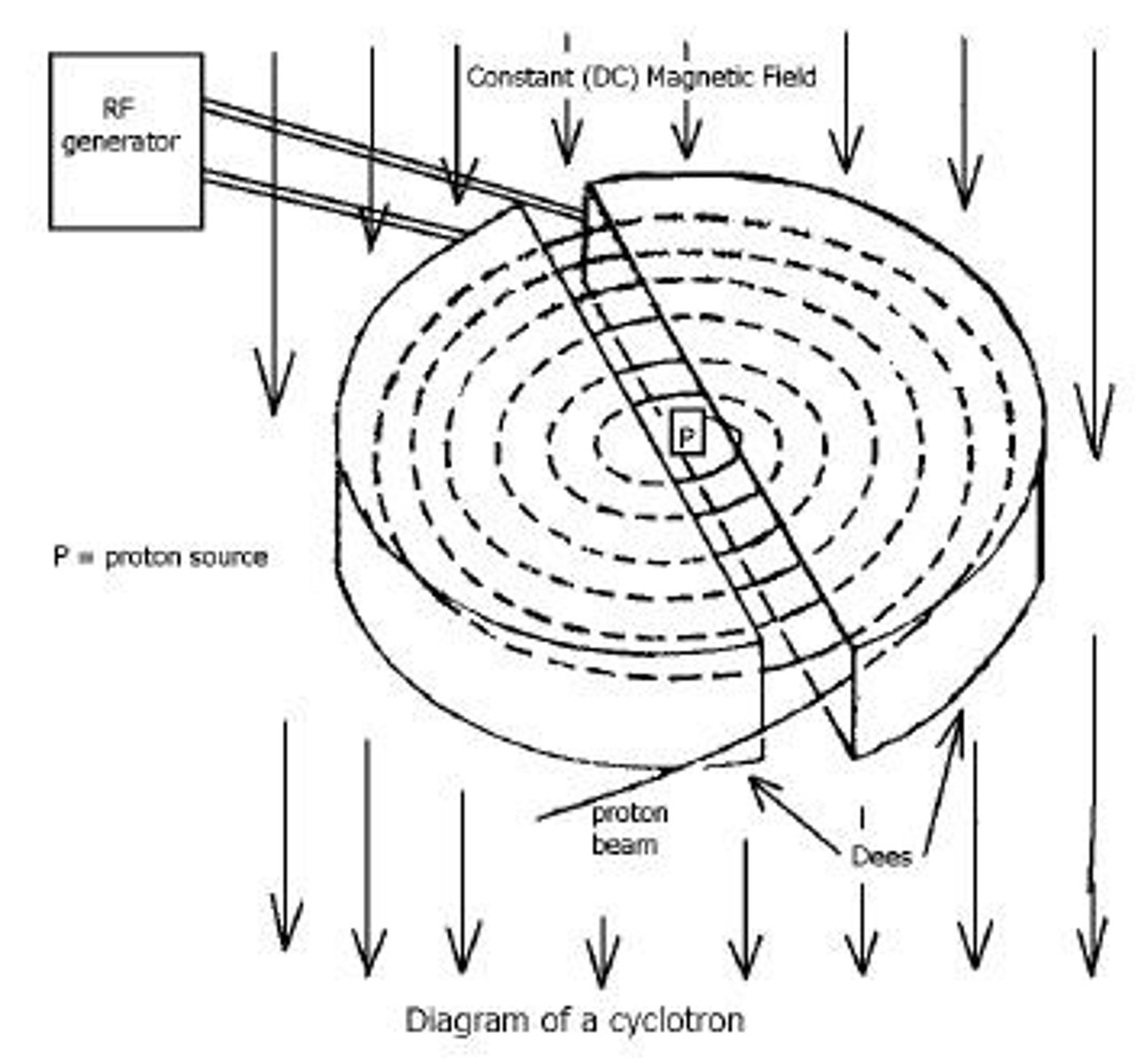
Describe the structure of a cyclotron
2 horizontal 'Dees' facing each other with a gap in the middle. 2 electromagnets, one above one below, both north-facing up. An alternating PD connected to the Dees.
How does a cyclotron work
A proton suspended in the gap between 2 Dees will be accelerated by the electric current to the negative D. The magnetic field will act perpendicular to the proton and cause a centripetal force, spiraling the proton back to the gap. At this point the alternating PD is switched and the polarities swapped, the particle is now accelerated to the other D, increasing in velocity and therefore radius of spiral. This repeats until the particle is fired out of the cyclotron.
What is the difference in terms of a particle between a magnetic and electric field
Magnetic field changes particle direction
Electric current accelerates particle
Frequency of supply (Cyclotron) =
Frequency of rotations
Equation to calculate Kinetic energy of the proton in a cyclotron
Final Ek= 2xVqxNorbits
Equation to calculate frequency of a cyclotron
f= Bq/m2(pi)
What must an alternating voltage have to function properly in a cyclotron
An equal frequency to orbits around cyclotron
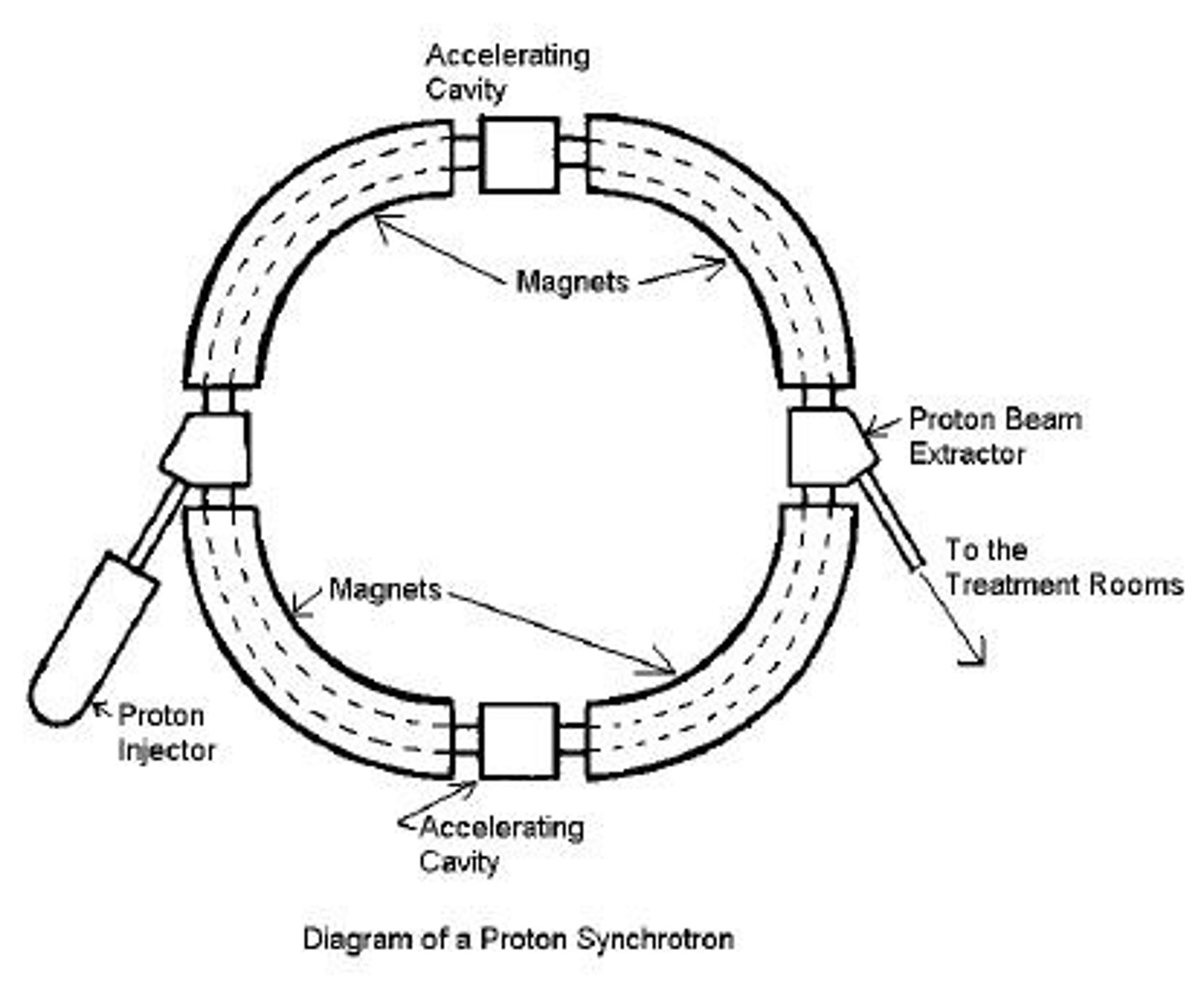
Synchrotron
Lowers the frequency of the supply in sync with the orbital frequency of particles, therefore accelerating them to a greater velocity
Donut shaped rather than disc shaped
Why do we sometimes need a Synchrotron
When a particle approaches the speed of light, it's mass changes. Due to the frequency equation needing mass, this would be disrupted however with a synchro-cyclotron we can alter frequency too
Linear accelerators (Linacs)
Electrons travelling in a vacuum, entering tubes of increasing length and accelerating in the gaps between tubes, done by a high freq alternating p.d.
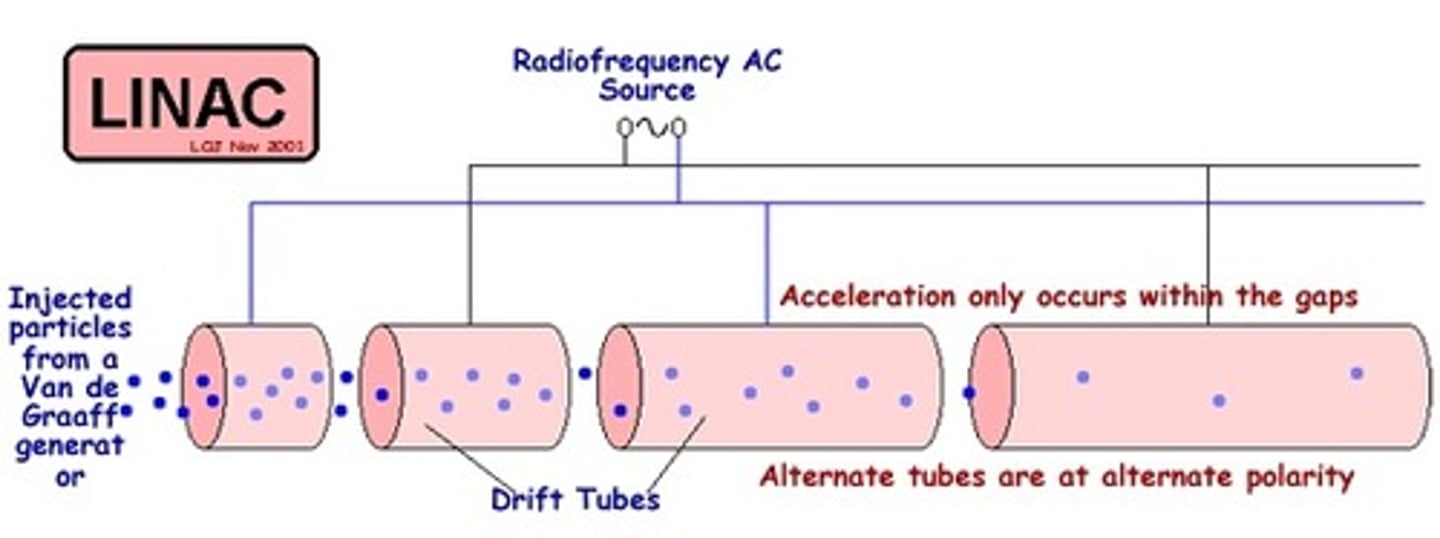
How is a particle accelerated to the next drift tube in a linear acclerator
The alternating PD will swap the next tube either positive or negative depending on the previous one to attract the electron
Adjacent tubes are connected to opposite terminals
Why does length of drift tubes increase in the linear accelerator
Because time spent in the tube must be a constant so length increases with velocity
What does the length of the LINAC limit?
The max speed
What is the advantage of the LINAC?
It can accelerate greater masses than cylotrons and synchrotrons as these require particles to be bent by a magnetic field so are limited by the strength of the magnetic field
What is the advantage of the cyclotron over the LINAC?
It has a spiral path so the particles travel a greater distance so go to greater speeds than the LINAC
Electron Scattering (to find properties of proton)
Electrons fired at proton from LINAC, proton is very small, so the wavelength of electron must also be very small. The way to achive this is by LINAC speeding up the electron to a really high energy as λ = h/p.
At relativistic speeds, E = mc^2, E = mcc = pc,
as a result λ = hc/E so wavelength is inversely proportional to KE.
Structure of the large Hadron Collider and Synchrotron
Accelerating cavities spin particles until they are ejected
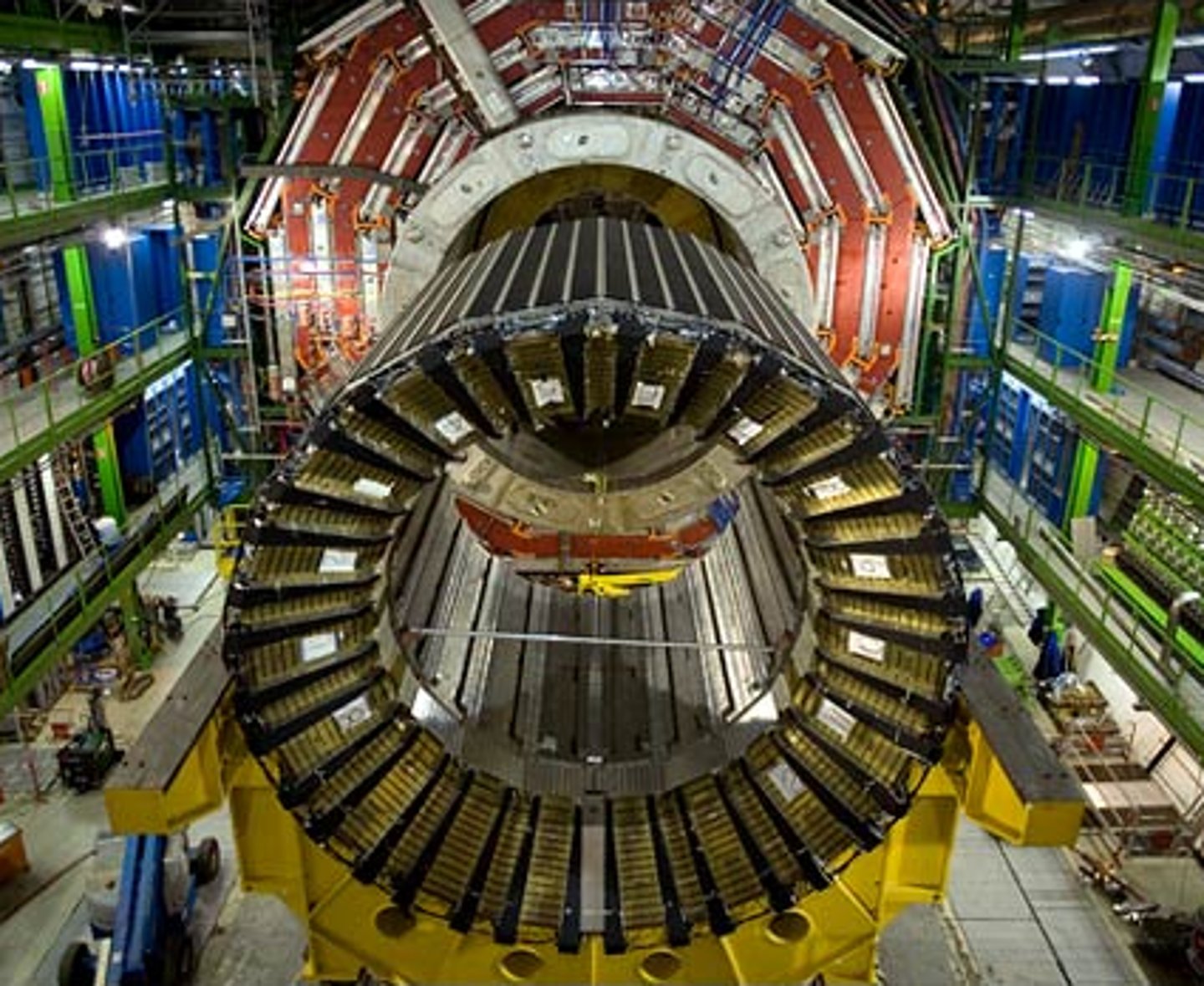
3 types of particle detectors
Cloud chambers, Bubble chambers, Multi wire chamber
Why do only charged particles leave tracks in particle detectors?
When a charged particle passes through a substance it causes ionisation and electrons are knocked out of atoms so the particle leaves a trail of ions as it goes
What does radius of path of a track represent in a particle detector
Momentum
What does direction of a path represent in a particle detector
Charge
Opposite charges have different directions
How would you tell if a particle is more ionising in a particle detector
A thicker/shorter path
Cloud chamber
In super saturated air (with ethanol), charged particles ionise the air and vapour form droplets along the line of ionisation. By shining a light on this a photograph can be taken.
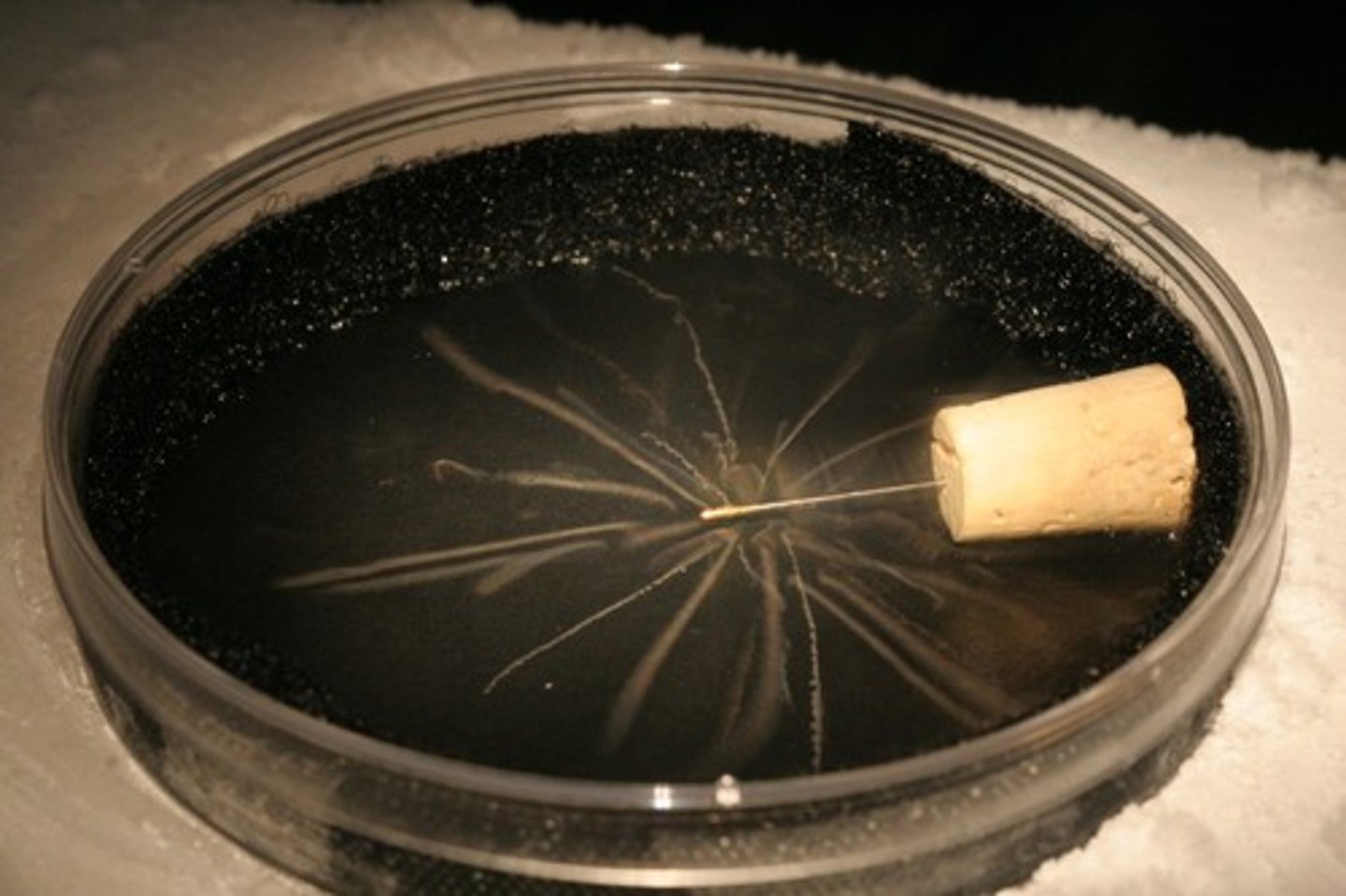
Bubble chamber
Liquid nitrogen boils along the path of ionisation, forming bubbles which can be photographed under light
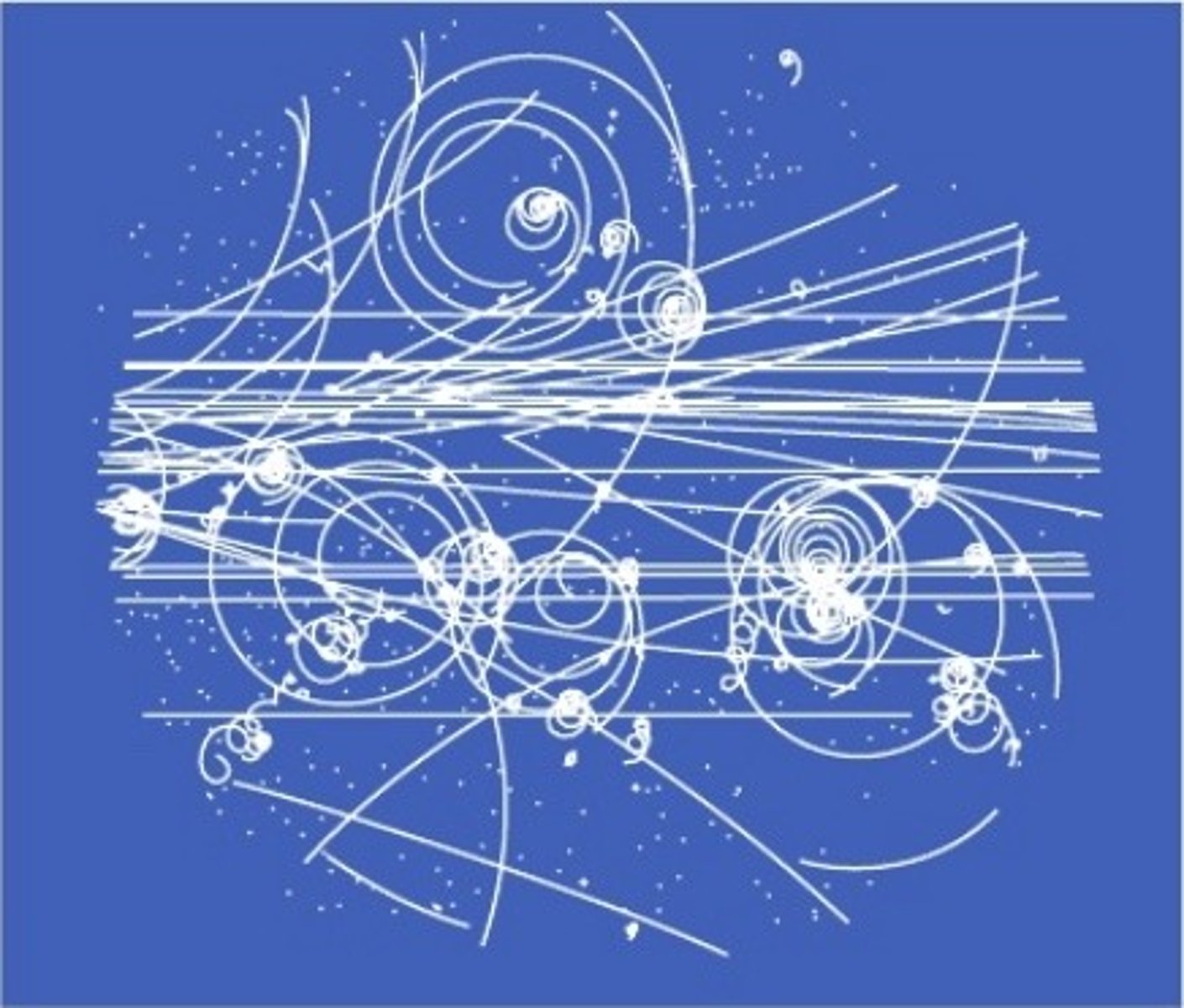
Multi wire chamber/Drift chamber/Spark chamber
A number of wires carrying alternating voltages are contained within a chamber filled with inert gas. The particle ionises the gas and the ions move to the oppositely charged wire, creating a spark. This creates pulses of current in the wires, which can be measured and used to calculate the 3D trajectory from the timing of the charged particles.
If the ionising path suddenly jumps forward what could we assume
potential collision with neutral particles
How to calculate radius of curvature of a path created by an ionising particle in a particle detector
r=p/BQ
Where does the positive curve if the magnetic field shows .
Field leaves page so positive curves down (clockwise)
Then use left hand rule
Where does positive curve if field shows X
Field going into page so positive curves up (anticlockwise)
Why do you see spirals on particle detector diagrams?
Interactions with the detector decrease the kinetic energy of the particle so the radius decreases as the particle loses kinetic energy
What is Einstein's theory of special relativity?
1) The laws of physics are the same for all non-accelerating observers 2) The speed of light within a vacuum is the same no matter the speed at which an observer travels
Why does lifespan of a particle increasing with relativistic effects
When a particle has such a high speed, time passes slower for it (it has an higher observed lifespan)
What happens to an object as it gains energy during relativistic effects
It gains mass because energy holds mass
Relationship between energy and mass
Energy can be converted to mass and vice versa
Why would the change in m be so small
Because c^2 is so large and change in energy is divided by c^2
Change in energy equation (relativity)
(delta)E=c^2(delta)m
how to convert from Kg to MeV/c^2
use E = mc^2
M = E/c^2
so to convert from kg to MeV/c^2, convert energy to MeV, then multiply by speed of light
How to calculate energy changes
Total Energy before = Total energy after
Account for rest masses (energy req to have a mass with 0 speed)
and account for KE.
Loss of Ke in a collision=
Total mass x c^2
Particle collisions do not conserve mass entirely but what is conserved entirely
Mass+Energy. If mass is lost there will be greater energy and vice versa.
Why does a particle in a cyclotron experience a centripetal force
Due to Fleming's left hand rule, motion switches direction
Equation to find the kinetic energy of the particle in a cyclotron
Final Ek= Vq x Norbits
(Final Ek= Protonvolt x Number of orbits)
Equation to find the frequency of rotations in a cyclotron
F= Bq/m2(pi)
(Frequency= magnetic flux density x charge of particle/ mass x 2pi)
How does a Synchrotron work
A synchro-cyclotron lowers the frequency of the supply in sync with the orbital frequency of particles, therefore it can accelerate particles to a greater velocity.
Why would a Synchrotron be necessary instead of a normal cyclotron
When the particle approaches speed of light, it's mass will increase, therefore the frequency of orbits will be out from the frequency of supply and accelerator will not work
What are fermions
Matter particles e.g. quarks and leptons
What are the bosons (force carriers)?
Gluon (Strong nuclear force between quarks)
Photon (Electromagnetic force)
Z boson and W boson (Weak nuclear force, responsible for radioactive decay)
Higgs Boson (Interacts with particle to give them mass)
What do bosons do?
Think of them as force transferring particles
Particle spins:
Fermions : Non integer
Bosons: Integer
non int spins mean they occupy space, int spins dont, therefore you can theoretically have infinite bosons in one space.
(Technically mesons are also bosons as they have 0 spin)
3 types of sub-atomic particles
Hadrons, Leptons, Quarks
2 fundamental particles
Quarks and Leptons
6 types of quarks in increasing energy levels
up, charm, top
down, strange, bottom
(the quarks exist in pairs of generations of similar energy levels, e.g. up and down have the same energy)
What is antimatter?
It consists of particles that are just like those of ordinary matter except with opposite properties, such as opposite charge.
What happens when a particle and antiparticle pair collide?
They annihilate. This means that their mass is converted to energy (in the form of a photon), The opposite can happen - energy can be converted to a particle-antiparticle pair. This is called pair production.
(Pair production tends to happen near a nucleus, and the singular photon needs to have enough energy to produce all the mass)
Charge of up, charm and top quarks
+2/3
Charge of anti up, anti charm and anti top quarks
-2/3
Charge of down, strange and bottom quarks
-1/3
Charge of anti down, anti strange and anti bottom quarks
+1/3
What is a proton made up of
2 up quarks and 1 down quark
Types of Leptons
Electron, Electron neutrino, Muon, Muon neutrino, Tau, Tau neutrino
Charge of electron, muon and tau leptons
-1
Charge of anti electron, anti muon, and anti tau leptons
+1
Charge of electron neutrino, muon neutrino, and tau neutrino
0
Charge of anti electron neutrino, anti muon neutrino and anti tau neutrino
0
Types of leptons in order of increasing mass
Electron, Muon, Tau
Electron neutrino, Muon neutrino, Tau neutrino,
(Neutrinos are very light almost massless)
2 types of Hadron
Meson, Baryon
What Hadron has greater mass
baryon is heavier than a meson
Meson
Made up of any one quark and any one antiquark