Chapter 34: Vertebrates
 Call Kai
 Learn
Learn Practice Test
 Spaced Repetition
 Match
Match Flashcards
 Knowt Play
1/64

Name | Mastery | Learn | Test | Matching | Spaced | Call with Kai |
|---|
No analytics yet
Send a link to your students to track their progress
65 Terms
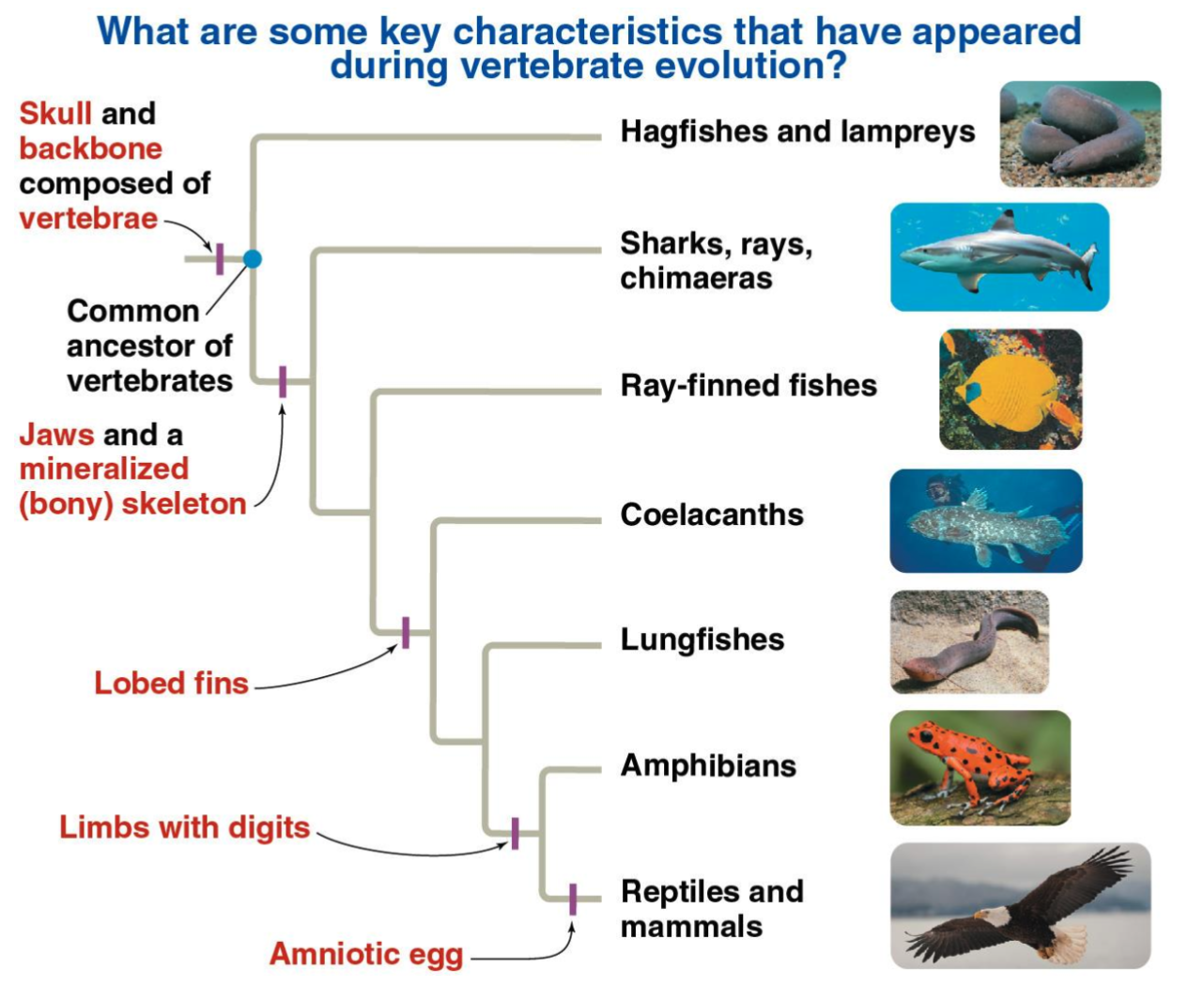
Vertebrate characteristics
Includes:
Skull and backbones composed of vertebrae
Jaws and a mineralized skeleton
Lobed fins
Limbs with digits
Amniotic eggs
Vertebrates
Animals with a backbone; includes over 60,000 species
Include the largest and heaviest animals to have ever lived
Smallest is less than a centimeter long
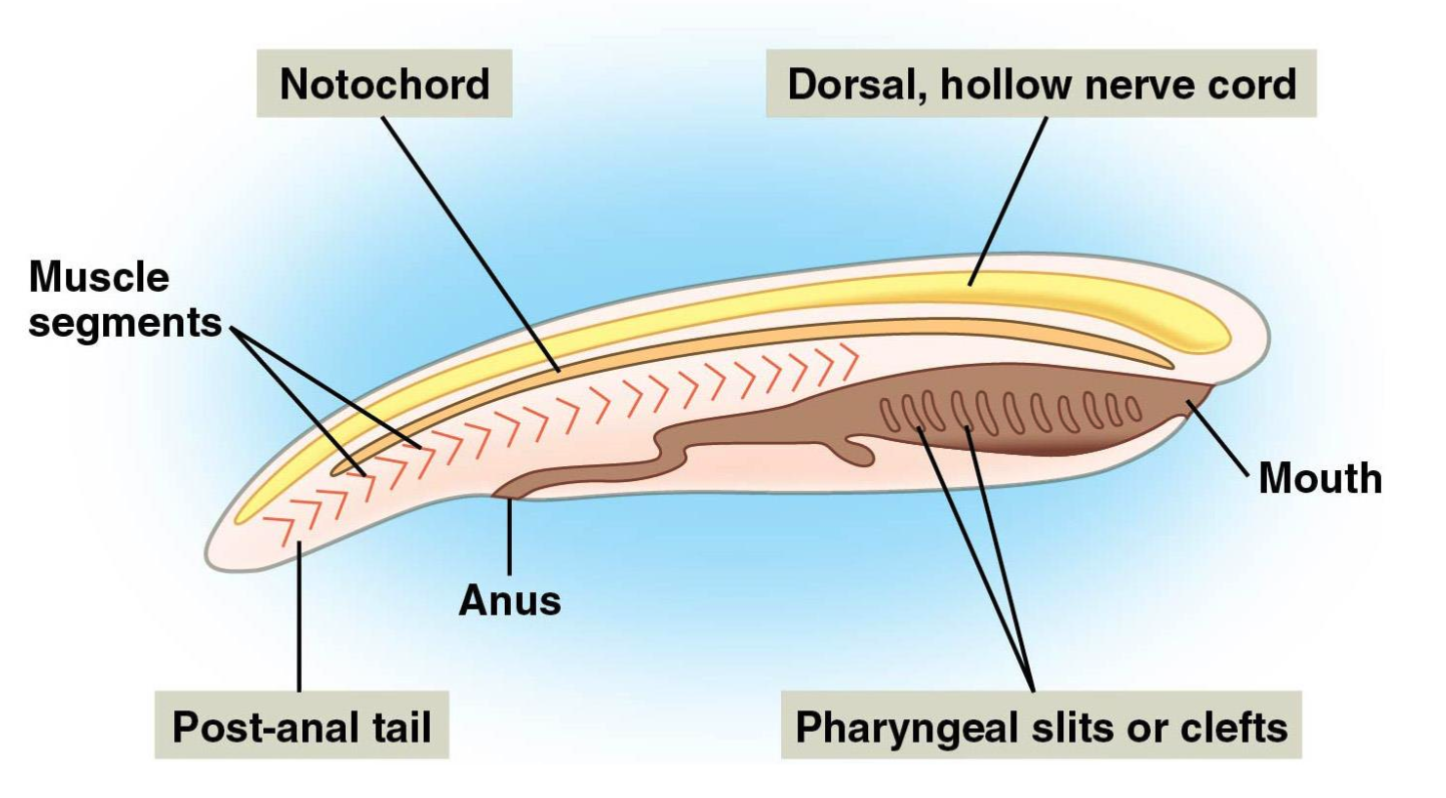
Chordates
Animals belonging to phylum Chordata, made of all vertebrates, urochordates, and cephalochordates
All exhibit, at some point in their life, a:
Notochord
Dorsal, hollow nerve chord
Pharyngeal slits or clefts
Muscular tail
Chordate characteristics
Includes, at some point in their life, a:
Notochord
Dorsal, hollow nerve chord
Pharyngeal slits or clefts
Muscular tail
These may appear only during developmental periods
Notochord
A longitudinal, flexible rod between the digestive tube and nerve cord
Provides flexible skeletal support; may be replaced by a jointed skeleton in adulthood
Nerve cord
Develops from a plate of ectoderm rolled into a neural tube dorsal to the notochord
After embryonic period, this develops into the central nervous system (brain and spinal cord)
Central nervous system
The nervous system comprising the brain and spinal cord, developed from the fundamental nerve cord
Pharyngeal clefts
Grooves along the outer surface of the pharynx in chordate embryos, later developing into pharyngeal slits opening into the pharynx
Pharyngeal slits
Slits that develop from the pharyngeal clefts that allow water to pass from the mouth to the outside of the body, bypassing the digestive tract
Can function as:
Suspension-feeding structures in invertebrates
Gills for gas exchange
Parts of the ear, head, and neck when developed as arches
Pharyngeal slit functions
Includes:
Suspension-feeding structures in invertebrates
Gills for gas exchange
Parts of the ear, head, and neck when developed as arches
Muscular tail
This is contained posterior to the chordate with skeletal elements and muscles
Provides propelling force in many species, but can be greatly reduced during embryonic development
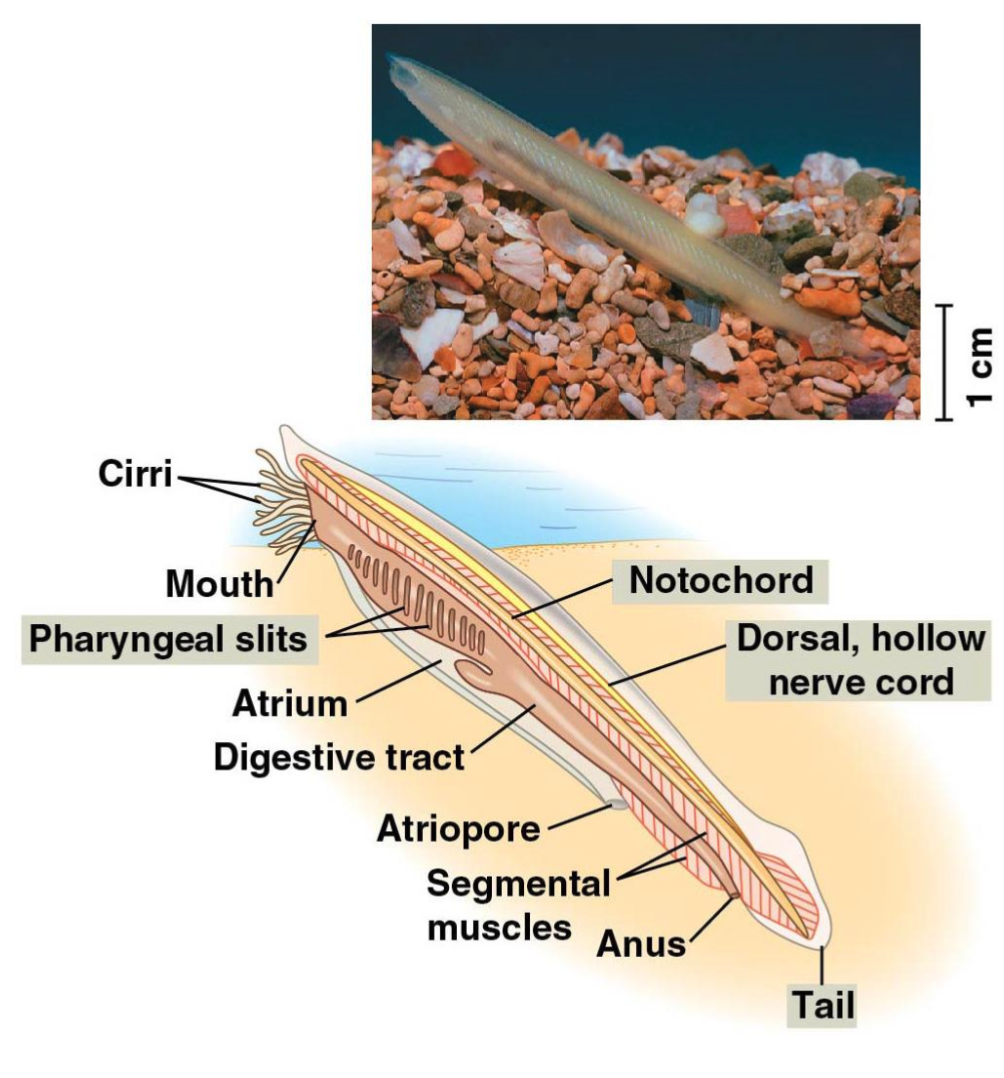
Lancelets (Cephalochordates)
Marine suspension feeders named for their bladelike shape, swimming using a simplified fish mechanism
Retain many of the key chordate characteristics
Ancestral chordates likely resembled these
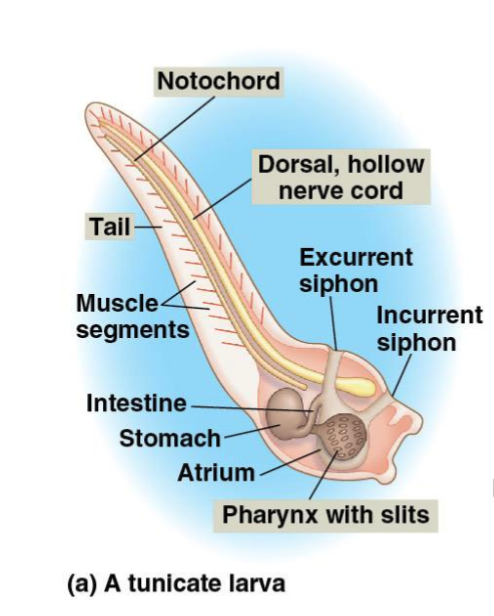
Tunicates (Urochordates)
Organisms more closely related to other chordates than lancelets
Chordate characteristics are most apparent during larval stage, lasting only a few minutes
Use tail muscles and notochord to swim until settling for metamorphosis
Adults (sea squirts) are sessile, filtering in and shooting out water for feeding and defense
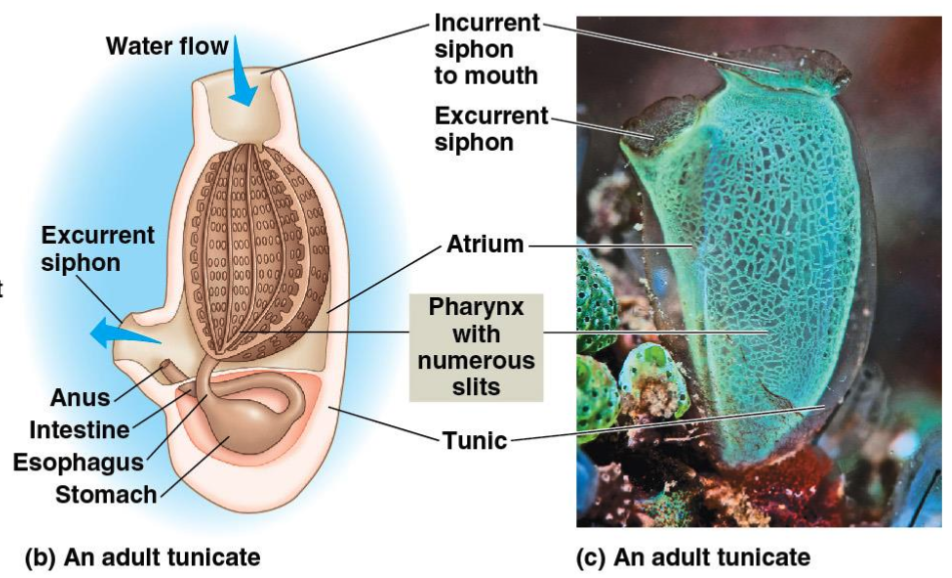
Sea squirts
Adult tunicates; these draw in and shoot out water to filter out food particles and repel attackers
These have fewer Hox genes compared to other vertebrates
Vertebrates
Chordates that have a backbone, skeletal system, and complex nervous system that enables efficiency in capturing food and evading predators
These have two or more sets of Hox genes while other chordates only have one
Enables nervous system evolution and skeleton innovations
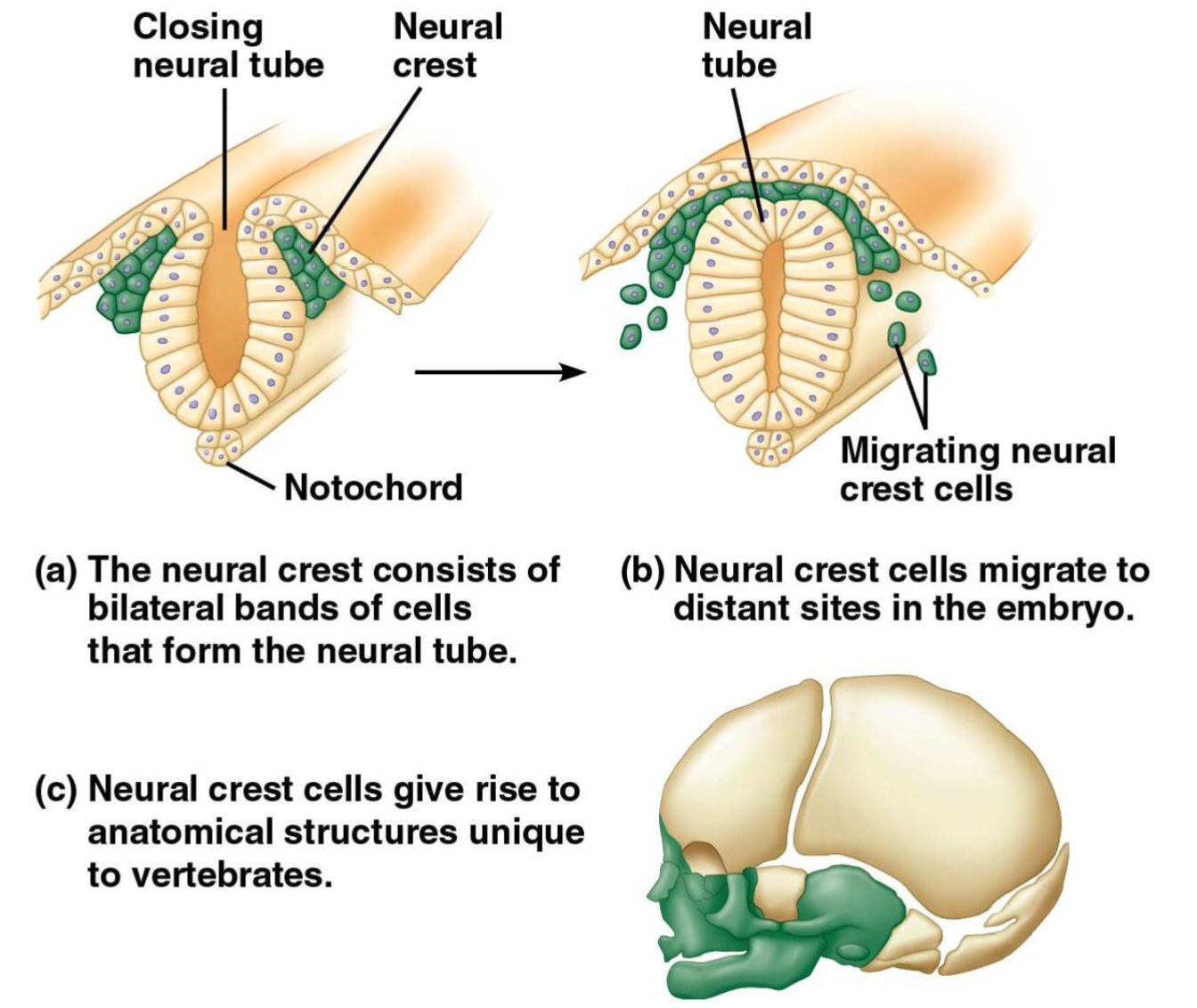
Neural crest
Vertebrate characteristics appearing along the edges of the closing neural tube, dispersing through the embryo and giving rise to:
Teeth
Some bones and cartilage of the skull
Several types of neurons
Sensory capsules
Cyclostomes
A clade including hagfishes and vertebrates with the only living vertebrates lacking jaws and a backbone; however, these do have rudimentary vertebrae
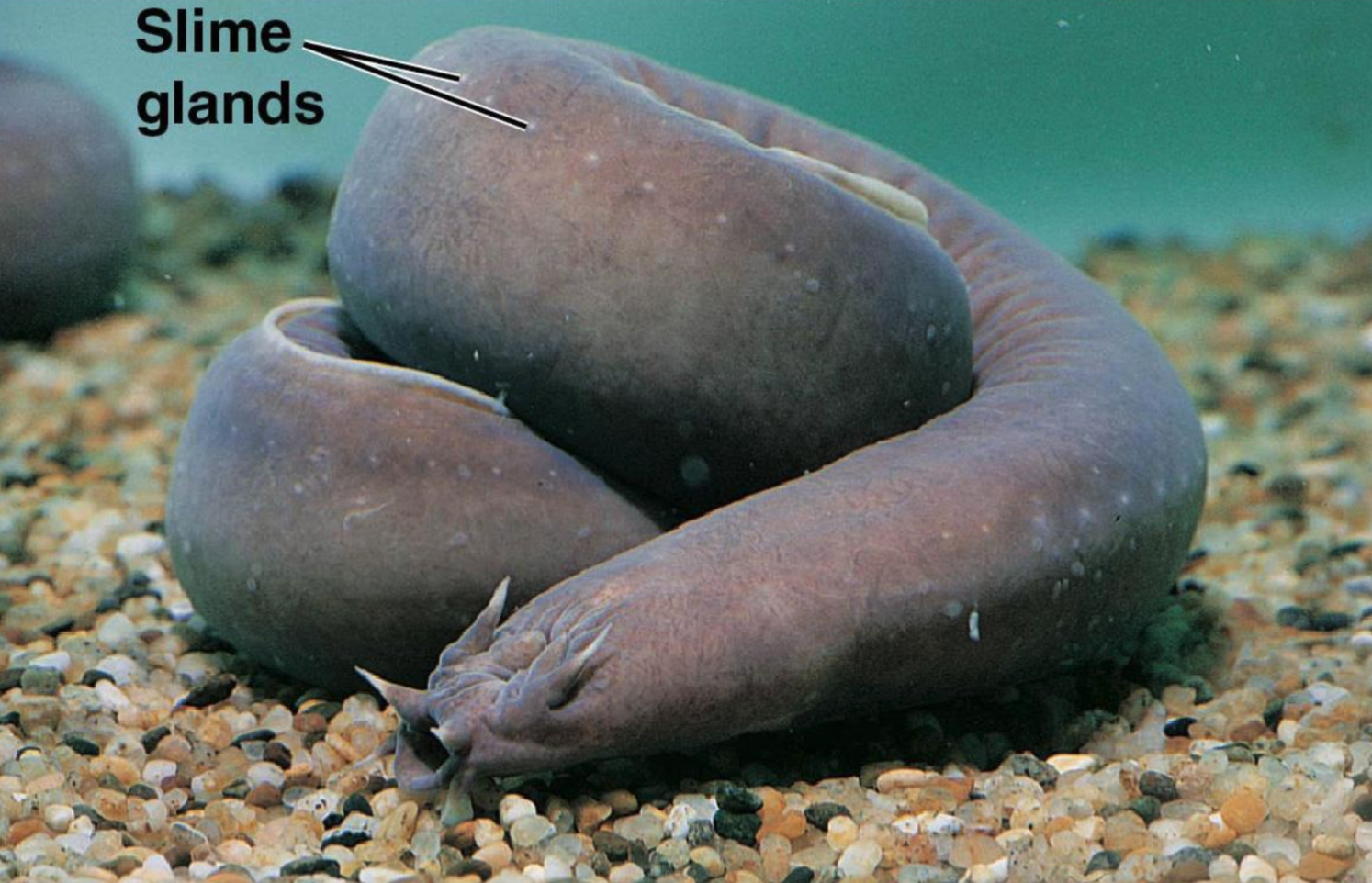
Hagfishes
Jawless vertebrates with reduced vertebrae and a cartilaginous skull
These retain the notochord and have eyes, ears, a small brain, and nasal opening connected to the pharynx
Mouth contains tooth-like keratin formations
All species of these are marine and most are bottom-dwelling scavengers
Rows of slime glands produce a slime to repel competitors and predators
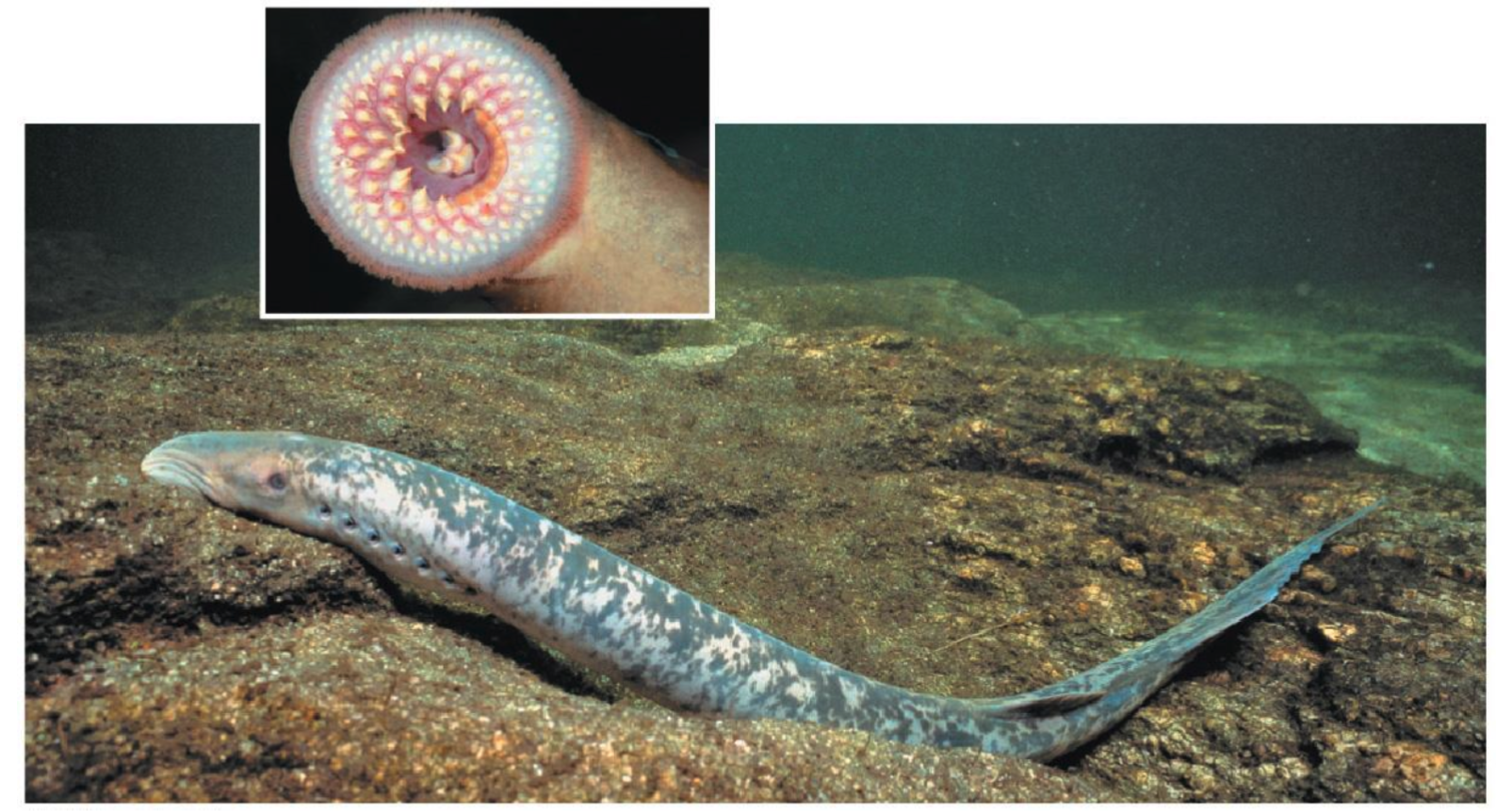
Lampreys
Jawless vertebrates with reduced vertebrae, a notochord, and cartilaginous skeleton
Includes about 38 species in marine and freshwater environments
Larvae live and feed in streams for several years
Parasitic species migrate to oceans or lakes, clamping with mouths onto host fish to feed
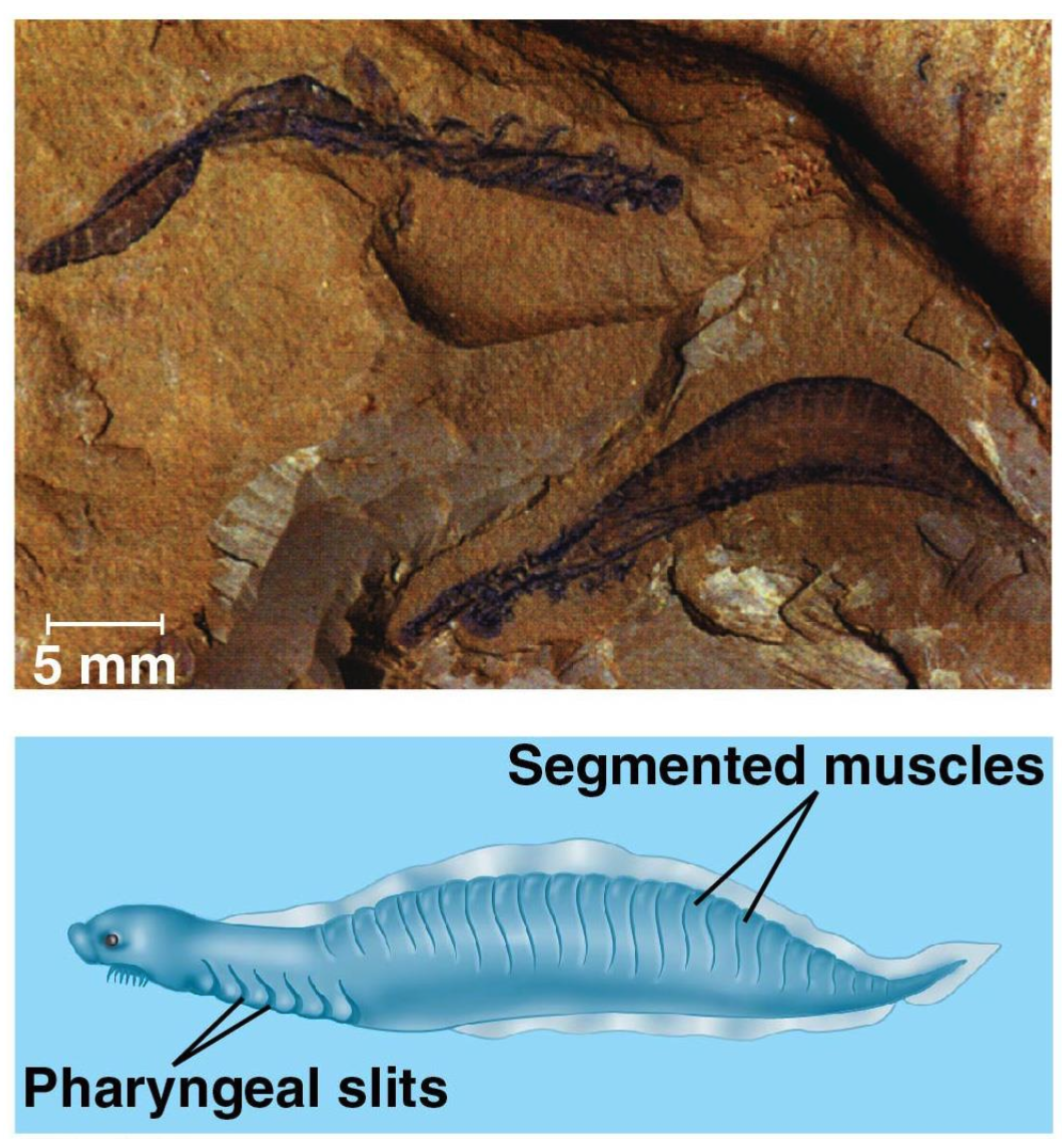
Haikouella
The most primitive fossil found documenting the transition to vertebrates
Were 3-cm-long suspension feeders resembling lancelets
Had a well-formed brain, eyes, and muscular segments, but lacked a skull and ear organs
Head
A part of vertebrates consisting of a brain, eyes, other sensory organs, and a skull, enabling more complex movement and feeding behaviors
First seen in Myllokunmingia with eye and ear capsules but lacking vertebrae
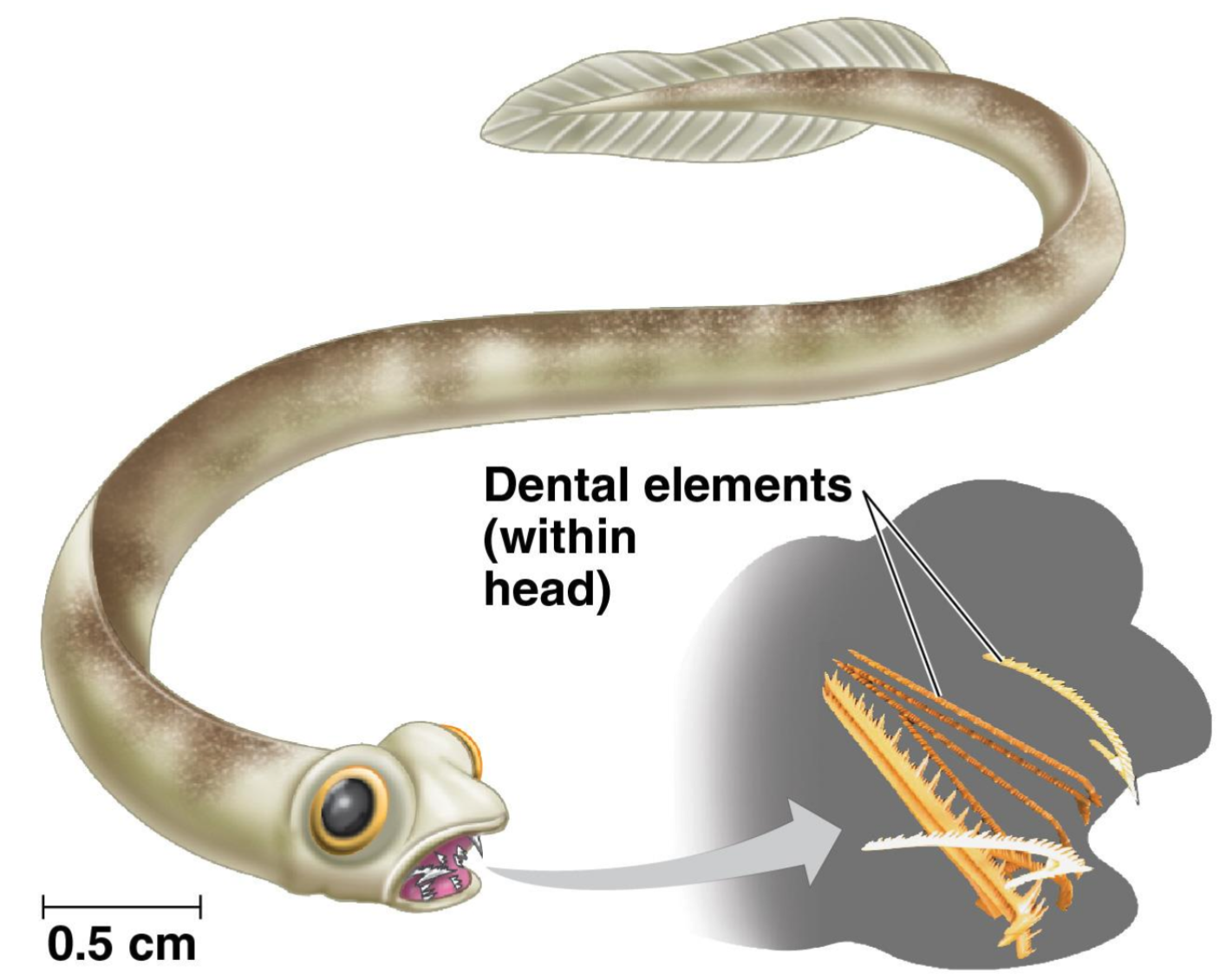
Conodonts
The earliest vertebrates in the fossil record, dating to 500 mya, capturing prey with large eyes and mineralized barbed hooks in the pharynx
Gnathostomes
Jawed vertebrates with teeth to grip and slice food; these outnumber jawless vertebrates and include:
Sharks and their relatives
Ray-finned fishes
Lobe-finned fishes
Amphibians
Reptiles (including birds)
Mammals
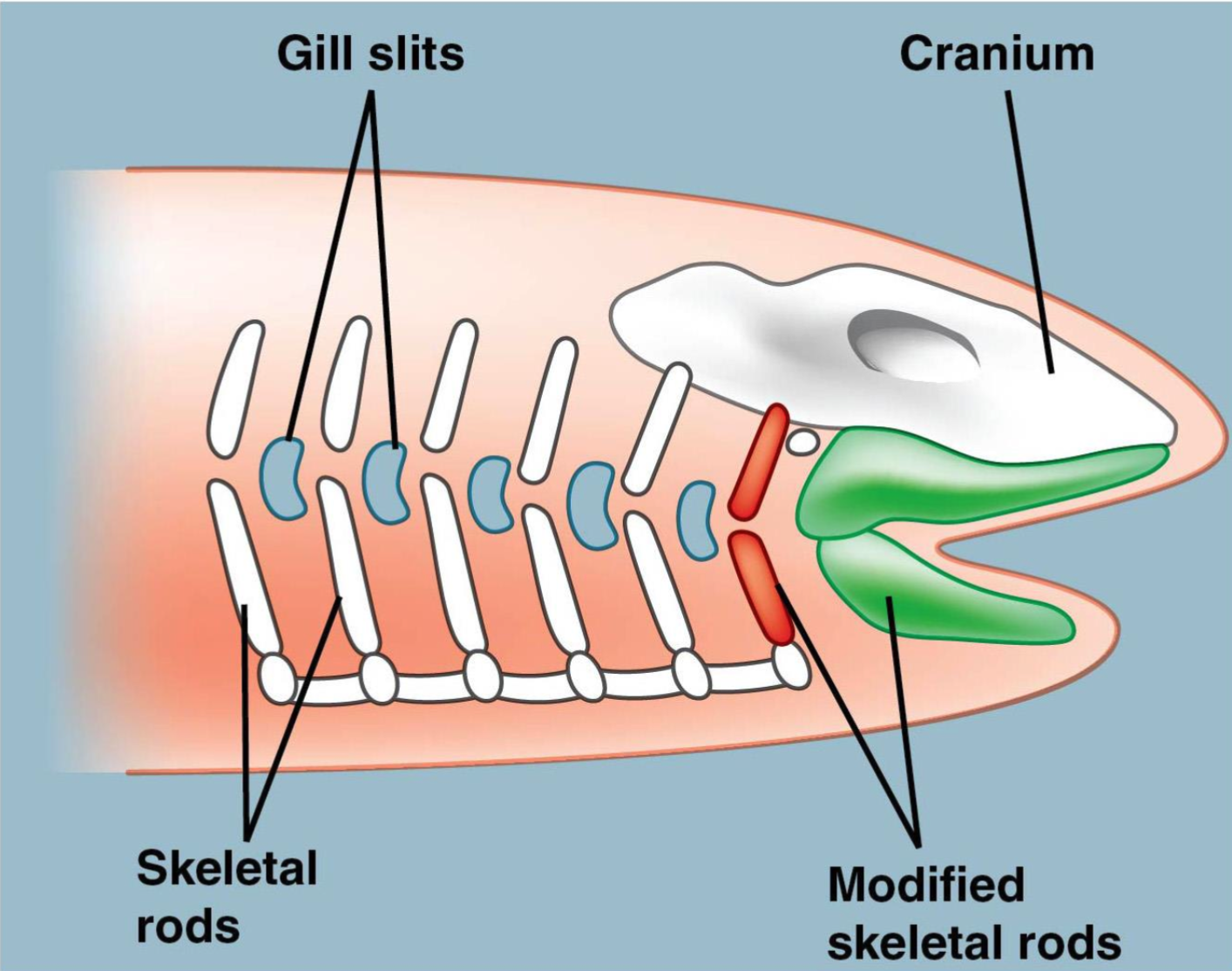
Jaws
Hinged structures in gnathostomes with teeth used to grip and slice food
May have evolved by modification of the skeletal rods supporting the pharyngeal (gill) slits
Gnathostome characteristics
Includes:
Jaws
Genome duplication, including four sets of Hox genes
Enlarged forebrain
Enhanced senses of smell and vision
Lateral line system, or rows of organs sensitive to vibrations along body sides
Lateral line system
Rows of organs in aquatic gnathostomes sensitive to vibrations located along body sides
440 mya
Time where gnathostomes first appeared in the fossil records, exhibiting adaptations like paired fins, a tail, and a more efficient gas exchange system in the gills for efficiency and control
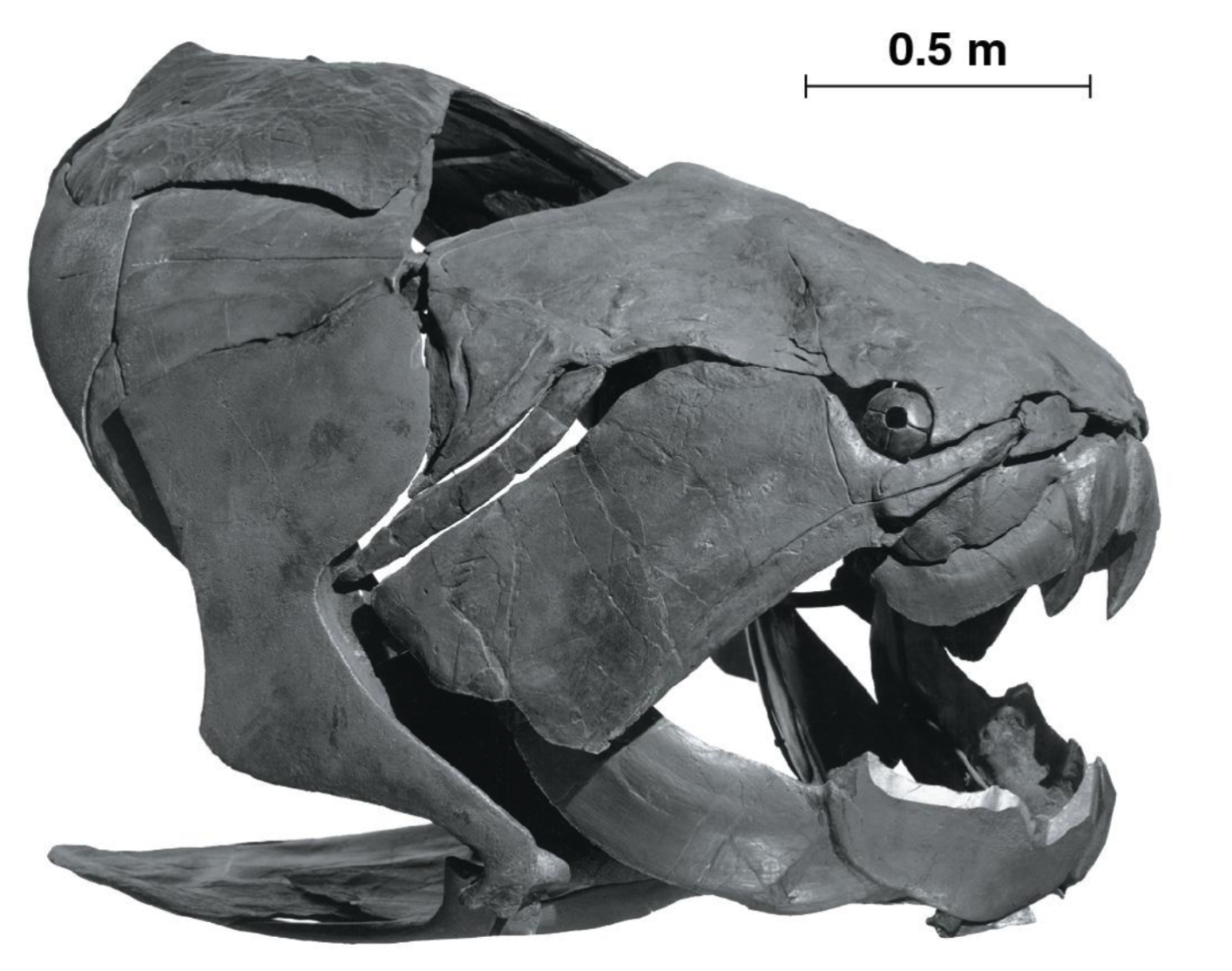
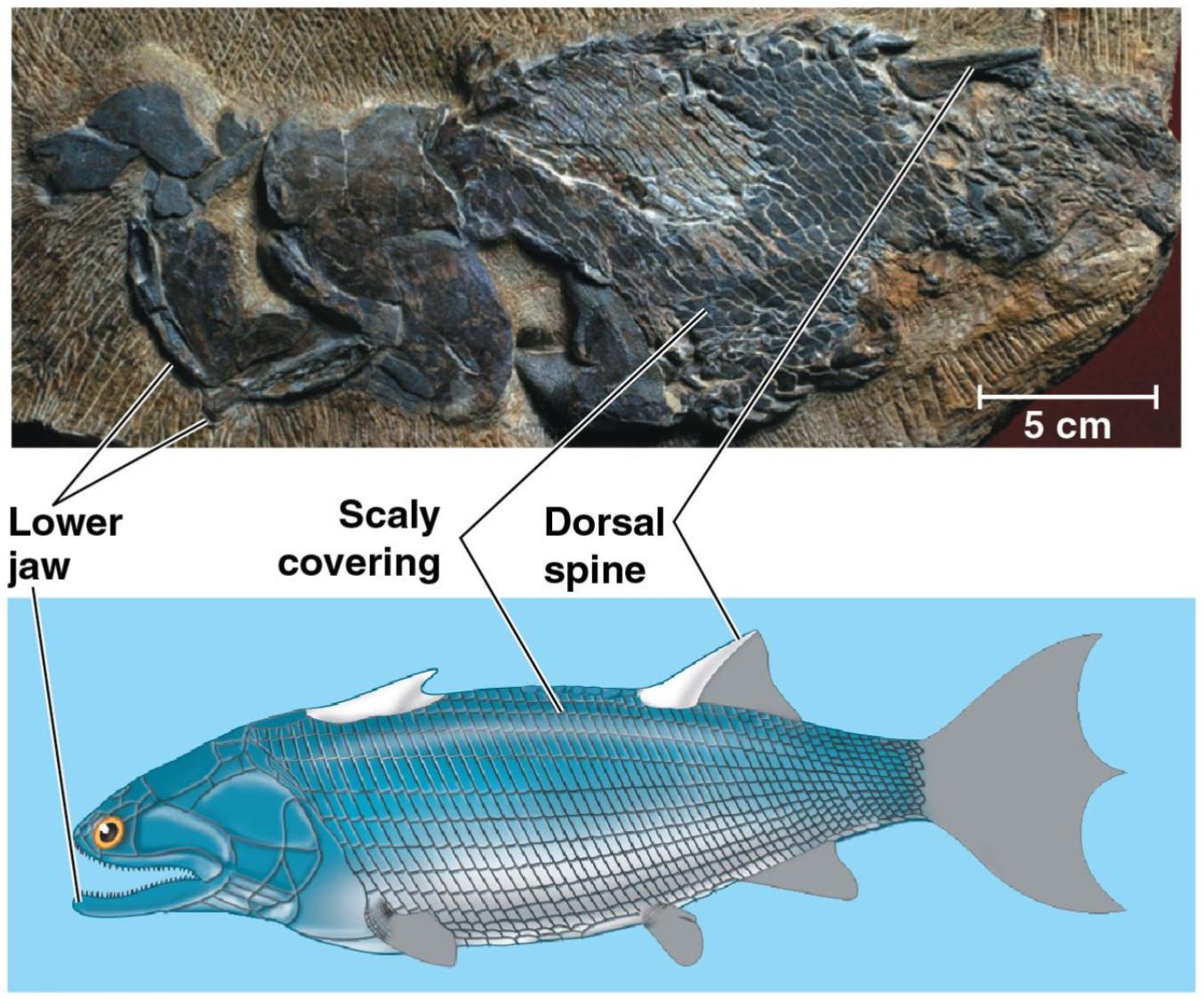
Placoderms
Early gnathostomes; these are extinct armored vertebrates ranging in size from less than a meter to more than 10 m
Gnathostome lineages
Includes:
Chondrichthyans (sharks, rays, and their relatives)
Ray-finned fishes
Lobe-fins
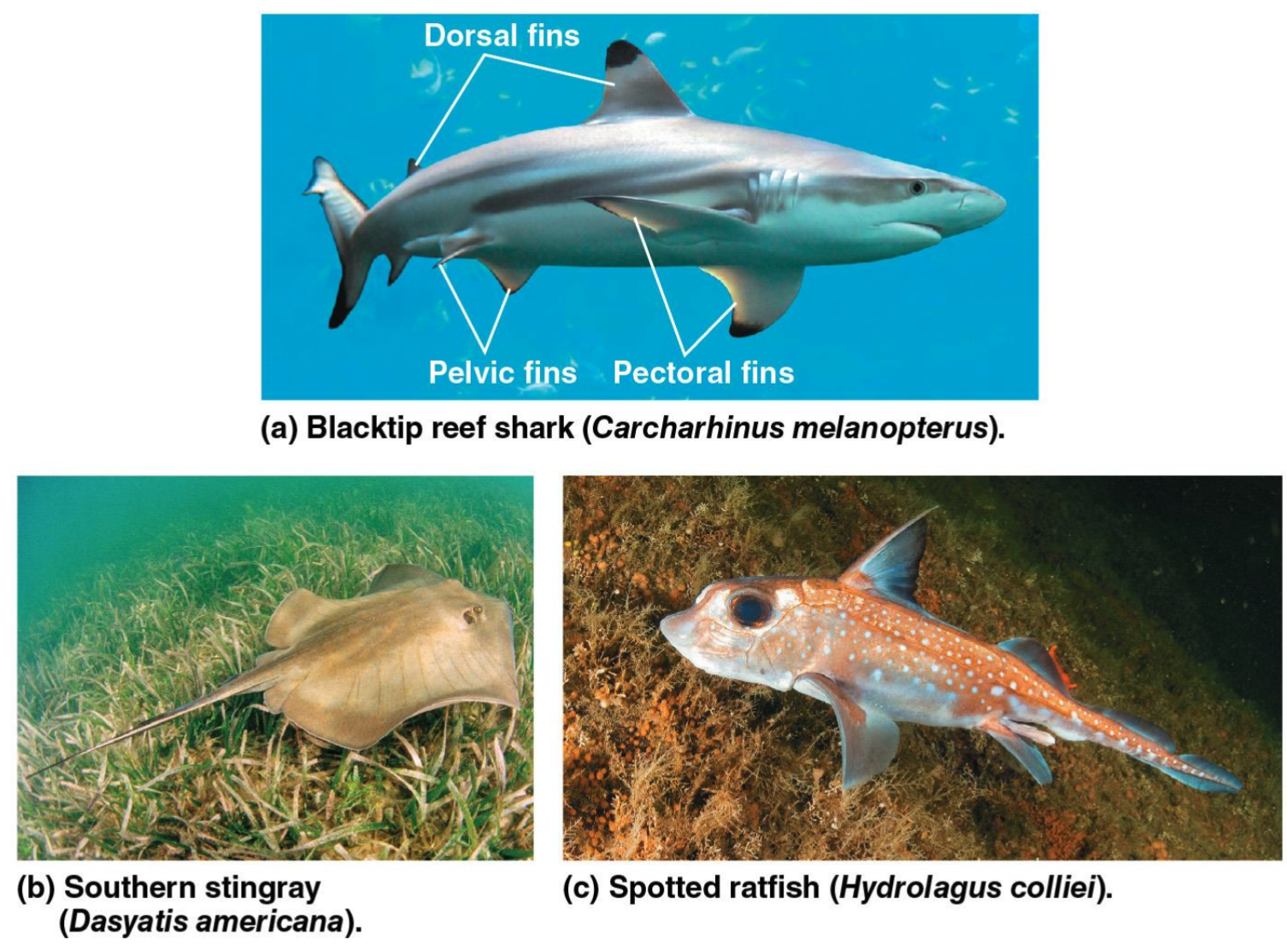
Chondrichthyans
One of the three lineages of gnathostomes including the 1,000 species of sharks, rays, and their relatives; these have skeletons composed primarily of cartilage and some calcium
Traces of bone are found in scales, at the base of teeth, and coating vertebrae in some sharks
Bone likely evolved in these before diverging
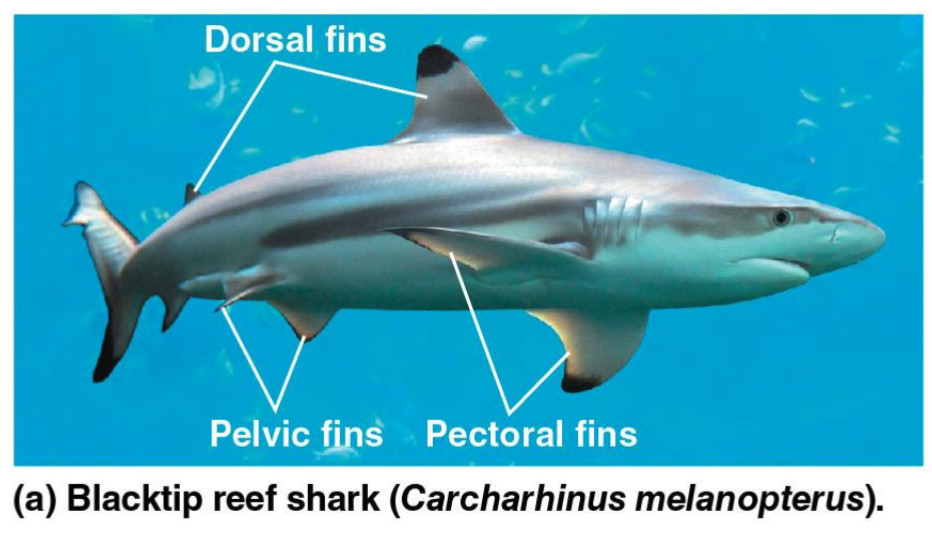
Shark
One example of a chondrichthyan, with a streamlined body for swift but less maneuverable swimming
Dorsal fins function as stabilizers, and paired pectoral and pelvic fins are used for maneuvering
Oil is stored in the liver for buoyancy
Continual swimming is necessary to avoid sinking, also keeping water flowing for gas exchange
During rests, muscles of the jaw and pharynx are used to pump water over gills
Eggs are fertilized internally, but can undergo oviparous, ovoviviparous, or viviparous development
Oviparous development
Development of the embryo where eggs hatch outside the shark mother’s body after internal fertilization
Ovoviviparous development
Development of the embryo where eggs are retained within the oviduct and young are born after hatching within the uterus
Viviparous development
Development of the embryo within the uterus, nourished by:
A yolk sac placenta,
Absorption of nutrient-rich fluid, or
Eating other eggs
Cloaca
A common chamber with a single opening to the outside of the body, with the reproductive tract, excretory system, and digestive tract all emptying into this
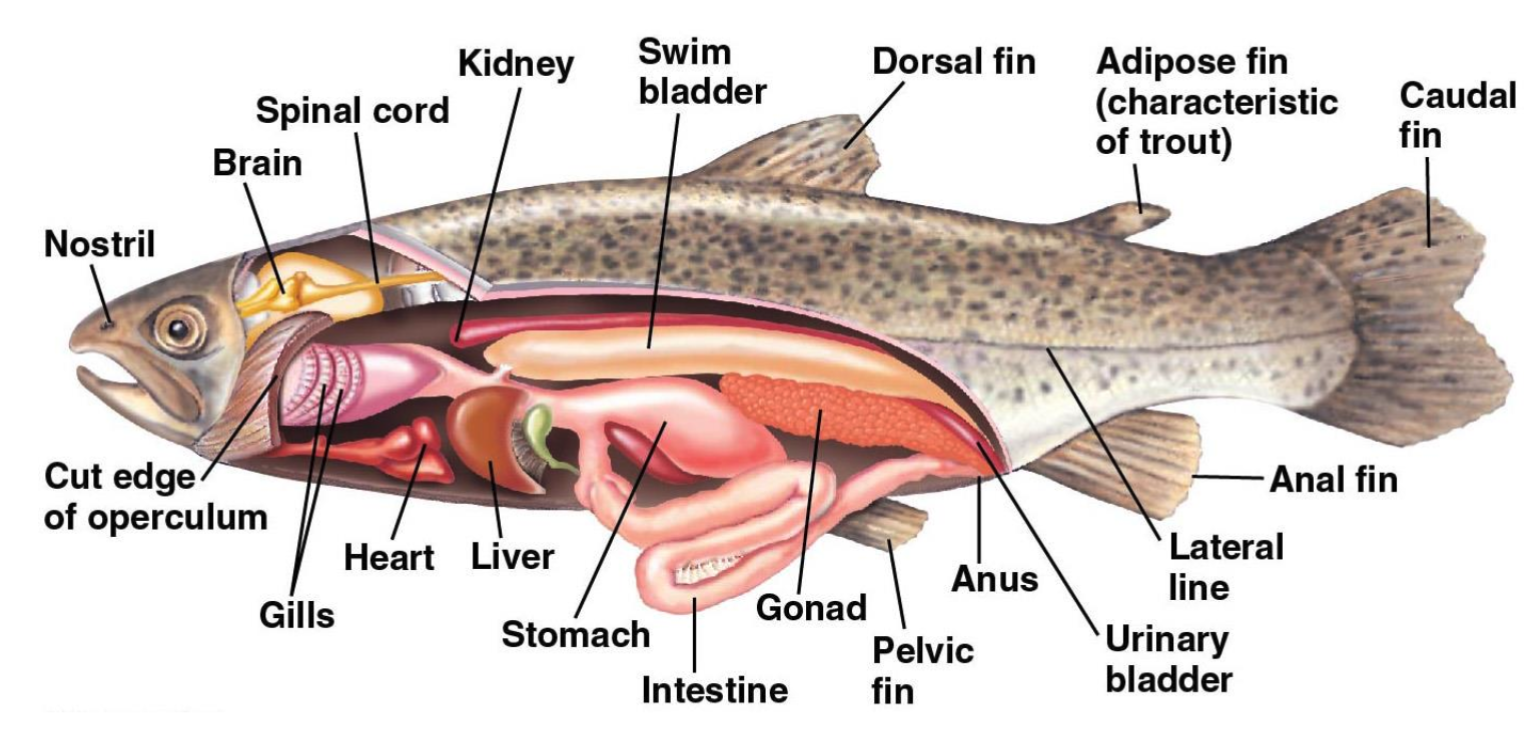
Osteichthyans
The vast majority of vertebrates, with a majority having bony endoskeletons
Includes bony fishes and tetrapods; aquatic species of these are informally called fishes
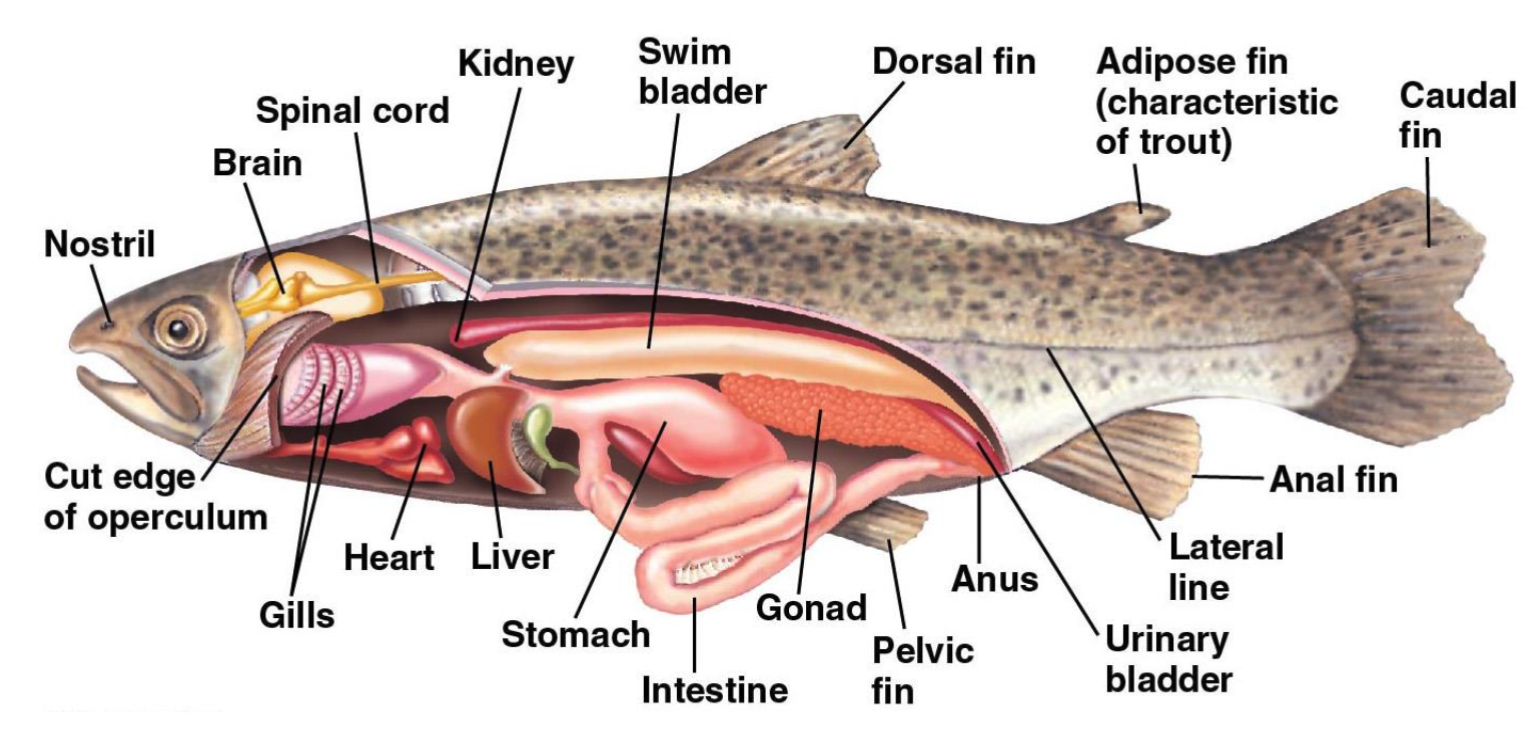
Operculum
A bony flap protecting the gills of fishes, helping draw water into the mouth and over the gills via muscle contractions
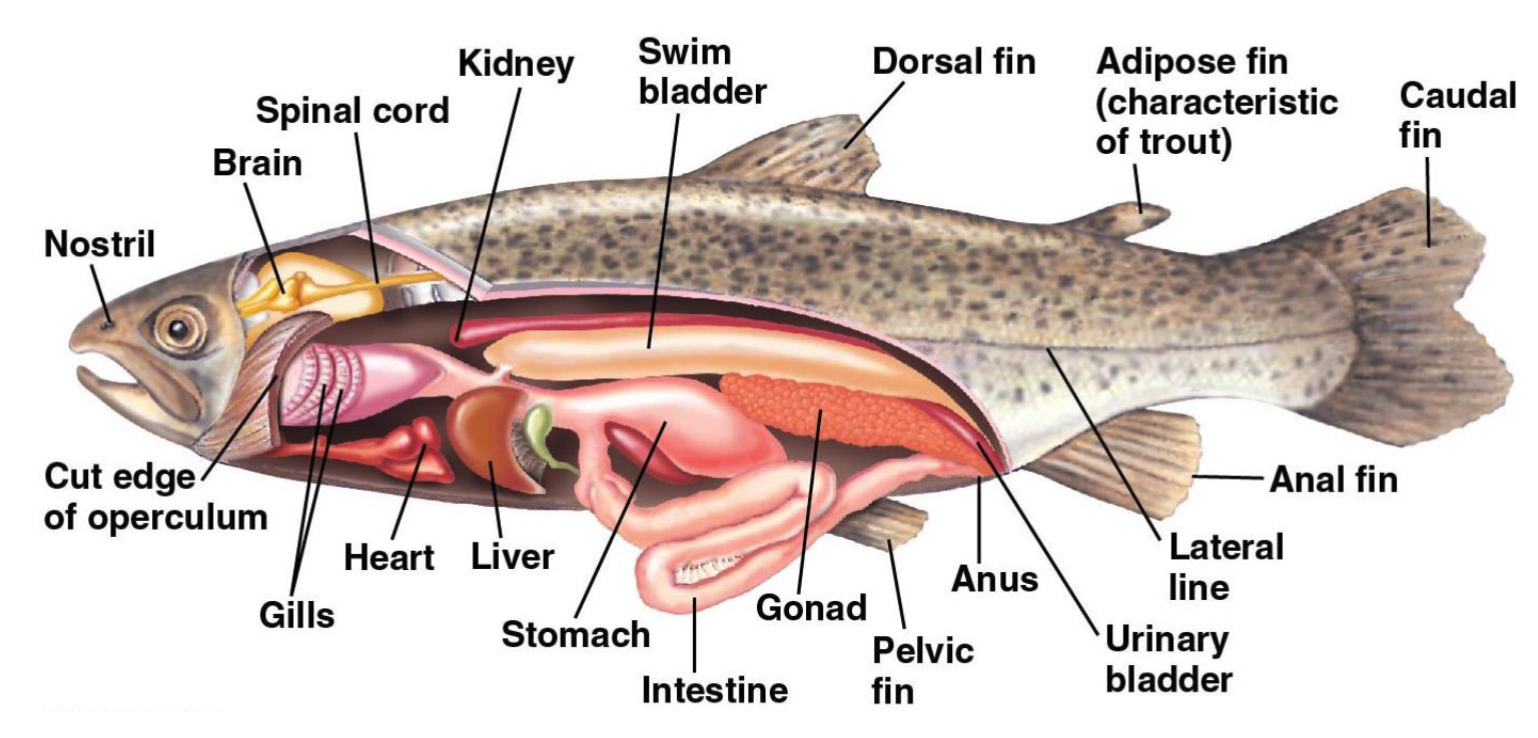
Swim bladder
An air sac in fishes filled to maintain buoyancy
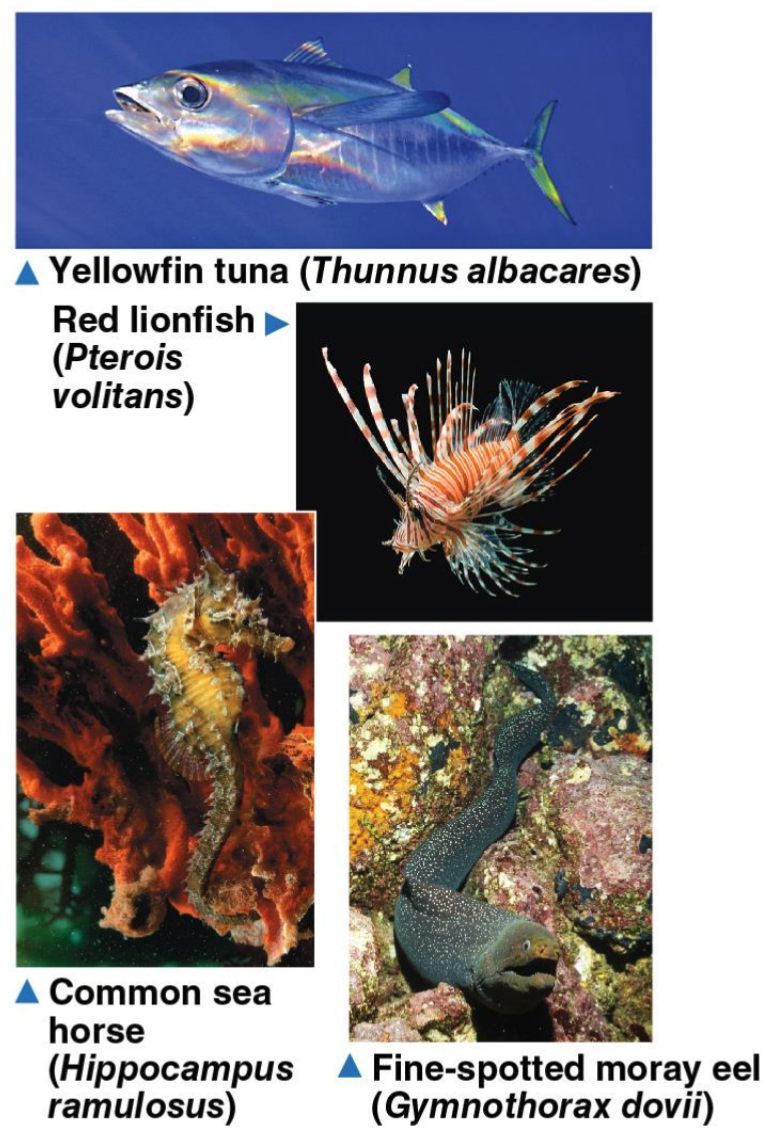
Ray-finned fishes
A group of gnathostomes including over 27,000 species, including most familiar osteichthyans
Have modifications in body form and fin structure affecting maneuvering, defense, and other functions
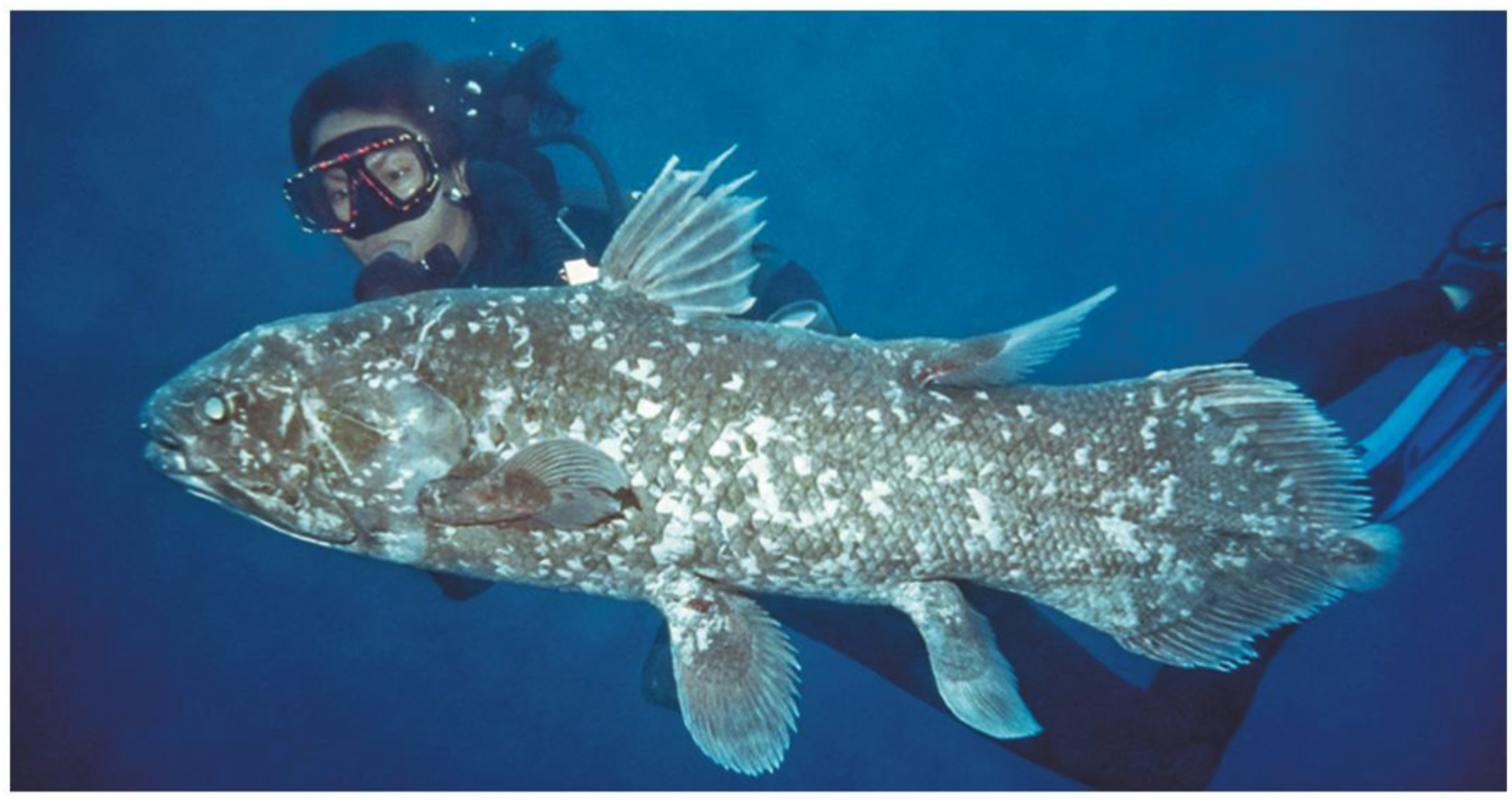
Lobe-fins
A group of gnathostomes with rod-shaped bones surrounded by a thick layer of muscle
Used to maneuver across the substrate of aquatic habitats
Lungfishes
Types of lobe fins initially arising in the ocean, but today living in stagnant ponds and swamps with gas exchange in water using gills or gulping air into lungs attached to the pharynx
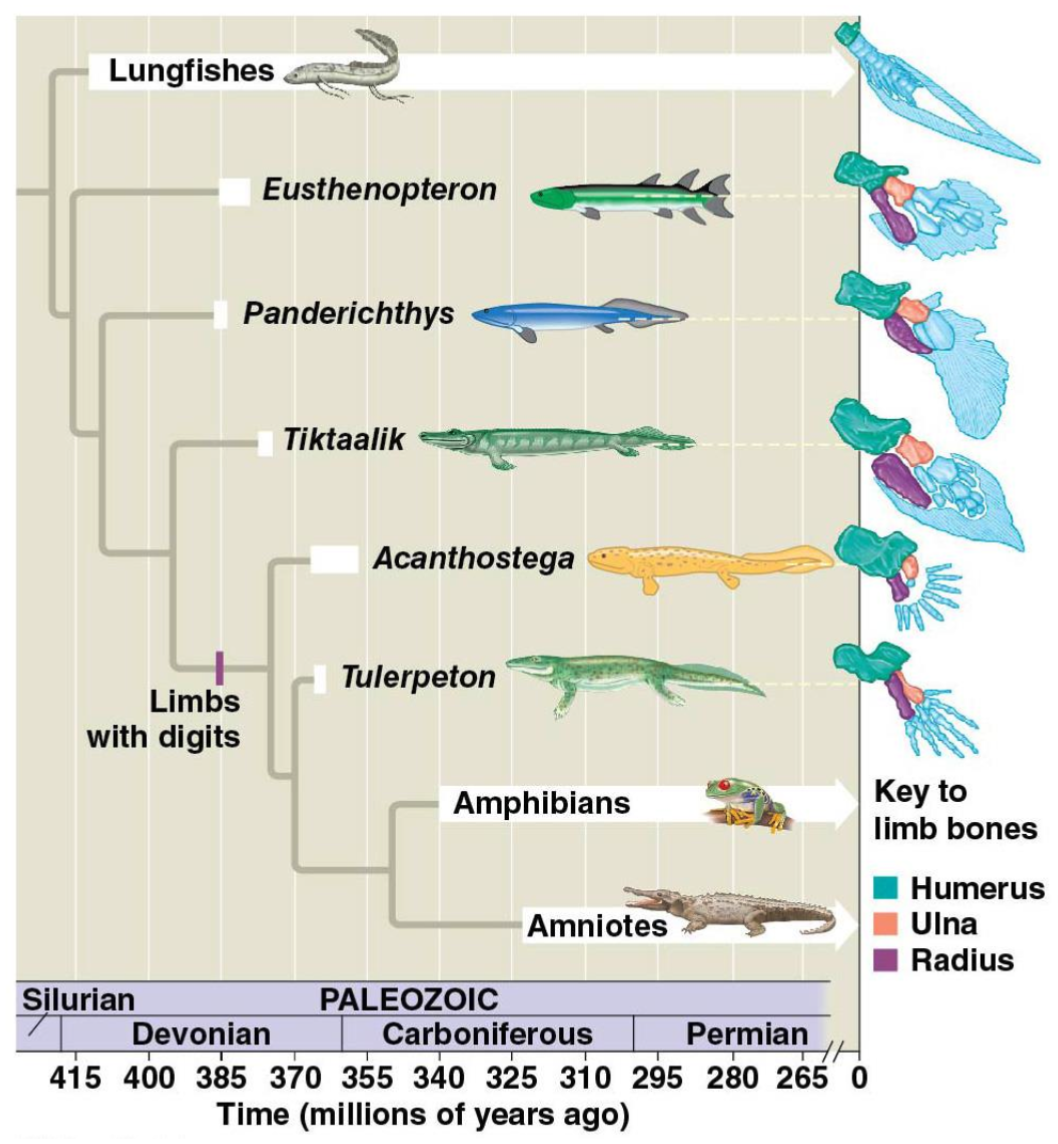
Tetrapods
Gnathostomes that have limbs via the evolution of a lineage of lobe-fins 365 mya, leading to great diversification
Have four limbs and feet with digits
A neck, enabling independent head movement
Fusion of the pelvic girdle to backbone
The absence of gills
Ears for detecting airborne sounds
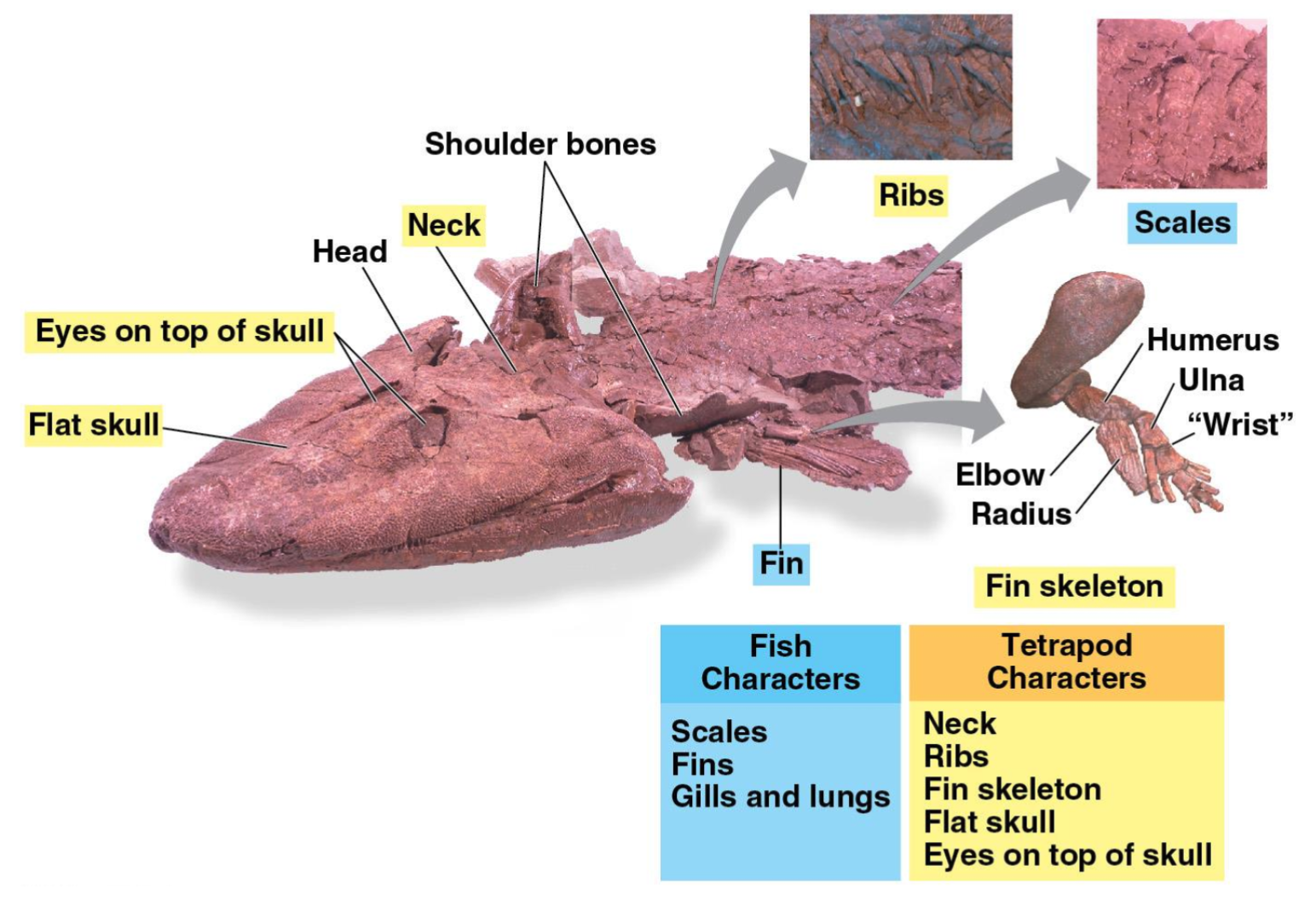
Tiktaalik
A fossil species with characteristics of both fish and tetrapods
Fish traits include fins, gills, lungs, and scales
Tetrapod traits include ribs, a neck and shoulders, front fins with similar bone patterns, and a pelvis and rear fin more robust than those found in fish
Likely could walk in water, but is unlikely that it walked in land
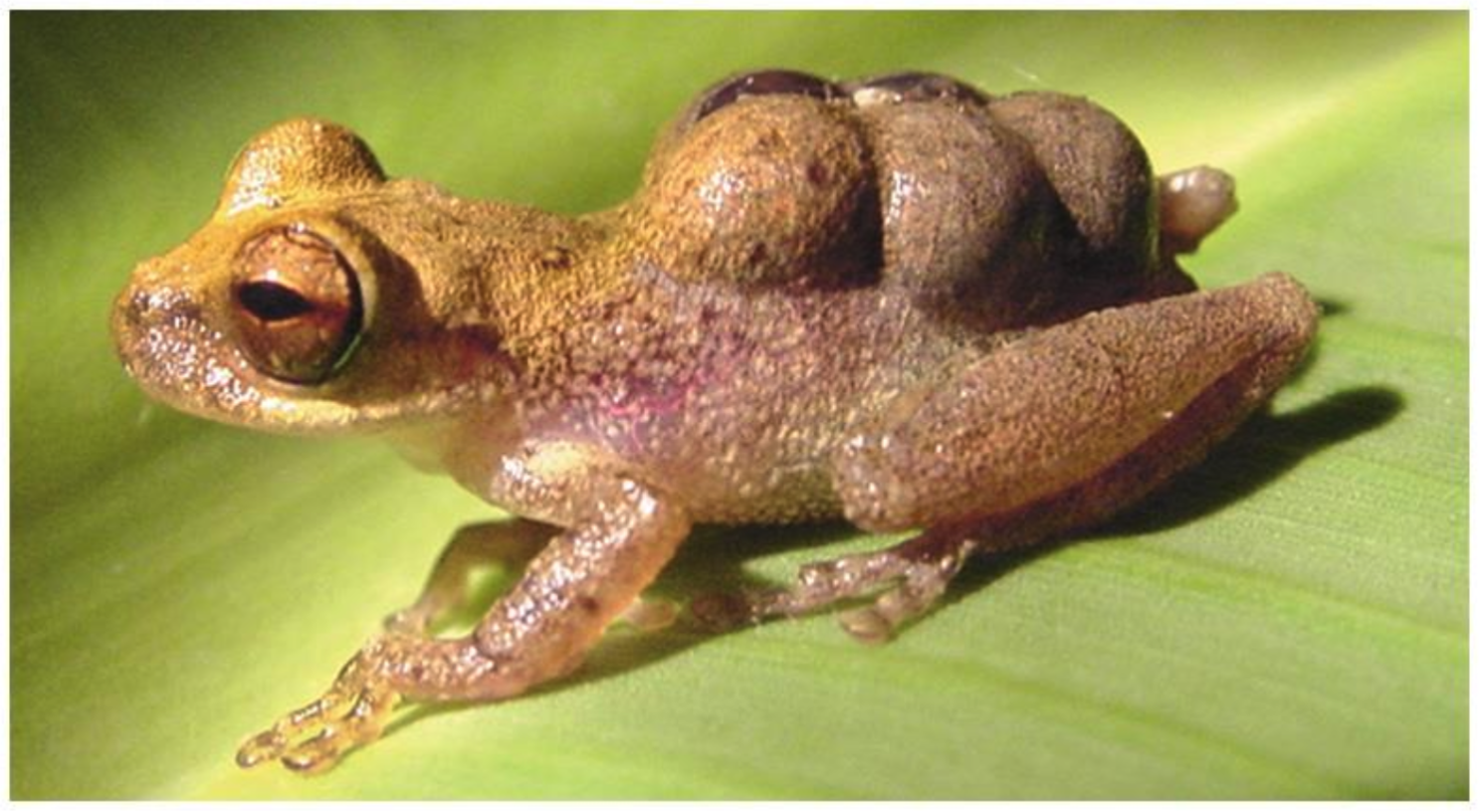
Amphibians
A class with 6,150 species in three clades:
Salamanders (Urodela or “tailed ones”)
Frogs (Anura or “tail-less ones”)
Caecilians (Apoda or “legless ones”)
Name means “both ways of life,” referring to the life stages of many frog species first in water and then on land
Usually found in damp environments; these have skin that function in gas exchange
Eggs lack a shell and must be laid in water or moist environments on land
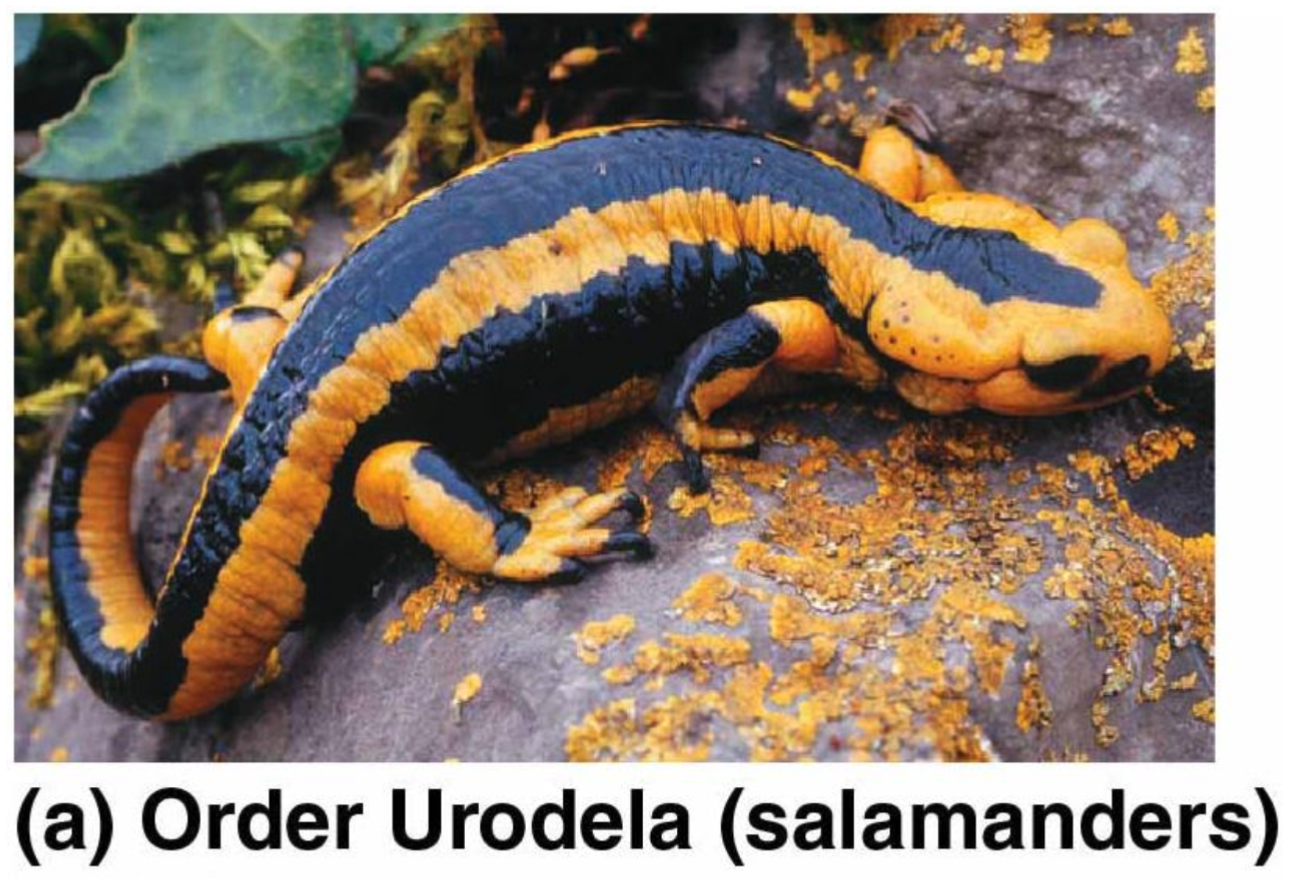
Salamanders (Urodela)
A clade under amphibians with about 550 species; these have tails
Some are aquatic
Exhibit paedomorphosis, or the retention of larval features when mature
Typically carniverous
Paedomorphosis
The retention of larval features when mature enough to reproduce; this is common in aquatic salamanders
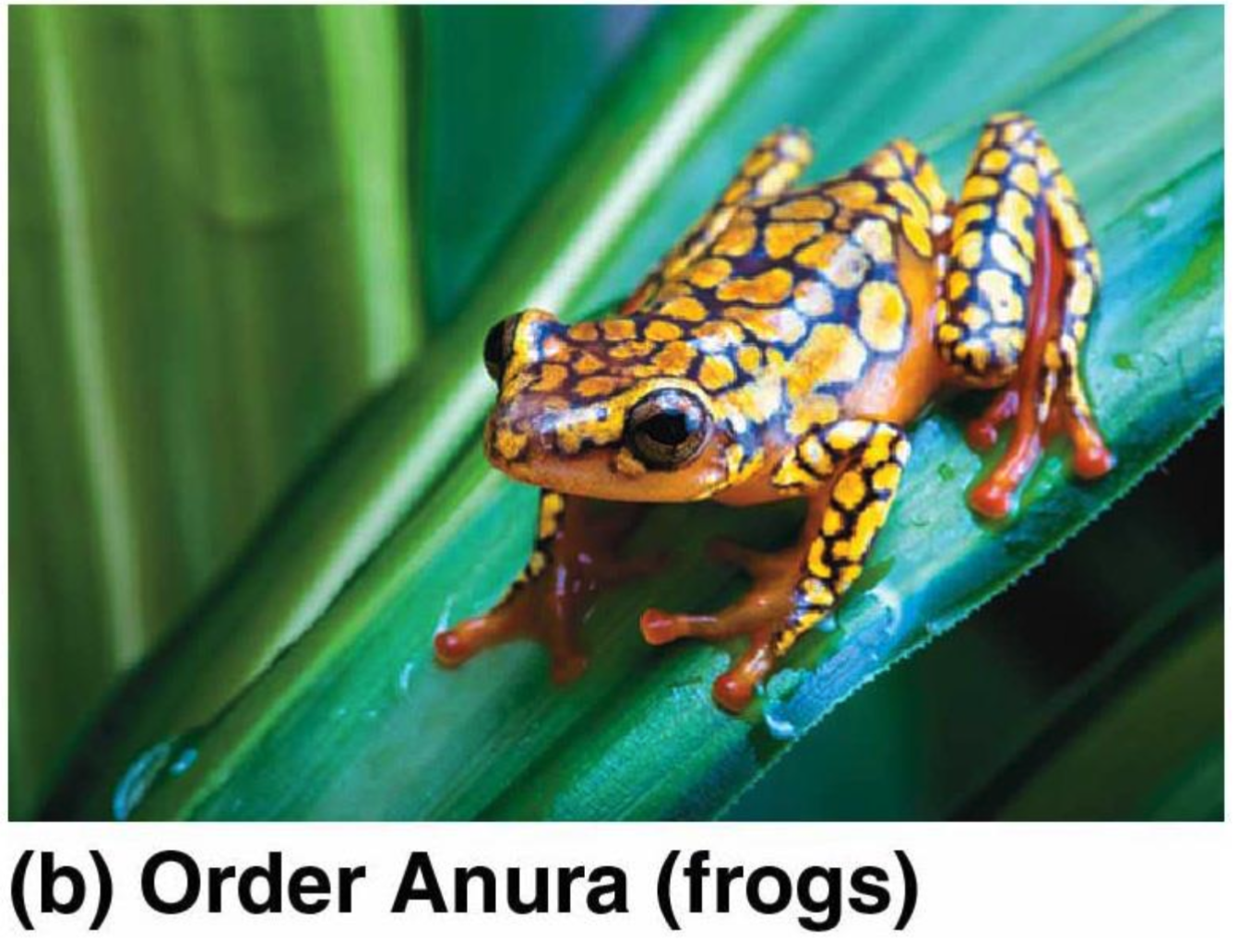
Frogs (Anura)
A clade under amphibians with about 5,420 species; these lack tails but have powerful hind legs for locomotion on land
These with leathery skin are called “toads”
Larvae are herbivoeres with gills, a lateral line system, and long, finned tails; this eventually is grown out of and a carnivorous diet persists
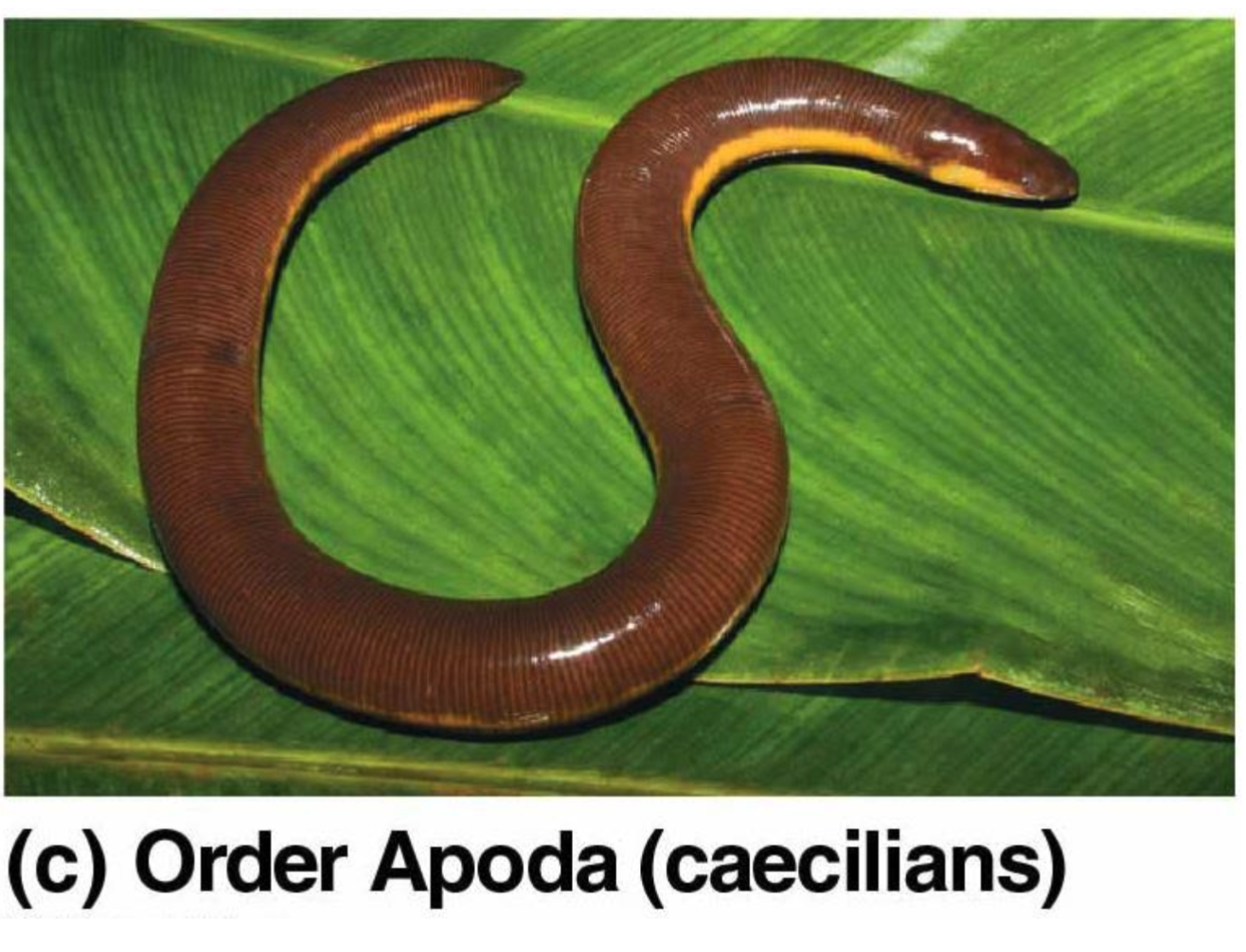
Caecilians (Apoda)
A clade under amphibians with about 170 species; these are legless and nearly blind, resembling earthworms
Legs were lost as a secondary adapation
These inhabit moist forest soils in tropical areas
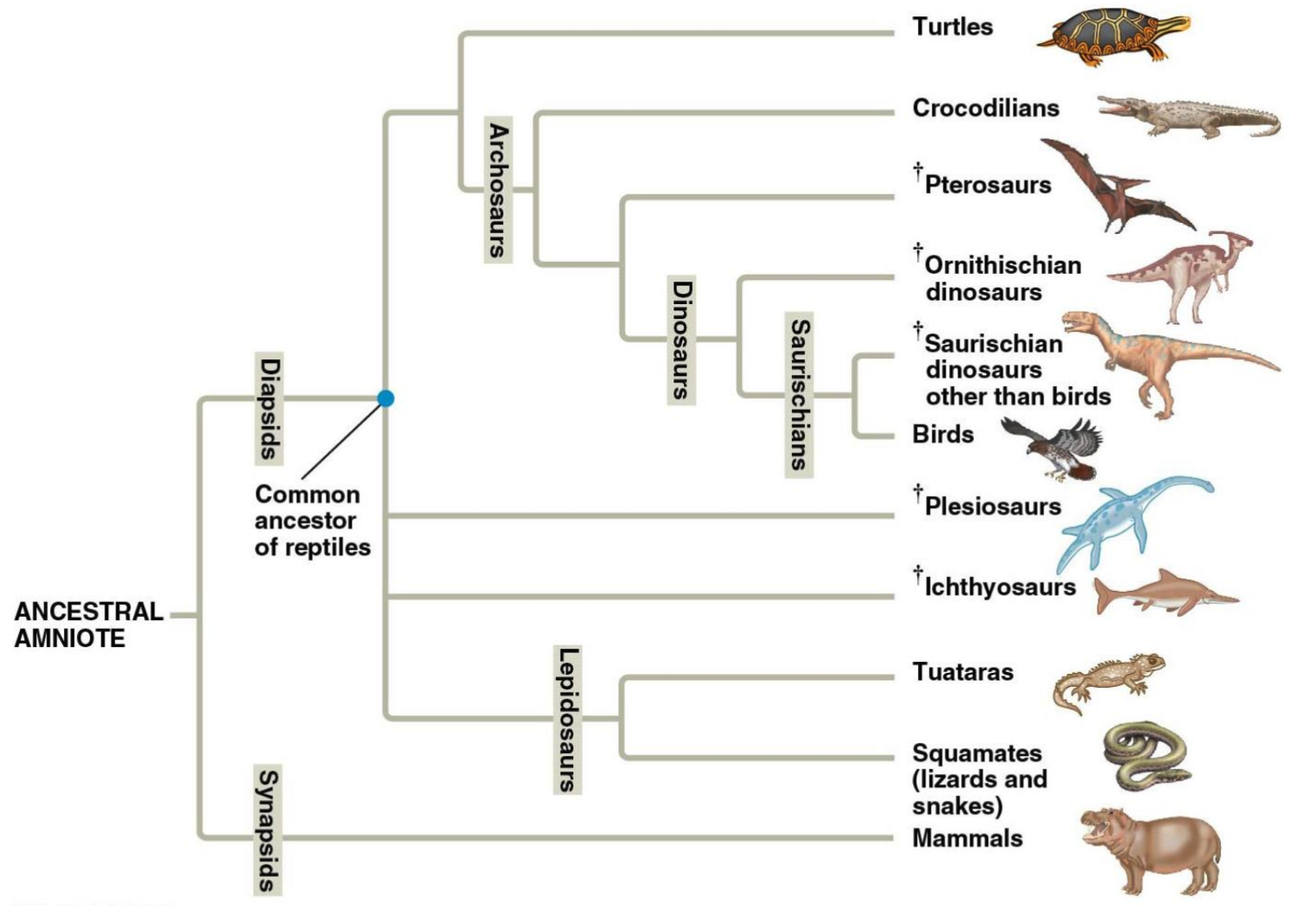
Amniotes
Tetrapods whose living members are the reptiles (including birds) and mammals
Named for their amniotic egg, containing four embryo-protecting membranes and reducing dependence on water for reproduction
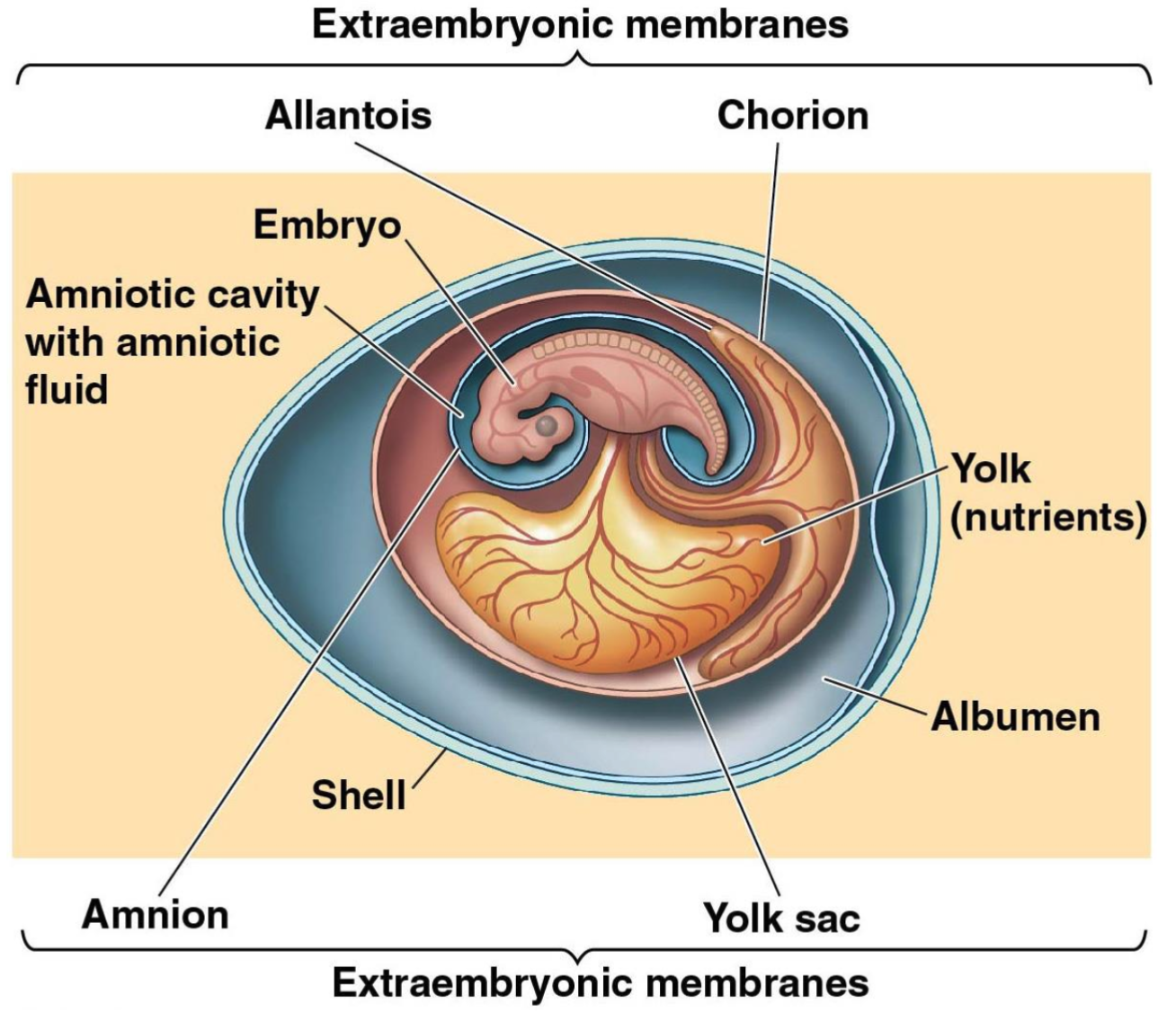
Amniotic egg
An egg type in amniotes reducing water dependence for reproduction and has four membranes of the amnion, chorion, yolk sac, and allantois
These often have shells when produced by reptiles to slow dehydration
Many mammals have lost the eggshell, developing within the mother’s body instead
Amnion
A fluid-filled sac that surrounds, bathes, and cushions the embryo as the other membranes function in gas exchange, nutrient transfer, and waste storage
Rib cage
A body part in amniotes that improved breathing efficiency through the ventilation of the lungs
This allowed for less dependency on gas exchange through the skin, causing lower permeability and enabling better water conservation
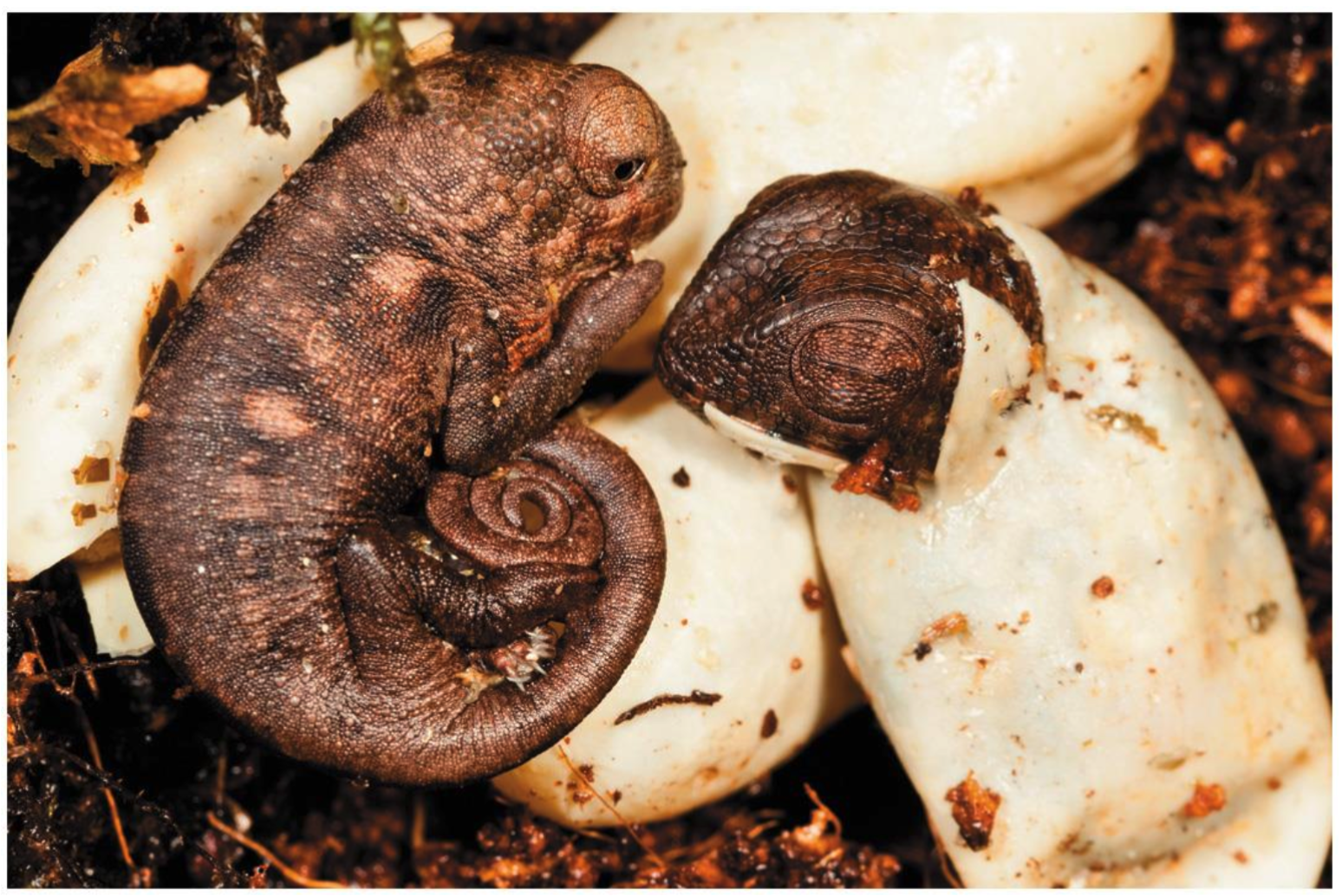
Reptiles
A group a member of the amniotes including tuataras, lizards, snakes, turtles, crocodilians, and birds; many share some characteristics:
Scales containing keratin to prevent desiccation and abrasion
Shelled eggs to prevent drying out
Internal fertilization before the secretion of the shell
Being ectothermic, except for birds which are endothermic
Ectothermism
Being able to absorb external heat as the main source of body heat; seen in most reptiles except birds
Temperature is regulated through behavioral adaptations, like basking in the sun or shade
Endothermism
Being able to maintain body temperature through metabolic activity
Seen in birds as reptiles that do not exhibit ectothermism
Pterosaurs
The first tetrapods to exhibit flapping flight, originating in the late Triassic
Filled ecological roles that would later be played by birds after their extinction, about 66 mya
Dinosaurs
Land-based tetrapods that diversified into a vast range of shapes and sizes
Herbivorous members evolved diverse adaptations for defense
Theropods were bipedal carnivores including Tyrannosaurus rex
Many were agile and fast moving; and some lived in groups, protected eggs, or were endothermic
Went extinct about 66 mya potentially from an asteroid or comet impact
Theropods
Bipedal carnivorous dinosaurs including Tyrannosaurus rex and the ancestors of birds
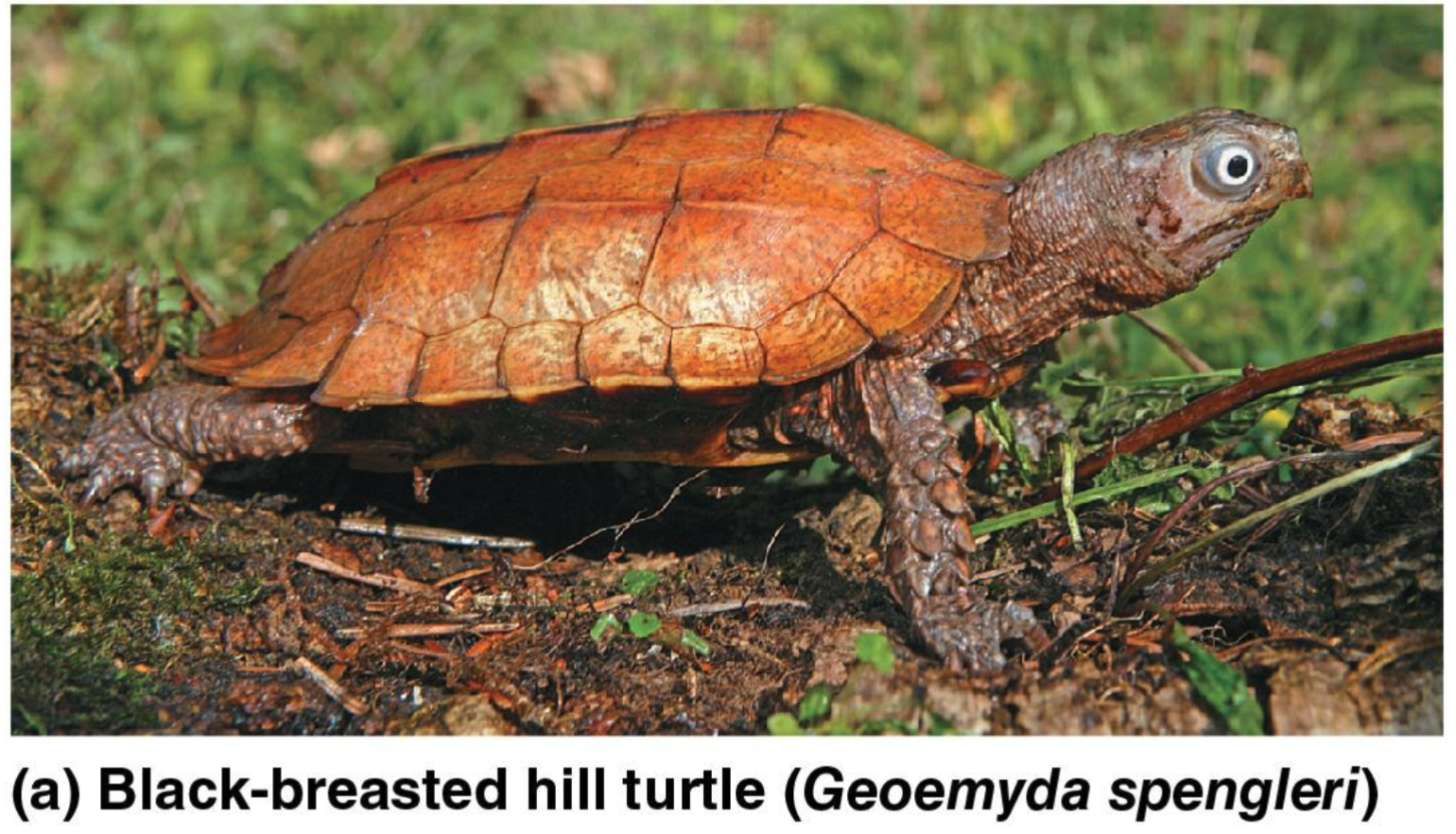
Turtles
Group of tetrapods containing 351 species, most closely related to crocodilians and birds
Their boxlike shell was acquired in stages over millions of years, made of upper and lower shields fused to the vertebrae, clavicles and ribs
The earliest could not retract their head into their shell
They have adapted to a variety of environments, like deserts, ponds, rivers, or the sea, but can be threatened by human development
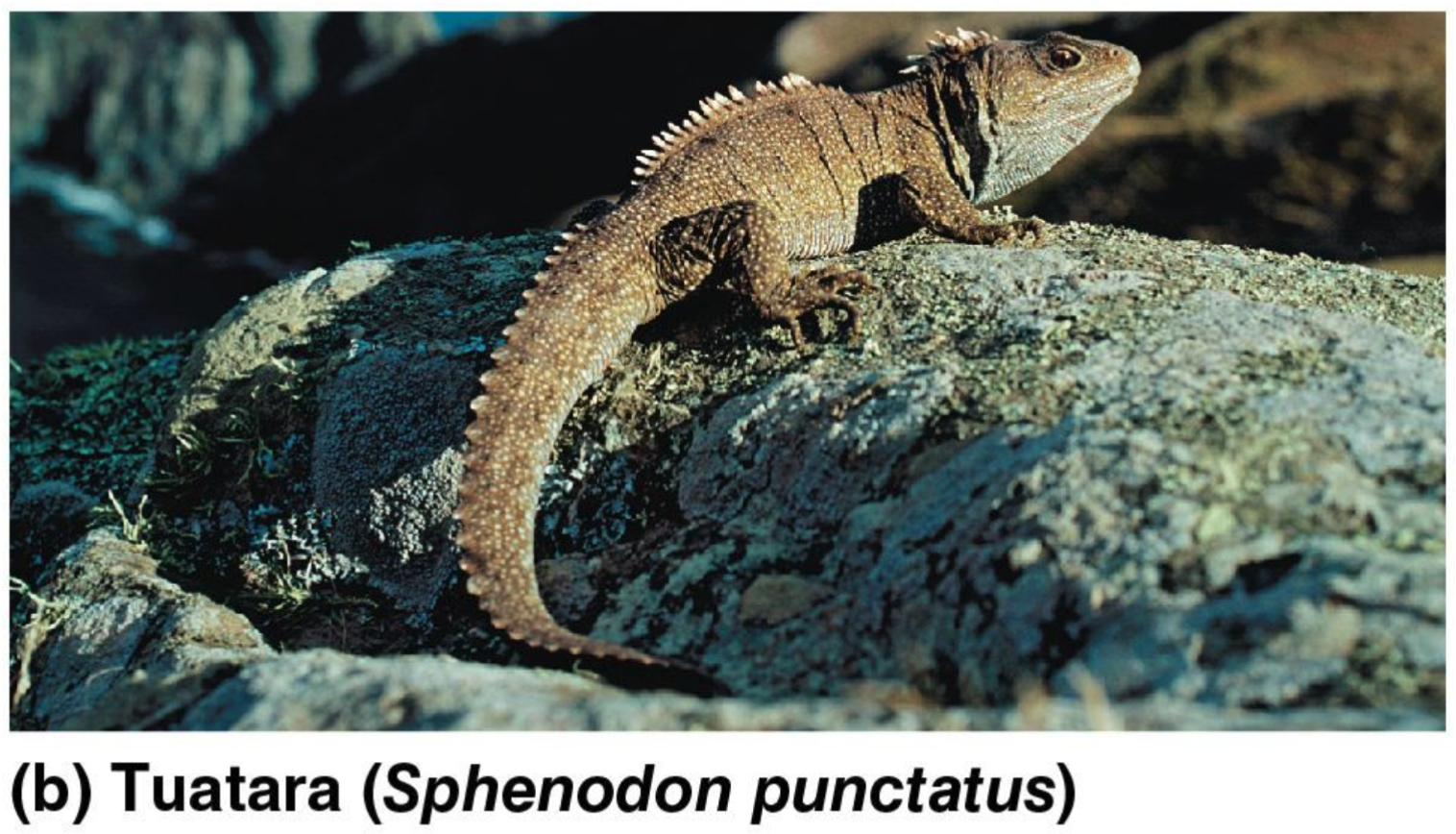
Lepidosaurs
Tetrapod group represented by a single lizard-like species called the tuatara, restricted to 30 islands off the coast of New Zeealand and threatened by rats which consume their eggs
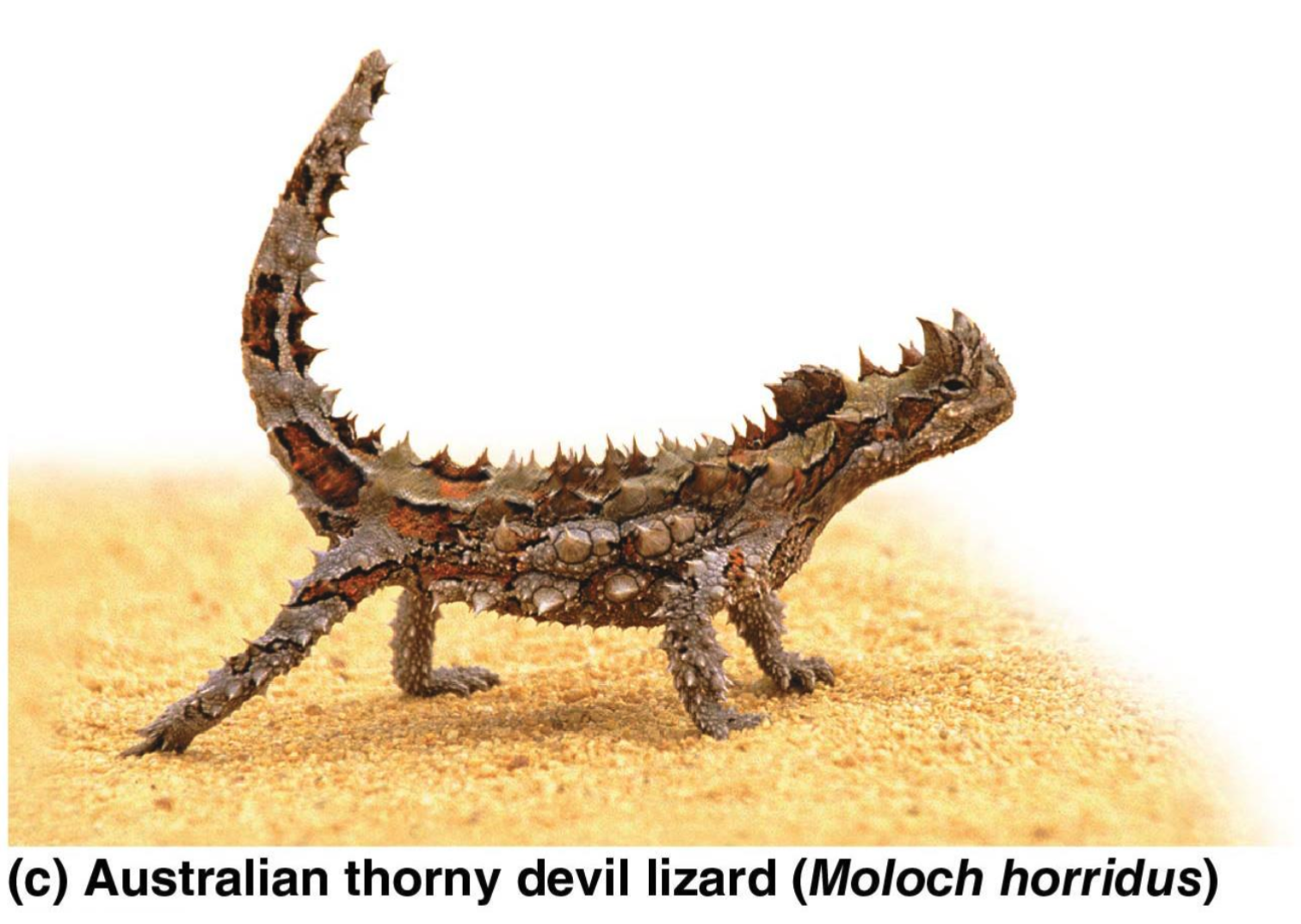
Squamates
Group of amniotes that includes all ~10,425 species of lizards and snakes, ranging in size from 16 mm to 3 m long
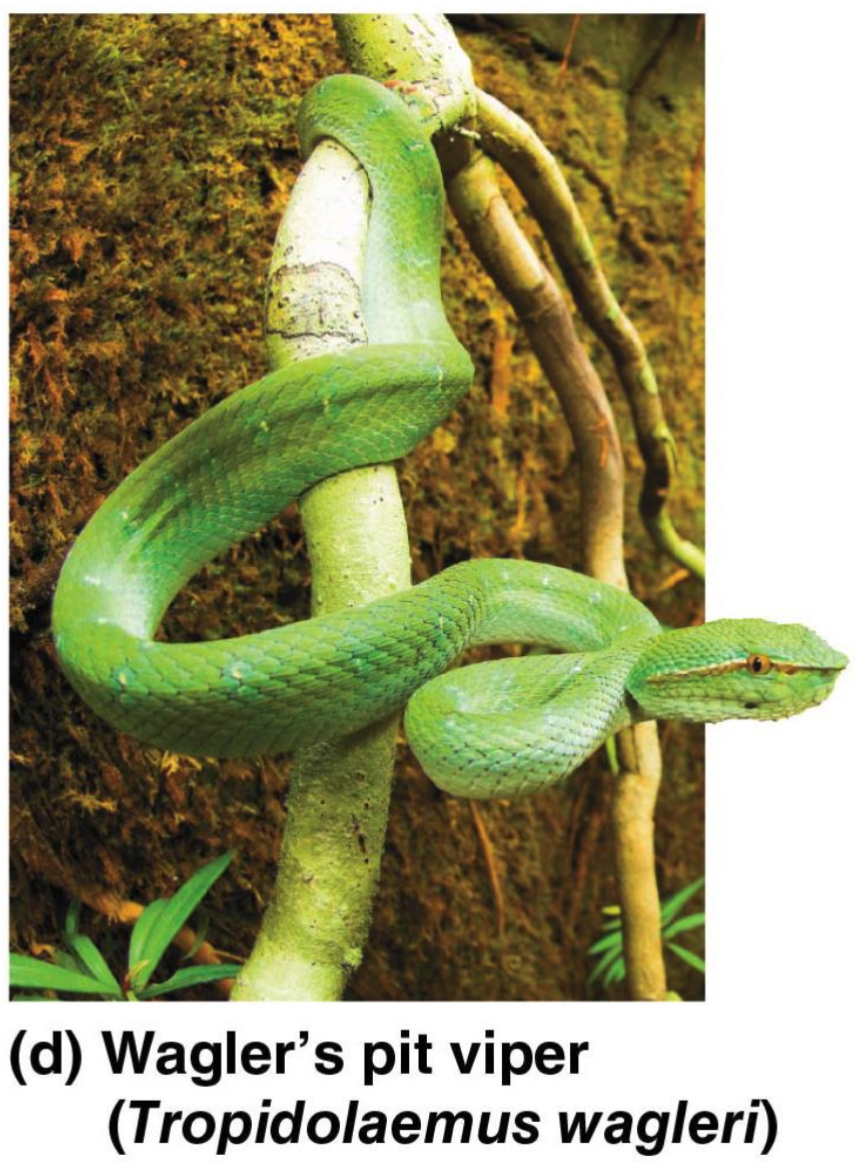
Snakes
Descended from lizards with legs; these move on land by producing waves of lateral bending from head to toe or via belly scales to grip and pull from the ground
These are carnivorous and have adaptations to aid in preying, such as chemical sensors, vibration sensitivity, heat-detecting organs, tongue flicking, toxic venom, and loosely articulated jawbones and skin for swallowing
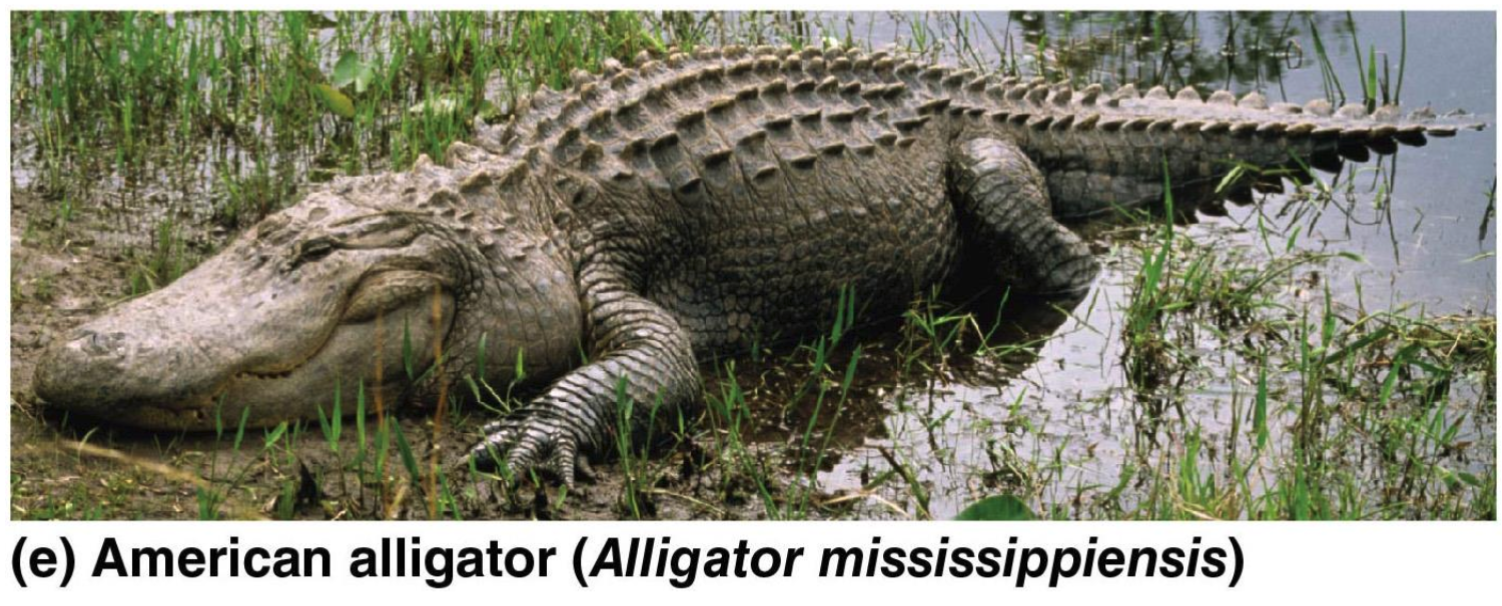
Crocodilians
Tetrapod group that includes all alligators and crocodiles; early species were small terrestrial quadrupeds before becoming larger and aquatic
The 24 species of these are restricted to warm regions of the globe
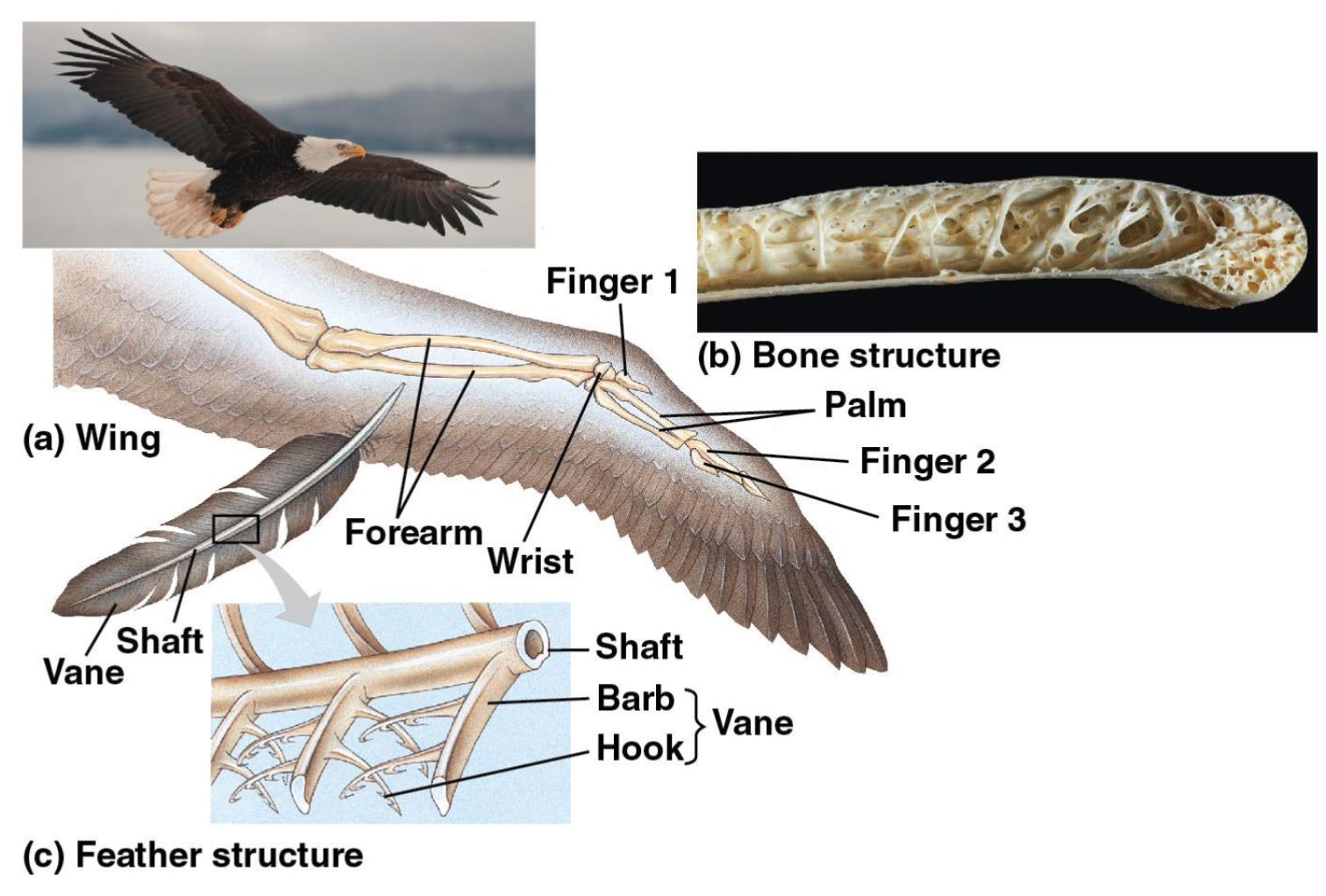
Birds
Archosaurs with extensive modifications in their adaptation to flight; this group has about 10,000 species
Adaptations include having no urinary bladder, only one ovary, small gonads, toothless mouths, and air-filled bones with honeycombed internal structures
They also have color vision, acute eyesight, and fine muscle control to support flight for hunting, escape, and migration
Large amounts of energy are dedicated to flight; feathers and some fat can insulate against heat loss while efficient respiratory and circulatory systems supply oxygen to tissues
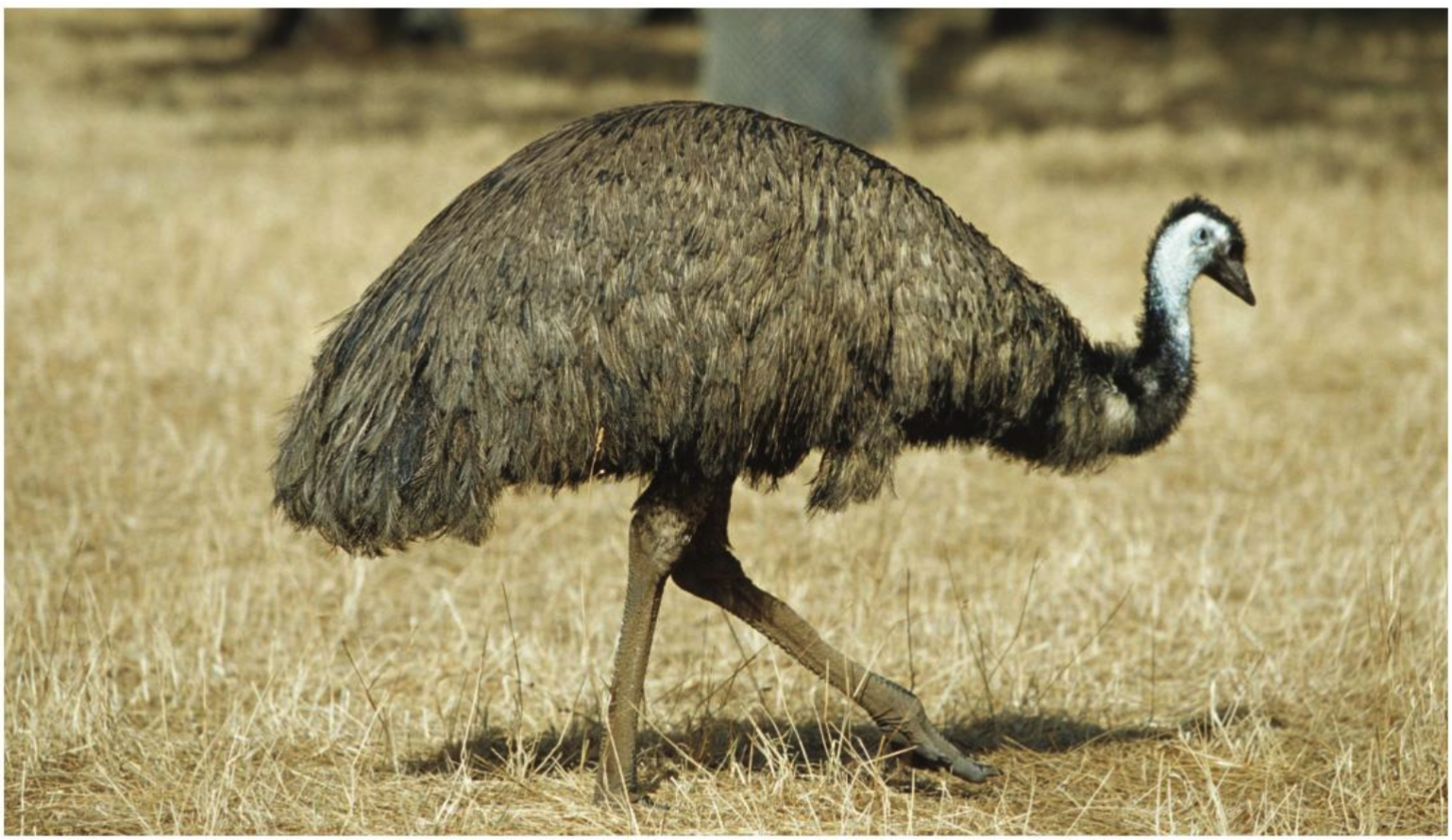
Ratites
An order of flightless birds including the ostrich, rhea, kiwi, cassowary, and emu