Anti-Social Behaviour and Psychopathy
 Call Kai
 Learn
Learn Practice Test
 Spaced Repetition
 Match
Match Flashcards
 Knowt Play
1/29

There's no tags or description
Looks like no tags are added yet.
Name | Mastery | Learn | Test | Matching | Spaced | Call with Kai |
|---|
No analytics yet
Send a link to your students to track their progress
30 Terms
How do we define anti-social behaviours? - the paradoxical nature of humans
Humans and non-human animals display prosocial behaviours but humans harm eachother intentionally sometimes
likely the same pathways for prosocial behaviours are important for anti-social behaviours - a lot of shared neural areas
e.g. understadning others to lie and manipulate
causing harm = prosocial if defending the vulnerable, antisocial if unwarranted aggression
the importance of non-cooperation / compliance
sometimes we need people who think slightly differently as cooperation and compliance can be maladaptive due to
pluralistic ignorance
collective attribution biases
bystander effect
diffusion of responsibility
tyranny of the majority
DEFINITION of antisocial behaviours
antisocial behaviours: behaviours that often yield a net negative effect for members within a group or against another group through undertaking behaviours that harm, disrupt or violate social norms (e.g., moral codes and conventions), established rules or laws
behaviours that are difficult to justify
but this definition may be too general for when we want to think about how social and affective neuroscience understands what causes antisocial behaviours
need to look beyond behaviours and think about the underlying processes - defensive behaviours
what do we need to understand about anti-social behaviour? - defensive behaviours and aggression
antisocial behaviours can be understood as an extension of defensive behaviours
defensive behaviours: associated with affective states like aggression, anxiety and disgust
aggression is more approach than avoidance
research often uses aggression and anger as key ways to study anti-social behaviour
the same brain systems underlie:
prosocial behaviours (altruism)
anti-social behaviours
→ so anti-social behaviours are not modular, to understand antisocial behaviours we need to look at defensive behaviours more broadly
functioning well = prosocial behaviours
disruptions and dysregulation = antisocial behaviour
proactive vs reactive aggression - reactive
reactive aggression: emotionally-driven, impulsive response to a perceived threat, provocation, or frustration. It's the "hot" anger response
defensive aggression
more intense and emotionally arousing
e.g., road rage
tend to show hostile attribution bias - misread neutral social cues as threatening
cognition and body markers:
unplanned and spontaneous
considered angry aggressive behaviour
shorter-term goals / rewards
higher physiological arousal
proximal threat-related defensive circuitary
proactive aggression
proactive aggression: considered, instrumental and premeditated aggression. It's used as a tool to obtain something (dominance, resources, compliance) without emotional provocation. It's "cold" and calculated
offensive aggression - trying to harm someone
less intense and emotionally arousing
Proactive aggressors show intact (sometimes superior) social cognition but use it instrumentally — they understand others' emotions well enough to exploit them
e.g., emotional manipulation
cognition and body markers:
deliberate and planned
cognitive preparation (hiding intentions)
longer term rewards / goals
lower physiological arousal
reduced cortisol levels and smaller amygdala volume
reactive and proactive aggression can occur within the same event - its adaptive, flexible and can be controlled
evolution of aggression
RA more readily observable across many species
given there are fewer animals with PA, this could suggest PA evolved after RA
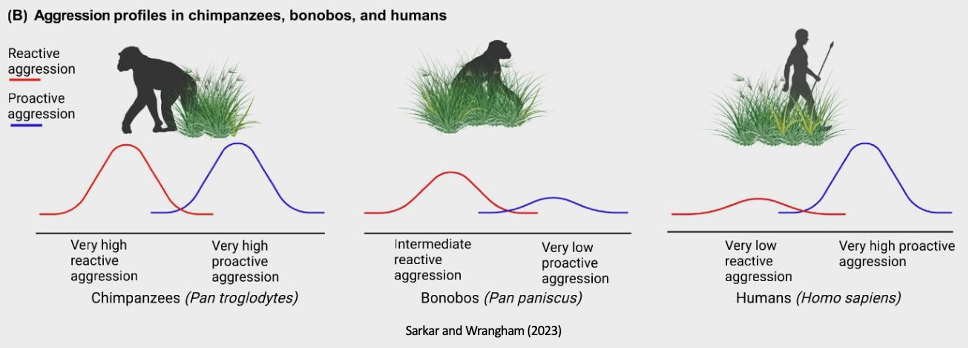
Wrangham’s theory proposes reactive aggression evolved first “as it is the one that is widespread across species,” then human self‑domestication occurred (reduction of reactive aggression and high proactive aggression over the last 300,000 years)
humans show unusually low reactive aggression but high proactive aggression, especially in coalitionary violence, relative to other primates
primate aggression-type ratios
Core idea:
a way to understand the context in which anti-social behaviours arise is to look at the types of aggression in primates
Primates differ in their balance of:
Reactive aggression (RA) = impulsive, defensive (“threat response”)
Proactive aggression (PA) = planned, deliberate (“goal-directed”)
Species differences:
Chimpanzees
Very high RA
Very high PA
Bonobos
Intermediate RA
Low PA
→ Slightly closer to humans overall
Humans
Very low RA
Very high PA
→ More planning and control
Key insight:
Humans are less reactive but more strategic
This suggests:
We share similar basic brain systems with other primates
BUT these systems are regulated differently by context
Why this matters:
The RA : PA ratio helps explain anti-social behaviour
To understand and predict behaviour, we must consider:
Type of aggression
Context!
Level of regulation (control vs impulse) - humans have strong regulatory capacity (larger PFC) but regulation ability is not fixed
social regulation and antisocial behaviours
Humans show greater control over arousal and aggression, shaping how anti-social behaviour is expressed.
Key points:
Humans have:
Lower reactive (impulsive) aggression
Higher proactive (planned) aggression
→ Behaviour is more controlled and deliberate
Raw emotions (e.g. aggression) are:
Filtered and regulated before action
Role of social complexity:
Humans live in highly complex social systems
Behaviour depends on understanding:
Social rules
Norms
Context
Individuals with delayed social development:
Struggle to understand these rules
→ More likely to show anti-social behaviour
Evolutionary insight:
Human brains have evolved to:
Be more socially driven
Rely more on planning and control (PA)
Anti-social behaviour is therefore:
More considered
Shaped by context and social pressures
Key takeaway:
Anti-social behaviour in humans reflects controlled, context-dependent aggression, shaped by our complex social world
why does socical regulation differ cross species?
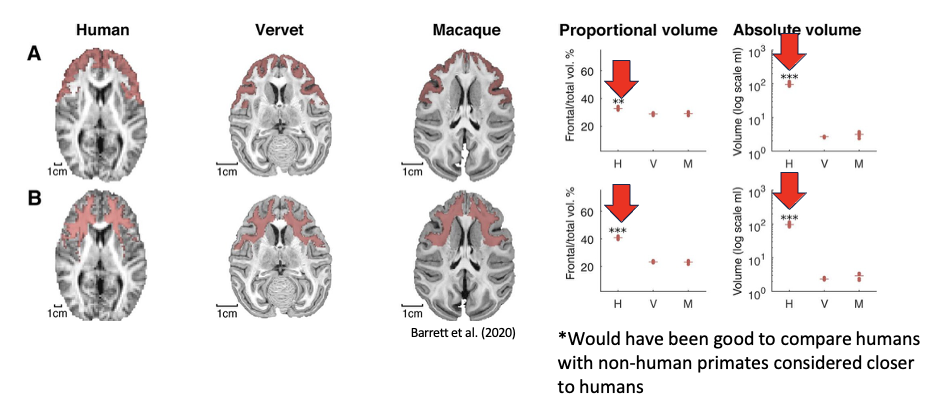
humans have bigger PFC and increased frontal lobe connections compared to non-human primates (Barrett et al, 2020)
larger PFC volume may explain why we express anti-social behaviours in more proactive forms of aggression
reason: PFC linked to executive functioning (higher order processes that enable individuals to control psychological processes and behaviours to achieve goals)
e.g., inhibition, updating and shifting focus (part of the frontoparietal network)
Larger PFC volume → stronger executive control → ability to suppress reactive impulses and plan deliberate actions → aggression becomes proactive rather than reactive
the importance of the PFC and brain networks
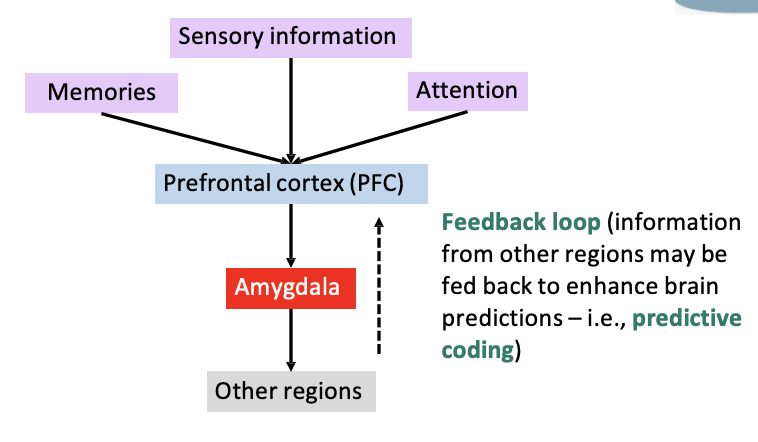
the PFC is connected to other regions to support executive functioning so human anti-social behaviour cannot be reduced to a single brain region → it emerges from atypical connectivity and disrupted feedback loops shaping how context is processed and behaviour is regulated
core idea:
it’s not just about size, it’s about the connectivity
humans have more connectivity than non-human primates which may explain why human antisocial behaviour tends to be more planned and context-sensitive
critical to remember the feedback loops which helps us learn new things and update information - links to predictive coding and reinforcement learning
PFC → Amygdala | Controls/dampens emotional/threat responses |
Amygdala → PFC | Flags emotional significance of a situation |
Memory regions → PFC | Informs decisions with past experience |
PFC → Action | Produces regulated, goal-directed behaviour |
why is the PFC so important to understanding antisocial behaviour? - functional connectivity
Core idea:
Optimal functioning requires flexibility—the ability to switch between brain networks
Key networks:
DMN (default mode network) → self-related thinking (internal focus)
FPN (frontoparietal network) → cognitive control (external tasks)
SN (salience network) → switches between DMN & FPN
Why switching matters:
Helps cope with ever-changing environmental demands
Allows appropriate responses to:
internal thoughts
external tasks
When connectivity is LOW:
Reduced flexibility in switching
Linked to:
Mood disorders (depression, anxiety)
Developmental & learning difficulties
Learning disabilities
Key takeaway:
Healthy brain function = flexible switching between networks
Poor connectivity = rigid, less adaptive behaviour
how does the brain ensure efficient functioning? (this is some random information i fear)
Mohr et al (2016)
Core idea:
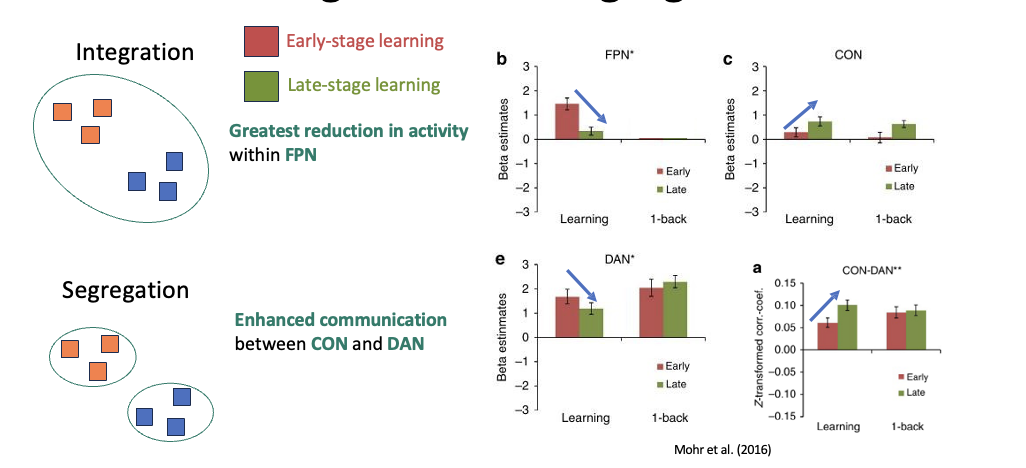
The brain balances integration (communication) and segregation (specialisation) for efficient functioning
Integration (early learning):
High communication between regions
High FPN activity (focus, control)
Used when tasks are new or difficult
Segregation (late learning):
Regions become more independent
Reduced FPN activity but enhanced communication between cingulo-opercular network (CON) and dorsal attention network (DAN)
Tasks become automatic → less attention needed
Helps save energy
Connectivity is flexible:
Changes depending on task demands
Key takeaway:
Early learning = high effort + integration
Skilled performance = low effort + segregation
atypical PFC activity
violent offenders struggle with emotion regulation
emotional dysregulation
aggression
impulsiveness
risky behaviours
why?- my research on the forensic application
forensic populations (e.g. individuals with psychopathy, persistent violent offenders) serve as examples of atypical feedback loops — where the usual PFC ↔ Amygdala communication is disrupted, reducing emotional learning and impulse regulation
example:
In prisoners, weaker vmPFC–striatal (NAcc) connectivity disrupts regulation of reward signals, relates to impulsive, short‑term choices, and predicts more criminal convictions (Penagos-Corzo et al, 2022)
the disrupted feedback loop undermines fear‑based learning, empathy, moral evaluation, and control of emotional actions, providing a mechanistic account of persistent violent and antisocial behaviour in these populations.
Loop element | Typical function | Disruption in forensic psychopathy | |
|---|---|---|---|
Amygdala → vmPFC | Convey emotional value of outcomes | Impaired stimulus–reinforcement learning, reduced fear conditioning and emotional responses | |
vmPFC → Amygdala | Regulate emotional reactivity, guide choices | Reduced functional connectivity; weaker top‑down control | |
PFC control of action | Inhibit maladaptive emotional actions | Less anterior PFC activity and PFC–amygdala coupling during tasks requiring control of emotional actions in psychopathic offenders |
study to show PFC irregularities in violent offenders
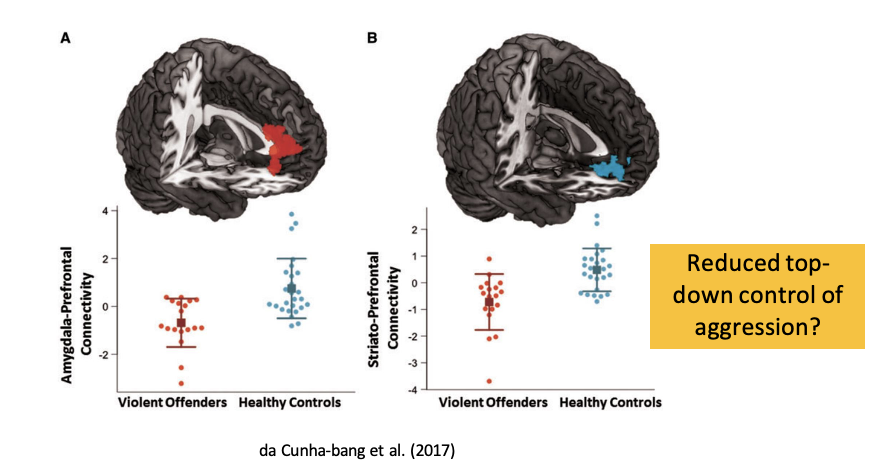
da Cunha-bang et al (2017)
violent and non-violent male offenders
had to keep pressing a button and after a certain amount of times there was money, every few seconds another opponent (computerised) would steal points and the participant was given different options
ignore
retaliate (steal points)
protect (protect points for a breif period of time)
findings:
Violent offenders – saw different levels of connectivity
Reduced connectivity between A and PFC and S-PFC in violent offenders → increased amygdala and striatal activity
Issues in regulating anger
Reduced activity from PFC but hypoeractive A and S suggests there is less top-down control, feeling anger way more intense
another study on emotion regulation in violent offenders
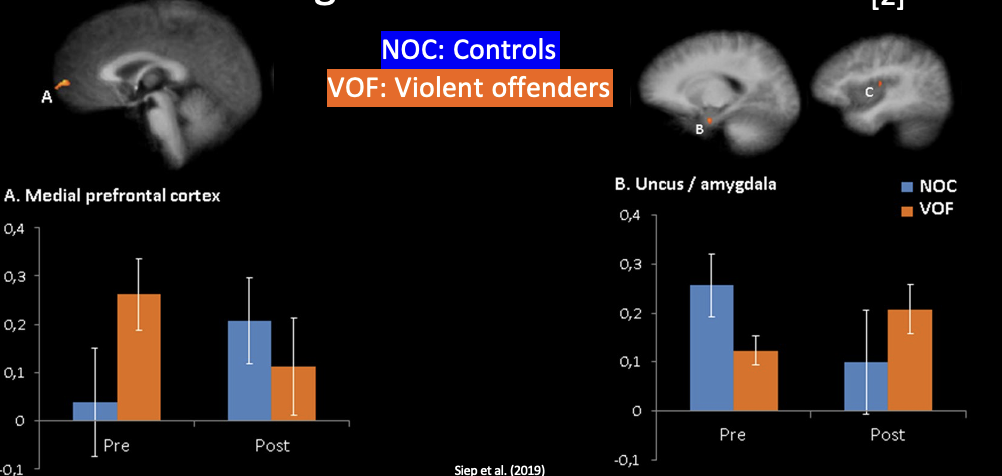
Siep et al (2019)
Violent offenders show poor emotion regulation due to abnormal PFC–amygdala interaction
Study setup:
25 violent offenders (high reactive aggression)
24 controls
Emotions induced using stories (anger, happy, neutral)
Medial PFC (control/regulation):
Controls:
Before → low activity
After emotion → increased activity
→ PFC engages to regulate emotion
Violent offenders:
Before → already high (baseline overactive)
After emotion → activity decreases
→ fails to regulate, becomes dysregulated
Amygdala (emotional reactivity):
Controls:
Before → high activity
After emotion → decreases
→ PFC successfully downregulates emotion
Violent offenders:
After emotion → amygdala increases
→ Emotion escalates instead of being controlled
Key takeaway:
Controls:
PFC ↑ → Amygdala ↓ → regulated emotion
Violent offenders:
PFC ↓ (when needed) → Amygdala ↑ → loss of control
but are the brains of people who commit murder-based violence different from non-murder-based violence?
criminal aggression is not alway the same
non-violent crime → fraud, hacking
violent crime → robbery, murder and manslaughter
Sajous-Turner et al (2020) → looked at whether there were grey matter volume differences between murderers and non-murderers
Key finding about homicide offenders’ brains
Homicide offenders showed widespread reductions in gray matter compared with all non‑homicide offenders (both violent and non‑violent)
Which brain regions had reduced gray matter in homicide offenders?
(all reduced vs non‑homicide offenders):
Prefrontal regions: ventromedial/orbitofrontal, dorsolateral, ventrolateral, dorsomedial prefrontal cortex
Cingulate regions: dorsal anterior, mid‑cingulate, posterior cingulate/precuneus
Temporal regions: anterior temporal cortex
Insula and cerebellum, plus superior parietal areas
these functions are linked to emotional processing, behavioural control, executive function, social cognition (empathy, theory of mind), moral decision‑making, and regulation of one’s own emotions
summary: among incarcerated men, those who committed homicide can be reliably distinguished by more extensive gray matter deficits in control and social‑emotional brain networks than other serious violent or non‑violent offenders, though this does not mean brain scans can identify individual murderers or predict homicide
TBI evidence
greater proportion of individuals with TBI in prison populations versus in the general population
vulnerable brain regions affected by TBI include, frontal lobe, basal ganglia and temporal lobes
personality changes (and mental health issues) are often observed in those who have with TBI, including chronic aggressive behaviours
Why do we find higher rates of TBI is prison populations?
40-60% of prisoners have TBI, compared to the 8-15% in general population
TBI can cause impulsivity, aggression, poor judgment, and cognitive deficits, which are linked to violence, offending, and earlier entry into the justice system
however, may be bidirectional as behaviour that leads to crime may increase risk of getting injured
criminal responsibility and the brain
Core question:
Did the person have control and intent during the crime?
Factors that can reduce responsibility:
Genetics (e.g. MAOA, serotonin)
Trauma (affecting brain function)
Temporary impairment (e.g. drugs, illness)
Mental health / intellectual disability
Brain abnormalities (emotion or control systems)
Why it matters:
Reduced capacity = may influence jury decisions & sentencing
Using Neuroscience in Law (Caution)
Core idea:
Be careful using brain data in legal decisions
Why?
Behaviour is multifactorial (not just the brain)
Brain measures are not fully reliable yet
Have limitations (timing + location of brain activity)
Especially risky in serious cases (e.g. death penalty)
need more reliable and robust biomarkers
One-line takeaway:
Brain factors can influence behaviour, but don’t fully determine responsibility - could use PFC to explain criminal behaviour but would have to be careful not to be reductionist
PSYCHOPATHY - associated behaviours and definition
psychopathy: personality trait characterised by atypical affective and social processing patterns that may increase the likelihood of antisocial or risk-taking behaviours. These patterns are often linked to persistent difficulties in empathising with others, alongside traits such as callousness, impulsivity, egocentricity, and boldness
there are many theories about why it arises and need to think about it from a fear not aggression standpoint
associated behaviours:
low empathy
high attention seeking behaviour
callousness
greater recidivism rates
psychopathy theoretical approaches
low fear
executive dysregulation
low empathy
the low fear hypothesis - do elevated levels of psychopathy primarily reflect a reduction in fear?