RP 10 - organic
 Call Kai
 Learn
Learn Practice Test
 Spaced Repetition
 Match
Match Flashcards
 Knowt Play
1/50

There's no tags or description
Looks like no tags are added yet.
Name | Mastery | Learn | Test | Matching | Spaced | Call with Kai |
|---|
No analytics yet
Send a link to your students to track their progress
51 Terms
what is RP10
preparation of a pure organic solid, test of its purity, and preparation of a pure organic liquid
steps
preparation - react suitable quantities of the reactants to produce the product
separation of the crude (impure) product - solid is separated from the reaction mixture by suction filtration
purification - removes impurities and carried out by recrystallisation
drying the product - by sucking air over the solid in a buchner flask and drying in a low temp oven
checking purity - by melting point determination
what is reflux
continuous boiling & condensing of a mixture
whens reflux used
to heat an organic mixture without losing reactants or products
purpose of anti bumping granuels
prevent vigorous or uneven boiling - by making small bubbles form instead of large ones
separating funnel purpose
to separate into two layers
higher density liquid (typically aqueous) = bottom layer
organic product layer = top layer
purifying organic liquid steps
put distillate of impure product in separating funnel
wash product
allow layers to separate, then run and discard aqueous layer
run organic liquid into conical flask
add 3 spatulas of drying agent
decant into distillation flask
distil to collect pure product
ways to wash the product (step 2)
sodium hydrogencarbonate solution, shaking and releasing pressure from CO2 produced - removes acid impurities by neutralisation
saturated NaCl solution - helps separate organic from aqueous layer, and removes any remaining alcohol
what should the drying agent be (step 5)
insoluble in the organic liquid and not react with it
what happens when the drying agent is added and examples
examples = anhydrous sodium sulphate, anhydrous calcium chloride
absorbs remaining water
liquid remains cloudy until all water drops have been removed
testing with melting point
pure = sharp, same as in quoted data books
impure = lower and melt over a range of degrees
measuring melting point ways
electronic melting point machine
practical set up - capillary tube strapped to a thermometer immersed in some heating oil
what happens in both cases
small amount of the salt put into capillary tube
heated up - slowly near melting point
compare experimentally determined value with one quoted in a data source
where can an error occur
if the temperature on the thermometer is not the same as the temperature in the sample tube
whats the most likely impurity to have caused a lower mp and how to prevent
water - press sample of crystals between filter papers
when preparing and carrying out a melting point test what must be done
correctly prepare the tubes
heat slowly
repeat multiple times
what does a melting point of less than 2 degrees mean
indicates a fairly pure substance
measuring boiling point to determine purity
distillation or boiling tube of sample in a heating oil bath
note pressure - changing pressure can change the boiling point
whys it not as accurate
several substances may have the same boiling point
how to get accurate measure of boiling point
thermometer should be above the level of the surface of the boiling liquid, and be measuring the temperature of the saturated vapour
recrystallisation method
dissolve impure compound in minimum volume of hot solvent
filter hot to remove insoluble purities
cool by inserting beaker in ice to recrystallise
suction filtrate with buchner flask to separate crystals
wash crystals with distilled water
dry crystals between absorbent paper
whats an appropriate solvent (step 1)
dissolves substance and impurities when hot, but only impurities when cold
allows substance to crystallise as it cools
why is the minimum volume added (step 2)
to obtain saturated solution, and enable crystallisation on cooling
means as much of the solute is obtained as possible
what does both do
means the desired compound is pure in the crystals formed
what does hot filtering do (step 2)
removes insoluble impurities
the heat prevents crystals forming during filtration
whys it cooled (step 3)
to increase the yield by ensuring all of the compound crystallises
yield is lower when warm
what does the water pump in a buchner flask do (step 4)
reduces pressure and speeds up filtration
why is it filtered this way
air passes through the sample, not just around it
why are the crystals washed with distilled water (step 5)
to remove soluble impurities
why is water removed (step 6)
it would affect % yield
what does recrystallisation do
remove impurities
whys slow crystallisation preferred
because fast can cause some soluble impurities to become trapped in the crystals
alternative methods of drying
low temperature oven
a desiccator with a drying agent
what can be done to compress the crystals in a buchner funnel
a clean cork - ensures air passes through the sample of crystals and not just round it, giving better drying
buchner flask diagram
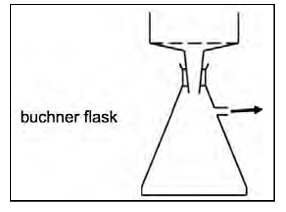
buchner flask set up
place circle of filter paper into a buchner funnel and place in a stopper in a buchner flask
connect buchner flask to a suction pump
pour mixture into funnel
suction draws the liquid through into the buchner flask and leaves the crude product in the filter paper
how is yield lost
crystals lost when filtering or washing
some product stays in solution after recrystallisation
other side reactions occurring
sample still wet
two ways the melting point shows a product is impure
it melts slower
its broad
why do you cool flask to room temp before the crystals are filtered
yield is lower when warm/solubility higher when warm
why are crystals compressed in the funnel ie by cork
so the air passes through the sample, rather than around it
assuming reaction goes to completion, practical reasons why % yield not 100%
sample still wet
product lost in beakers/via filtration
whys the sample dissolved in hot water
to increase yield
to ensure cyrstallisation on cooling
why is the sample dissolved hot
to remove insoluble impurities
whys it cooled in ice
to increase amount of crystals formed
role of H3PO4 and how can it be added safely
catalyst
added slowly, with stirring, to safely distribute any heat produced
what happens to the ethanoic acid formed by hydrolysis of ethanoic anhydride
ethanoic acid is miscible with water, so it will be in the filtrate
preparing aspirin equation
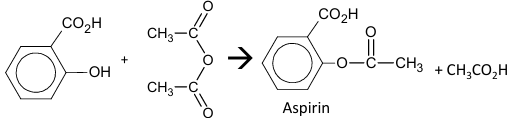
preparing aspirin
reflux - both reactants and H3PO4
put in beaker with cold water and cool
suction filtration
recrystallisation
record solid mass
selecting a heating oil
in exam, can say oil bath
needs to have a bp higher then the samples mp, and low flammability
benefits of an electric heater
allows for controlled heating
stops flammable vapour lighting
whys pressure noted when measuring bp to determine liquid purity
because changing pressure can change the boiling point of a liquid