Environmental archaeology final exam
 Call Kai
 Learn
Learn Practice Test
 Spaced Repetition
 Match
Match Flashcards
 Knowt Play
1/86

There's no tags or description
Looks like no tags are added yet.
Name | Mastery | Learn | Test | Matching | Spaced | Call with Kai |
|---|
No analytics yet
Send a link to your students to track their progress
87 Terms
zooarchaeology
study of animals as they relate to the archaeological record
uses animal remains to study the relationship between people and animals in the past
combination of paleontology and archaeology
zooarchaeology vs. archaeozoology
zooarchaeology: emphasis on people first, how did people use animals
archaeozoology: emphasis on animals first, what animals were present, paloecology
faunal analysis
study of bones from archaeological site
bones and their analysis come first then broader research questions
looking at taphonomic processes from living populations to recovery and reporting
why is taphonomy important
need to understand how bones are modified through many different agents to get to human modification and usage
human vs non-human modifications
need taphonomy to distinguish human vs non-human modifications
more appropriately food usage vs other modifications
look for specific marks and signs of alteration
cut marks, burning, weathering, fracturing
cut marks and other abrasions
cut marks with stone tools leave a distinctive patterning
V-shaped, repeated strokes in same direction
feathering diverging ends
other abrasion causes
wind abrasions
non-human causes during animal’s life
plow scarring
scavenger gnawing
burning
burned and charred bone
black or dark grey
fires from 200 - 400 C
calcined bone
white to blue
fires over 400 C
unaltered bone
brown/tan, sometimes blackish mineral deposits
fires under 200 C
bone fracturing
need to distinguish between fresh and dry fractures
fresh fractures
obtuse or acute edges
rarely right angles
helical in shape
dry fractures
right angles
crumbly and irregular along edges
longitudinal or transverse in shape
identification
use comparative collection for your region
try to identify to lowest taxonomic level possible
often only possible to give class and size
also may try to age and sex individuals
quantification
NISP: number of identifiable/individual specimens
MNI: minimum number of individuals
weight = weight of specimens by taxa and/or part
animal resource management
hunting and fishing can directly affect prey ecology and populations
can determine human selection or not based on prey profile
can also offer sustainability models
human role in extirpation or extinction
megafauna overkill
idea that when humans spread around the globe they were responsible for the extinction of large land animals
assume bigger game would be more targeted
supported in some areas not others
north american megafauna overkill
48 large mammal species in Pleistocene, 36 extinct by Holocene
close timing between human arrival and extinction led by overkill hypothesis
but not much actual evidence for human hunting of megafauna
pleistocene rewilding
based on megafauna overkill hypothesis
north american environment adapted to Pleistocene fauna that humans wiped out
after extinction important niches left unoccupied
need to reintroduce analogous species to increase sustainability
moa in new zealand
moa were a large, flightless bird extinct shortly after human arrival
human arrival circa 1300 AD
extinct by mid 1400s AD
evidence for predation of moa and their eggs
Haast’s eagle also went extinct
antelope in the levant
humans also likely extirpated antelope from the levant
antelope kites led to mass herd level kills
no sign of preferential killing (all ages and sexes)
selecting only best cuts
overhunting and resource depression
intense predation can impact prey species
change in size, change in abundance, change in age/sex profiles, end point: extinction/extirpation or domestication
mass hunting but not overkill
Mass hunting does not necessarily lead to overkill even with mammals, bison jumps are archaeological sites with evidence for the mass killing of bison, basically entire herds were driven off a cliff to their death by native people who would harvest meat from them for consumption, numerous examples of this
Also evidence for game traps similar to antelope kites, the walls were used for buffalo and antelopes, also maybe elk. Also evidence that native people in the northeast cleared the underbrush up to a certain point in forests but would leave heavy underbrush in some places to drive herds of deer into; not sure if there is good evidence for this impacting populations but clearly did not lead to extirpation or extinction
sustainable fishing
herring fishing amongst the Coast Salish to manage populations which were more abundant
kelp gardens to keep population high but still harvesting more than enough food
managed kelp gardens to catch large amounts of fish
did not harvest all roe or all fish
can help to show levels of fish prior to colonial over fishing and more sustainable practices
more sustainable practices for herring
agriculture and hunting
agriculture creates new niches
deer, rabbits, rodents, birds
greater exploitation of garden attracted animals
agriculture may have led to loss of habitat for other animals or groups of people
social elements of hunting
humans hunt primarily in groups, which allows for killing of larger prey or more animals
hunting is a social activity
whole animal butchering could indicate resource stress but may see only high valued parts being taken back to other locations
hunting may be gained social status
can determine which parts are more valued and who gets them
after domestication hunting moves from necessity to prestige
seasonality
when was a site occupied at the most basic level and for how long
what were people’s subsistence strategy was (were they moving throughout the year to be nearer to ripening or spawning or just generally in season plant, or relying on stored goods throughout the year)
seasonality can explain community organization - were people dispersing into smaller units during the winter or vice versa
how were people exploiting the environment throughout the year
how much food they were harvesting or growing
how do archaeologists study seasonality
generally food remains most helpful - most reflective of actual seasons and what people had access to
zooarchaeology better paleoethnobotonay
plant resources more storable than animal resources
any plant can be stored for a long time, so finding these resources is not necessarily indicative of the time a year a site was occupied since it is much easier to transport dried plants
animal resources can be stored for a long period of time as well, but you are generally not transporting the bones to the next site, so it is less likely for archaeologists to recover the bones
seasonality and paleoethnobotany
how do we use food resources to study seasonality
ripening schedule most important with plants
storability and processing of plant
general storage patterns and movement patterns
you would need to know the above to analyze the past
good to know how frequently people were moving their camps
these questions make determining seasonality from plant remains difficult but not impossible to determine a lot more variables at play, this is why animal remains can be better
shawnee minisink, hawthorn plums, seasonality
•Shawnee Minisink is located in the Upper Delaware Valley
•Large Paleoindian (14,000 to 11,000 years ago) encampment
•Hearth contained numerous Hawthorn plum pits dating to approximately 13,000 years ago
•Assumed to be fall encampment for Hawthorn plum and maybe fish or shellfish harvesting
animals and seasonality
•although seasonality can be determined from plants in some cases you need to be more careful when using it becaus there are many more factors that can go into the seasonality of an occupation - especially when agriculture is introduced - many more factors come into play when determining seasonality
Stored meat unlikely to be transported on the bone, so animals present less of an issue
AND
•Many animals produce growth structures that vary by season
•Cementum on teeth
•Seasonal Growth Structures
•Mollusk Shells Growth Increments
•Juvenile growth patterns
•Migrations
Dental cementum
method for determining the season in which an animal was killed is to examine the dental cemetum
•Anchors tooth into root
•Deposited throughout lifetime with different seasonal growth rates
•Similar to tree rings
•Wider bands in warmer months, narrower in colder months
•Thin sectioned, stained and examined under high powered microscope
seasonal growths
some animals also produce seasonal growth structures besides cementum that can be used in determining seasonality of when an animal was killed
•Primarily Cervids
•Deer, elk, moose, caribou - deer shed their antlers in january or february after mating season
•Pronghorn too
•Growth and shedding highly scheduled by the season
•Examine frontal bones for antler development stages
mollusk and shellfish
analysis is based on primary data such as the taxonomic attribution of the animals in the study assemblage, the number of taxa present (richness), the anatomical portions represented, NISP, weight, measurements, modifcations
•Little to know preparation
•Need to be careful older shells or shells in acidic soils do not disintegrate
•Identify using reference collections and manuals
•Series of standardized measurements
•Can be correlated to growth rates and harvest patterns
mollusk shell growth pattern
•Some mollusk species grow similar to trees
growth inderminate meaning never stop growing until dead
oysters bad because no growth structures but often found with attached parasitic snail which can be used; these structures are laid down incrementally
•Clams, scallops, snails
•Ways to determine seasonality
•Examining incremental growth structures under microscope
•Size
•Isotopic analysis
growth is not constant - responds to tidal, daily seasonal, and annual rhythms, stress
fish otoliths
•Fish ear growths (aragonitic ear structures)
•Distinctive and identifiable to fish species
•Grow seasonally in fish
•Can be used to determine age
•Age profiles also useful in determining harvest patterns and population stress
•Also changes in climate/environment
juvenile maturity
•Animals that only produce one litter a year
•Growth is usually regular in first year
•Teeth eruptions
•Epiphyseal fusion
migration patterns
•Many economically important birds migrate throughout the year
•Ducks, geese, swans, passenger pigeons etc.
•Presence can help to indicate season
seasonality and sedentism
•Can use seasonality to determine degree of sedentism
•Differential relationship with and impacts on environment
•Year-round occupation may extract larger toll on local environment
•More mobile less extractive
seasonal resource usage
•Seasonality, foodways, and inequality
•Seasonal slaughter patterns in Colonial society
•Urban vs rural meat distribution
•Greater reliance on wild species in rural areas than urban
•Distribution changes seasonally
seasonal ceremonialism
•Shell mounds and heaps common along Atlantic and Pacific Coast
•Probably constructed seasonally
•Many over thousands of years
•Marked important places and times of seasonal gahtering
seasonality and inequality
•Urban vs rural meat distribution
•Greater reliance on wild species in rural areas than urban
•More wealth in urban areas at this time
•Not just urban vs rural
•Fish in Philadelphia
•Seasonality at Mississippian sites
seasonal resource stress
•Resource variability season-to-season can be seen archaeologically
•Bone fracture patterns in Norse Greenland vs Norse Iceland
•Greater extraction of marrow and bone grease in Greenland
•Could be tied to seasonal resource availability
seasonality and environmental reconstruction
•Incremental growth structures can record environmental change
•Oxygen isotopes and El Niño
•Oxygen isotopes recorded in fish and shellfish incremental growth structures in Peru
•Used to determine onset of El Niño
•Linked to rise of formative cultures
aquaculture
•Intentional cultivation of shellfish and fish
•Primarily shellfish like mussels, clams, and oysters
•Measured through changes to shell size
•Or lack of change
domestication in animals
•Selection of genetic, morphological or behavioral traits beneficial to humans
•Also human control over breeding and survival of domesticated species
•Humans also own these animals and familiarize themselves with them
•Continuum not a dichotomy
•Managed populations
•Tame animals
•Mutualistic relationship
•Both parties benefit from the relationship
animal vs plant domestication
•Behavior most important factor in animals domestication
•Resource potential probably most important in plants
•Some animals cannot be domesticated
•All plants in theory could probably be domesticated
morphological and genetic selection
•Smaller brain size=dumber
•Shorter limb length=can’t run as far
•Fatter=more food resources, also linked to shorter limbs and increased sedentism/lack of mobility
•Grow and reproduce more quickly
•Changes to coat color and growth
•Reduced or absent horns and tusks=less dangerous
•Neoteny=cuter and less dangerous
genetic evidence for domestication
•Tracing when and where animals first domesticated
•Reconstruct genome of both wild and domesticated versions of animals
•Often find multiple domestication events
•Dogs
pathways to domestication
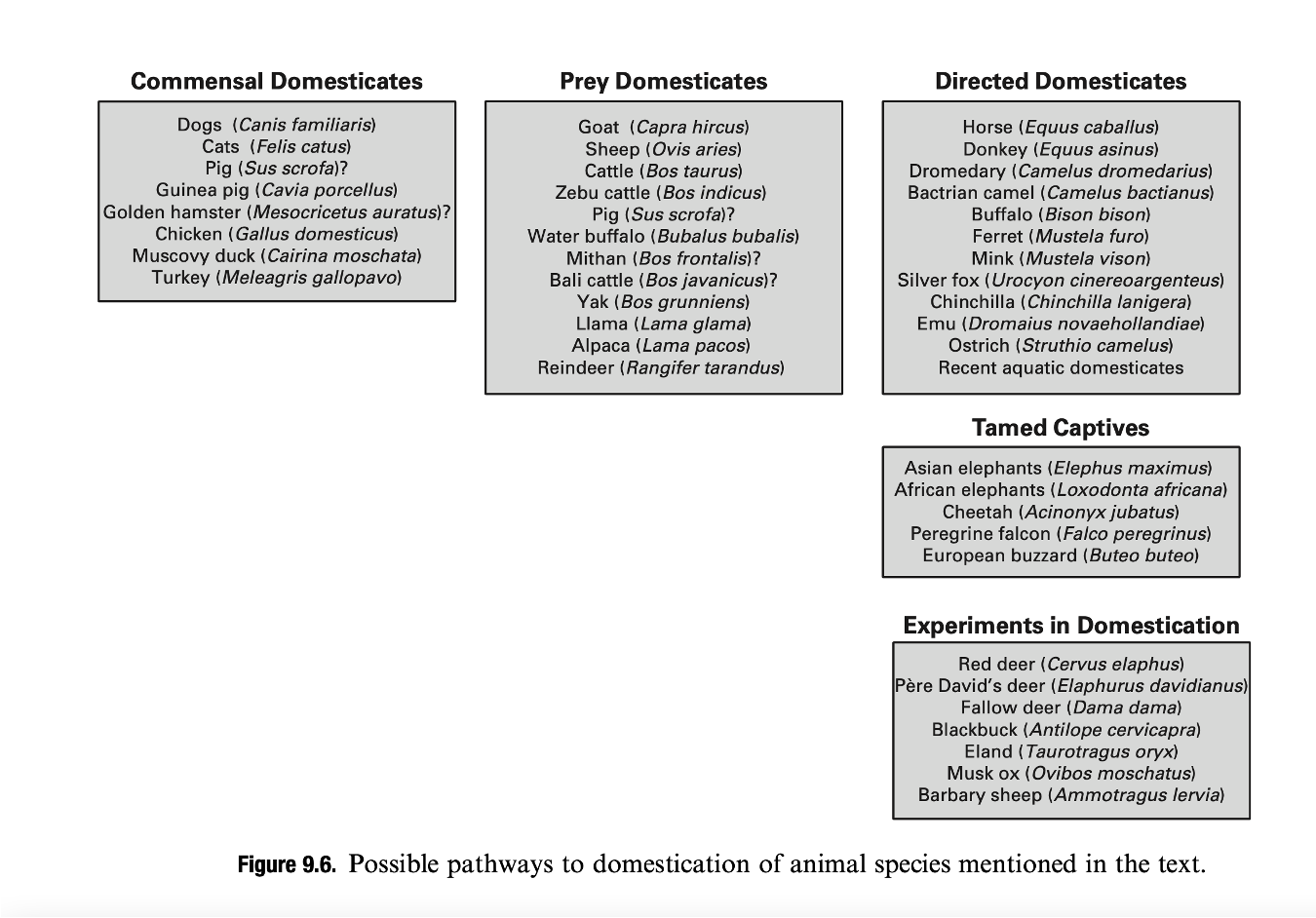
commensal pathway
•Animals attracted to human settlements for refuse scavenging or other hunting opportunities
•Eventually develop mutually beneficial, close social and economic relationship
•Two Examples: Dogs and Cats
commensal pathway: dog
•Dogs are the original and only preagricultural domesticate
•Tamer or more outcast wolves likely attracted to human settlements for food scraps
•Provide protection, companionship, and cleanup for people, eventually more tame and cuter animals selected
commensal pathway: cat
•Cats domesticated around 10,000 years ago
•Probably attracted to mice in villages attracted agricultural surplus
•Debate over level of domestication in cats
•Not as severe changes to cranial morphology
•Feral cat populations booming
•Maybe only semi-domesticated
Prey pathway
•Most major livestock species
•Human initiated management from prey populations
•Shift from hunting to managing herds (selected hunting) to control of breeding
•Behavior is a large factor in domestication of these animals
prey pathway: goats
•Domesticated in the Near East (Zagros Mountains) or Anatolia
•Likely transitioned from just prey to being herded 12-13000 years ago with managed hunting
•People likely had genetic impact from the management even before morphological changes appeared
Directed pathway
•Latest pathway exploited by people, probably after other domesticates used or even on domesticated species
•Focused on secondary and work resources
•Actively managing and selective breeding of species with directed goal likely
•None of the tradition morphological markers are found in directed pathways
directed pathway: horses
•Domesticated on Eurasian Steppe multiple times
•No clear morphological changes
•No clear age or sex selection patterns either
•Wild horses likely captured and tamed and bred for specific traits
farming without domestication
•Shellfish, especially oysters
•Sterile
•Dependent on humans for protection
•Farmed
•But are they domesticated?
•Deer herd domestication/farming
why domestication
•allowed for people to be able to obtain
Primary Products
•Meat, blood, fat, hides, horns
•Secondary Products:
•Milk, Wool, Feathers, Eggs, Dung
•Work:
•Pull/Carry Plow, Cart, Load, Person
primary product domestication
•Goats: Meat (also milk but primarily meat)
•Cows (?): meat during prey pathway phase of domestication for some species
•Sheep (?): likely meat during the prey pathway phase of domestication
•Pig: Meat
•Fowl(?): Maybe meat at first but also eggs
secondary product domestication
•Sheep(?): Wool during direct pathway phase of domestication
•Cows (?): Milk during direct pathway phase of domestication
•Alpaca: Fur coat (although also some meat)
•Turkey (?): Eggs and feathers may have been primary reason but also meat
•Other fowls (?): Eggs likely important domestication factor
work
•Dogs: Hunting, sled pulling, protection
•Cats: Protection of stored grain
•Llamas: Probably meat originally but important for load carrying at certain points
•Horses: Transportation, Plowing
•Cows: Plowing (during direct pathway phase of domestication)
archaeological signals of domestication
•Direct:
• Bone changes in the shape and proportion of some skull traits
• Body size changes as humans select for growth rates, proportion
• Age and sex proportions in herd
•Indirect:
• Architecture: corrals, sheds, fodder storage
• Soil changes: the archaeology of dung
• Context: burials of whole animals, artistic renderings of animals
controlled by humans
pastoralism
•Many animal domestications linked to agriculture/plant domestication
•But not all!
•Pastoralism= raising animals in without use of agriculture, generally highly mobile
Pastoralism Environmental Impact
•Extirpation of wild species to make room for pastoral animals
•Expansion of grasslands and desertification(?)
•Not as severe as agriculture though
agricultural expansion and animals
•Domesticated animals played large role in expansion of agriculture
•Increase in arable land
•Field clearance
•Transportation
•Fertilizer and Fuel
•Animals encouraging plant domestication
•Llama and potatoes and quinoa
food security
•Domesticated animals did increase food security
•Milk and eggs especially
•But also meat
•Age and sex profiles key in looking for secondary resource importance
•Also can see status through distribution of animal parts
disease transfer
•Domesticated animals are major pathway of disease into humans
•Tuberculosis
•Brucellosis
•Small Pox
how is global warming created
•Livestock major source of greenhouse gas emissions
•Cows and other livestock produce methane largely emitted by belching
•Also being fed farmed products
•Farming is also major greenhouse gas source
global warming and shellfish
•Shellfish farming can help combat global warming and pollution
•Sequester carbon
•Little to no carbon emission
•Habitat protection
•Clean up waters
geoarchaeology
•Stratigraphy and Pedogenesis
•Environmental Reconstruction and Human Impacts
•Climate Change
•Meaning in the environment
•Sourcing Studies
•Trade and movement
•Remote Sensing
•Landscape Modification
paleoethnobotany
•Seeds and Nuts
•Domestication
•Wood charcoal and Dung
•Forest and land management practices
•Microbotanical remains
•Environmental Reconstruction
•Missing food pieces
•Agricultural field relocation
zooarchaeology
•Hunting
•Overhunting and resource management
•Domestication
•Land impacts
•Adverse affects
•Seasonality
•Sedentism
•Inequality
•Environmental reconstruction
what can we learn by combining methods
•Reconstructing foodways and daily practice
•Habitus
•Foodways and impact on environment
•Environmental reconstruction and human impacts
•Climate change or people changing climate?
•Modern impacts
habitus
•Sociological concept comprising socially engrained habits, skills, conceptions, practices etc.
•That which we take for granted or assume to be true because of our background
•Agency back to people but assumed norms
daily practices
•Why focus on routine practices surrounding food in particular?
•Daily practices more likely to shape environment or landscape
•Small scale events pile up for big impact
•And more closely related to environmental perceptions
foodways reconstruction
•Subsistence farming economies centered around food production
•Even true in societies with more craft specialization
•Biggest impact on environmental systems is food production
•Definitely in the past
•Still partially true today too
foodways reconstruction
•Production
•Agricultural fields and pasture lands
•Geoarchaeology- field locations, size and structure
•Paleoethnobotany- what was being grown, what was replaced
•Zooarchaeology- what animals were being raised
•Wild resources too!
•Processing and storage
•Mostly on rooftops or away from homes
•Storage at household, not for full year
•Cooking
•Conducted at household level
•Varied by season
combined envrionmental reconstruction
•Can be done with just one method
•Geoarchaeology: flood regimes, coastline change, other climate proxies
•Paleoethnobotany: plant community reconstruction, fire regimes
•Zooarchaeology: Faunal community reconstructions, incremental growth structures
•More powerful when combined!
yellow river valley
•Tracking environmental change in region over 6,000+ year period
•Changes in dynastic rule often attributed to environmental factors
•But environmental change in region was almost wholly anthropogenic
•Site/local-8000-5000 years ago
•Changing landcover
•Tied to swidden agriculture and millet production
•Eventually caused increased flooding in region
•Tributary/regional→ 5000 to 2200 BP
•River basin wide → 2200-2000 years ago onward
archaeology and the modern world
•Is archaeology for archaeology’s sake still viable in the modern world?
•If not, what can archaeology contribute to the modern world?
archaeology and the experience economy
•Archaeology still of interest to people in the modern world
•But not the sides of archaeology we wish were!
•Discipline needs to cater more toward public interests than academic ones
•Extreme example although not entirely wrong
•Depends on how you define the public
what else can archaeology contribute
•Understanding human-environment interactions!
•In the past and present
•Food security
•Long-term environmental and landcover change
food insecurity
•Food insecurity=insufficient food resource, linked to persistent poverty
•Common narrative focuses on climate
•Primarily drought
•Actual causes are colonialism and global economic systems
bali and green revolution
•Complex system of rise paddies dictating when to plant and harvest rice
•Guided by Water Temple system
•Abandoned by Indonesian during Green Revolution
•Led to massive crop failure
•Return to system has led to return to improved yields
indigenous agricultural systems
•Traditional, Indigenous farming systems more sustainable than modern farming methods
•Locally adapted
•More diverse diets
•Improve food security
•Improve biodiversity
•Only 10 million hectares worldwide
•Archaeology can help reestablish these practices where lost
raised fields
•Raised fields in Lake Titicaca basin completely abandoned after
•Food insecurity very high in region
•Reconstructed raised fields averaged about 2.5x more potatoes per year than average
three sisters productivity
•Historical accounts document 40 bushels of maize per acre
•European farmers similar yields by the 1950s
•Experimental results found 50-75 bushels may be more accurate
•Not to mention beans and squash!
•Archaeology can help map these systems and show other foods
archaeology and environmental reconstruction
•Improving scale of environmental reconstructions
•Smaller time and areal scale
•Good for areas with limited environmental proxies
•Can better input human impacts into these systems
•Environmental change vs human impact on environment
•Needed to help model future change
landcover change and people
•Mapping land cover change globally
•Human induced landcover change
•Agriculture, pastoralism, etc.
•Landcover changes affect environment on global scale
•Reduced or increased biodiversity
•Water and Air Quality
•Climate through land-atmosphere interactions
defining the anthropocene
•Generally tied to Industrial Revolution
•Highly Eurocentric
•Archaeology complicates this picture
•“Wherever humans have trodden, the natural environ- ment is somehow different, sometimes in barely perceptible ways, sometimes in dramatic ways"
secondary product revolution
people started using animals for secondary products
strayed away from only primary uses