Skeletal Muscles (errors)
 Call Kai
 Learn
Learn Practice Test
 Spaced Repetition
 Match
Match Flashcards
 Knowt Play
1/12

There's no tags or description
Looks like no tags are added yet.
Name | Mastery | Learn | Test | Matching | Spaced | Call with Kai |
|---|
No analytics yet
Send a link to your students to track their progress
13 Terms
Why do we need a stats tests / standard deviations / error bars?
to see if difference is significant
why does converting pyruvate to lactate allow the continued production of ATP by anaerobic respiration
reduction oxidises NADH to NAD
to reduce troise phosphate to pyruvate again
so glycolysis can continue
If theres more dehydrogenase activity, that is used in krebs cycke, in the muscle,,
there is an increase in aerobic respiration, as krebs cycle only occurs in aerobic respiration
how does higher dehydrogenase activity, occuring in the krebs cycle, make you be able to exercise for a longer period of time
more aerobic respiration produces more ATP
you can aerobically respire for longer
less lactate is built up
order of specifcation for:
sacromere
muscle filament
myofibril
muscle fibre
muscle fiber > myofibril > sarcomere > muscle filament
Hows does a decrease in pH reduce the ability of calcium ions to stimulate muscle contraction (5)
pH lowering changes the tertiary shape / structure of the Ca2+ binding sites on troponin
Ca2+ is no longer complimentary to binding sites so fewer binding sites are binded to
tropomyosin moves awsay less
fewer binding sites on actin revealed
fewer cross bridges form
Draw the structue of a myofibril
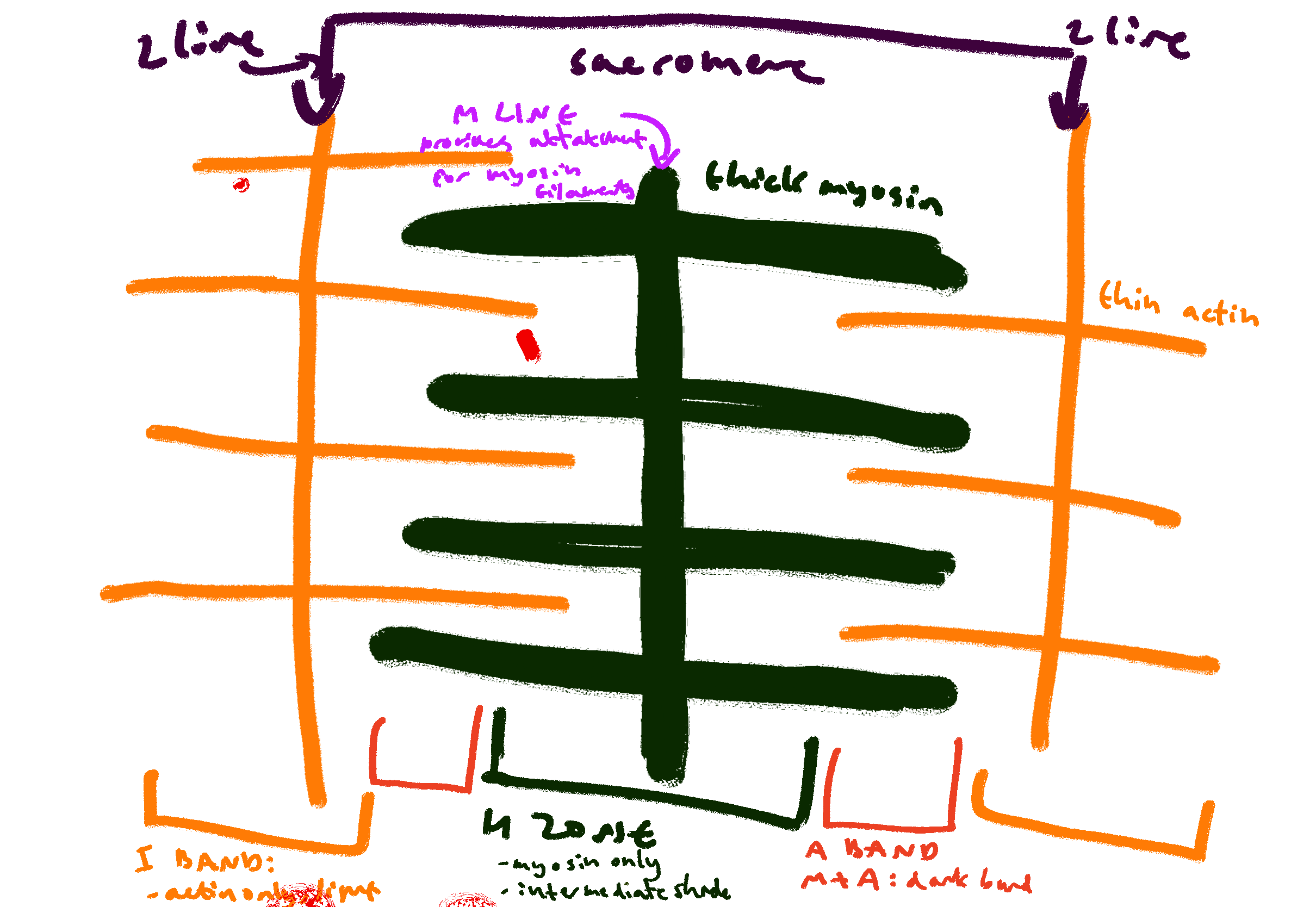
Describe initiation of muscle contraction (5)
Motor neurone releaes Ach
Ach attaches to sacrolemma receptors, depolarising sarcolemma
if threshold is reached, action potential spreads along entire muscle fibre
depolarisation spreads down T tubules
causing sacroplasmic reticulum release of Ca2+
Explain the role of Ca2+ in muscle contraction (4)
ca2+ binds to troponin
tropomyosin changes shape
exposing binding site for myosin head
to form actino-myosin crossbridges
Explain why atheletes take creatine supplements (3)
ATP combines with C to form ADP and PC (phosphocreatine) at rest
during exercise, ATP is quickly regenerated with PC and ADP
Explain carbohydrate loading
eating more carbohydrates a few days before competition
maximises glycogen storage in muscle
during events, glycogen is hydrolysed to glucose to be used in aerobic respiration
An increase in muscle activity causes increase in heart rate. describe and explain how (4)
increase in CO2 concentration of blood is detected by chemoreceptors
sends more impulses to medulla / cardiac center
increased frequency of nervous impulses along sympathetic pathway
to SAN
describe the events leading up to ca 2+ leaving the sarcoplasmic reticulum (6)
motor neurone stimulated, releasing Ach
Ach diffuses down neuromuscular junction
Ach binds to complimentart sarcolemma receptors, depolarising sarcolemma
if threshold is reachemd action potential spreads along enire muscle fibre
depolarisation spreads down T tubules
reaching sarcoplasmic reticulum