PHYS C12
 Call Kai
 Learn
Learn Practice Test
 Spaced Repetition
 Match
Match Flashcards
 Knowt Play
1/34

There's no tags or description
Looks like no tags are added yet.
Name | Mastery | Learn | Test | Matching | Spaced | Call with Kai |
|---|
No analytics yet
Send a link to your students to track their progress
35 Terms
Alternative Treatment Options
neutron generator, cyclotron, or neutron recator producing neutrons
synchroton or cyclotron generating heavy ions (protons, He, C, N)
Proton Therapy
Precise, non-invasive, non-surgical
Unlike x-rays, protons stop at tumour site, minimising damage to surrounding healthy tissue, allowing for higher doses
Fewer side effects
When is proton therapy especially useful
Treating childhood cancers, as minimising healthy tissue damage is crucial in a growing body
When/why might proton therapy not be preferred
fast-growing tumours - requires longer planning, set-up, and delivery
widespread cancer - radiation must be delivered broadly
higher cost, limited availability
Bragg Peak
proton enters tissue with high velocity
it interacts mainly with orbital electrons, losing energy through dose deposition during ionisation and excitation
Energy loss per unit distance (thus dose) inversely proportional to proton velocity
Near the end of its range, proton slows significantly, electron interaction probability increases sharply, just before stopping proton deposits lots of energy in a very short distance (Bragg peak)
After peak, proton stopped, dose drops to ~0
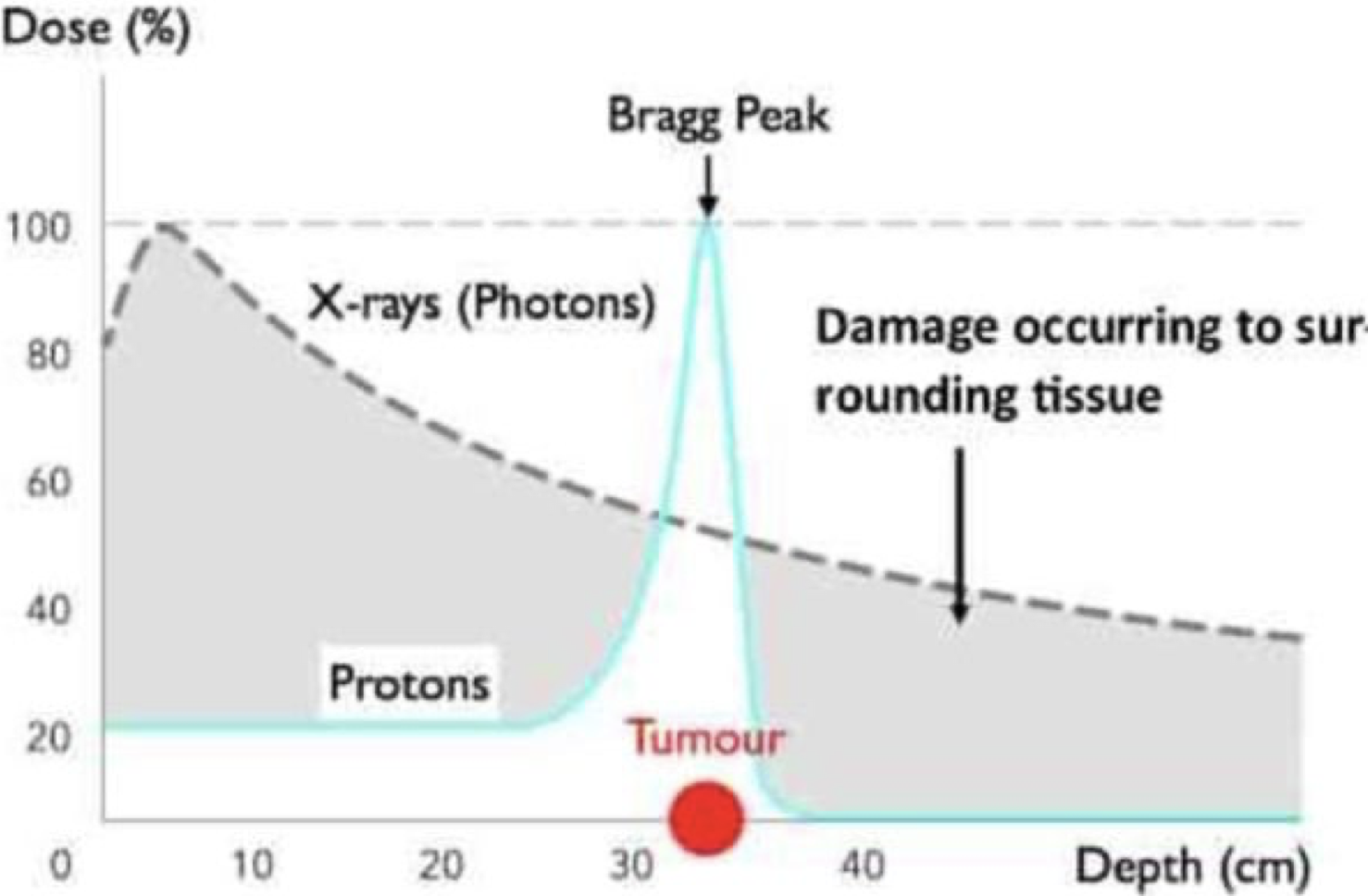
Clinical use of bragg peak
peak is positioned at tumour depth to minimize exit dose (beyond tumour)
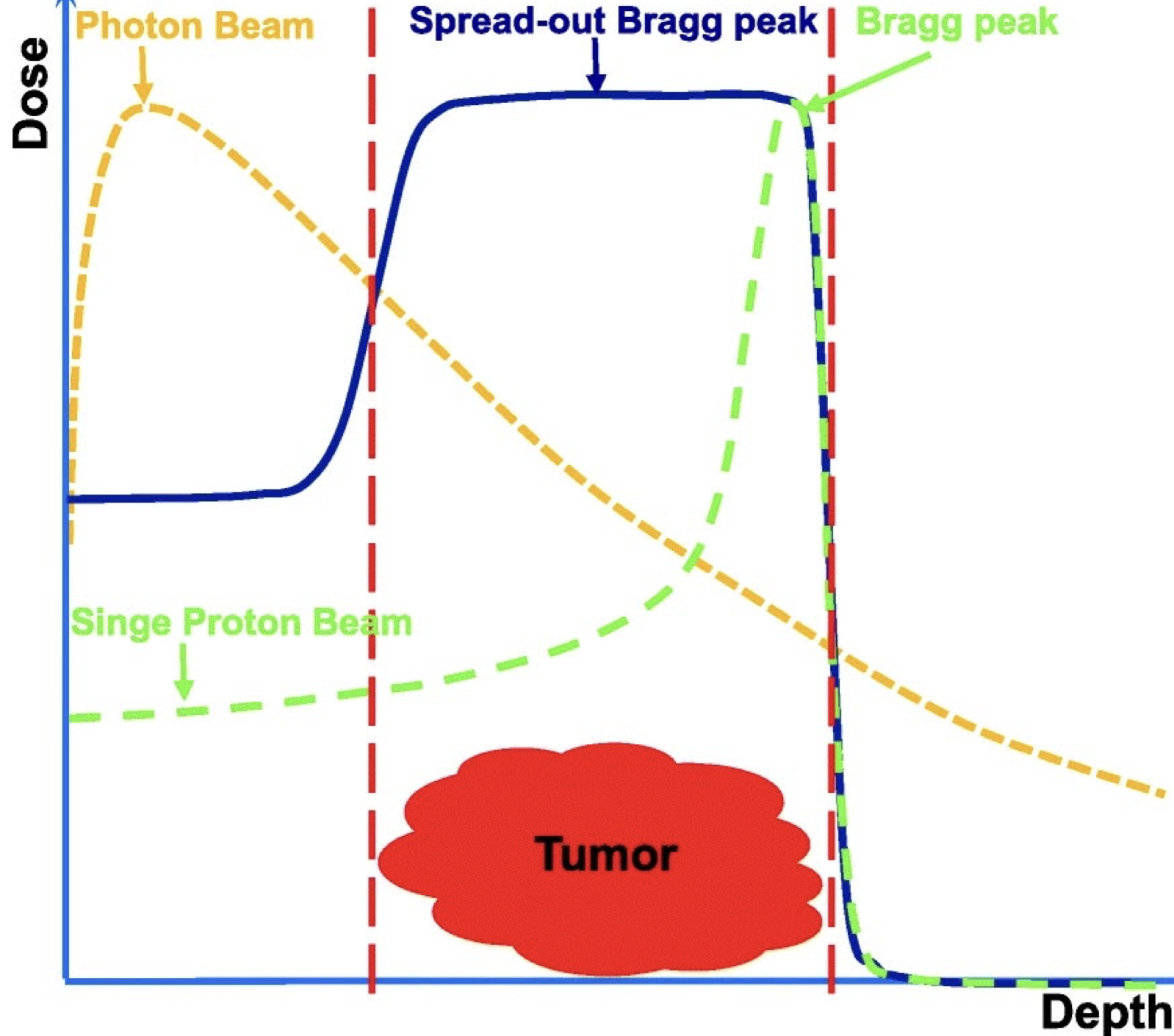
Spread-Out Bragg Peak (SOBP)
Bragg peak of monoenergetic proton targets narrow depth ranges but to treat entire tumour, bragg peak is laterally spread
Incident photon beam energy is modulated, giving multiple peaks that are super-imposed into a wide, flat plateau, increasing size of treatment field
Gives flexibility in distrubuting dose
Penumbra depends on system design and setup parameters, is it possible to shield parts of
the beams to remove low-dose 'tails'
Heavy Ion Beam Therapy
Also have Bragg peak
Higher LET, thus biological effectiveness, than protons - Beam directly cleaves DNA in multiple sites, even with low oxygen, resulting in cells being unable to repair
Higher mass limits lateral scattering
Sharper longitudinal dose fall off than protons
Nuclear interactions activate nuclei of irradiated atoms, inducing localised radioactivity that can be externally imaged for tumour and normal tissue dose verification
Heavy Ions beyond Bragg peak
near the end of their range, heavy ions come to a stop in the tumour
their biological effectiveness increases by 3-4 times due to denser ionisation
This may allow destruction of radioresistant tumours and overcome therapeutic resistance
But it also may damage healthy tissue beyond peak
Synchrotron
Microwave energy is fed into RF cavities which creates an electric field that accelerates electrons to almost speed of light
When electrons deflected by magnetic field, they emit broad spectrum of electromagnetic radiation
Particle Acceleration
Electron gun: thermionic emission from filament
Klystron: microwave RF power
Linear accelerator: RF cavities generate electric field that rapidly oscillates at exactly the correct frequency so that e- passing through cavities gain kinetic energy from electric field in forward direction (accelerated)

Booster Ring
e- gain more energy as they repeatedly circulate, passing through RF cavities in the ring
Dipole magnets bend e- into circular path
Quadrupole magnets focus beam
Magnet’s field strengths increase as electron energy increase to keep them on same circular path
operates at 3GeV in Australia
Storage Ring
where electrons circulate at constant high ebergy to be stored and used
Insertion devices produce intense x-rays
Dipole magnets bend e- into circular path
RF cavities replace energy lost by electrons
Imaging and Medical Beamline (IMBL) at Australian synchrotron
Provides dynamic, 3D, high-resolution X-ray images that reveal minute differences at air, tissue, and bone interfaces
Can visualise blood vascularisation, lung air movement, and tissue/organ structure in far greater detail than MRI
Developing new methods that could destroy whole tumours with minimal disruption to healthy tissue:
Microbeam Radiotherapy (MRT)
Stereotactic Synchrotron Radiotherapy (SSRT)
Ultra-High Dose Rate (FLASH) Radiotherapy
Proton Synchrotron
Most famous one is in CERN's accelerator complex
Accelerates protons delivered by either the Proton Synchrotron Booster or heavy ions from the Low Energy Ion Ring
Cyclotron
10-590 MeV
charged particles injected into centre of cyclotron chamber and are accelerated within electrodes called dees in a spiral path, which allows for a longer acceleration path than a straight line accelerator
Cyclotron - Ion Acceleration
Alternating RF (10-30 MHz) voltage applied to two hollow D-shaped electrodes, creating an electric field in narrow gap between them
Uniform magnetic field applied perpendicular to the dees, creating a force that bends ions into circular path
When ions reach gap, electric field is timed to accelerate them toward the opposite dee
As ions gain velocity each time they pass through gap, their orbital radius (thus spiral path) increases
Cyclotron
size of dees determines spiral path length, hence maximum attainable energy
Electric fields stays synchronised as the longer distance ions must cover counteracts their faster velocity, allowing them to always arrive at gap at same frequency
Once ions reach outer edge, they are deflected as a high-speed beam towards a target
Cyclotron - Proton beam production
If source is hydrogen gas, electric fields ionises it
Metal foil strips e- from H- ions, leaving protons
Proton beam used for clinical treatment or to bombard a target, causing nuclear reactions (p,n) that produce radionuclides, some of which are used for PET
(p,n) nuclear reactions
Incident proton ejects one or more neutrons from target nucleus to stabilise it
Target atom becomes radioisotope and its atomic number number increases by one
This is becasue neutrons are not bound by electrostatic forces, so require less energy to escape than protons

Proton Treatment - Source of beam and Room design
Cyclotron (only protons, fixed energy, smaller, lower cost) or synchrotron (protons or carbon ions, 70-250 MeV, larger, higher cost, less radiation activation in room)
1-5 treatment rooms
360° rotating gantries
2m thick concrete walls
Cyclotron: Neutron Production
used for neutron therapy when tumours resistant to x-rays and neutron radiography, which images water or lubricants inside metal parts
Cyclotron beam directed onto beryllium target mounted in rotatable isocentric gantry structure
Fast neutrons produced by either(p+Be where fast proton knocks out a neutron from Be target nucleus or d+Be where a deuteron (1 proton, 1 neutron) strikes a Be target, stripping proton and producing recoil neutron that retains some of the deuteron’s inital kinetic energy
In both processes, each neutron produced converts one Be atom to a B atom
Neutron Generator
contain compact linear particle accelerators
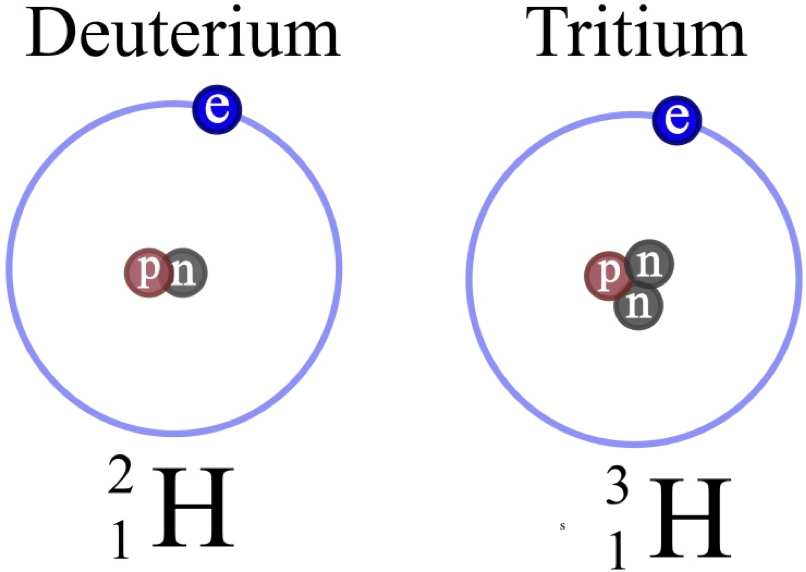
Deuterium or tritium gas is ionised
deuterium ions (deuteron), tritium ions (triton), or a mixture are accelerated by a high voltage into a negatively charged Ti or Sc target loaded with deuterium, tritium or a mixture
Fusion of two deuterons (D + D) or a deuteron and a triton (D + T) forms a Helium ion and a neutron
Nuclear Reactor
Each fission (one nucleus absorbs a neutron and becomes two smaller nuclei) event liberates ~200 MeV energy that is distributed among reaction products
Each time Uranium-235 nucelus undergoes fission, it releases 2-3 neutrons that create a self-sustained fission chain reaction
Nuclear Reactor Core Components
reactor fuel (e.g. U-235) - undergos fission when struck by a free neutron
moderator - slows fission-produced neutrons down to be reflected back into fuel, sustaining chain reaction
control rods (boron or hafnium) - absorb neutrons, their position affects the number of neutrons available to induce fission to control the fission rate
Open Pool Australian Lightwater (OPAL) Reactor Functions/Purposes
Irradiation for radioisotope production
Dopes Si for semiconductors
Delayed and prompt neutron activation analysis
Nuclear research, education, and training
Open Pool Australian Lightwater (OPAL) Reactor
operates at 20 MW power
Compact core of 4 x 4 fuel assembly array with 5 control rods, cooled with demineralised water and surrounded by a zirconium alloy vessel containing heavy water that reflects neutrons back towards core
low enriched uranium fuel
Water Phantoms
large, tissue-equivalent container filled with water
used to measure and verify radiation dose distributions
What is Dose Deposition in Water Dependant On
beam type (electron, x-ray, etc)
beam energy
field size
source-to-patient distance
Skin Sparing
Dose deposition concentrated at large depths, which allows pateint’s sensitive skin to recieve low dose
X-ray Dose Distribution
x-rays release secondary electrons, indirectly proportional to x-ray energy, which deposit dose (indirect ionisation)
dose rapidly rises until a maximum at depth of tumour, then almost exponentially decreases with depth because photon energy fluence (number of photons at given energy) decreases, causing energy and range of electrons to decrease
This delivers lower dose to patient’s highly sensitive skin (before maximum) and healthy tissue beyond tumour (after maximum)
depth of maximum dose directly proportional to beam energy
Dose Distribution for Neutron Beams
Indircet ionisation - neutrons interact with nucleus, producing protons or heavier nuclei, that deposit dose
More skin sparing than electrons, less than x-rays because recoil protons are not strongly forward-peaked and have shorter ranges, so deposit dose quicker and shallower
Dose Distribution for Electron Beams
High surface dose (very little skin sparing)
Maximum dose at short depth due to fast dose build-up, so best for superficial tumours
After dmax, dose drops rapidly due to their short range which limits dose to deep healthy tissue, and levels off at low dose Bremsstrahlung tail (x-ray contamination of beam)
Higher incident electron energy = more Bremsstrahlung contamination
Electron Beam Dose Distribution Link to Denisty
Higher density (bone) decreases dose transmission, creating under-dosage behind the bone
and potential backscatter hotspots
Lower density (lung) increases electron penetration, thus dose to underlying tissue
Dose Distributions for Heavy Charged Particle Beams
Penetrate tissue, lose energy but do not diverge from direction of motion
Range in tissue depends on incident kinetic energy and mass
Just before particle expended all of its kinetic energy, its energy loss per unit distance traveled increases drastically, resulting in high dose deposition at that depth (bragg peak)
Because of their large mass, heavy charged particles lose their kinetic energy only by interacting with target atom’s orbital electrons (not through Bremsstrahlung interactions with target nuclei)