OEB 130 Lecture 15+16 (Sensory Systems)
 Call Kai
 Learn
Learn Practice Test
 Spaced Repetition
 Match
Match Flashcards
 Knowt Play
1/73

Earn XP
Description and Tags
Midterm 2
Name | Mastery | Learn | Test | Matching | Spaced | Call with Kai |
|---|
No analytics yet
Send a link to your students to track their progress
74 Terms
What do fish need to sense, and how do they do it?
Light
Water movement, both velocity and pressure
Smell and taste
Body position/balance
Light: eyes
Water movement, both velocity and pressure: lateral line and individual neuromast sensors
Smell and taste: olfactory system (“nose”) and mouth (and body) taste buds
Body position/balance: inner ear semicircular canals and otoliths (ear stones)
Vision: main challenges
water density (bends light differently to air)
water high absorptive capacity - 10% or more lost in first meter of clear lake water
Water absorbs long wavelengths (low frequency) light more readily than short wavelengths
red vs blue in water
red drops out in shallow water blue penetrates to greatest depths
Ciliary muscle
in humans — muscle (oval in shape) changes the shape of the lens
fundamental idea of how we see
Light enters the eye and strikes the retina
What is refractive index? what is fish’s refractive index?
light bending ability of 1.65
fish vs human lens
Fish lens fixed
human lens flexible
Retractor muscles
muscles in fish that move the whole fish eye lens
Argentiniformes
A procanthopterygii
Contains Opisthoproctidae: “marine smelts” and “barreleye fishes”
Opisthoproctidae
the barrel eye fish
possibly adapted to eat crumps out of Siphonophores, but avoids stinging with eyes inside head
Siphonophores
colonial organisms in the ocean with stinging cells to capture prey, usually copepods, small crustaceans, and small fish.
Almost all species are bioluminescent.
Shark eye adaptations
Nictitating membrane —closes over eyes for protection
Tapetum lucidum – reflects light back toward the retina, to amplify vision
What does the presence of cones suggest in fish?
presence of cones suggests color vision in most fishes.
Rods are predominately in what type of fish?
predominate in deep-sea fishes
detect light intensity (brightness) → used for night vision, no color, low detail
problem of parallax
parallax refers to the apparent shift in the position of an object when viewed from two different points (in and out of water)
How do fish overcome parallax?
2 retinas and an oval lens in each eye
oval shaped to account for refractive index of water/air
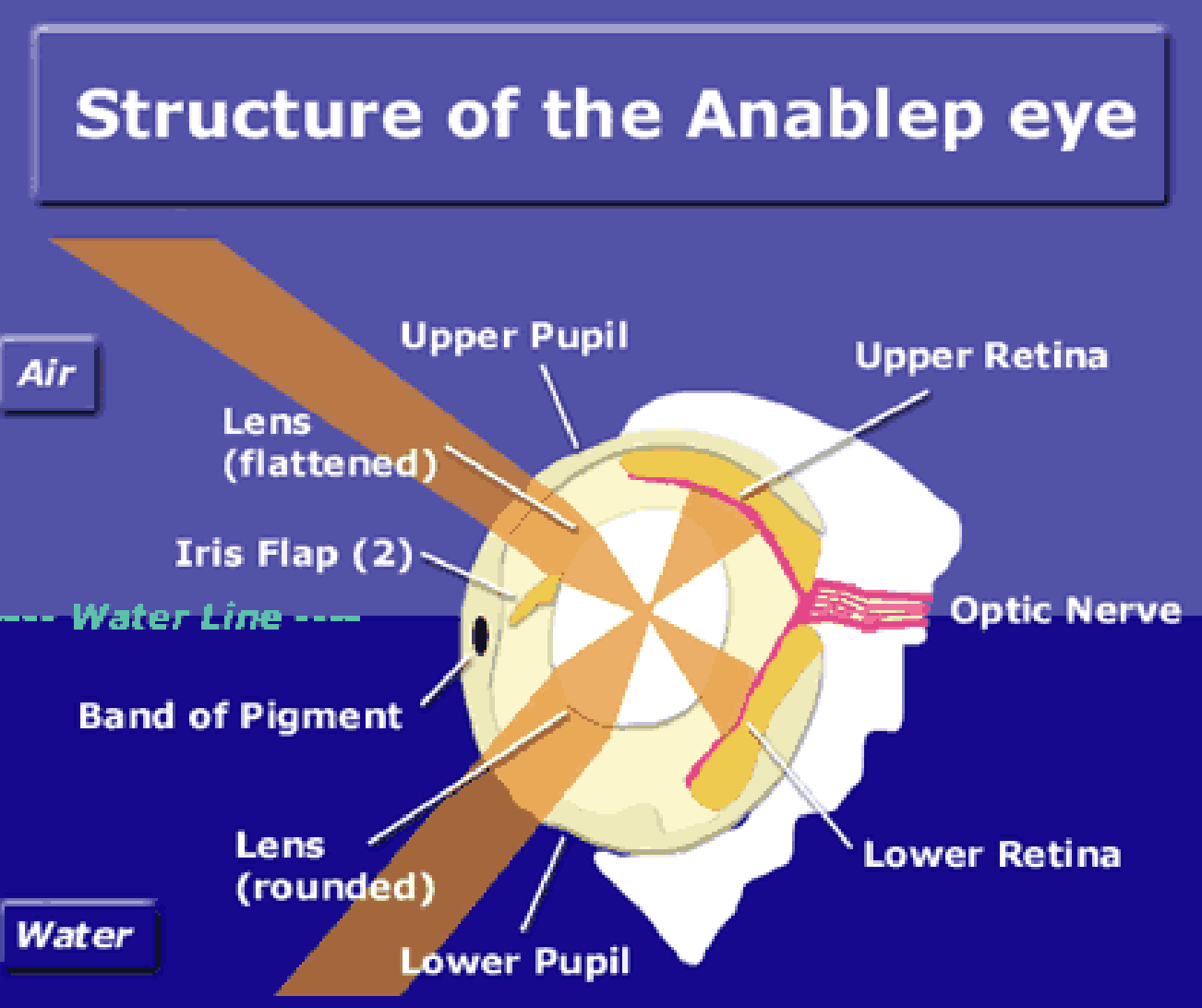
Anableps
the “four-eyed fish”
specialized eyes to overcome parallex
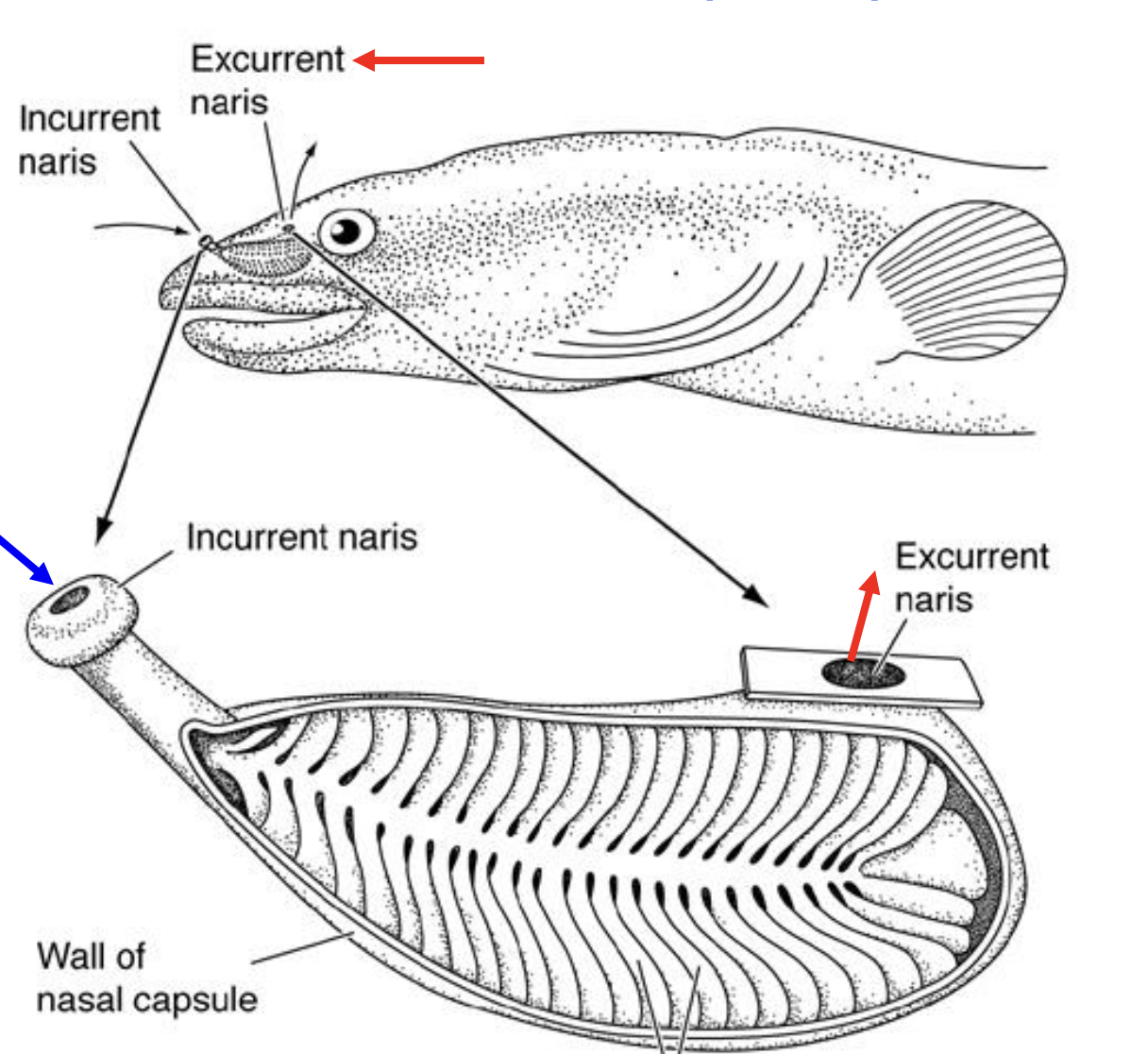
What is the olfactory rosette? What does it include?
nasal smelling system of fish which includes
plates of sensory epithelium
walls of nasal capsule
Incurrent vs excurrent nares
Incurrent vs excurrent nares
Entrance vs exit of olfactory rosette
olfaction rosette
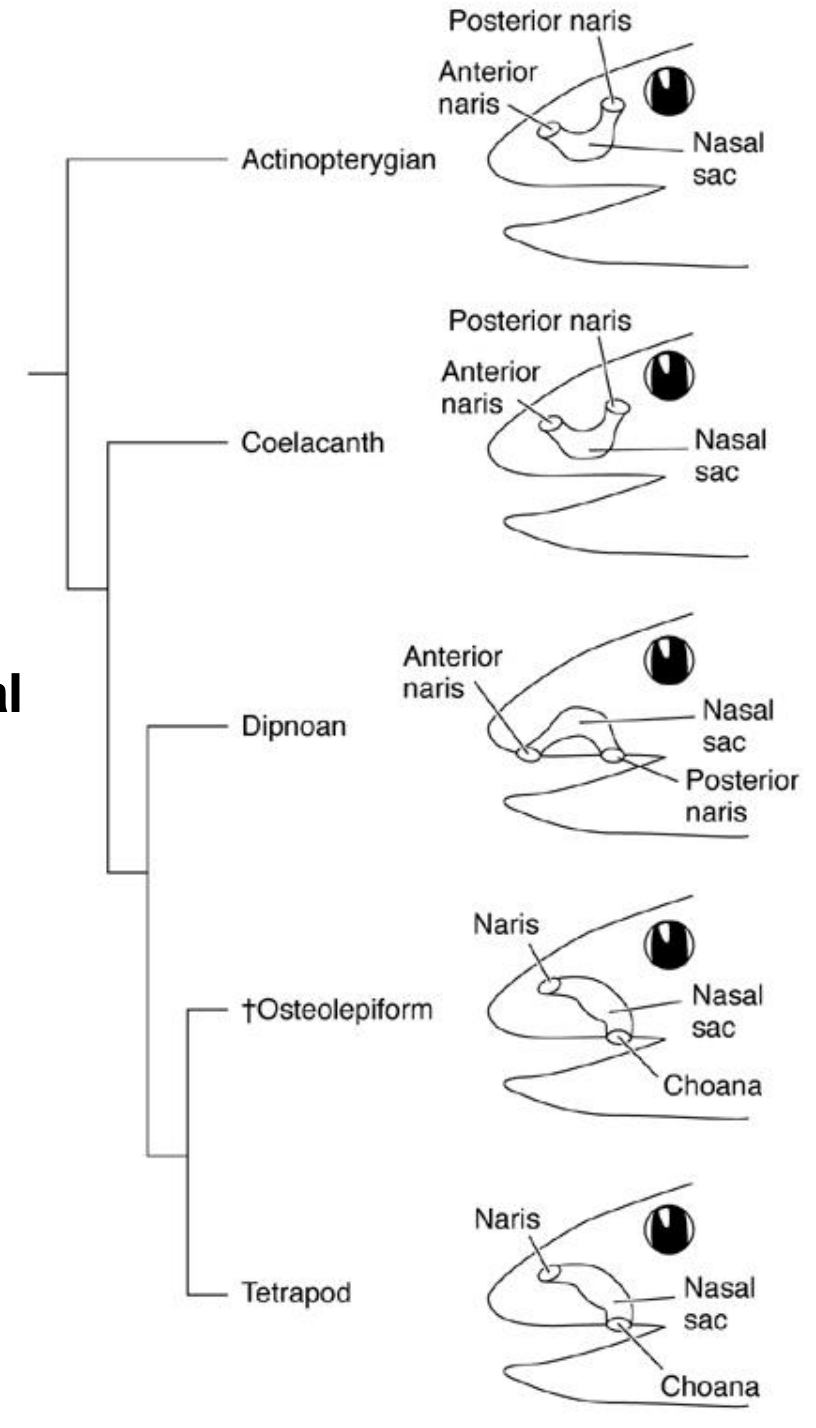
Olfaction evolution
the change from both openings external in ray-finned fishes, to one or more openings internal in sarcopterygian “fishes
chemical sensing system aka
chemosensation
chemosensation includes? How are they different?
Olfaction (smell) and Gustation (taste)
Both are part of the chemical sensing system (chemosensation), but involve different cranial nerves
how do fish tastebuds differ
taste buds located all over the body
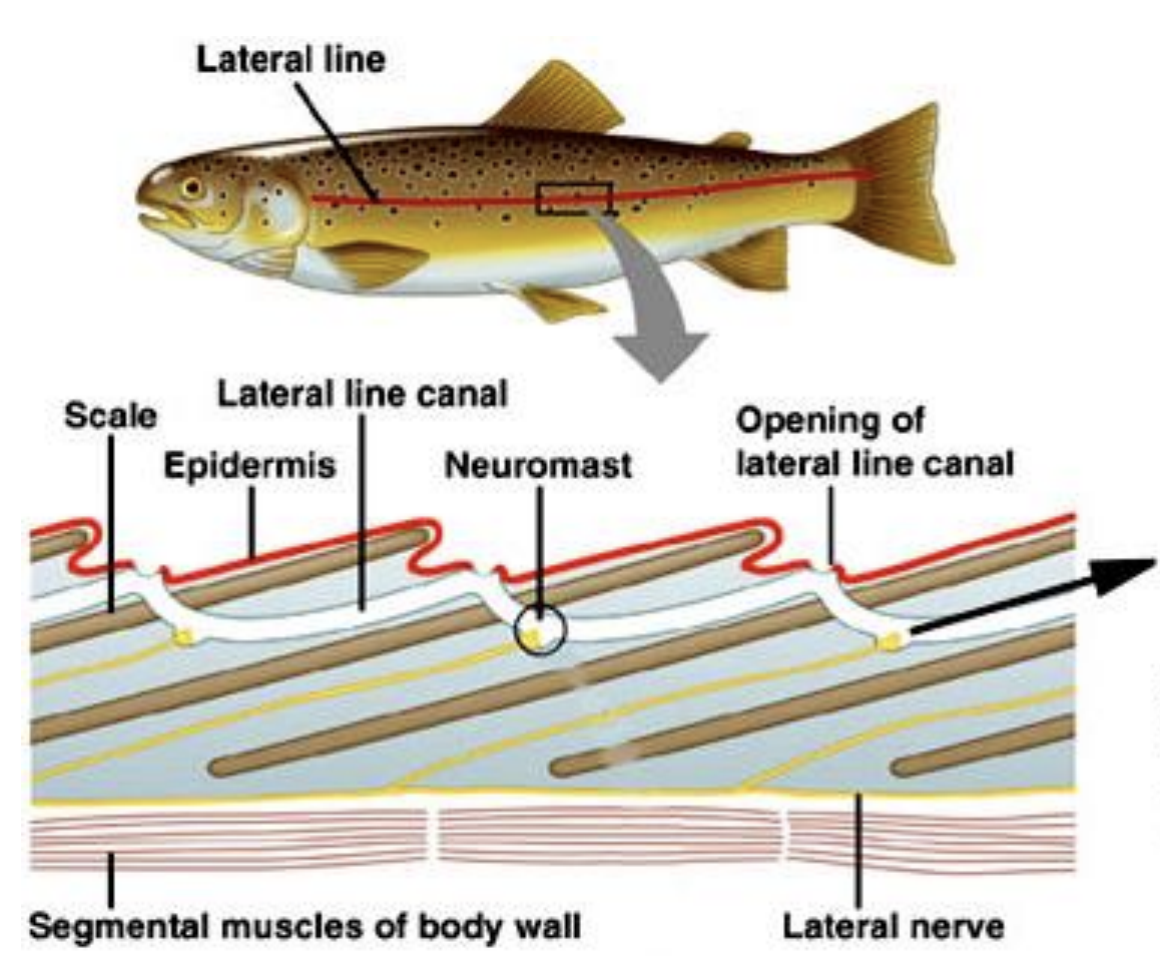
The lateral line senses water flow:
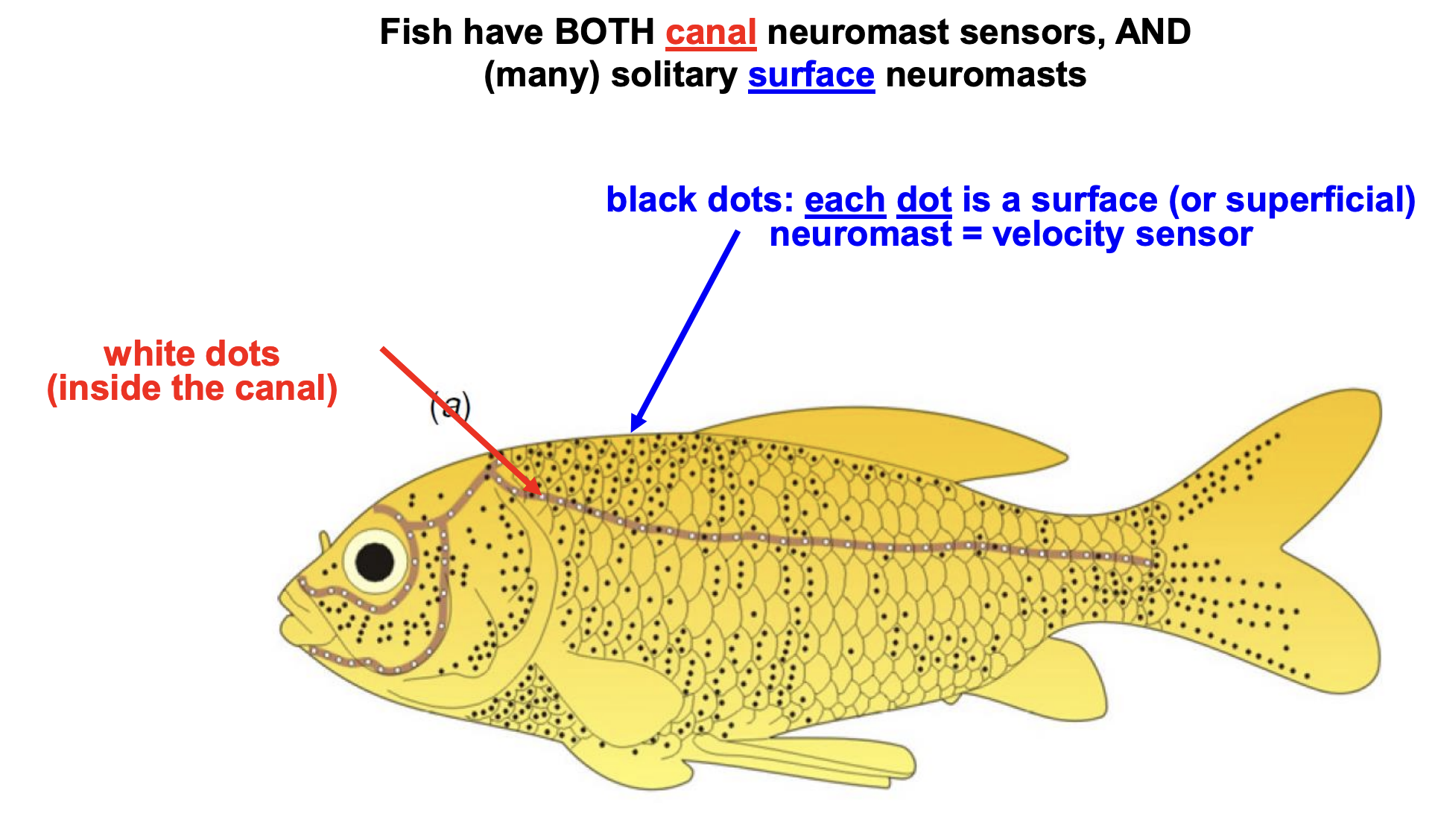
-- surface sensors detect velocity
-- canal sensors detect pressure differences
Lateral lines contain:
pore to canal
and Trunk canal
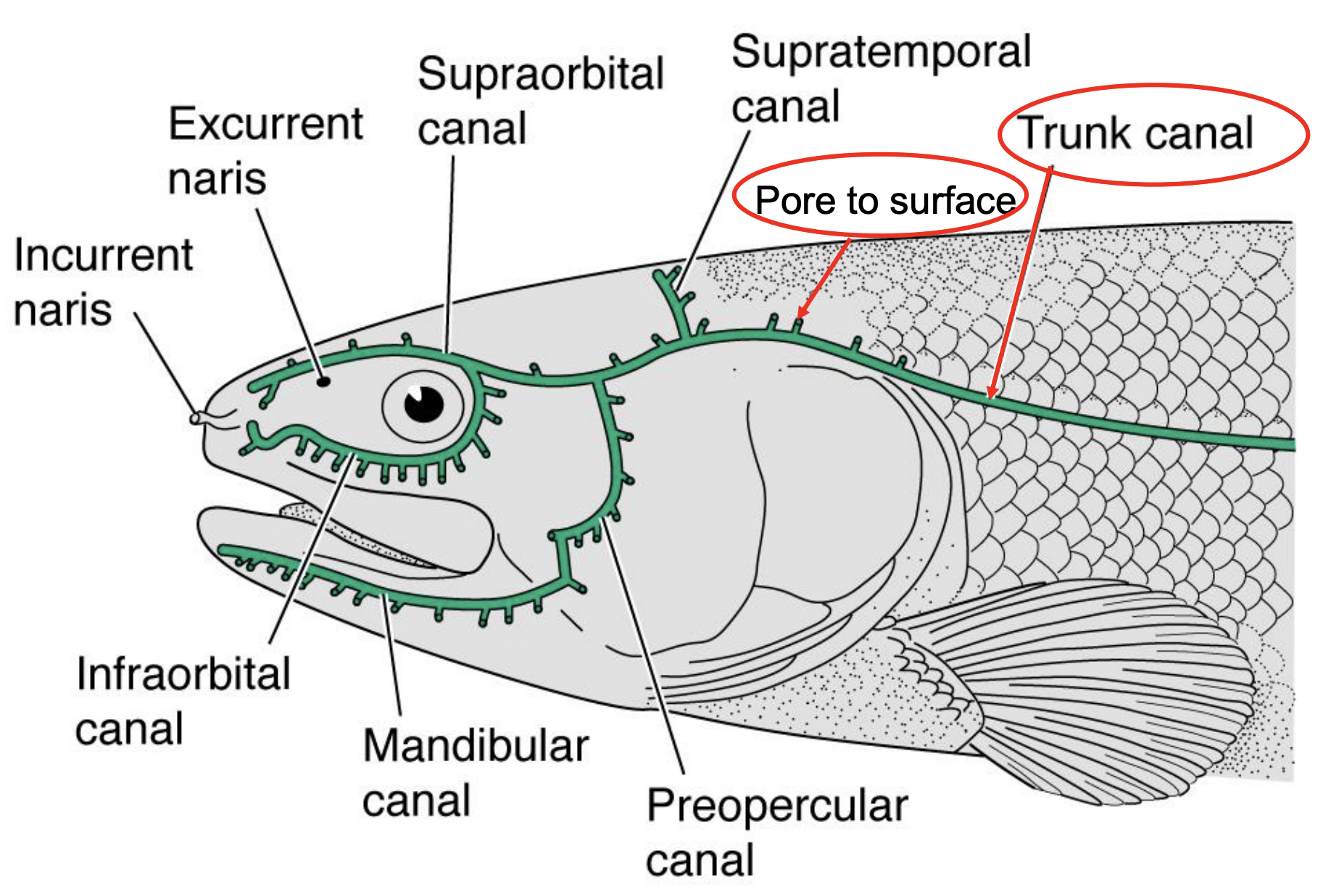
Surface velocity sensors
Lateral line canal structure
Flow sensing is based
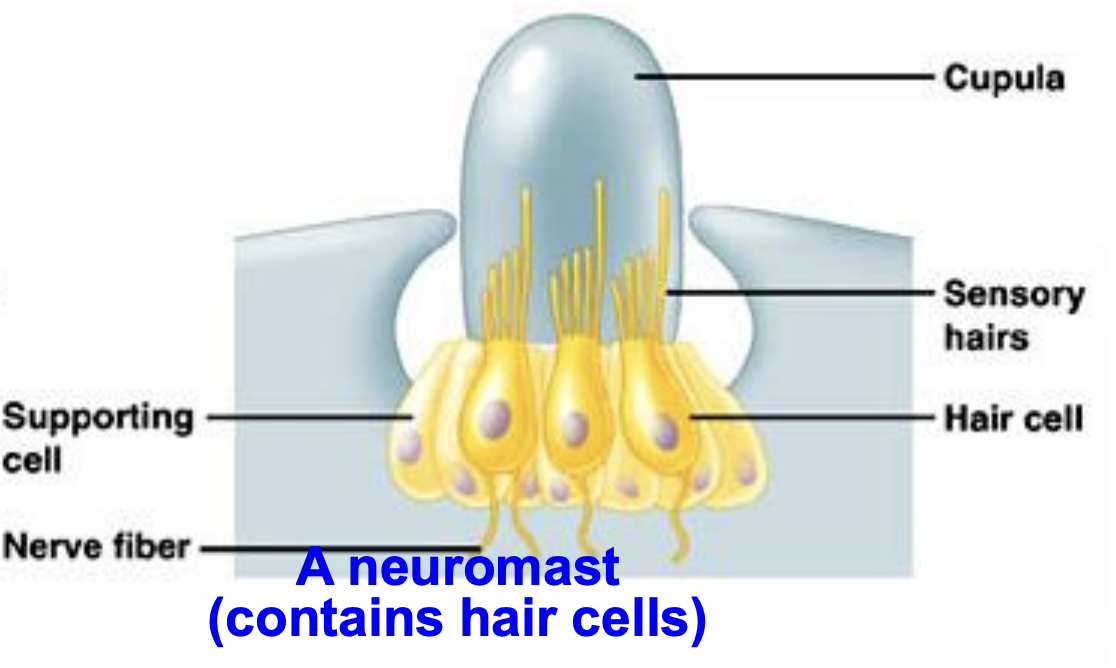
Flow sensing is based on neuromasts which contain multiple sensory hair cells
superficial vs canal neuromast
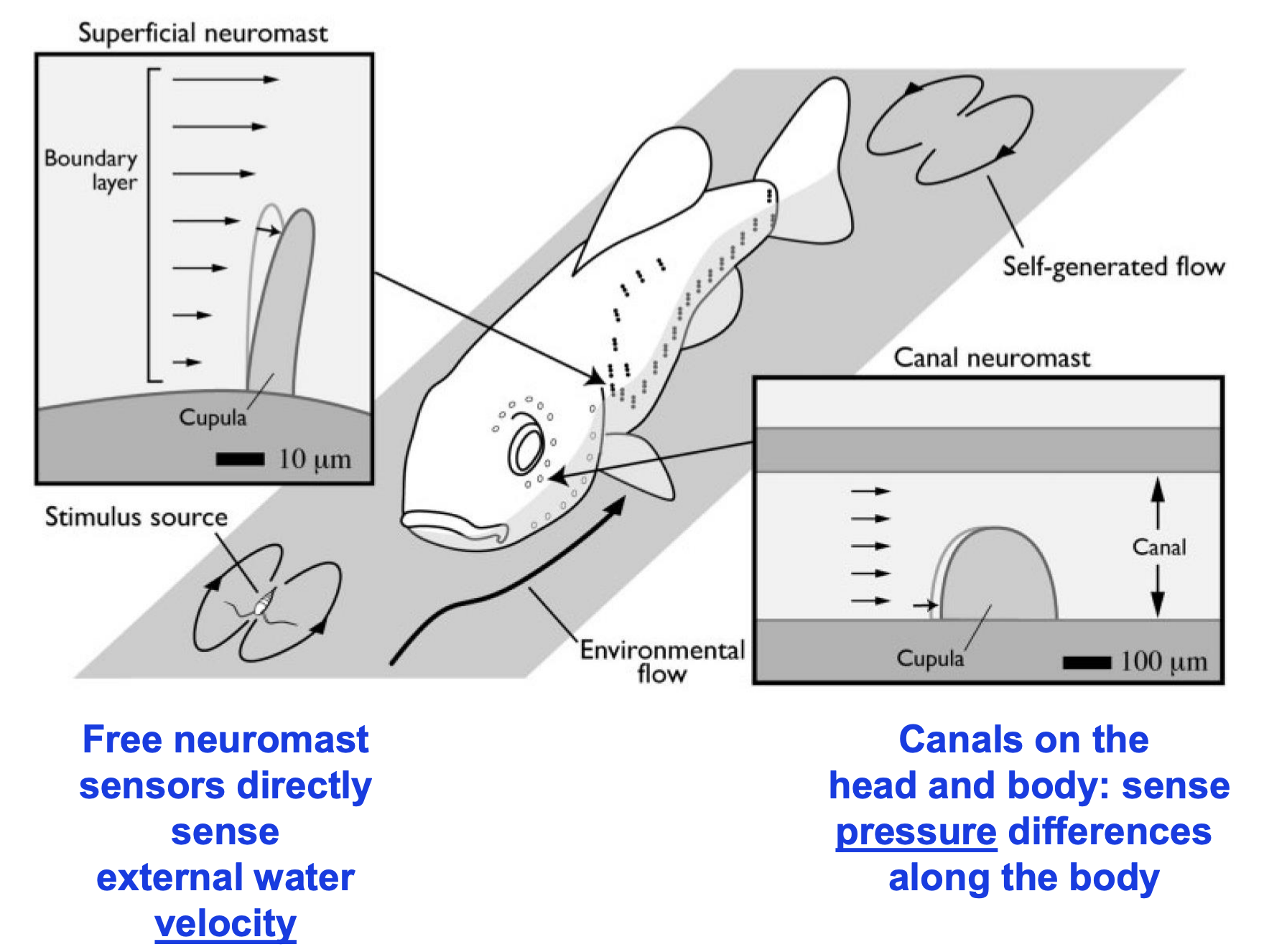
schematic of velocity vs pressure sensors on fish
The tail of rays is a hydrodynamic antenna means that
tails can sense pressure and velocity
Balance relies on:
the inner ear and otoliths
is used for balance, and senses head/body position and acceleration
Inner ear of a teleost fish contains
three looping hollow canals
three “ear stones” = otoliths inside three sacks
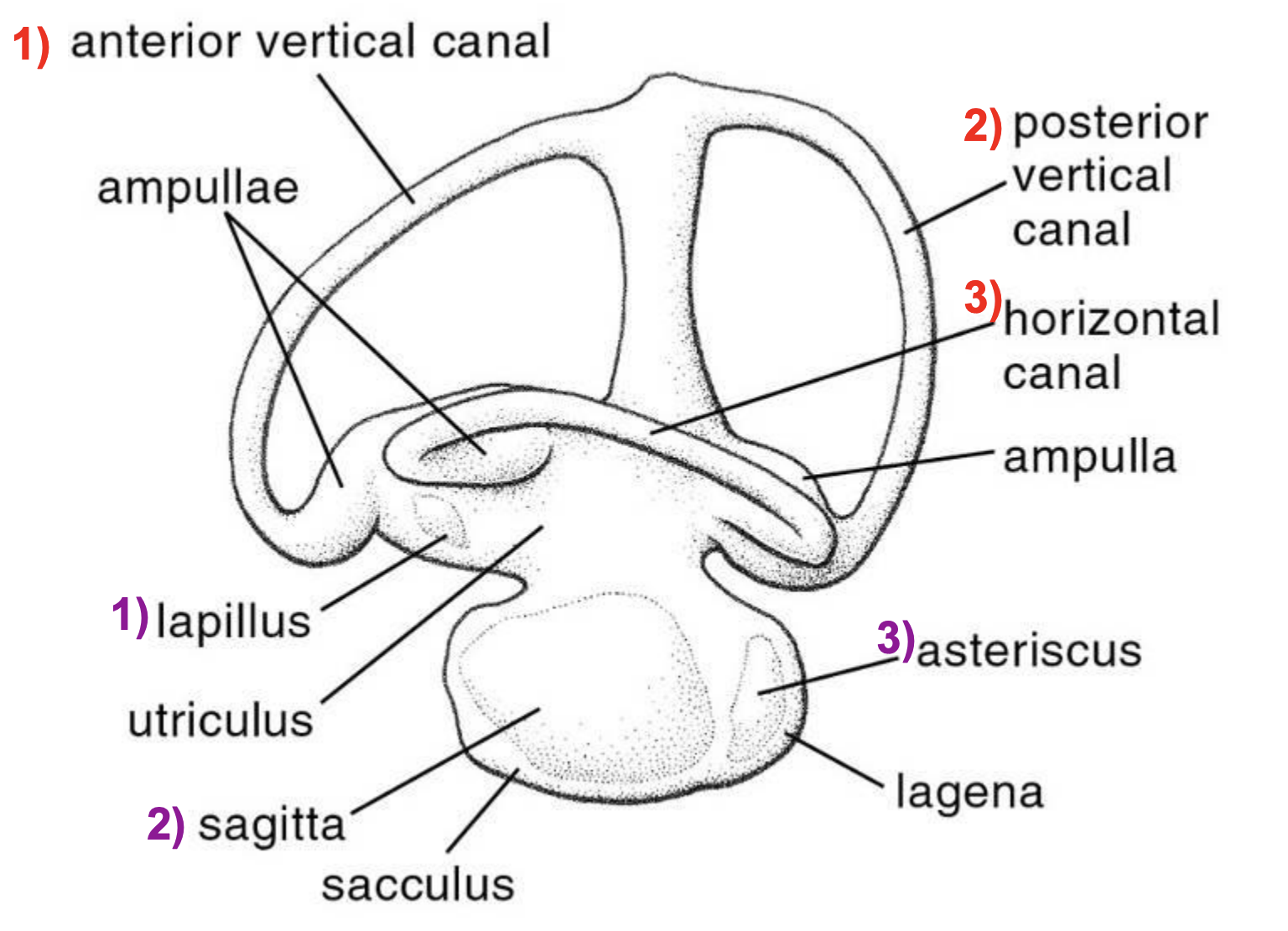
three looping hollow canals
anterior vertical canal, posterior vertical canal, horizontal canal
three “ear stones” = otoliths inside three sacks
sagitta, lapillus, asteriscus are otoliths that sit inside three sacs
The three semi-circular canals allow fish
to sense acceleration of the body
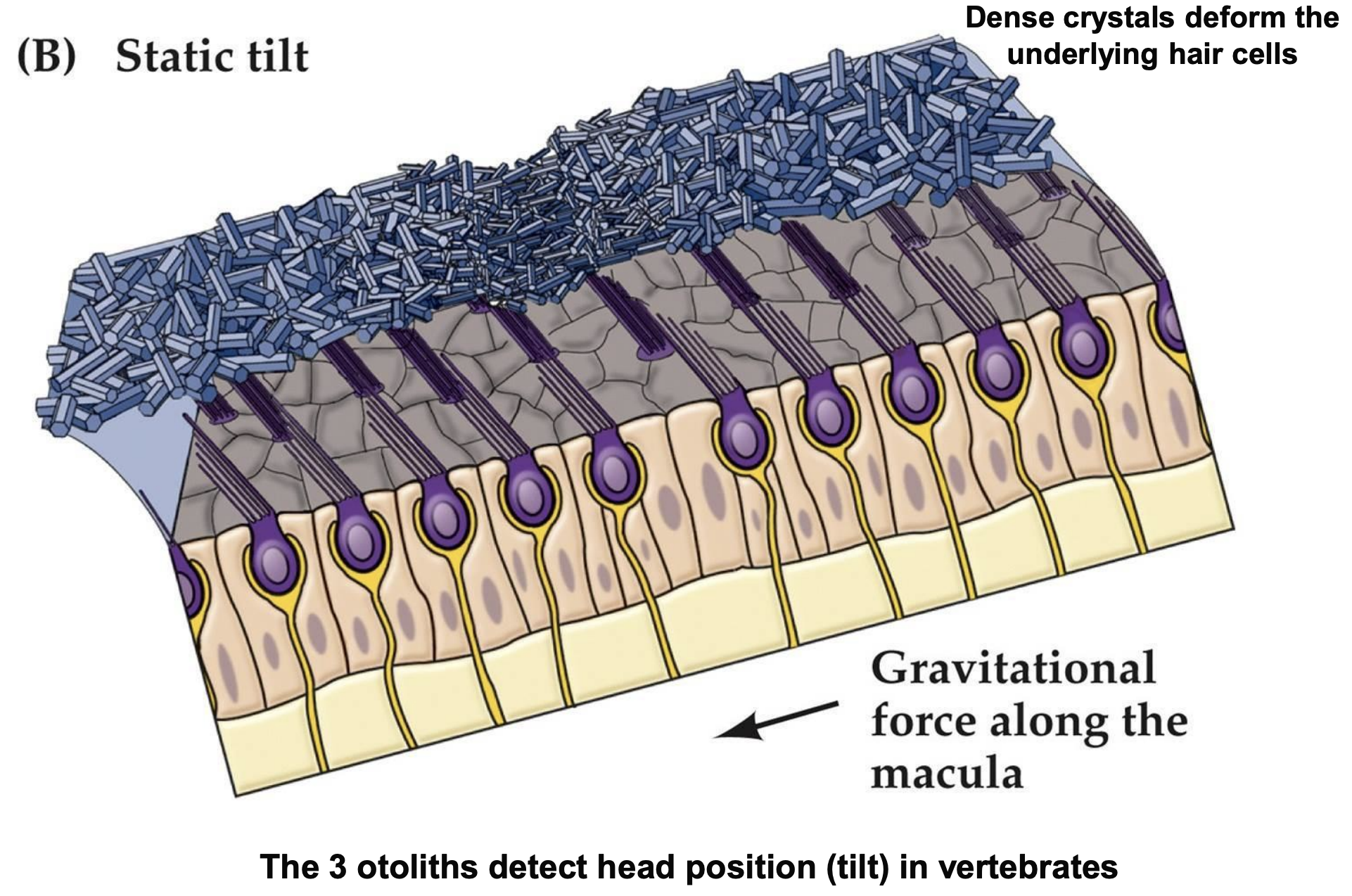
The three sacks and ear stones allow fish
to sense position and orientation of their body
The macula:
The macula is a sensory membrane w/ haircells underneath the otolithic membrane
How do otoliths help detect head position?
3 Electric fish general classification
Strong generation of electric fields: to stun prey or defend against predators
Weak/active electroreception: they sense distortion of electric fields that they generate themselves and use these to actively sense their environment
Passive electroreception: sense ambient electric fields (from the earth or other organisms): they don’t generate electric fields
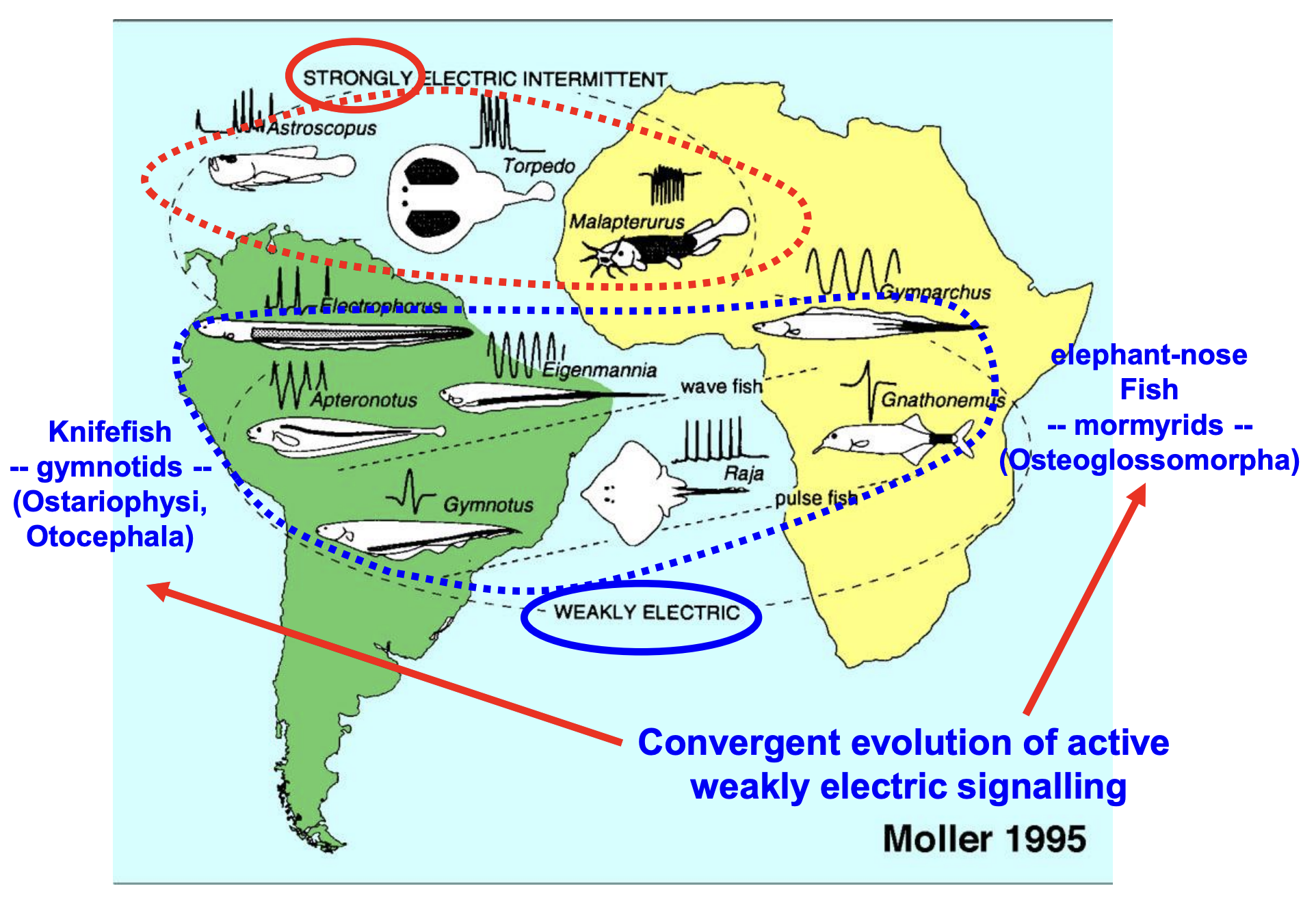
Strongly electric fish (generate) examples + clade
electric “eel” - otocephela catfish
torpedo rays - Batoid/chondrichtys
stargazer - acanthomorpha
Passively electric (only sense)
all chondrichthys
basal ray-finned fish: bichirs, paddlefish, sturgeon
lungfish, coelocanth
platypus; amphibians
Weakly electric fish
skates
elephant fish - osteoglossamorphs
“knifefish” fish - otocephela
Electric field produced by
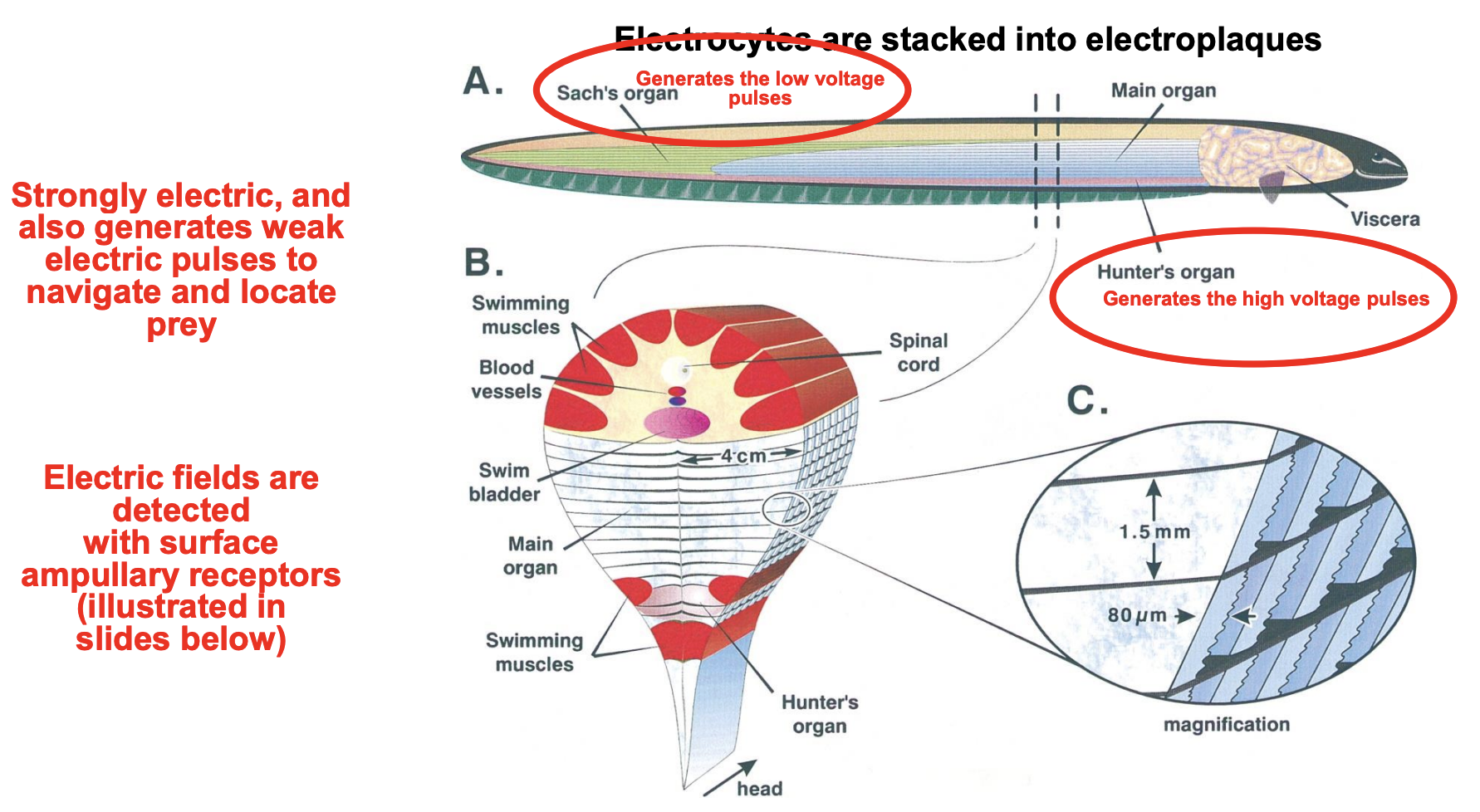
modified muscle cells (electrocytes) —> electroplaques
Electrocytes are disc shaped and stacked in columns called
electroplaques
Why are electric currents efficient in water
Great efficiency of electric currents in water due to the water’s density and salt content
What is electrosense used for?
prey detection, navigation, and communication, but has been modified for defensive purposes and feeding in several species
2 teleost groups with the most “electric” fish species
osteoglossomorphs + otocephela
Where are strongly vs weakly distributed in the world?
Otocephela phylogeny. What orders are electric?
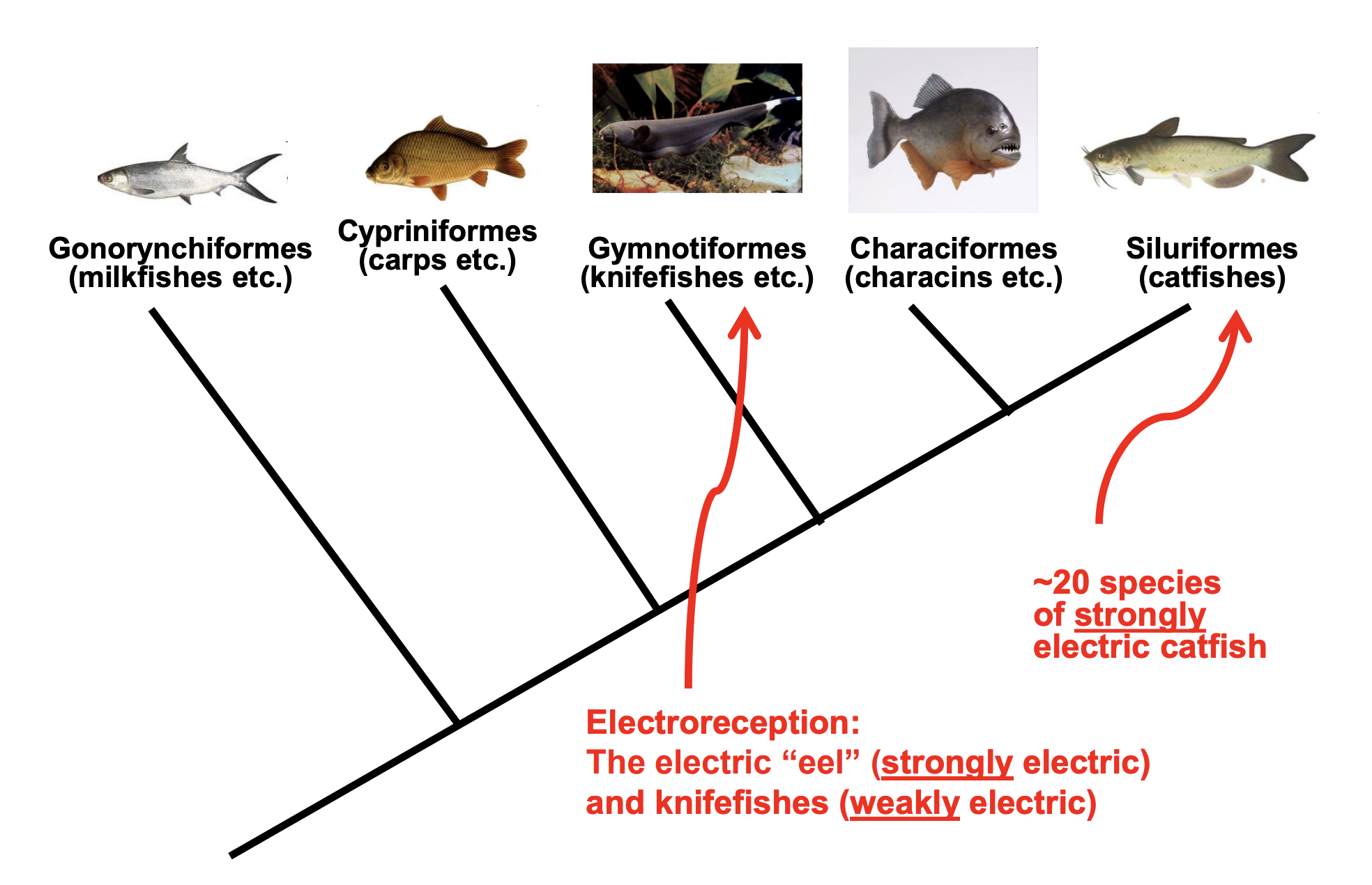
Electric rays and electric eels ____ evolved capability of generating strong electric fields
Independently evolved capability
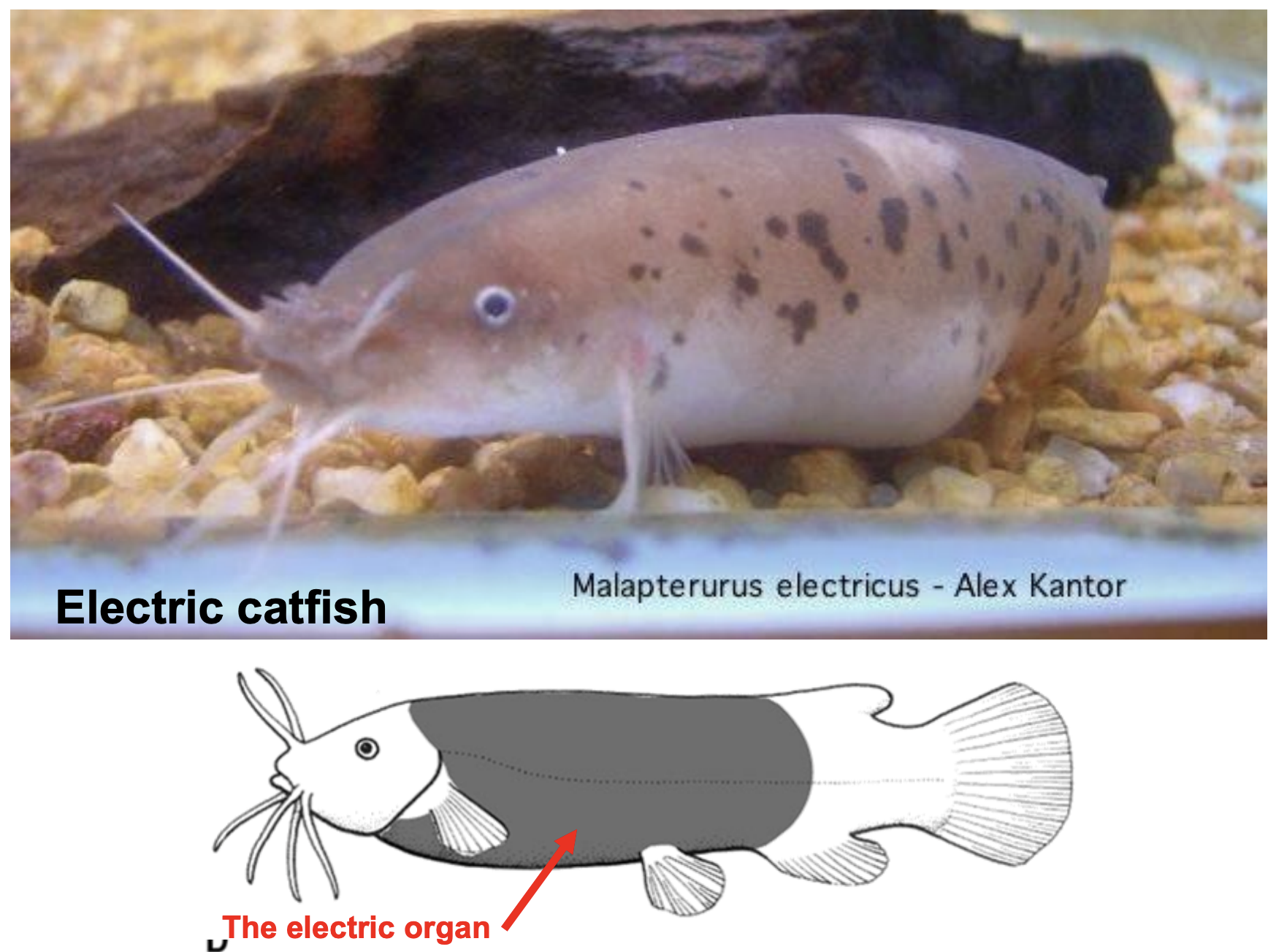
where is the electric organ on a catfish?
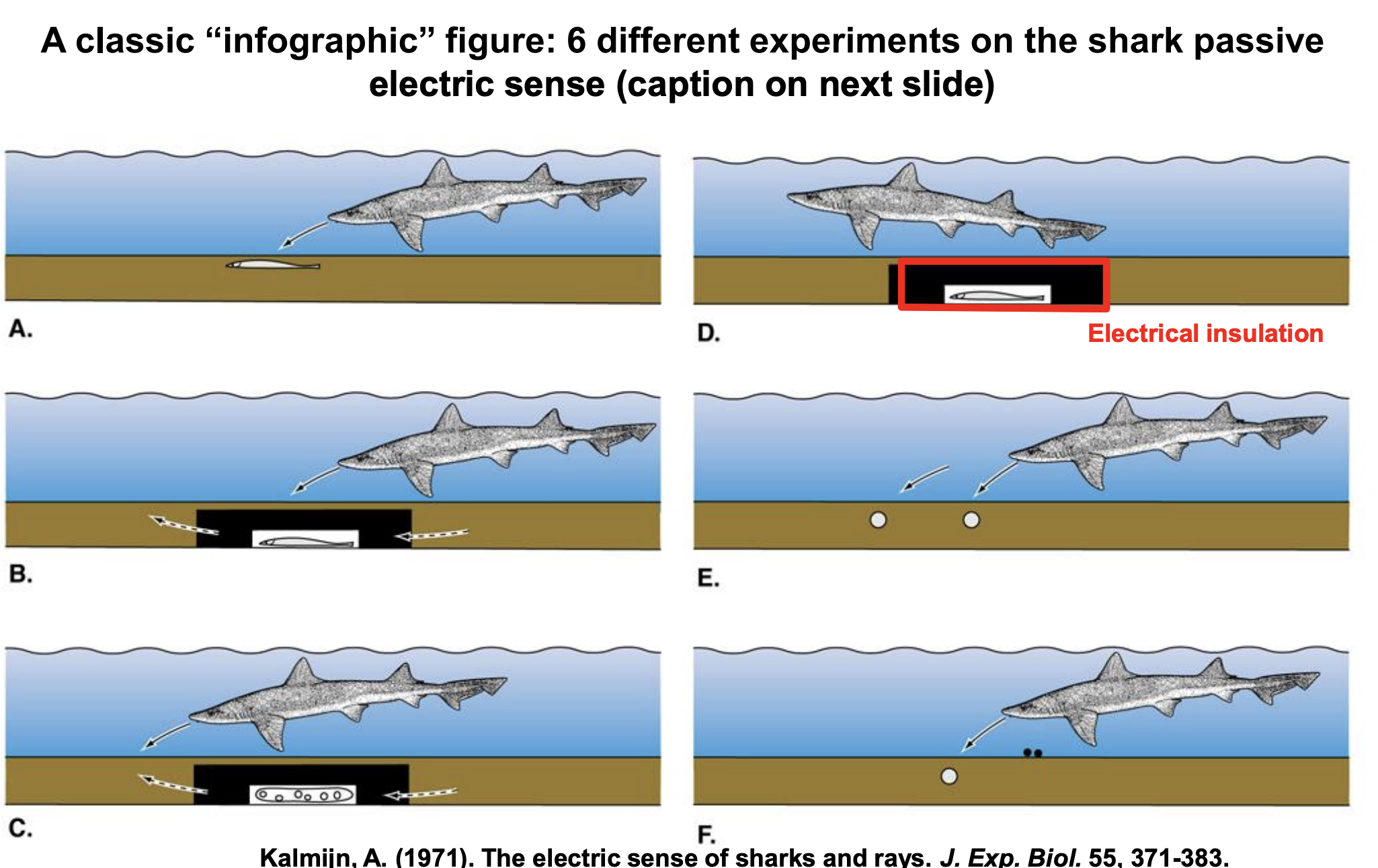
Kalmijn, A. (1971). The electric sense of sharks and rays
passive sense of electric fields for feeding
preference of electric field over chopped up fish
Sharks detecte electric signals throug
Ampullae of Lorenzini
Sachs vs hunters organ in electric eel
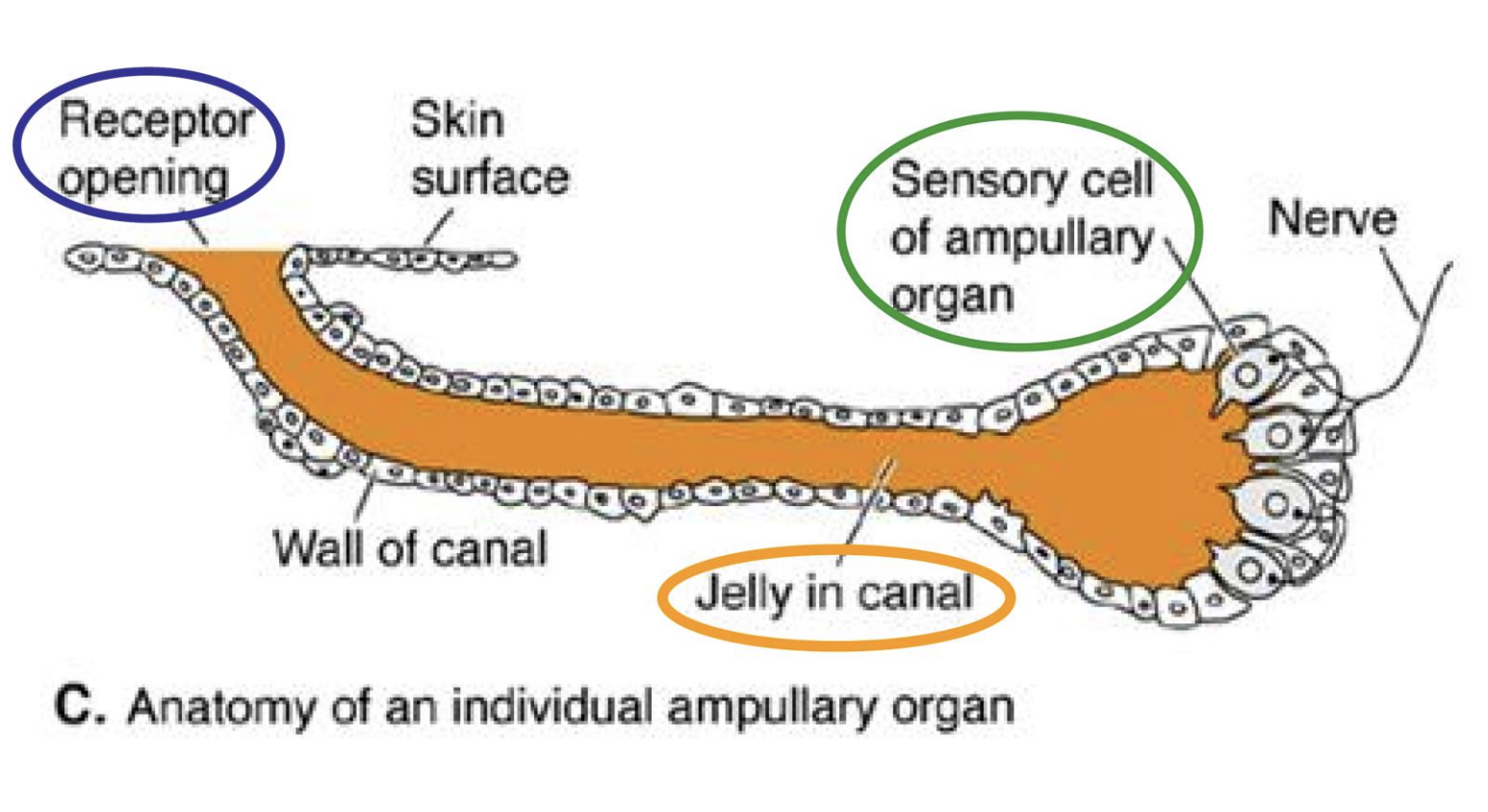
Ampullary Organ
Recepter opening
Jelly in canal
Sensory cell of ampullary organ
Nerve
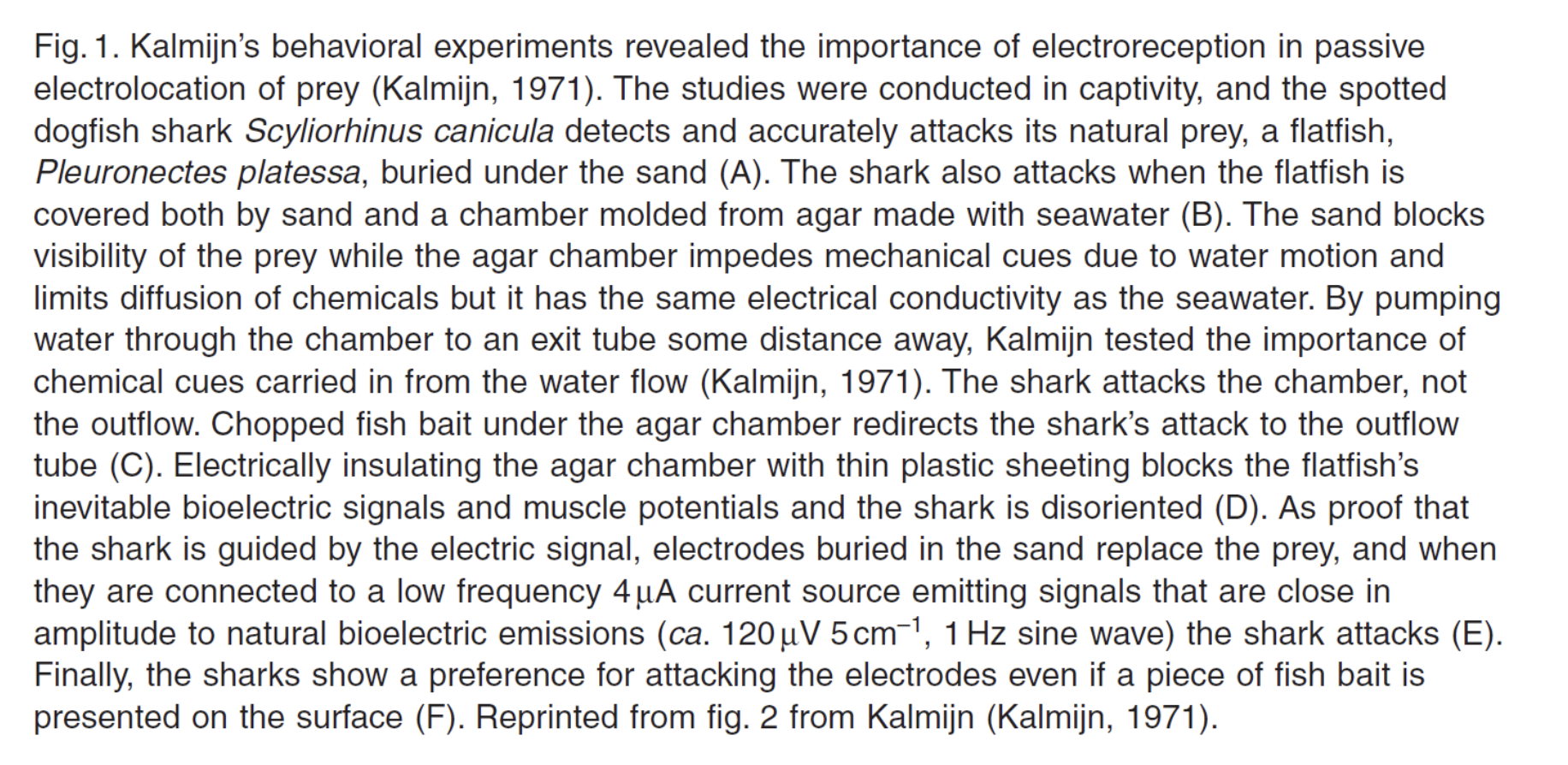
Kalmijn, A. (1987) blurb
Where is the electric organ usually located
In the tail
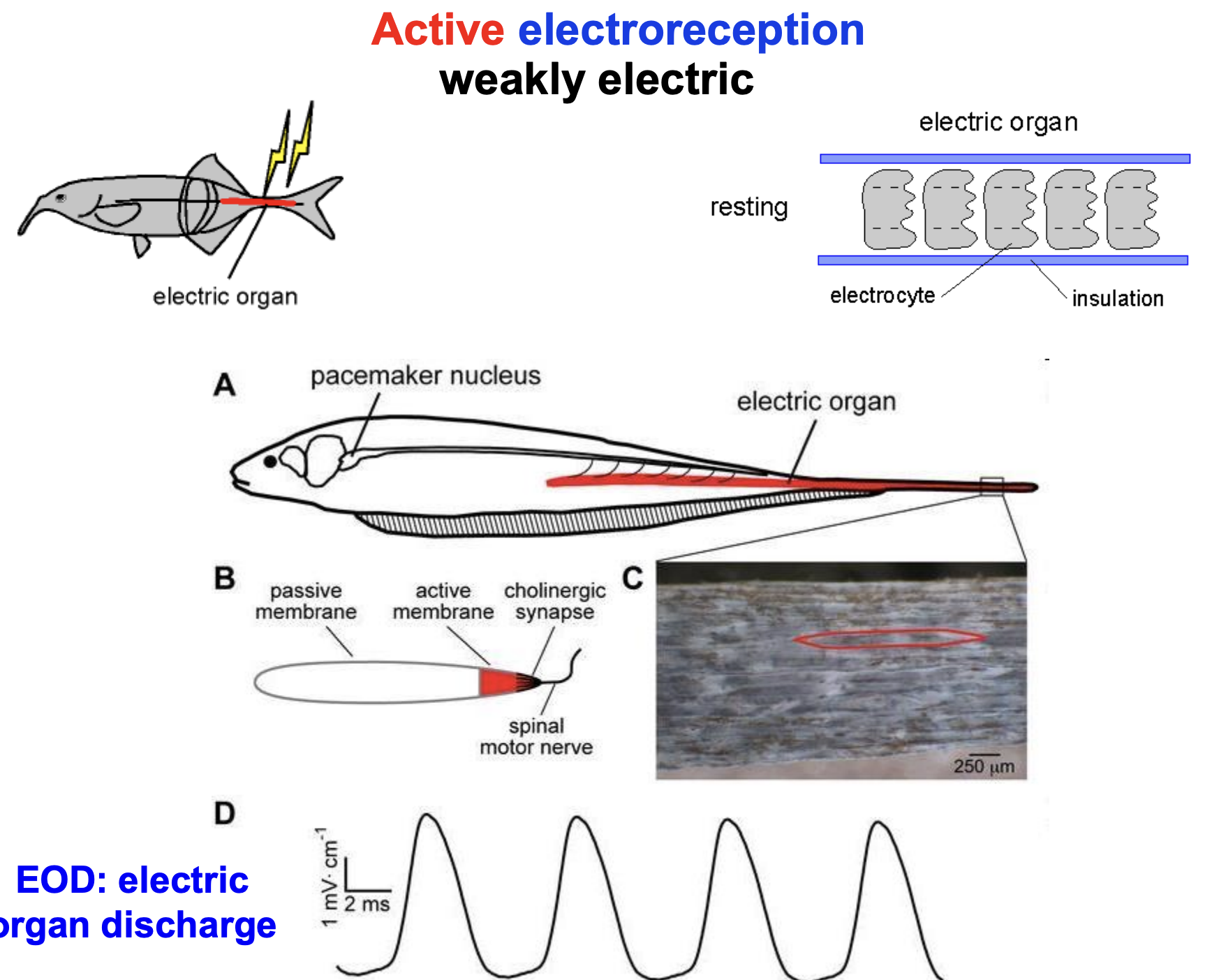
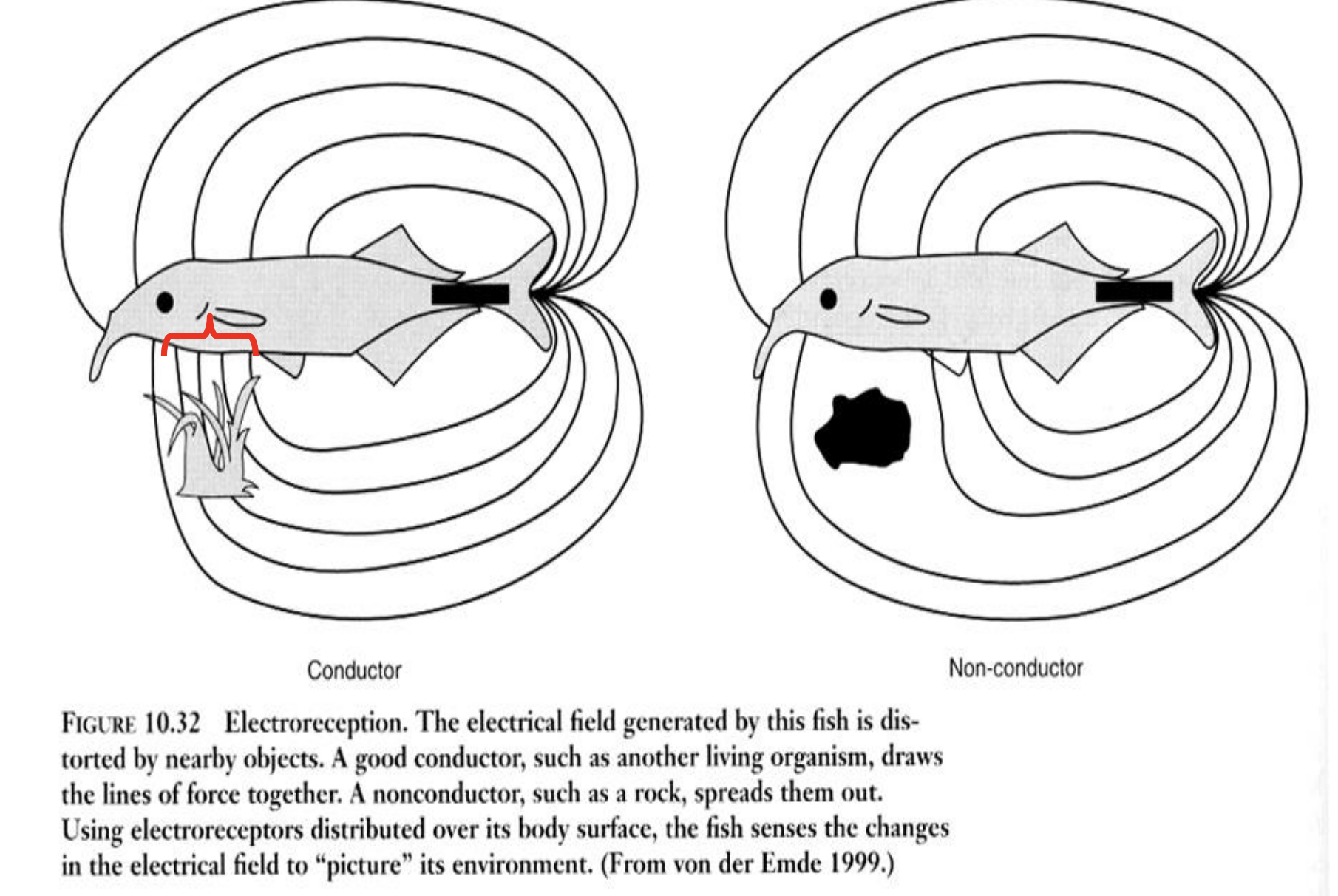
how does electroreception work
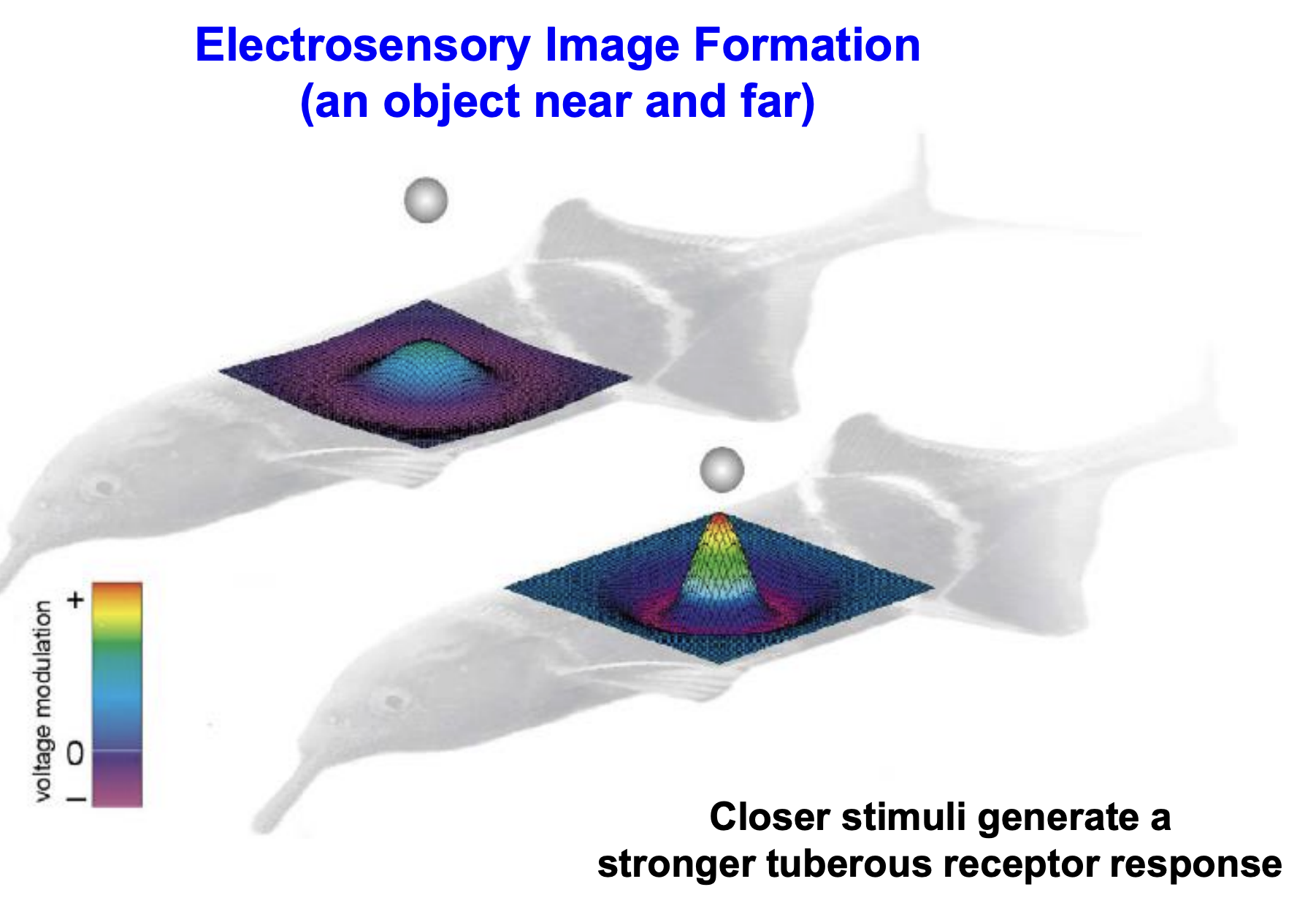
local increase in current density = an "electrical bright spot" on the skin
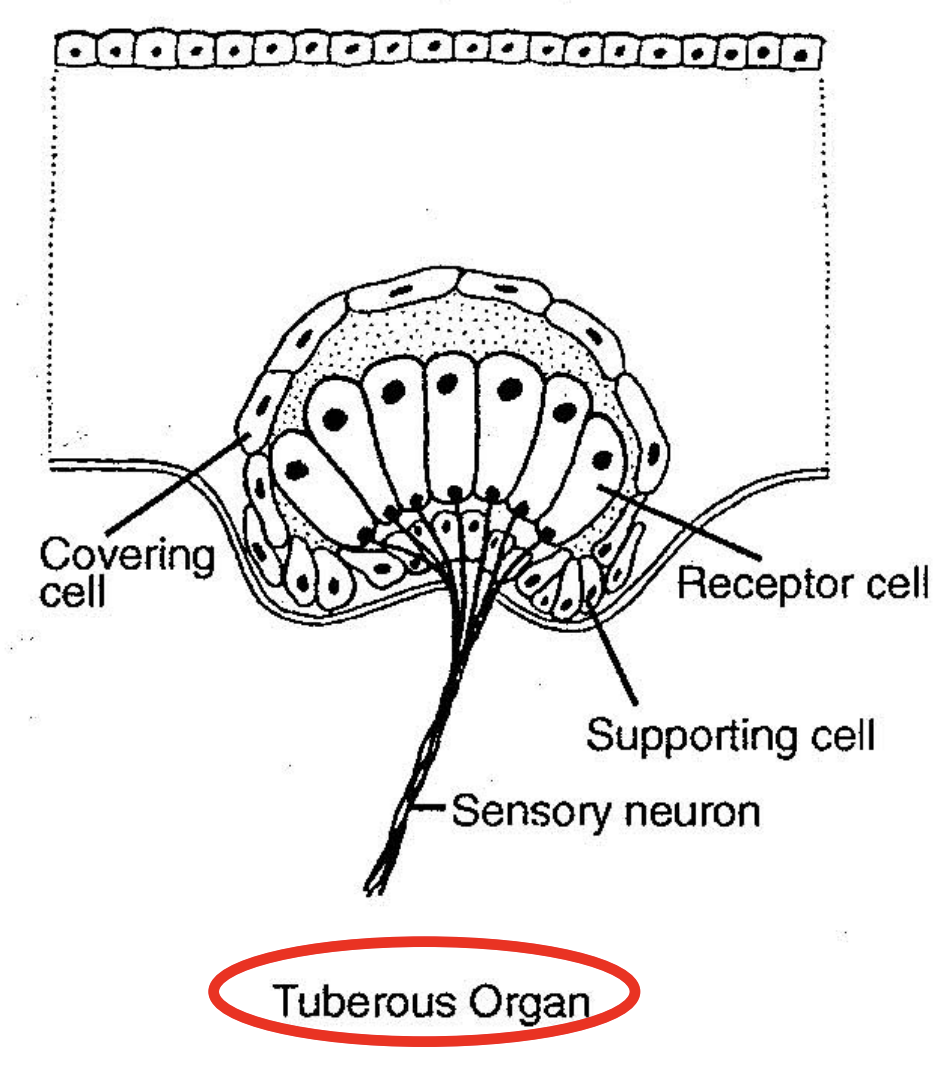
how do fish sense their own electric fields (electroreception)
with tuberous organ receptors (bud-shaped swellings under the skin)
Electrosensory Image Formation (an object near and far)
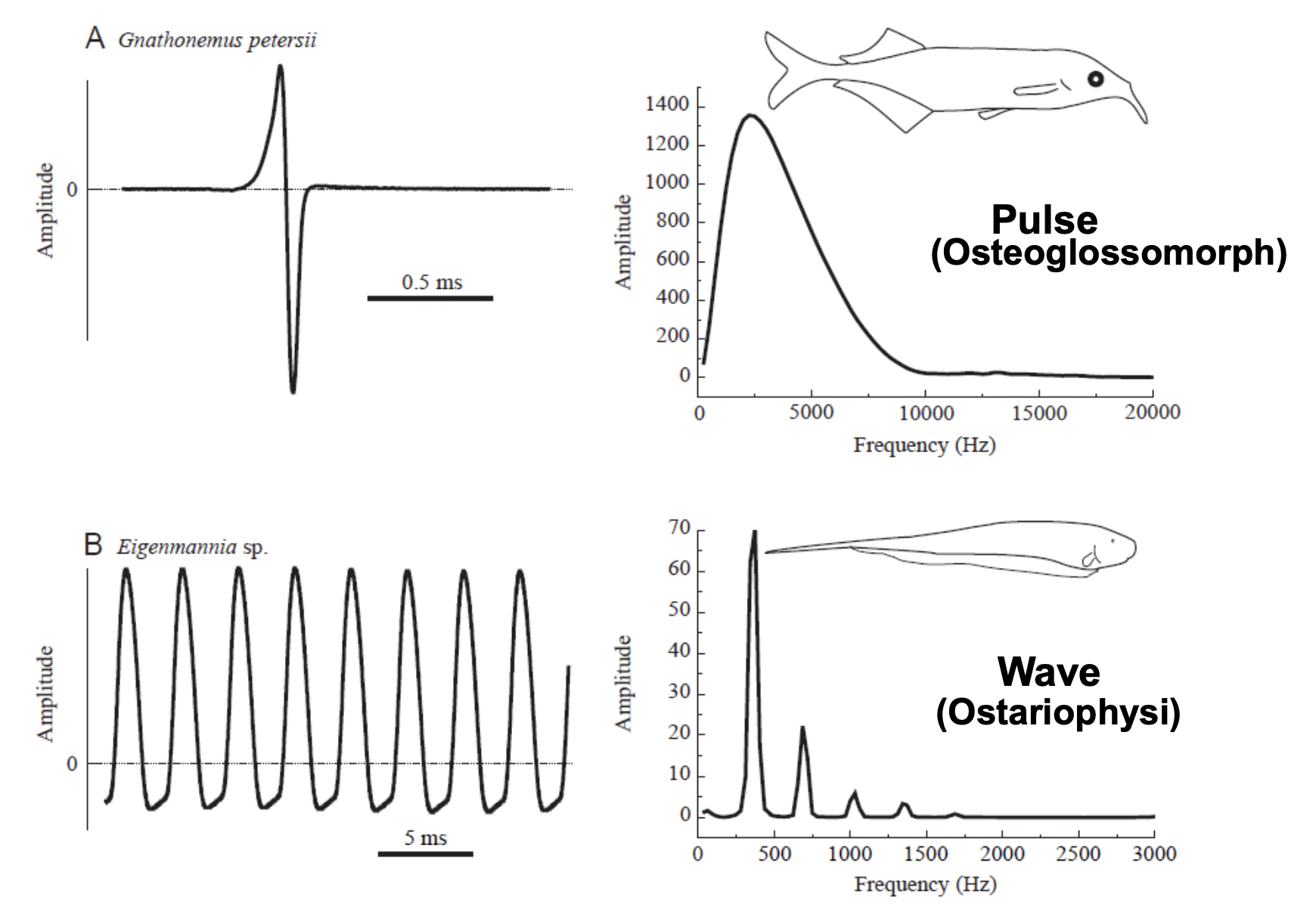
2 types of electric production
Wave - Ostariophysi
Pulse - Osteoglossomorph
How do species deal with Intraspecific communication
Intraspecific communication can result in a JAR: Jamming Avoidance Response
change pitch slighty to avoid confusion
Sound travels rapidly in water. How much faster?
5x faster than air
Harder to determine the directionality of sounds in water
facts
Hearing in Otocephela
Amplification of sound by air-filled organs (swimbladder)
Hearing in fish is primarily by the otoliths
“near-field” hearing
lateral line can detect low frequency sounds that are close to the body, where the sound generates water displacement which activates the neuromasts
“far-field” hearing
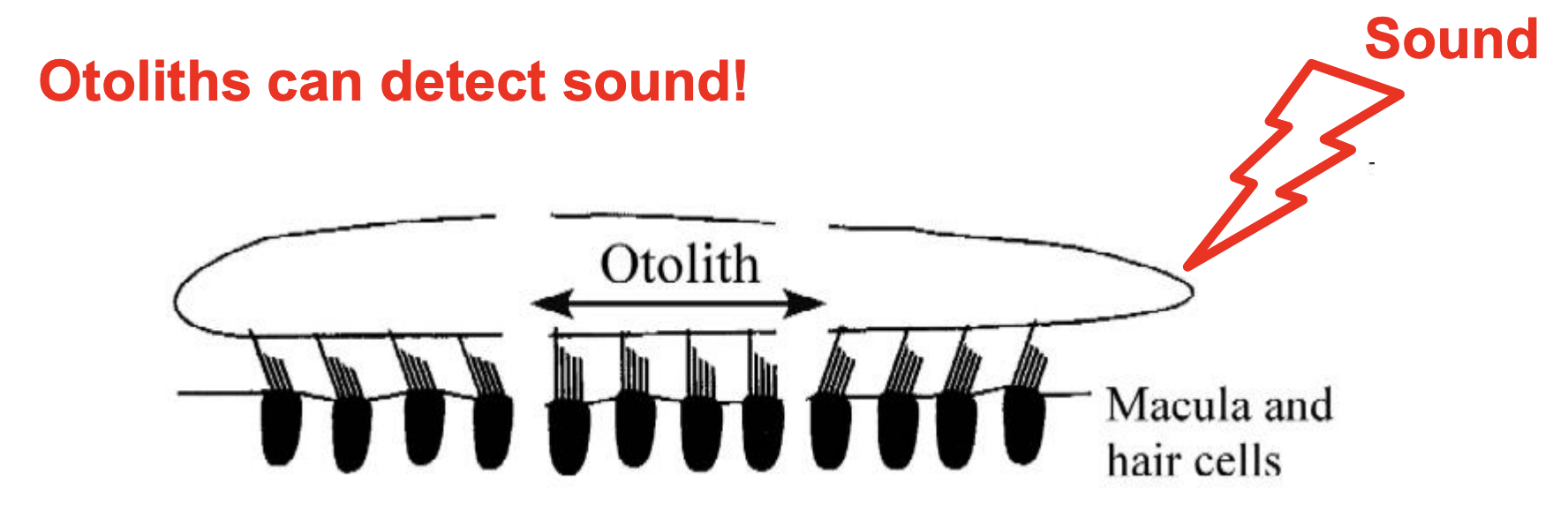
otoliths detect stimuli which are pressure waves with little water displacement
when these pressure waves hit the otoliths, they cause motion of the denser otolith over the hair cell bed
What does the inner ear do? Where is it located?
used for balance, and senses head/body position and acceleration
Located inside the neurocranium
Beyond head position, what else does the otolith detect
SOUND!
How do fish produce sound?
Stridulation: rubbing of structures together
Drumming: producing vibrations of the swimbladder with specialized muscle
Clap front or pharyngeal jaws together to make sounds
What do you know about magnetic reception (who, how, what for)?
few ray finned fish (like tuna) can detect earth strength magnetic fields
Mechanism unknown
used for locating long distance migration routes for feeding and reproduction
Magnetic reception conditioning studies found that
fish alter their heart rate in response to an electric field