3. Indigenous Languages in Turtle Island
 Call Kai
 Learn
Learn Practice Test
 Spaced Repetition
 Match
Match Flashcards
 Knowt Play
1/41

There's no tags or description
Looks like no tags are added yet.
Name | Mastery | Learn | Test | Matching | Spaced | Call with Kai |
|---|
No analytics yet
Send a link to your students to track their progress
42 Terms
Current Research
Sheds light on the nature of human language; certain structural and semantic phenomena are not found in more widely studied languages
Can yield clues (sometimes the only ones available) to help resolve problems in archaeology and anthropology (especially ethnohistory) relating to the origin and migration of the Indigenous peoples of Turtle Island (North America)
Indigenous languages are in a grave state of decline, so an urgency underlies their study
“Language is our unique relationship to the Creator, our attitudes, beliefs, values, and fundamental notions of what is truth. Our languages are the cornerstone of who we are as a People. Without our languages we cannot survive.”
ASSEMBLY OF FIRST NATIONS, TOWARDS LINGUISTIC JUSTICE FOR FIRST NATIONS (1990)
Languages in Canada
Indigenous people in Canada fall into three distinct political groupings:
First Nations (no less than 8 language families)
Inuit (a separate language family)
Métis (a unique mixed language)
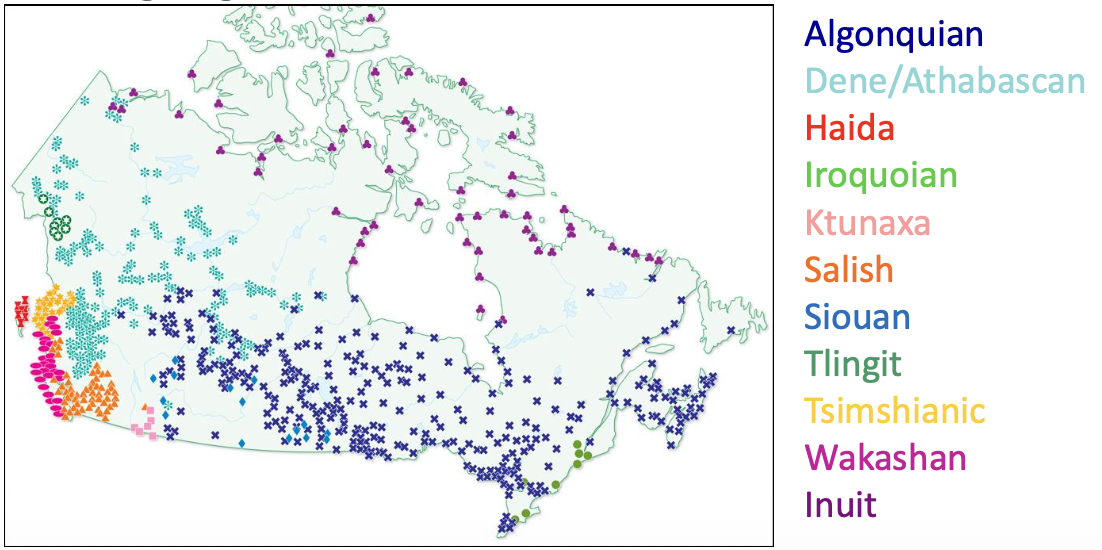
Languages in Canada
Algonquian (167,000)
Dene/Athabascan (20,000)
**For the purposes of this map, we treat Dene/Athabaskan and Tlingit separately, even though they are now often considered to be members of the larger Na-Dene family.
Haida (35)
Iroquoian (4000)
Ktunaxa (45)
Salish (4000)
Siouan (24,000)
Tlingit (665)
Tsimshianic (2000)
Wakashan (<1000)
Inuit (107,700)
Difference of Languages
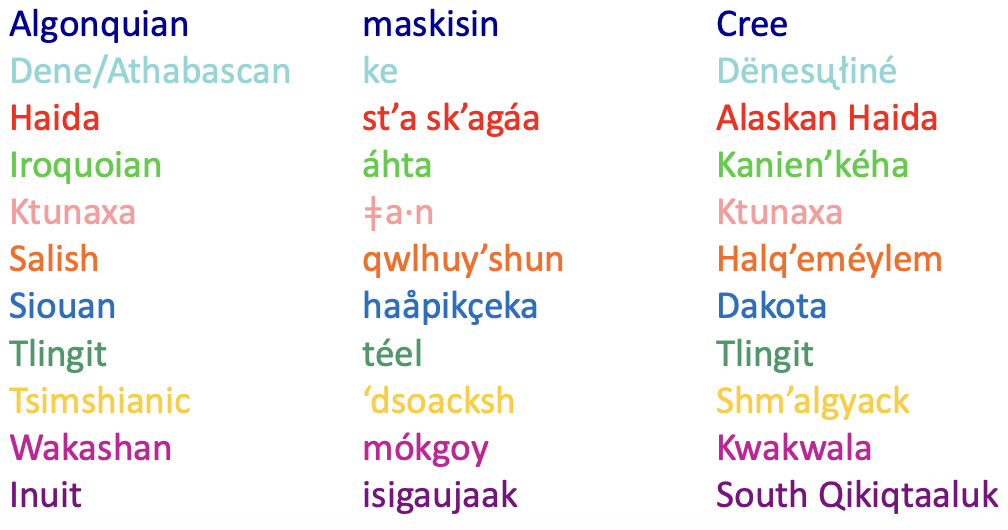
These languages are all very different, they have little in common with each other
For the word “shoe”
Algonquian
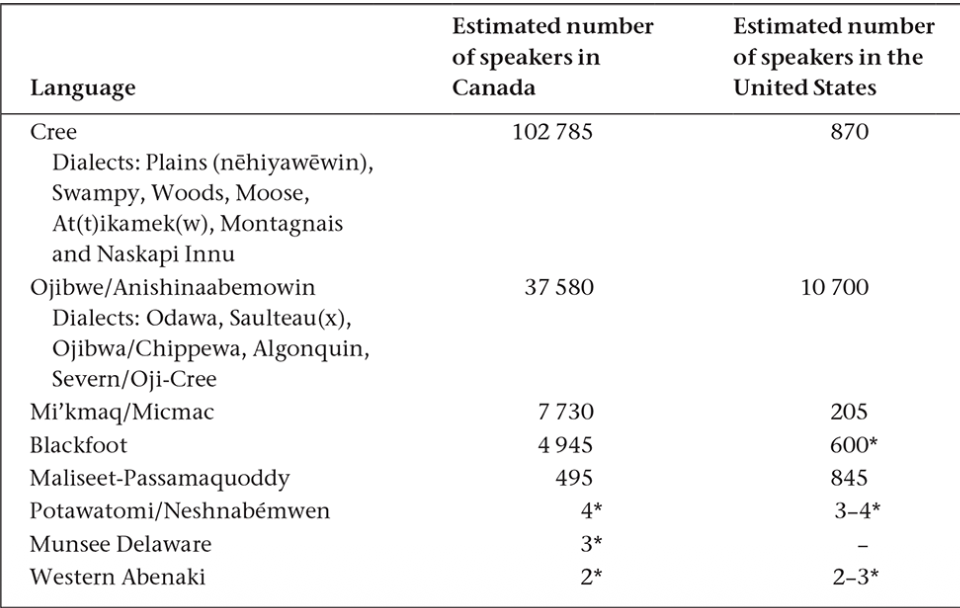
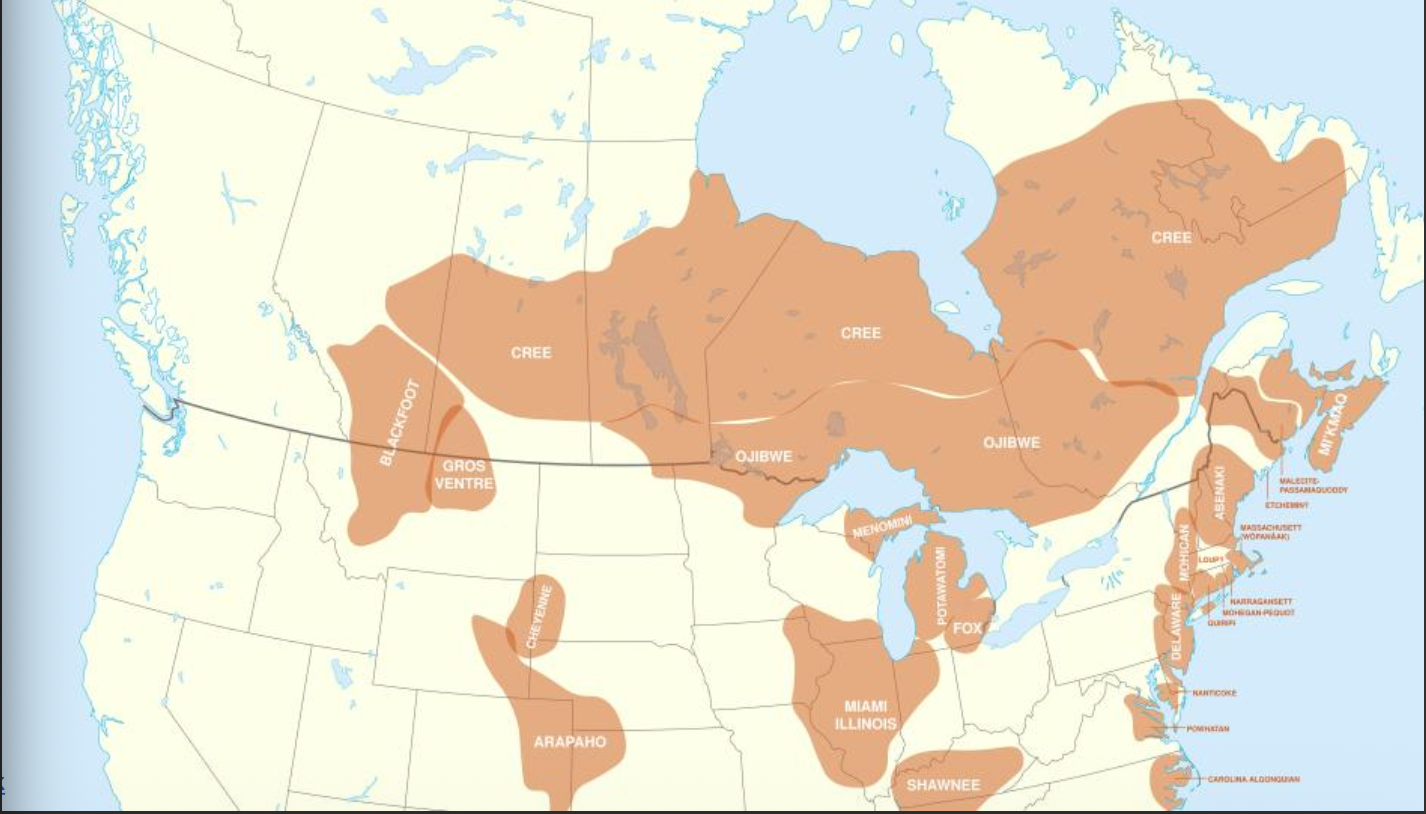
___________: Include the two most widely spoken indigenous languages in Canada – Cree and Ojibwe/Anishinaabemowin
Dialects of Cree and Ojibwe are spken in BC, AB, SK, MB, ON, QB; Cree is also spoken in Labrador (Innu dialect)
Map of the Algonquian Languages
Thought to move West to East
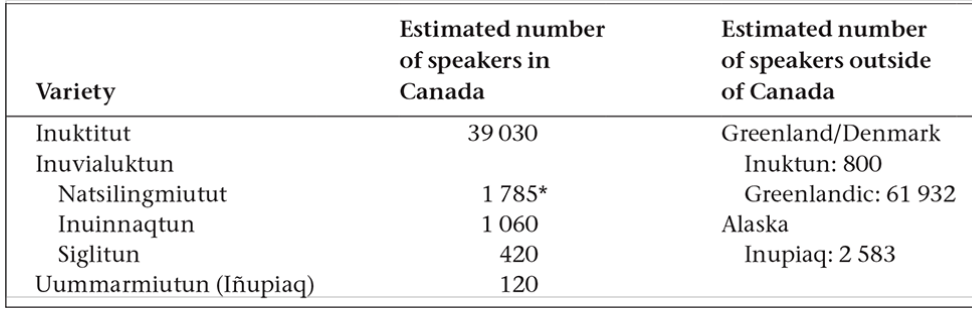
Inuit-Yupik-Unangan
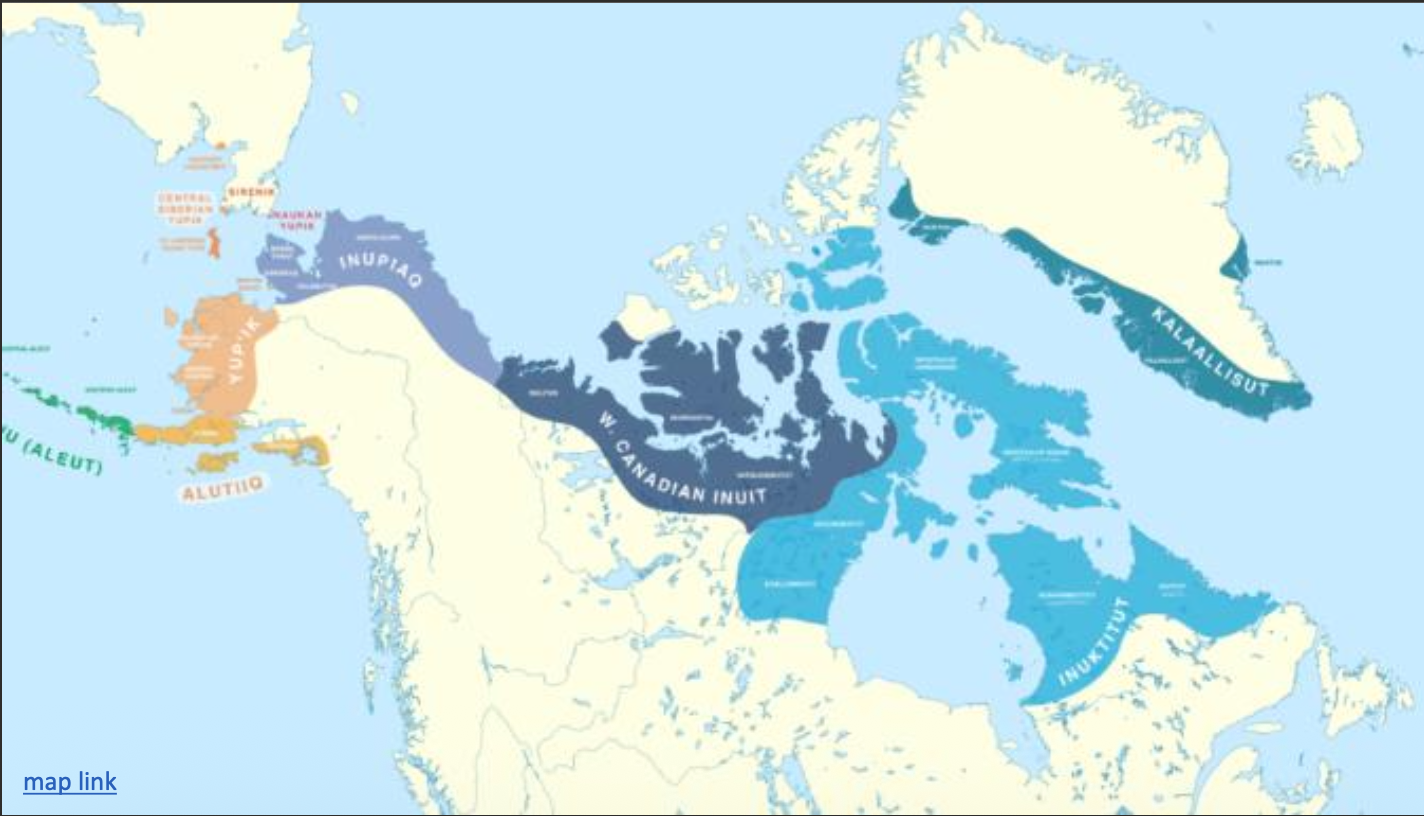
1/3 live in North QB
2/3 live in Nunavut
Map of Inuit-Yupik-Unangan
Na-Dene
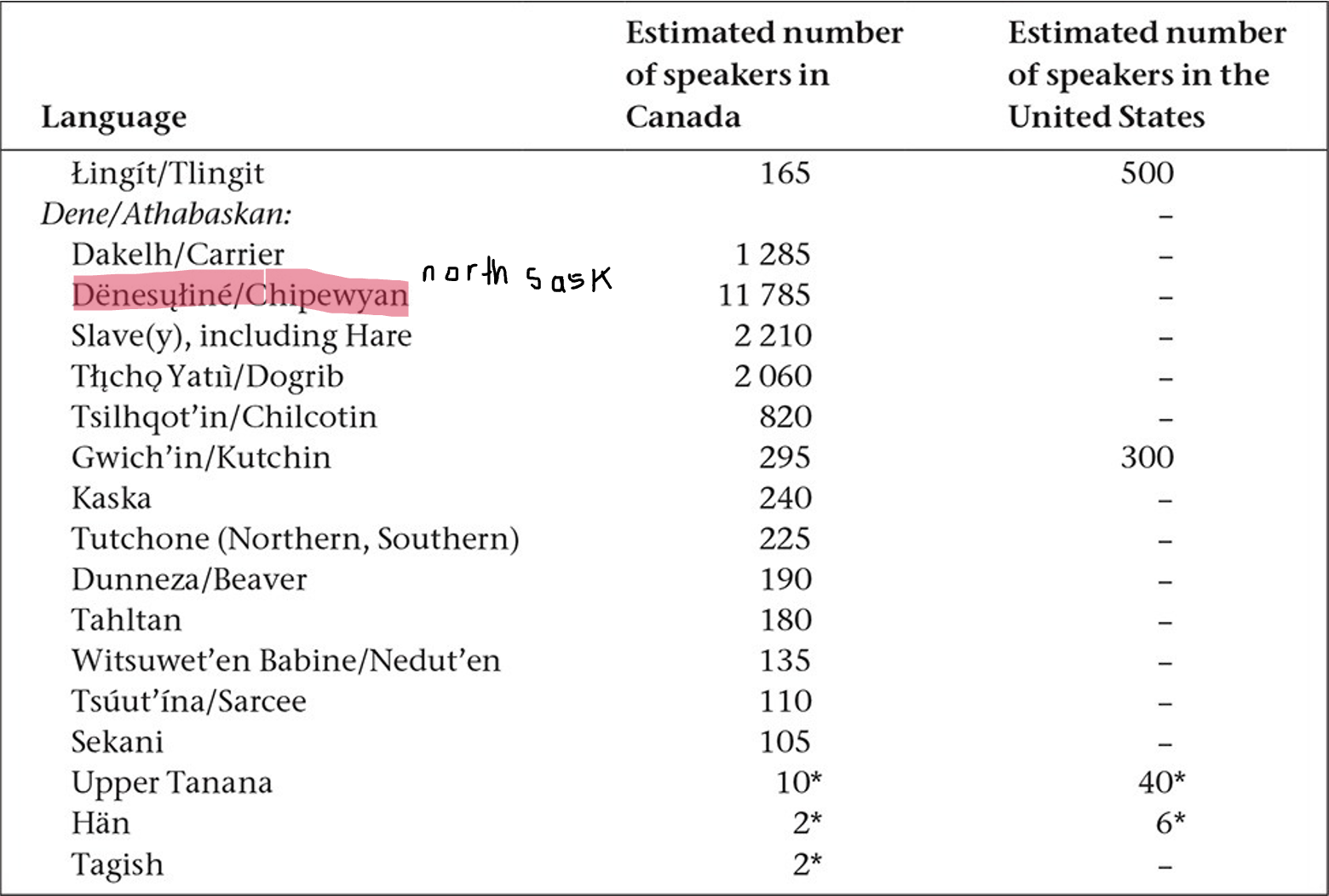
Greatest internal diversity, with 17 distinct languages in Canada alone
BC, YK, NWT, AB, SK, MB
All except Tlingit belong to the Dene (old name=Athabaskan) family
A very large language family covering considerable discontinuous territory
Northwest (Canada) 12,000 strong first language Dene speakers
Pacific Coast (US)
Southern/Apachean (US/Mex) (includes Navajo, with 100-170,000 speakers, the most spoken in the US)
Exonym
A name given by peoples outside of the community
Endonym
The name a people gives themselves
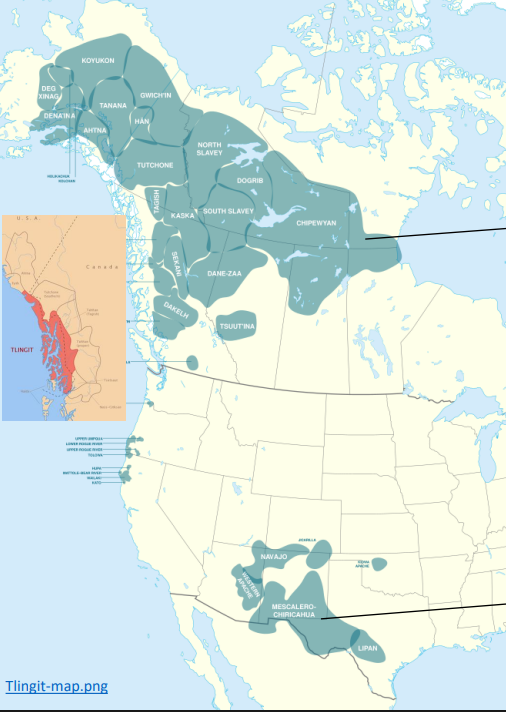
Map of Na-Dene
Southern US & Mexico
Northern Canada→ Dene Sųłiné
Oral history that at one point they separated looking for resources then come back together prior to colonization which is why there is a discontinuous territory
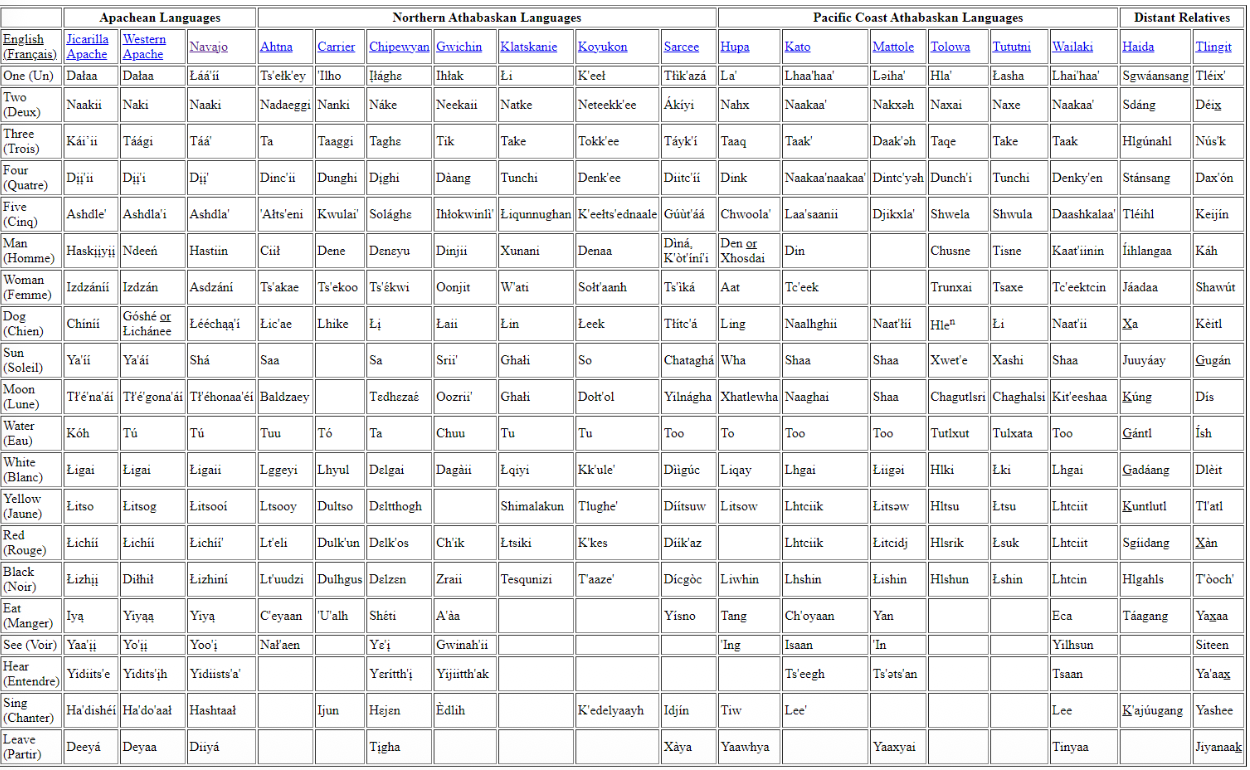
Athabaskan Word Sets
The words for three
Can likely exclude Haida, we don;t think it’s a distant relative anymore
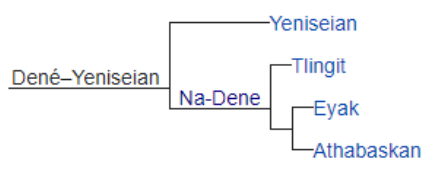
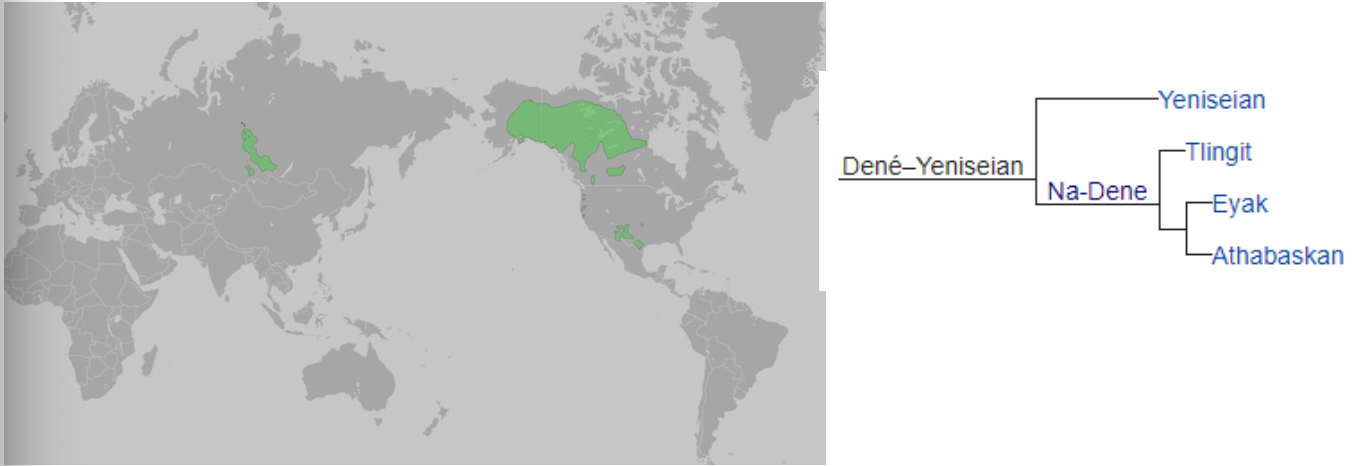
Dene-Yeniseian Hypothesis
Recently (2022), the Yeniseian languages of central Siberia were convincingly argued to be related to the other Na-Dene languages, thus forming an even larger Dene-Yeniseian phylum
Approx. 140 cognates found between Proto-Dene and Ket (Siberia), the only remaining Yeniseian language
~500 speakers
Recent work in genetics seems to support the hypothesis
When proposed to Dene students not well accepted
Siouan
___________: Represented by 3 Dakotan languages:
Stoney Nakota (AB),
Assiniboine Nakota (SK),
Dakota-Lakota (a dialect continuum spoken in SK and MB)
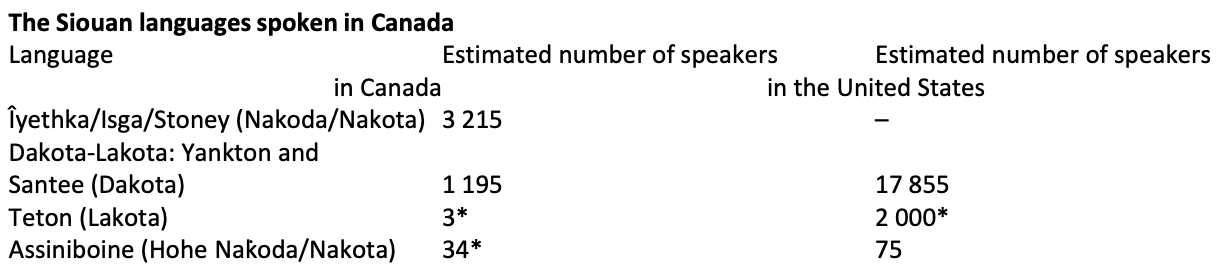
Siouan Map
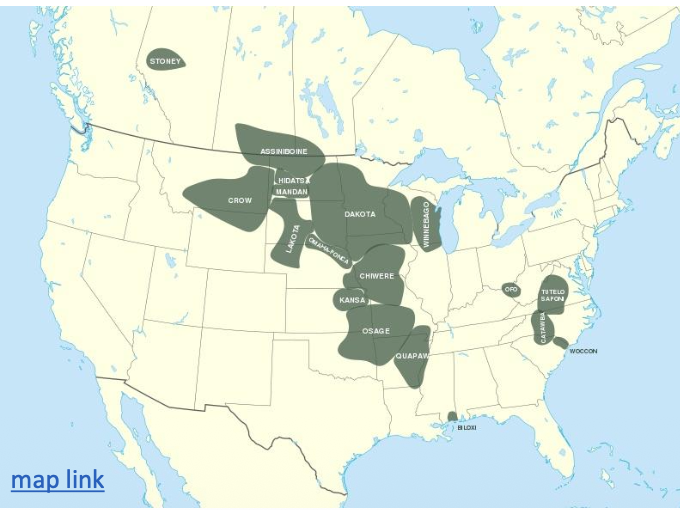
Salish
10 languages spoken in BC
Nuxalk has few speakers, but is taught in the school system
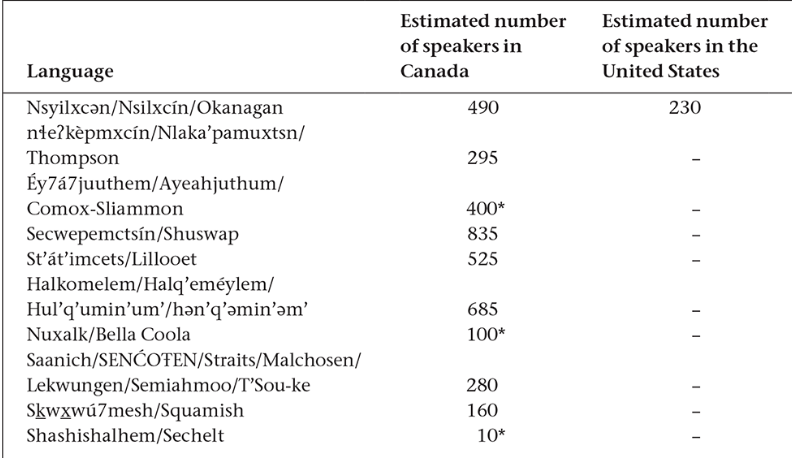
Salish Map
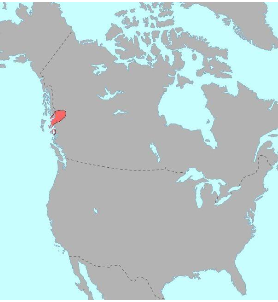
Tsimshianic
NW BC
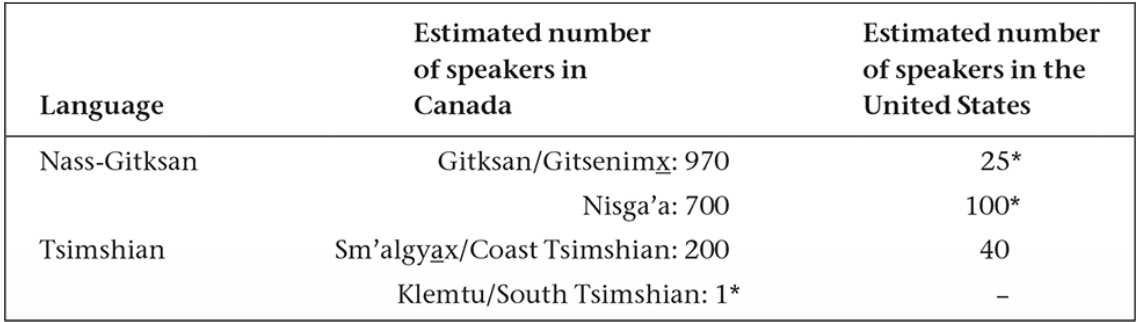
Tsimshianic Map
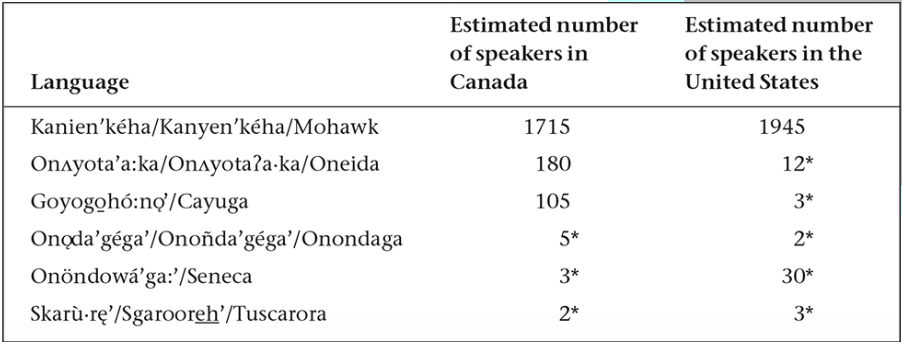
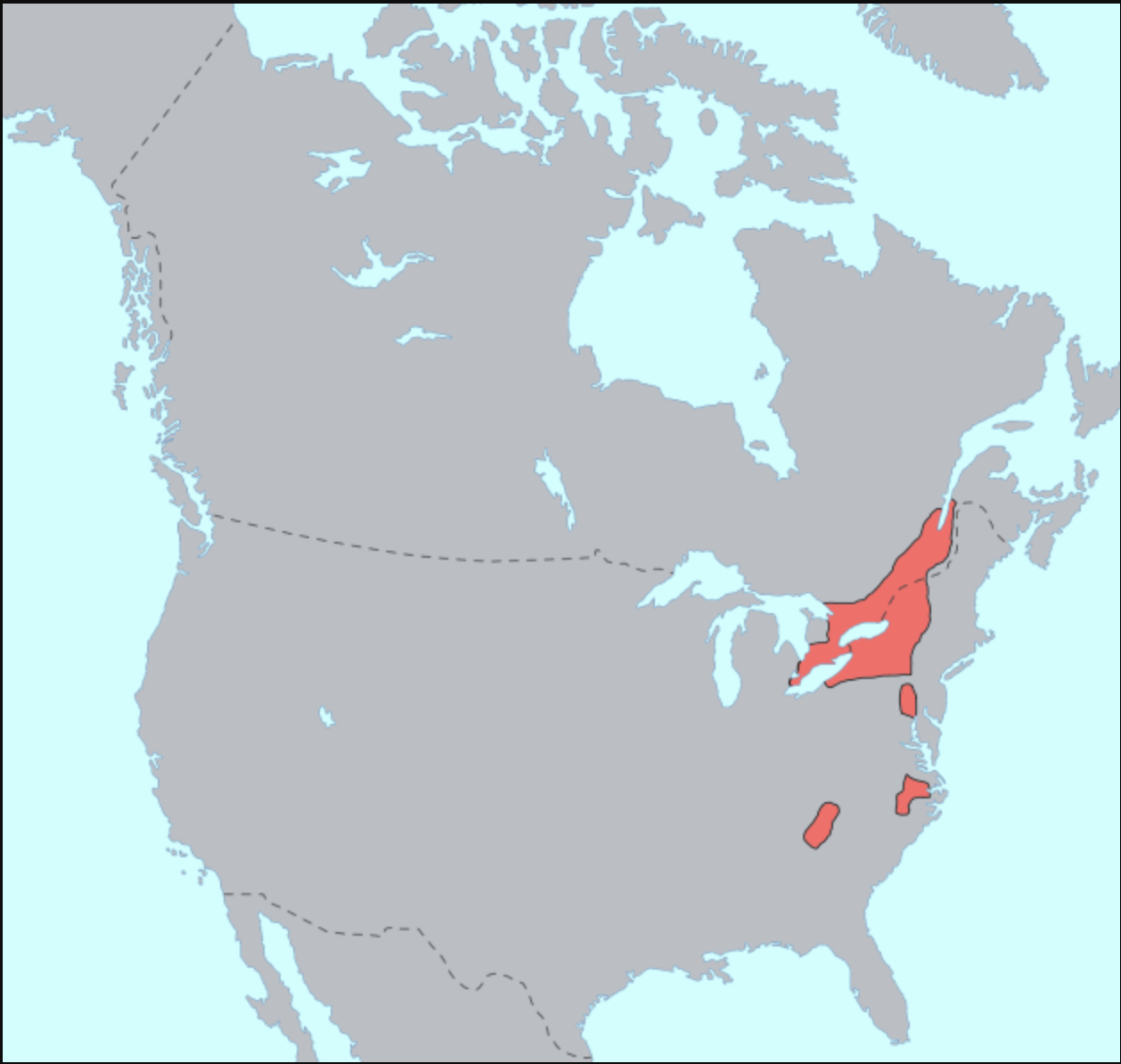
Iroquoian
SW Quebec, S Ontario, and the United States
Mohawk
Oneida
Cayuga
Onondaga
Seneca
Tuscarora
Iroquoian Map
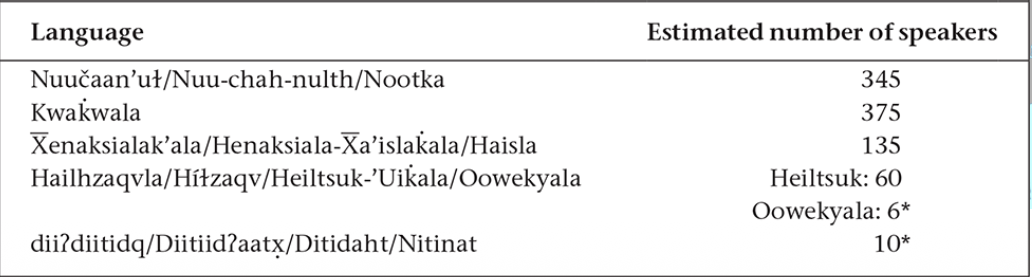
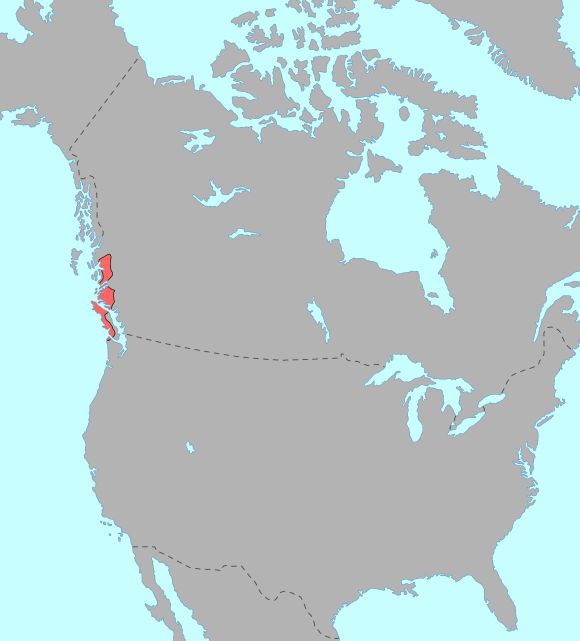
Wakashan
Mostly on Vancouver Island
Wakashan Map
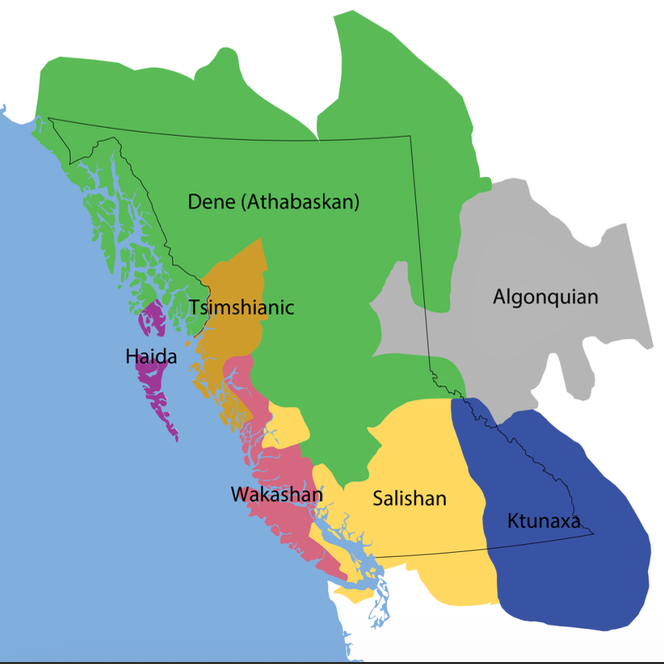
BC Languages and Families
Language isolate: a language with no known relatives. They do well on their own due to access to food water. There’s a lot of diversity as people are able to settle and don’t need to trade in order to survive
Haida
Ktunaxa
The Amerind Hypothesis
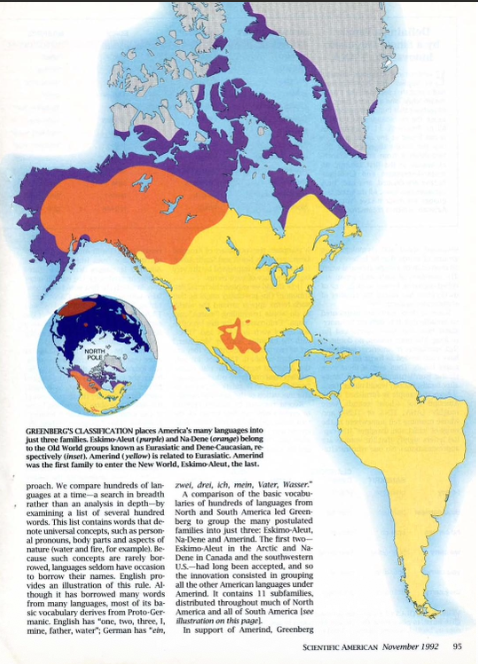
_______: Highly controversial, this classification recognizes the Inuit-Yupik-Unangan family and Na-Dene—a stock consisting of the Dene/Athabaskan family, Tlingit, Eyak, and perhaps Haida—but places all other Indigenous languages of the Americas into a single large group, labelled Amerind.
Both the methodology and the data underlying this proposal have been subjected to severe criticism, and not currently accepted by most specialists in the field.
The Amerind Hypothesis Proposes…
Only three language families, implying three waves of immigration from Asia, in the following order. Unfortunately sneaks into idea of a pan-Indigneous culture
Amerind (yellow)
Na-Dene (orange)
Inuit-Yupik-Unangan (purple)
Contact Languages
Mitchif
Chinook Jargon
Plains Sign Talk
Mitchif
Contact Languages
________: Language of the Metis Nation, a true mix of two languages
Descendents from Cree/Ojibwe women and French-Canadian fur-trappers
French: nouns, prepositions, negation markers
Cree: verbs, personal pronouns, question words, demonstratives, adverbials
Mutually unintelligible with Cree or French
Just over 700 speakers (most do not know French or Cree)

Chinook Jargon
Contact Languages
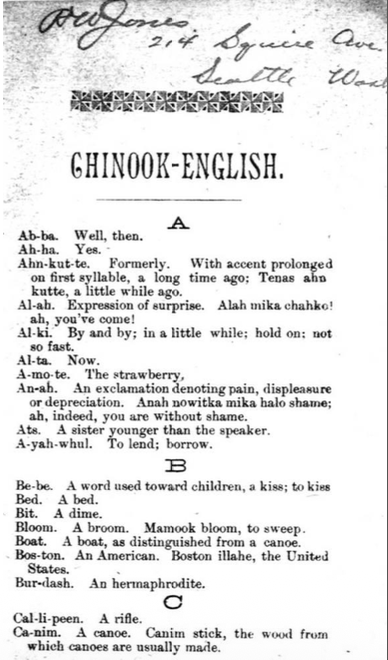
___________: Lingua franca of the Pacific NW,
drew many basic words from Nuu-chah-nulth (Nuučaan’uɫ) and from Canadian French
Probably had up to 100,000 speakers in the 19th century
Now less than a dozen in BC
Plains Sign Talk
Contact Languages
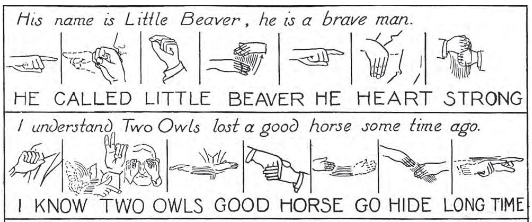
________: Lingua franca of the plains still used by some Cree, Blackfoot and Dakota to accompany oral narratives. There were multiple sign languages throughout Turtle Island but this was the most common.
Confusing Signs
The Plains sign for ‘big belly’ involves moving the right hand outward and down, fingers pointing left. The sign for ‘waterfall’ is similar but with fingers pointing forward. Eighteenth-century Cree and French speakers apparently mixed these signs and began referring to the ‘Falls Indians’, whom they encountered on the Canadian Prairies, as ‘Big-Bellied Indians’. The Algonquian-speaking Gros Ventres—’Big Bellies’ in French—now reside in Montana.
Decline of Indigenous Languages
Epidemics (especially smallpox), famines, and innumerable wars reduced the Indigenous population of North America from over five million at the time of Columbus (the late fifteenth century) to fewer than half a million at the beginning of the twentieth century.
Fortunately, Indigenous peoples are now recovering rapidly from these historical disasters: the Indigenous population in Canada has grown from 120,000 in 1925 to a million today
This state of affairs resulted in part from deliberate action: Indigenous language use was generally forbidden in the church- and government-run residential schools to which Indigenous children were sent from the 1880s to the 1970s (the last residential school closed in SK in 1996).
Last speaker death
Nonetheless, many Indigenous languages in (what is now) Canada were lost when their last speakers died, including:
Laurentian (Iroquoian, QB) in the late 1500s
Beothuk (isolate, NL) in 1829
Nicola (Dene, BC) in the late 1800s
Huron-Wendat (Iroquoian, QB), Tsetsaut/Ts’ets’aut (Dene, BC) in the early 1900s
Pentlatch (Salish, BC) around 1940.
Of the languages that remain in Canada, many are critically endangered, and only have a few speakers remaining:
Munsee Delaware and Western Abenaki (Algonquian)
Hän and Tagish (Dene)
Tuscarora and Seneca (Iroquoian)
Reclamation of Indigenous Languages in Canada
In the 2016 census, 228 765 people reported speaking an Indigenous language at home.
It is remarkable that in spite of the difficulties confronting them, certain Indigenous languages in Canada remain relatively healthy.
For instance, speakers of Dënesųłiné abound in parts of Saskatchewan (9065). Nine out of every ten people who have grown up speaking this Dene/Athabaskan language continue to use it regularly at home. It therefore continues to be acquired by children as a first language in many northern communities, such as Fond du Lac, Black Lake, and La Loche.
A similar situation holds in Québec among speakers of Inuktitut (12 250), Innu-aimun (9770), and Atikamekw (6600). Children raised in homes with these Inuit and Algonquian languages all but guarantee the continued existence of their Indigenous linguistic heritage.
Cree Phonemic Inventory
Phonology
____________: is relatively similar to English, and therefore should be easy to pronounce
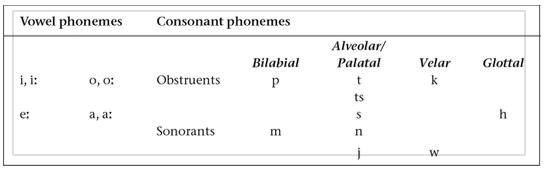
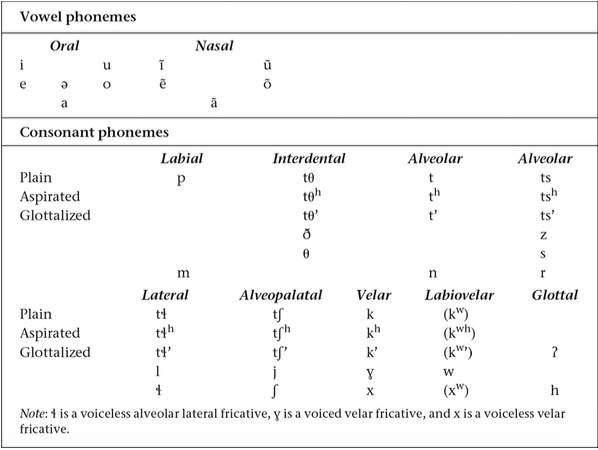
Dënesųłiné Phonemic Inventory
Phonology
______________: is much more complex, they have distinctions between oral and nasal sounds, have phonemes we don’t, and a high/low tone distinction.
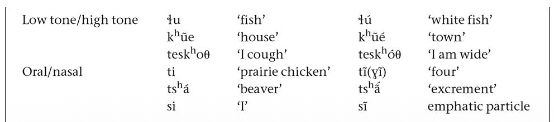
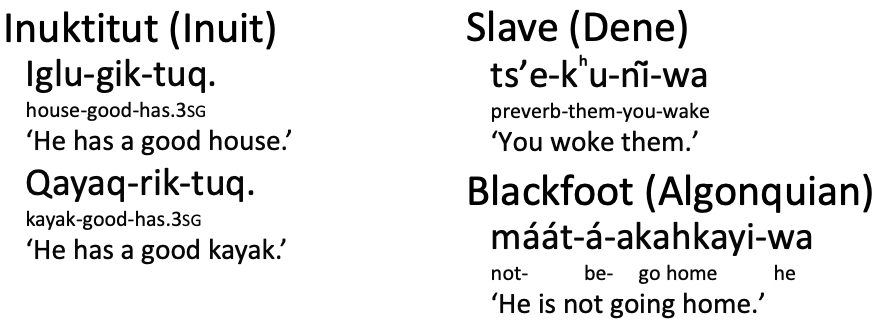
Morphology
____________:Polysynthetic languages: have morphologically complex words with component morphemes (as opposed to inflection or individual words)
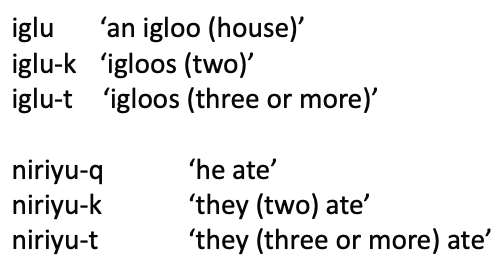
Person & Number Variations
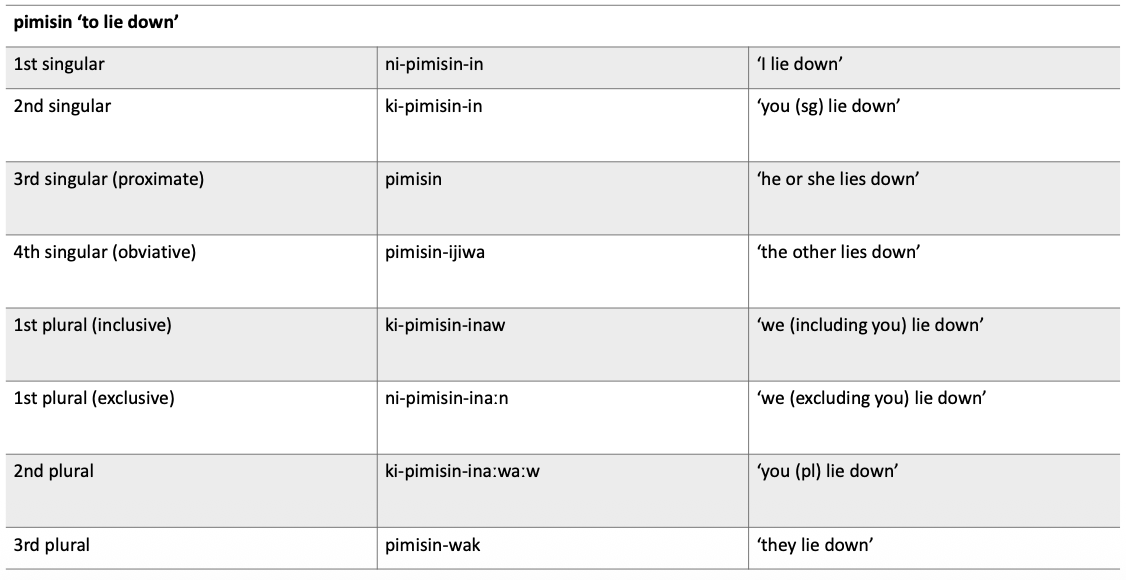
Inclusive/exclusive Distinction
Gender—animate/inanimate
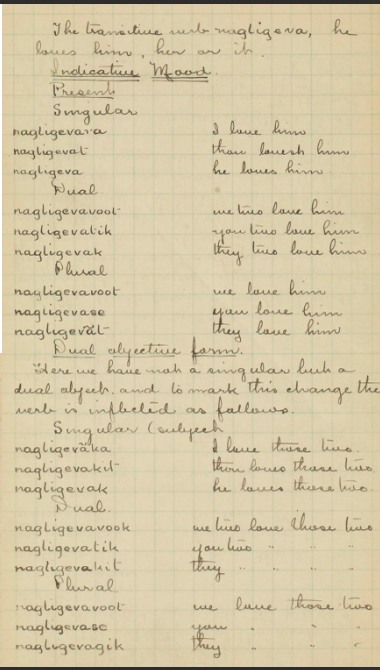
Person & Number Variations
Morphology
__________: Inuktitut has a single, dual, plural distinction (one thing=one morpheme, a different=another)
Inclusive/exclusive Distinction
Morphology
_____________: Cree has this.
“We” all of us are included vs.
“We” not you guys
Gender—Animate/Inanimate
___________; In Algonquian languages, “most nouns are classified by their reference to living or non-living things, and hence the terms that have been applied to this are _____________.
Just as the linguistic use of terms like masculine, feminine, and neuter in the description of European languages should not be taken too literally, the terms should be viewed merely as useful names for the two noun classes of Cree.
Animate: Marked as special in one way or another, its association with and/or importance to life in general
Actual possession of life
Contribution towards creating life
Contribution towards sustaining life in difficult conditions
Contribution to spiritual life
Syntax
Word Order
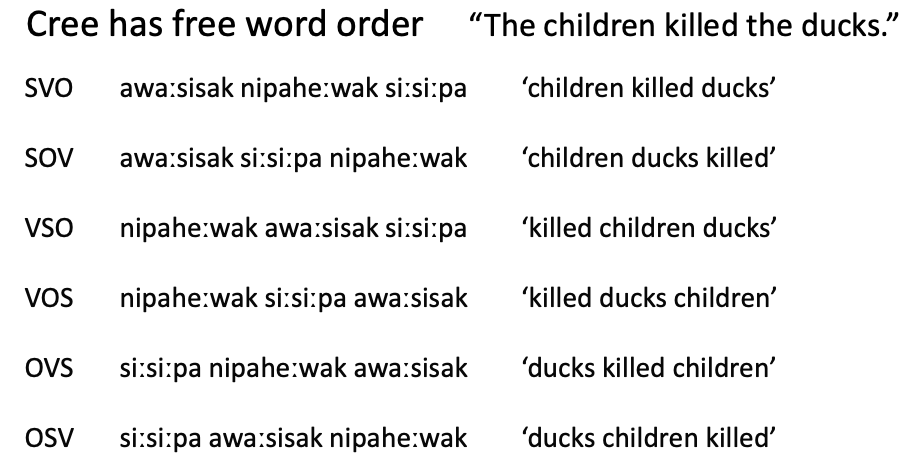
Cree has free word order