3. PLATYHELMINTHES
 View linked note
 Call Kai
 Learn
Learn Practice Test
 Spaced Repetition
 Match
Match Flashcards
 Knowt Play
1/23

There's no tags or description
Looks like no tags are added yet.
Name | Mastery | Learn | Test | Matching | Spaced | Call with Kai |
|---|
No analytics yet
Send a link to your students to track their progress
24 Terms
AIMS – FREE LIVING PLATYHELMINTHES
Understand the basic morphology of Platyhelminthes.
Describe the locomotion and reproductive system of free-living flatworms.
Describe the typical life history strategies seen.
Describe the adaptions for parasitism in Trematodes
Platyhelminthes - The basics
Platy = flat
Helminth = worm
30000 species
0.2 mm - 40 m
simple animals - some specialised features
Bilateral (first ones to be called that)
Free living and parasitic
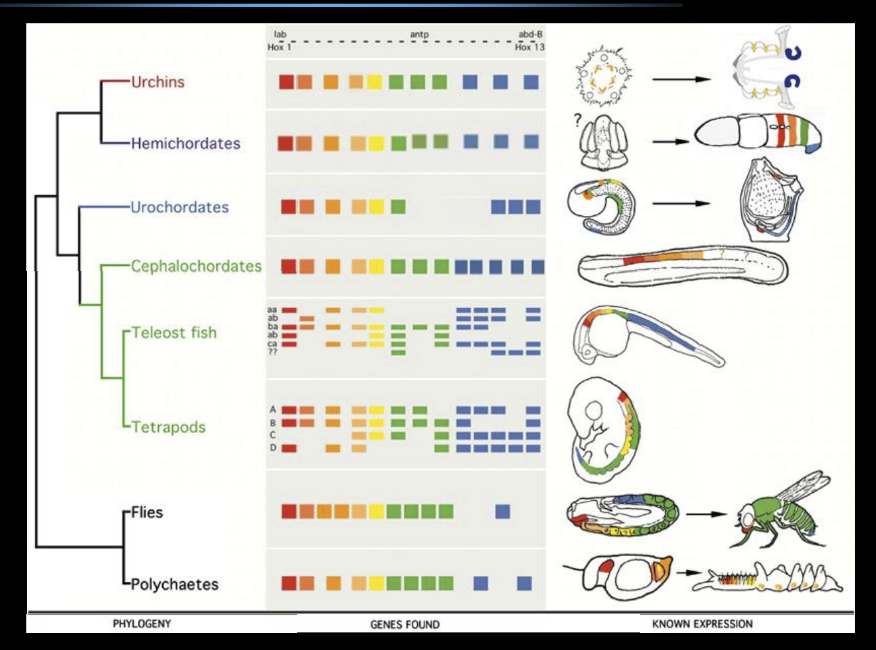
HOX Genes
Used to look at how species evolve
Group of related genes that conrol how embryo develops - along aterior-posterior end
Embryo segments have associated HOX protiends that determine what the segment becomes
Free Living PLATYHELMINTHES
Thought to be the first of Bilateral - bilaterally symmetrical
Dorso-ventrally flattened
Sagittal planes - head to tail - similar halves on either side
Secondarily Simple
eg. cave fish that lost eyes
lost traits from ancestral form due to evolution
Does simple form= ancestral form?
EVOLUTION OF BILATERIA
CEPHALISATION and DIFFERENTIATION- allowed the Platyhelminthes to pioneer a new way to survive
allow for movement - first hunters
Paired sense organs and a locomotory surface, they were able to move in a forward direction; they were able to hunt for food and for mates
find food
find mate
CEPHALISATION
Sense organs at head end. • Anterior end meets the environment first • Anterior/Posterio
DIFFERNTIATION
Of upper surface – dorsal, and lower surface- ventral.
• The ventral surface becomes the locomotor surface
Terrestrial Movement of Platyhelminths
small cillia and slime (muscus)
anterior end senses where it is
mouth is at middle of body
inverts pharynx (tounge) into prey and puts digestive enzymes into prey
Marine Movement of Platyhelminths
undulating muscular contractions to swim
still use gliding action over surfaces
Classes of Platyhelminthes
Turbellaria - Mostly free living hunters and scavenger
Monogenea - Flukes, all parasitic, most species are ectoparasites on fish -will be covered more in the platyhelminth lab
Cestoda - Tapeworms, all endoparasitic in vertebrates
Termatoda - Flukes, all parasitic, found in digestive tracts of vertebrates
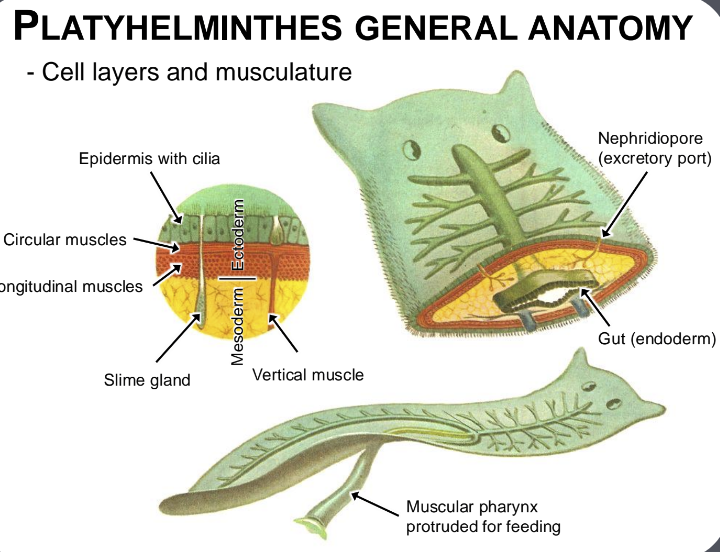
PLATYHELMINTHES GENERAL ANATOMY
muscular structures - allow for size and variety
Rabdite cells - slime production
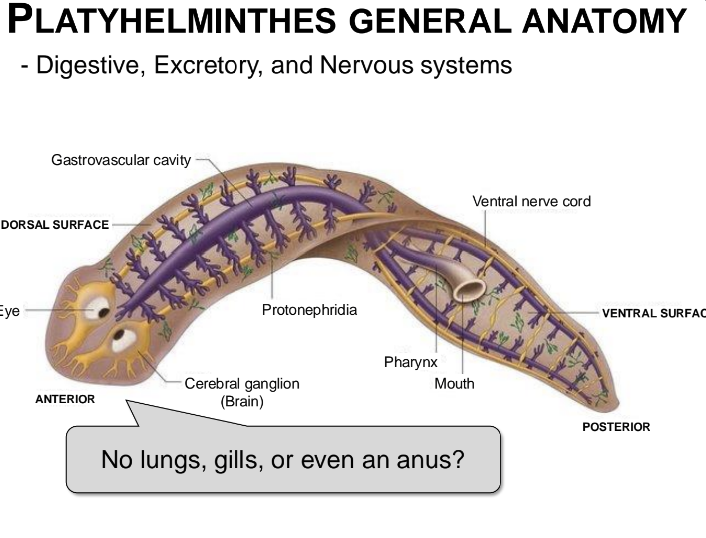
sensory: cerebral ganglion and ventral nerve cord
LOCOMOTION
Smaller - Turbellaria generally glide over secreted mucous using ciliary action.
Larger - species are too heavy to glide using cilia alone and use muscular contraction to swim or creep, raising and lowering their ventral surface
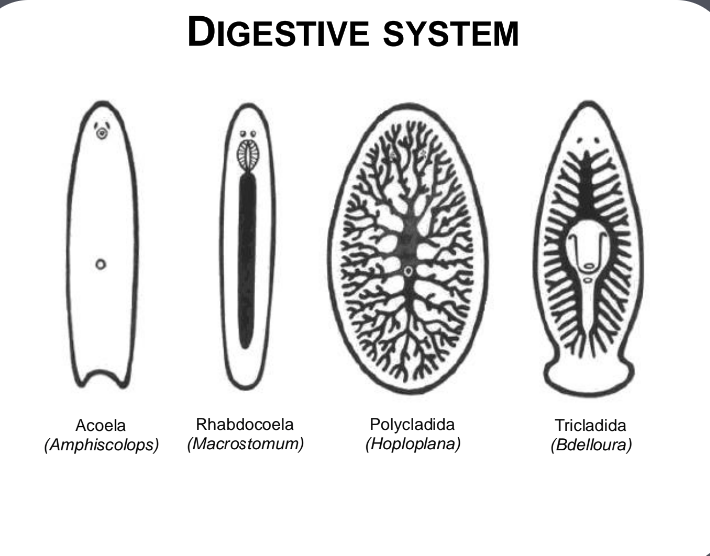
Platyhelminth digestive system
similar to sponge canal system - but not relying on water coming in and out
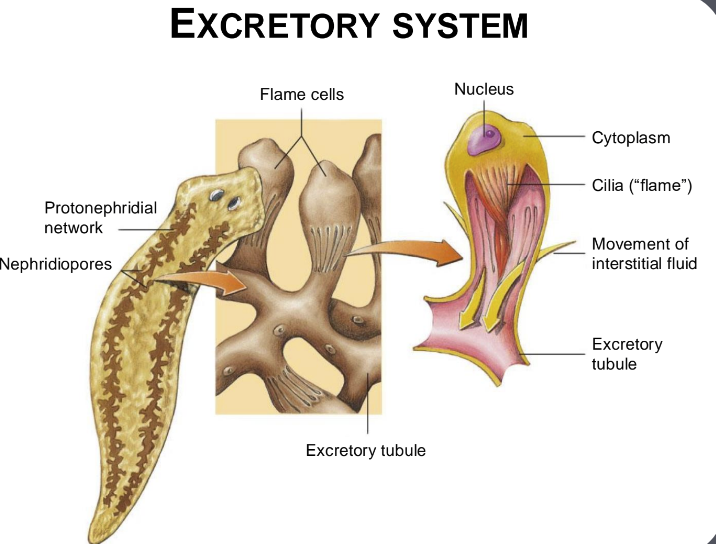
Platyhelminth EXCRETORY system
Flame Cells: Protonephridial network of tubules - act like kidneys - processing and purifying nutrients (get rid of ammonia)
Active - draw stuff in and get rid of rest
Osmoregulatory process- regulates water
Platyhelminth Nervous system
simple to complex
Cerebral gangalia (brain)
complex ones have lateral nerve systems
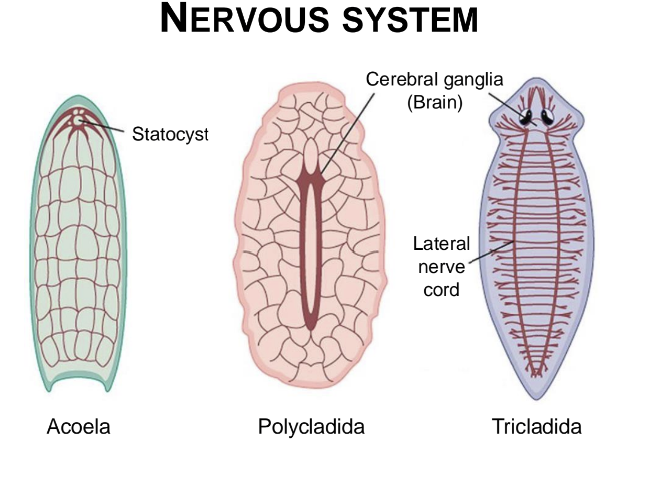
key to them being the first hunters - able to make decions on where to go
Platyhelminthe Sensory Organs
Photoreceptors - “cup eyes” - see light and dark
Statocysts - gravity senses
Mechanoreceptors - can feel what they’ve touch before
Cempreceptors - tasting environment
Frequently arranged to locate the source of sensory stimuli, useful for a hunter!