USE THIS Q4 OR244 Question Bank
 Call Kai
 Learn
Learn Practice Test
 Spaced Repetition
 Match
Match Flashcards
 Knowt Play
1/110

There's no tags or description
Looks like no tags are added yet.
Name | Mastery | Learn | Test | Matching | Spaced | Call with Kai |
|---|
No analytics yet
Send a link to your students to track their progress
111 Terms
In which decade of life is facial growth completed?
Fifties and later
3 multiple choice options
Growth, most of the time, will refer to:
(A) increase in number
(B) increase in size
(C) change
(D) increase in complexity
A+B+C
3 multiple choice options
Development is primarily used to refer to:
(A) gaining cells specialization
(B) increase in numbers
(C) change
(D) increase in size
(E) increase in complexity
A+E
3 multiple choice options
Growth pattern refers to the predictable changes in body proportions over time as individual grows.
True
1 multiple choice option
The maxilla (A) grows faster than the mandible during adolescent growth because (B) it's closer to the brain and more influenced by the neural growth curve than the mandible is.
A false, B true
3 multiple choice options
Synchondroses are thin, soft tissues between adjacent bones:
(A) have only periosteum and connective tissue
(B) filled with cartilage
(C) have direct ossification
(D) are capable of active, independent growth
B+D
3 multiple choice options
Growth of a long bone occurs (A) in the growth plate, (B) in a layer of periosteum adjacent to bone surface, (C) in bone marrow.
A true, B true, C false
3 multiple choice options
Osteoclasts are bone cells responsible for (A) bone stability (B) synthesizing of specific bone matrix components, (C) bone resorption, and (D) sensory input during adaptation of bone to mechanical factors.
A, B, D false, C true
3 multiple choice options
Main steps in conversion of cartilage into bone (endochondral ossification) are:
1. Invasion of blood vessels into cartilaginous anlage
2. Multiplication of cartilage cells
3. Degeneration of cartilage cells
4. Replacement of cartilage cells by osteoblasts
5. Formation of bone matrix by osteoblasts
All true
3 multiple choice options
The mandible grows by:
(A) pushed from behind by the lengthening the cranial base
(B) endochondral replacement at the condyles
(C) apposition and remodeling resorption at the ramus
(D) pulled away from the skull by the growth of the soft tissues
B+C+D
3 multiple choice options
Mandibular condyle (mark all that applies):
(A) is the center of growth
(B) is the site of growth
(C) have a growth cartilage involved in growth
(D) has independent growth that is controlled genetically
B+C
3 multiple choice options
Which of the synchondroses fuses at birth?
Intra-sphenoidal
1 multiple choice option
Melvin Moss was a dentist-anatomist from Columbia University who recommended in 1970
The Functional Matrix Hypothesis that states that growth of the brain provides the force to separate bones
2 multiple choice options
The secretion of extracellular material is the most important cellular activity for growth of the craniofacial skeleton.
True
1 multiple choice option
Bone (mark all that applies):
(A) increase in the diameter by appositional growth
(B) grows under pressure
(C) grow in length at the epiphyseal plate
(D) grows under tension
(E) is tension adapted
A+C+D+E
3 multiple choice options
Which of the following is not characteristic of the face of a newborn infant?
face is longer than it is broad
3 multiple choice options
Embryonic period (mark all that applies):
(A) Is period when functions of organs develop
(B) is also called organogenetic period
(C) Is from 3-8 week of gestation
(D) Is from 9-22 weeks of gestation
(E) Is period when embryo is most sensitive to teratogens
B+C+E
3 multiple choice options
Development of the face begins in _____ week of gestation
4th
3 multiple choice options
Almost all the tissue of the face and neck originate from ectoderm
True
1 multiple choice option
If a child has a chronologic age of 10 but a bone maturation age of 12, what is her dental age most likely to be?
12
3 multiple choice options
(A) Acute febrile illness in a child leaves a mark in the teeth forming at the time because (B) growth of dentin and cementum stops during the feverish episodes
A true, B true, A and B not related
3 multiple choice options
On the growth chart with 6 months data plots, what is the significance of a child "crossing the percentiles" downward?
indicates growth disturbance, perhaps chronic illness or chronic problem
3 multiple choice options
In fetal and postnatal growth, what is meant by the "cephalocaudal gradient of growth"?
trunk and limbs grow faster than head
3 multiple choice options
At what stage do the lymphoid tissues reach their maximum development?
pre adolescence
3 multiple choice options
The mandible (A) grows faster than the maxilla during adolescent growth because (B) it's closer to the brain and more influenced by the neural growth curve than the mandible is
A true, B false
3 multiple choice options
The adolescent growth spurt is characterized by sexual differences in (mark all that applies):
(A) sexual orientation
(B) timing
(C) rate
(D) duration
(E) cognitive changes
B+C+D
3 multiple choice options
Major contributor to variability of growth
timing of adolescence
2 multiple choice options
More space in the pharyngeal area is provided during adolescent growth by (mark all that applies:
(A) Shrinkage of the tonsils and adenoids
(B) Backward remodeling of the posterior pharyngeal wall
(C) Forward movement of the tongue as the mandible grows
A+C
3 multiple choice options
The adolescent period of life is mediated by sex hormones (A) and controlled through hypothalamic area of the brain (B) and the pituitary gland (C).
All true
3 multiple choice options
What percentage of a normally distributed population is within two standard deviations of the mean
95
3 multiple choice options
When considering physical growth and development, which term refers to qualitative changes (functional abilities), the gradual advancement in skills needed to be able to function?
Development
3 multiple choice options
What is the best way(s) of assessing growth and in particular the pubertal growth spurt of a patient for possible timing of orthodontic treatment? E.g. For growth modification treatment.
Skeletal age - Lateral cephalometric radiograph
3 multiple choice options
Dental age is determined by:
(A) The amount of development of the permanent teeth
(B) Which primary teeth have exfoliated
(C) Which teeth are erupted
(D) The amount of resorption of the roots of the primary teeth
All of the above
3 multiple choice options
When considering rate of growth of a child - which statement is correct?
Rate of growth declines in infancy rapidly, slightly declines in childhood, significantly increases in adolescence, and decreases going into adulthood.
3 multiple choice options
When considering growth and development in girls and boys:
There is a gender variation between girls and boys - girls tend to start the pubertal growth spurt earlier than boys and achieve complete growth earlier than boys
3 multiple choice options
When considering Scammon Systemic Growth Curves for the growth of the maxilla and mandible, which statement is incorrect?
The reason why the facial profile begins straight and then becomes more convex as a child growing into adulthood, is associated with the difference in the rate and timing of the maxillary and mandibular growth curves
3 multiple choice options
Eruption sequence of the primary dentition in the upper right quadrant is usually:
Start tooth - #e, #d, #b, #c, #a last tooth
3 multiple choice options
Eruption Hematoma. Which statement is INCORRECT?
Usually requires surgical treatment
3 multiple choice options
Anatomy of Primary Teeth - which is incorrect?
Primary teeth have less cervical constriction than permanent teeth
3 multiple choice options
In a complete primary dentition we see primate spaces. These are positioned and measure in the upper dental arch:
Mesial to the upper primary canine tooth and usually is 4mm
3 multiple choice options
Evaluation of the Primary Complete Dentition - incisal overjet and overbite. Which answer is correct?
Incisal overbite is the vertical overlap of the anterior teeth and measured in % or mm
3 multiple choice options
Complete primary dentition - Molar relationship. When classifying the primary molar relationship, which relationship is not described/classified?
Exaggerated distal step
3 multiple choice options
A mesial step primary molar classification will usually produce a ?_ permanent molar relationship in the permanent dentition.
Class I
3 multiple choice options
In a complete primary dentition, the class I canine relationship is best described as ......the cusp tip of the maxillary primary canine is in the same vertical plane as the distal surface of the mandibular primary canine tooth.
True
1 multiple choice option
In the early mixed dentition, between the ages of 6 to 9yrs of age, the permanent upper central and lateral incisor teeth start to erupt into the mouth. At this stage, all the statements below are correct, except:
There is an "incisor liability", the 4 maxillary permanent incisors are 2mm larger than the primary incisor teeth
3 multiple choice options
The Leeway Space - is the tooth size differential between primary, canine and molars and their permanent successor teeth. Which of the following statements is correct?
The Leeway space is estimated to be 0.9mm per quadrant in the maxillary arch and 1.7mm per quadrant in the mandibular arch
3 multiple choice options
The Primary Dentition/Intact Dental arch - True or False?
Primary tooth eruption starts at age 6 months and typically completes at age 4 (T or F)
Is typically associated with crowding in the dental arch (T or F)
The primary forces acting on the teeth as they erupt into the mouth are the muscles of the tongue and muscles of mastication (T or F)
The dental arch growth continues in the permanent dentition, especially posteriorly (T or F)
False, False, True, True
3 multiple choice options
Transition of mixed dentition into the permanent dentition - True or False?
The mixed dentition typically ranges from 6 years to 10 years of age (T or F)
The primary force on the teeth in the dental arches comes from the muscles of mastication, the tongue and includes erupting permanent teeth (T or F)
The primate spaces typically remain open (T or F)
The amount of growth is moderate and steady until puberty (T or F)
False, True, False, True
2 multiple choice options
In the mixed dentition phase, in a non-intact dentition, where there has been premature loss of a primary molar...
...the amount of space loss will be dependent on the eruption phases of the adjacent teeth/active eruption.
3 multiple choice options
In the Intact Dentition, during the mixed dentition phase of development...
...the lower first permanent molar tooth erupts using the distal surface of the second deciduous/primary molar tooth, without rotation.
3 multiple choice options
What is the correct eruption sequence for the permanent dentition in the upper right quadrant of the dental arch?
Start #3, #8, #7, #5, #4, #6 last tooth
3 multiple choice options
If the upper right second deciduous/primary molar tooth is lost earlier than it should be (i.e. extracted due to caries)...
The upper right first permanent molar tooth will tip mesially and rotate around its palatal root
3 multiple choice options
Which would be an undesirable quality (incorrect statement) of a space maintainer?
Should be able to be activated to cause tooth movement
3 multiple choice options
Which diagnostic record is not routinely taken as part of standard orthodontic diagnostic records?
Bone scan
3 multiple choice options
When evaluating a patient's physical growth and assessing the cervical vertebral maturation, which phase is most ideal to carry out optimal orthodontic treatment or mandibular growth modification?
CVM 2 to 3
3 multiple choice options
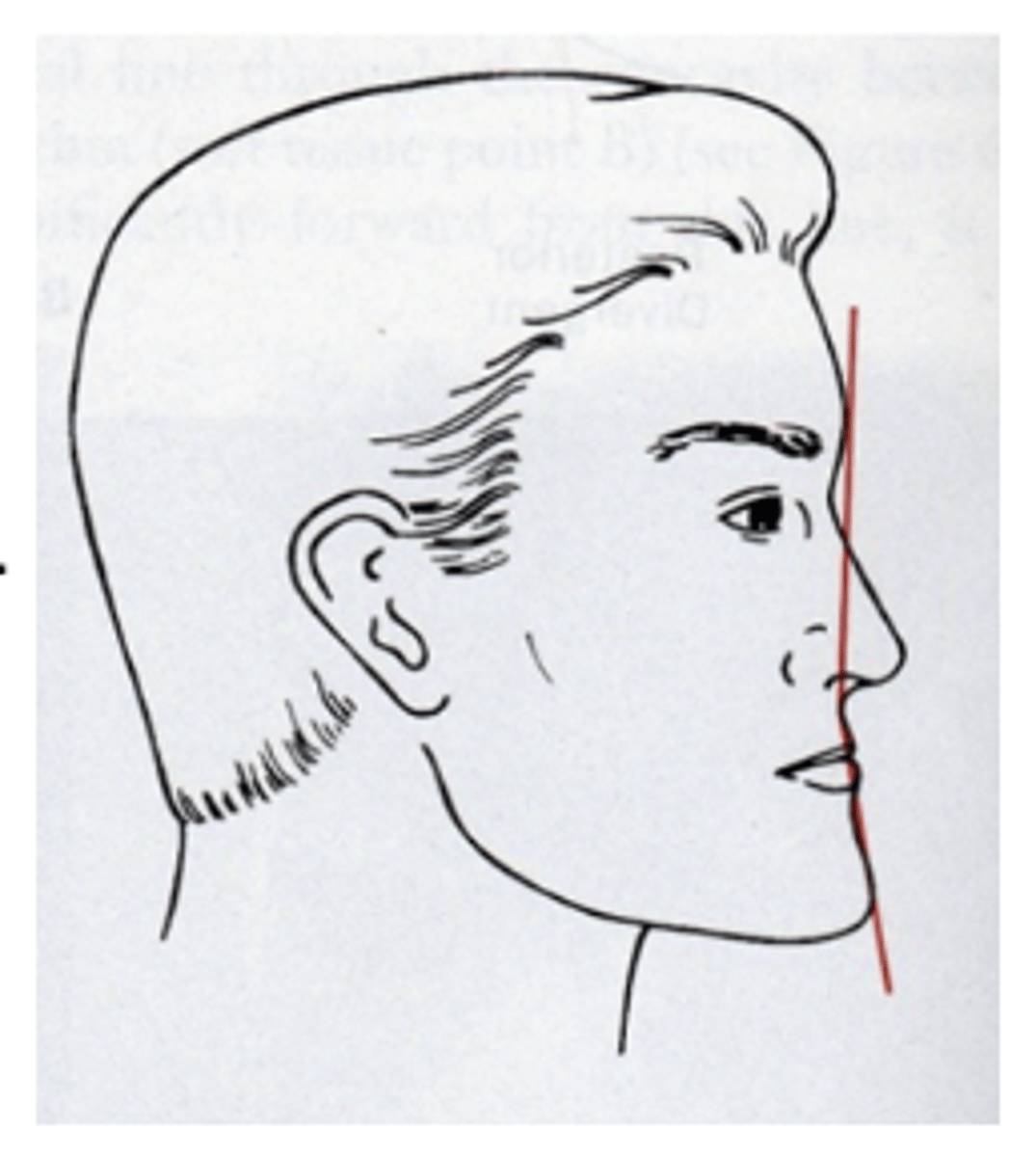
When carrying out a clinical evaluation of the face, a concave facial profile would be?
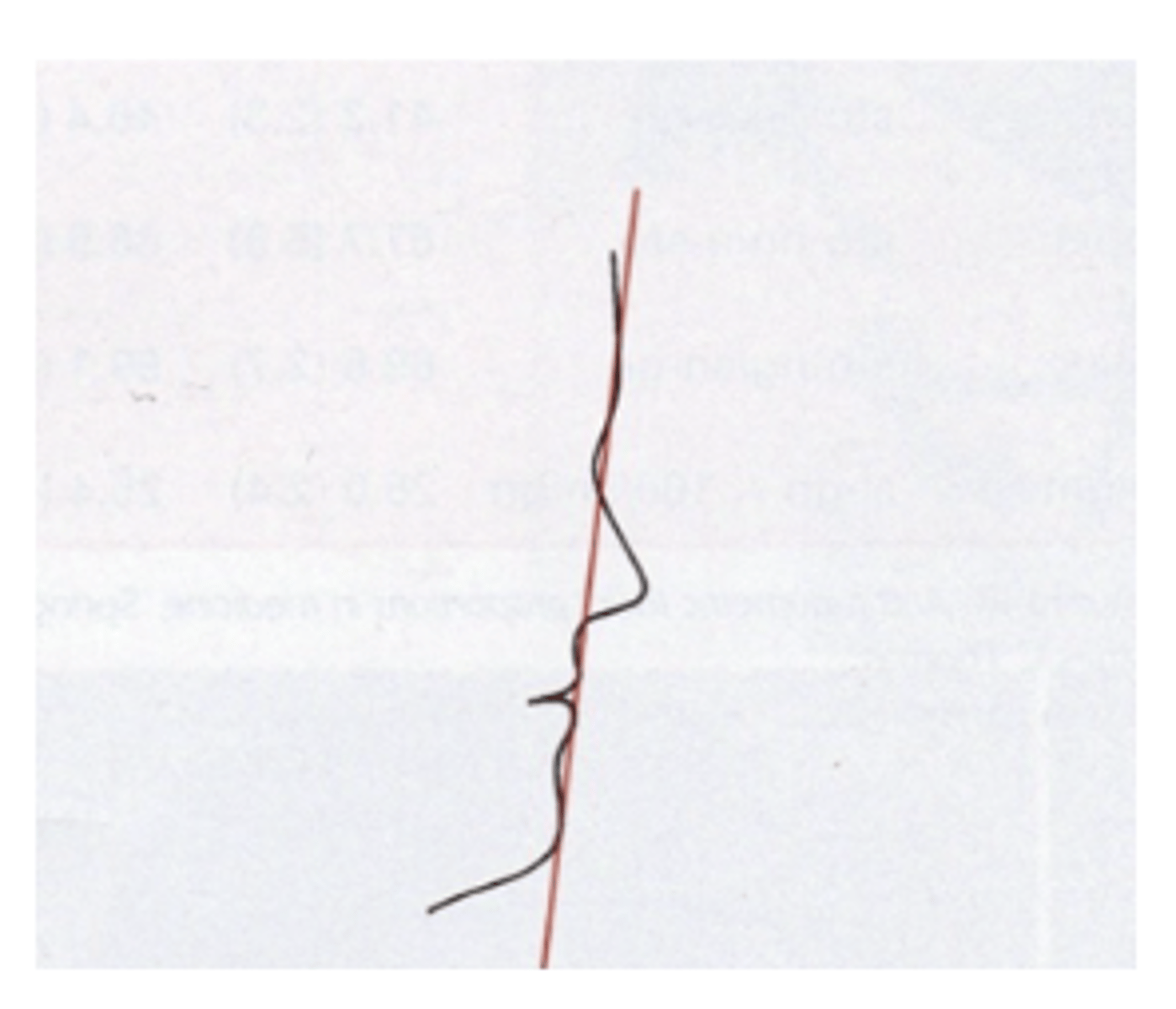
When carrying out a clinical evaluation of the face, a posterior divergent facial profile would be?
When orthodontically evaluating a patient's tooth-lip relationship, at mini esthetic level, the ideal amount of incisor display and gingival display should be:
On full smile - show 70 to 100% incisal display and 1 to 2mm gingival display for females
3 multiple choice options
A patient with a significant posterior divergent facial profile is likely to have:
Skeletal II jaw relationship
3 multiple choice options
A patient with a significant convex facial profile is likely to have a:
Skeletal II jaw relationship
3 multiple choice options
When orthodontically evaluating a patient's tooth-lip relationship at the mini esthetic level, the ideal amount of incisal show at repose should be:
1 to 2 mm
3 multiple choice options
The smile arc is:
The contour of the upper anterior teeth incisal edges relative to the curvature of the lower lip on social or posed smile
3 multiple choice options
When evaluating the dental appearance of the upper anterior teeth, the micro esthetics of the teeth are:
The width of the upper central incisor should be 4/5th's the height of the anatomical crown height
3 multiple choice options
In a complete primary dentition we see primate spaces. These are positioned and measure in the upper dental arch:
Mesial to the upper primary canine tooth and usually is 4mm
3 multiple choice options
In the early mixed dentition, between the ages of 6 to 9yrs of age, the permanent upper central and lateral incisor teeth start to erupt into the mouth. At this stage, all the statements below are correct except:
there is an "incisor liability", the 4 maxillary permanent incisors are 2mm larger than the primary incisor teeth
3 multiple choice options
In the early mixed dentition, there can be crowding in the lower incisor region. As the dentition progresses, the crowding may resolve. This is by several means: (which is the incorrect answer)
The lower permanent incisors intrude relative to the position of the primary incisor teeth
3 multiple choice options
The Leeway Space - is the tooth size differential between primary canine and molars and their permanent successor teeth. Which statement is correct?
The Leeway space is estimated to be 0.9mm per quadrant in the maxillary arch and 1.7mm per quadrant in the mandibular arch
3 multiple choice options
Leeway space and Molar drift. Which is the correct statement:
A mesial step in the primary dentition will most likely lead to a class I molar relationship in the permanent dentition
3 multiple choice options
In carrying out a mixed dentition arch length analysis, there are four analysis that can be carried out. Which is the incorrect answer?
Indirect measurement
3 multiple choice options
Using the Direct Measurement method space analysis in the mixed dentition — which statement is incorrect?
Lower permanent canine and both premolar teeth need at least 36mm spacing per quadrant
3 multiple choice options
When considering treatment in the mixed dentition, the goals you should consider are:
(A) Mixed dentition treatment should not be too long
(B) Mixed dentition treatment should have specific aims for intervention and be time limited
(C) Precise tooth movement is essential if a second phase of treatment is anticipated
A and B only are correct
1 multiple choice option
Examples of orthodontic treatment in the mixed dentition include: (which statement is incorrect)
Correction of a protrusive mandible
3 multiple choice options
Space can be created in a moderate to severe mixed dentition dental arch. Which is the incorrect answer?
Retrocline lower incisors
3 multiple choice options
Serial extraction is carried out in the mixed dentition. Which is an incorrect indication for treating a patient by serial extraction?
Crowding of 2.5mm in each dental arch
3 multiple choice options
The Serial extraction sequence is below — which statement is incorrect?
Extraction of primary canines to facilitate the second premolars to erupt first
3 multiple choice options
When considering the Stress/Strain curve of a material, eg orthodontic archwire, the ultimate tensile strength-maximum stress of a material is when: (which is the correct answer)
the maximum amount of Stress-Strain a material can withstand while being pulled before necking occurs
3 multiple choice options
NiTi Orthodontic archwires special properties are: Which are the correct two statements?
A — They do not have superelastic properties
B — They do have shape memory properties
C — They do have superelastic properties
D — They do not have shape memory properties
B and C True
3 multiple choice options
When considering the interpretation of a NiTi orthodontic archwire stress-strain curve/graph:- (which is incorrect)
The stress-strain curve for stainless steel archwire shows the same typical stress-strain pattern as NiTi
3 multiple choice options
When considering a force on a tooth, which factors need to be considered: (which is the incorrect answer)
Can be defined as when a force is applied to an object, it will move the object in the opposite direction to the force applied
3 multiple choice options
Which statement/principle is incorrect:
When an object is partially restrained, eg root of tooth in bone, the center of resistance of the object, eg root of tooth, for moving will remain unchanged
3 multiple choice options
When a force is applied to the clinical crown of a tooth, with a healthy alveolar bone around the root, a moment will occur. This means: (which is the correct answer)
The tooth will tip and translate forwards in the direction of the force
3 multiple choice options
When considering couple forces placed on a tooth, they can be classified as First, Second and Third Order. Which of the below statements are correct:
A couple in the second order is a mesiodistal movement and a third order is a labio-lingual movement
3 multiple choice options
When considering the optimal force to apply to an upper permanent central incisor tooth for intrusion, it should be in the range of: (which is the correct answer)
10 to 20 grams
3 multiple choice options
There are several types of cell in the periodontal ligament (PDL). These include...
A - Undifferentiated cells (pluripotential mesenchymal cells)
B - Osteoclasts
C - Neural and vascular cells
D - Fibroblasts
E - Osteoblasts
All of the above are correct
1 multiple choice option
Characteristics of cells in the PDL. Which is the correct statement?
Osteoclasts are multinuclear cells derived from the haemopoietic stem cells
3 multiple choice options
Characteristics of osteoclast cells. Which statement is correct?
A - Their differentiation pathway is common to macrophages and dendritic cells
B - Their main function is to dissolve mineral and degrade the underlying organic matrix
C - They are multinuclear cells
D - They originate from the haemopoietic stem cell population
All A, B, C and D are correct
2 multiple choice options
The response of the periodontium to NORMAL Function when an orthodontic force is applied is:
A - During normal mastication of food, the forces generated between teeth are heavy and intermittent
B - Less than 1 sec - PDL fluid incompressible and alveolar bond bends. This causes a piezoelectric signal in the bone
C - 1 to 2 sec - PDL fluid is expressed, and tooth moves in the PDL space
D - 3 to 5 sec - PDL fluid expressed, the PDL tissues are compressed, and immediate pain is experienced
E - The PDL is designed to resist/adjust to short duration light and heavy forces. As orthodontic treatment forces are generally of longer duration, the result to this type of light/continuous force produces a very different physiological response.
All statements are correct
1 multiple choice option
In the Bioelectric Theory, which statement is incorrect?
The Bioelectric theory is the MAIN theory that underlies how teeth/roots move through bone under the influence of orthodontic forces
3 multiple choice options
When considering the Pressure - Tension theory and the cells involved in areas of tension and compression in the PDL: (which are the correct statements)
A - Osteoblasts respond to pressure and build bone
B - Osteoclasts respond to tension and remove bone
C - Osteoblasts respond to tension and build bone
D - Osteoclasts respond to pressure and remove bone
C and D are correct
3 multiple choice options
In the Pressure - Tension Theory - when a LIGHT orthodontic force is applied to a tooth/root against bone: (which is the incorrect statement)
Hyalinization or sterile necrosis of the bone will occur
3 multiple choice options
In the Pressure - Tension Theory - when a HEAVY orthodontic force is applied to a tooth/root against bone: (which is the incorrect statement)
This process is also called Frontal Resorption
3 multiple choice options
Types of bone remodeling. (Which is the incorrect statement?)
Frontal resorption occurs in response to heavy sustained force
3 multiple choice options
For orthodontic tooth movement to take place, a sustained force must be applied to a tooth. Clinically...
The time threshold before tooth movement occurs is 4 to 6 hours
3 multiple choice options
When considering orthodontic tooth movement, using the Tension-Pressure Theory - when a LIGHT FORCE is applied to a tooth, which statement is true?
A - On the pressure side of the root, the PDL area is fully compressed, and blood flow is cut off
B - On the compressed side of the PDL, within hours of the PDL blood flow being cut off, cell death occurs
C - The tooth starts to move in 2 to 3 days
D - The process is called Frontal Resorption
E - The process produces sterile bone necrosis and undermining resorption
C and D correct
3 multiple choice options
Systemic Factors affecting orthodontic tooth movement. Which statement is incorrect?
Bisphosphonates significantly increase orthodontic tooth movement
3 multiple choice options
Clinically, when considering root resorption and orthodontic treatment: (which statement is incorrect)
Invisalign orthodontic treatment generally causes significantly more root resorption than fixed appliance therapy
3 multiple choice options
Orthodontic Relapse after orthodontic treatment. Factors that have been shown to be implicated in orthodontic relapse after a course of orthodontic treatment include: (which are the correct answers)
A - Gingival and periodontal fibers
B - The distance the teeth have been moved during orthodontic treatment
C - The force duration on the teeth
D - Time period of bone remodeling following orthodontic tooth movement
E - Soft tissue pressures, eg the lip
A, B, C, D, and E are all correct
3 multiple choice options
Orthodontic retention is used to help control: (which is the incorrect answer)
Bone remodeling - this takes 20 to 30 days
3 multiple choice options
When considering the treatment plan for a patient, there is a hierarchical prioritization of stages to their dental treatment and plan. Orthodontic treatment would be in: (what is the correct answer)
Definitive phase
3 multiple choice options
There are FOUR stages or phases of orthodontic treatment involved when a patient is treated with a fixed appliance. Which statement is correct?
When in the leveling and aligning phase, you would expect to be in a light NiTi orthodontic archwire
3 multiple choice options