ACTIVITY 14 THE INVERTEBRATES: DIGESTION, EXCRETION, AND NEURAL INTEGRATION
 Call Kai
 Learn
Learn Practice Test
 Spaced Repetition
 Match
Match Flashcards
 Knowt Play
1/14

There's no tags or description
Looks like no tags are added yet.
Name | Mastery | Learn | Test | Matching | Spaced | Call with Kai |
|---|
No analytics yet
Send a link to your students to track their progress
15 Terms
incomplete; complete
There are two types of digestive systems: the ____________ and the ___________ digestive systems.
incomplete; gastrovascular cavity;
mouth
Lower invertebrates exhibit an ___________ digestive system, which is made up of a sac-like structure called the ___________________.
It has only one opening, called the ________, wherein food particles enter, and undigested materials leave the body.
alimentary canal;
mouth; anus;
complete
In higher invertebrates, the digestive system is a long tube referred to as the digestive tract or _______________.
This has two openings: an anterior opening, the __________, and a posterior opening, the ___________.
This type of digestive system is described as ____________.
mouth; pharynx; esophagus; stomach; small intestine; large intestine; rectum
A complete digestive system consists of seven functional regions: __________, _________, ___________, _________, ___________, ____________, and __________.
mouth; peristalsis;
small intestine;
anus
Food is generally broken down mechanically in the _________ and moved through the digestive tract by the contraction of its muscular walls (____________).
Chemical digestion occurs along different parts of the digestive tract.
Digested food material is then absorbed through the walls of the _____________ and transported to the various tissues of the animal by the blood.
The undigested residue is eliminated as feces via the ________.
instinctive; learned;
Feeding and digestion are but part of the wide array of complex behaviors coordinated by their small brains of invertebrates like insects.
Insect neural circuits perform both ____________ and ___________ sensorimotor transformations.
Neural processing is controlled internally by variables like the invertebrate’s behavioral state.
On the other hand, neural processing can be controlled externally through factors such as the time of day.
Hence, it is useful to look at insect model systems in providing insights on sensorimotor integration.
mouth; pharynx; intestine;
ventrally;
pharyngeal sheath;
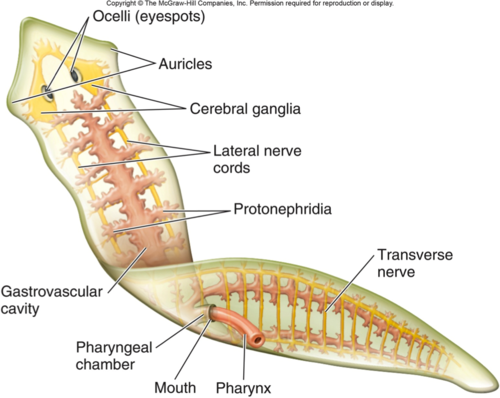
When ingested food travels from the mouth through the pharynx into the intestines where it is digested by the cells lining the intestines.
Incomplete Digestive System in Invertebrates
Planarians exhibit an incomplete digestive system made up of only a __________, a __________, and an ____________.
The pharynx is located ___________ at the middle portion of the planarian body.
It is enclosed by a _____________ which opens just posteriorly in the mouth.
Meanwhile, the intestine has three multi-branched trunks: one anterior and two posterior trunks.
All these forms the gastrovascular cavity that spreads out to the body.
foregut; midgut; hindgut
Complete Digestive System in Invertebrates
Keenly observe the three main parts of the cockroach digestive tract or alimentary canal: _________, _________ and __________.
foregut or stomodeum;
pharynx;
esophagus;
crop;
gizzard
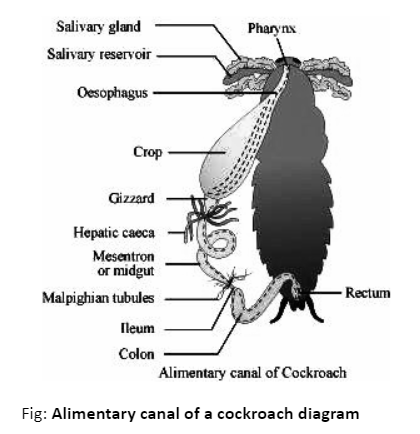
The _________ or ___________ of the alimentary canal starts with the mouth.
The cavity of the mouth is called as ___________.
Next to the pharynx is the extension of the foregut called the __________.
The inflated extension of this canal would be the __________ . This is where food is temporarily stored. that has a similar structure like the esophagus.
An opening of the crop is a muscular organ called the ____________. It has sharp teeth-like structures that grinds the food into smaller pieces.
gastric caeca;
mesenteron;
gastric caeca;
ventriculus;
peritrophic membrane;
Six pairs of finger-like projections at the joint of the gizzard are referred to as the _____________.
The gastric caeca mark the start of the midgut or the ____________. The gastric caeca serve to increase the surface area of the midgut.
The _______________ increase both its (midgut) ability to secrete digestive enzymes and its ability to extract useful products from the partially digested food.
These digestive juices and enzymes in turn, flow into the stomach or _____________.
In addition, the midgut is lined by a ________________ (not by a cuticle) which prevents damage to the stomach wall and allows full passage of enzymes as well as digested food.
proctodeum;
Malpighian tubules;
small intestine or ileum;
large intestine; rectum
The hindgut or ___________ consists anteriorly of a short small intestine, a middle colon, and posteriorly, a rectum.
The _________________ are thread-like extensions that mark the start of the hindgut.
Further digestion and absorption take place in the short segment of the _______________ or __________.
Meanwhile, the _____________ reabsorbs water from the undigested food and the __________ stores waste until elimination.
pharynx;
Malpighian tubules; fluid absorption
Excretion - Part 1
In invertebrates that have incomplete digestive systems like planaria, excretion is executed in a very simple manner. The undigested food is egested back to the _________.
On the other hand, insects that possess complete digestive systems make use of the _______________ for excretion. These fine projections marking the start of the hindgut is the site for _______________.
Fluid is absorbed at the distal end of the tubules, since they are directly bathed by the hemolymph in the perivisceral sinus.
uric acid;
Excretion - Part 2
Next, the absorbed fluids move toward the proximal region of the malphigian tubules.
Water and various salts are absorbed by the body and nitrogenous waste is precipitated as ___________, in the form of urine.
The concentrated urine is discharged into the hindgut and past onto the rectum. Here, water is reabsorbed, and the urine and feces are released as dry pellets.
Neural integration;
supraesophageal ganglia; subesophageal ganglia; brain; nervecord
Neural Integration
Invertebrate behavior such as feeding, grooming, and escaping in insects is largely made possible because of neural Integration.
______________ is a way of connecting the communication pathways in the brain that may have become blocked or shut down because of varying factors and conditions (e.g. stress).
Examine under the dissecting microscope and locate the ventral nerve cords which lie on the median portion of the sternum.
Note the knobby, paired structures that occur along the nerve cord. These are the ganglia which are clusters of cell bodies. Nerve fibers radiate from these bodies.
There are the: ___________________ and the _________________. The former is referred to as the _________. Meanwhile, the latter is connected to the ____________.
Sensory input;
motor output
Review the recording of feeding behavior of the cockroach observed in the earlier activity. Log observations on the feeding behavior of the cockroach in Table 1.
Take note of the sensory input and motor output corresponding with the behavior of feeding.
_____________ is the stimuli that is perceived by the organism like olfactory, visual, mechanoreception, gustatory, and hearing. Anything perceived by the senses is considered as sensory input.
On the other hand, ______________ results after the nervous system integrates and process of sensory input.
It synthesizes sensory input to compute an appropriate motor response like leg extension, change in direction of locomotion etc.