BIO 107: Unit 4 - Ch 15.1 Autonomic Nervous System
 Call Kai
 Learn
Learn Practice Test
 Spaced Repetition
 Match
Match Flashcards
 Knowt Play
1/51

Earn XP
Description and Tags
Be sure to enable 'answer with term' in the Practice Test and Learn feature.
Name | Mastery | Learn | Test | Matching | Spaced | Call with Kai |
|---|
No analytics yet
Send a link to your students to track their progress
52 Terms
What is the autonomic nervous system?
Which nervous system:
Routine homeostatic adjustments made from subconscious mind
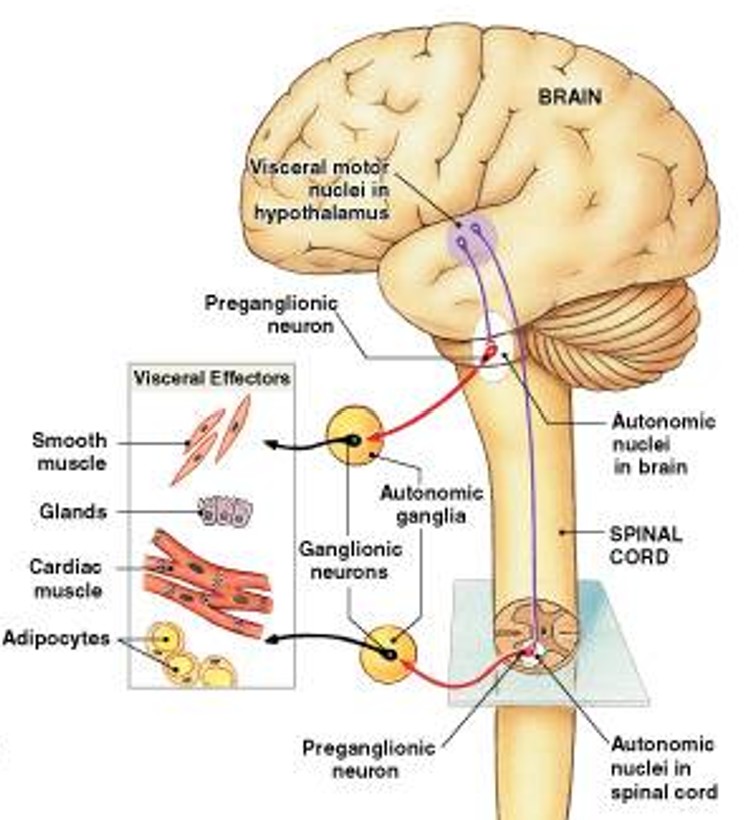
What are preganglionic neurons?
Which type of neuron:
Visceral motor neurons in the brain stem and spinal cord
What are preganglionic fibers?
Which type of fiber:
Axons of preganglionic neurons
What are ganglionic neurons?
Which type of neuron:
Visceral motor neurons in peripheral ganglia
What is the autonomic ganglia made of?
What is made of ganglionic neurons → innervate visceral effectors?
What are postganglionic fibers?
Which type of fiber:
Axons of ganglionic neurons, go from autonomic ganglia to peripheral target organ
What is the sympathetic division?
Which nervous division:
Readies body for a crisis
What is the first step of sympathetic activity?
Which step of sympathetic activity is:
Heightened mental alertness
What is the second step of sympathetic activity, after heightened mental alertness?
Which step of sympathetic activity is:
Increased metabolic rate
What is the third step of sympathetic activity, after increased metabolic rate?
Which step of sympathetic activity is:
Reduced digestive and urinary functions
What is the fourth step of sympathetic activity, after reduced digestive and urinary functions?
Which step of sympathetic activity is:
Energy reserves activated
What is the fifth step of sympathetic activity, after energy reserves activated?
Which step of sympathetic activity is:
Increased respiratory rate and respiratory passageway dilate
What is the sixth step of sympathetic activity, after increased respiratory rate and respiratory passageway dilate?
Which step of sympathetic activity is:
Increased heart rate and blood pressure
What is the seventh of sympathetic activity, after increased heart rate and blood pressure?
Which step of sympathetic activity is:
Sweat glands activated
What is sympathetic chain ganglia of sympathetic division?
Which ganglia of sympathetic division:
Lateral to vertebral column
Innervates body wall, head, limbs, & thoracic
What are sympathetic nerves of sympathetic chain ganglia?
Which nerve of sympathetic chain ganglia:
Postganglionic fibers from chain that innervates thoracic cavity
What is collateral ganglia of sympathetic division?
Which ganglia of sympathetic division:
Anterior to vertebral bodies, tissues & organs of abdominal cavity
What are splanchnic nerves of collateral ganglia?
Which nerve of collateral ganglia:
Preganglionic fibers that innervate the collateral ganglia
What is celiac ganglion of splanchnic nerves?
Which ganglion of splanchnic nerves:
Innervates stomach, liver, gall bladder, pancreas, & spleen
What is superior mesenteric ganglion of splanchnic nerves?
Which ganglion of splanchnic nerves:
Innervates small intestine & most large intestine
What is inferior mesenteric ganglion of splanchnic nerves?
Which ganglion of splanchnic nerves:
Innervates distal large intestine, urinary & reproductive systems
What is adrenal medulla of sympathetic division?
Which part of sympathetic division:
Center of adrenal glands
Release neurotransmitters into blood
Acts as hormones
What is the 1st step of parasympathetic activity?
Which step of parasympathetic activity is:
Decreases metabolic rate
What is the 2nd step of parasympathetic activity, after decreases metabolic rate?
Which step of parasympathetic activity is:
Reduction in heart rate & blood pressure
What is the 3rd step of parasympathetic activity, after reduction in heart rate & blood pressure?
Which step of parasympathetic activity is:
Digestive glands increase secretion
What is the 4th step of parasympathetic activity, after digestive glands increase secretion?
Which step of parasympathetic activity is:
Increase in digestive motility & blood flow
What is the 5th step of parasympathetic activity, after increase in digestive motility & blood flow?
Which step of parasympathetic activity is:
Defecation & Urination
What is the 6th step of parasympathetic activity, after defecation & Urination?
Which step of parasympathetic activity is:
Sexual arousal - stimulation of sexual glands
What are preganglionic neurons of parasympathetic division?
Which neurons of parasympathetic division:
Vagus nerves control 75% of parasympathetic activity
What is terminal ganglion of ganglionic neurons?
Which ganglion type of ganglionic neurons:
Located near the target organ
What is intramural ganglion of ganglionic neurons?
Which ganglion type of ganglionic neurons:
Embedded in the tissues of the target organ
What are pelvic nerves of ganglionic neurons?
Which nerve of ganglionic neurons:
Preganglionic fibers from sacral segments that innervate distal large intestine, urinary & reproductive systems
What is parasympathetic activation?
Which type of activation is:
Relaxation, food & energy absorption, cell growth
What do neurotransmitter release?
What always release ACh, and has a localized effect at neuromuscular & neuroglandular sites?
What are nicotinic receptors of neurotransmitters?
Which receptor of neurotransmitters:
Always causes excitation
Found in tobacco leaves
What are muscarinic receptors of neurotransmitters?
Which receptor of neurotransmitters:
Can be excitatory or inhibitory
Found in poisonous mushrooms
What is dual innervation?
Which type of innervation is:
Receiving sympathetic & parasympathetic
What does autonomic tone maintain?
What maintains the background level of activity?
Ex) heart rate & blood vessel diameter
What are visceral reflexes?
Which kind of reflexes:
Lowest level of ANS reflexes
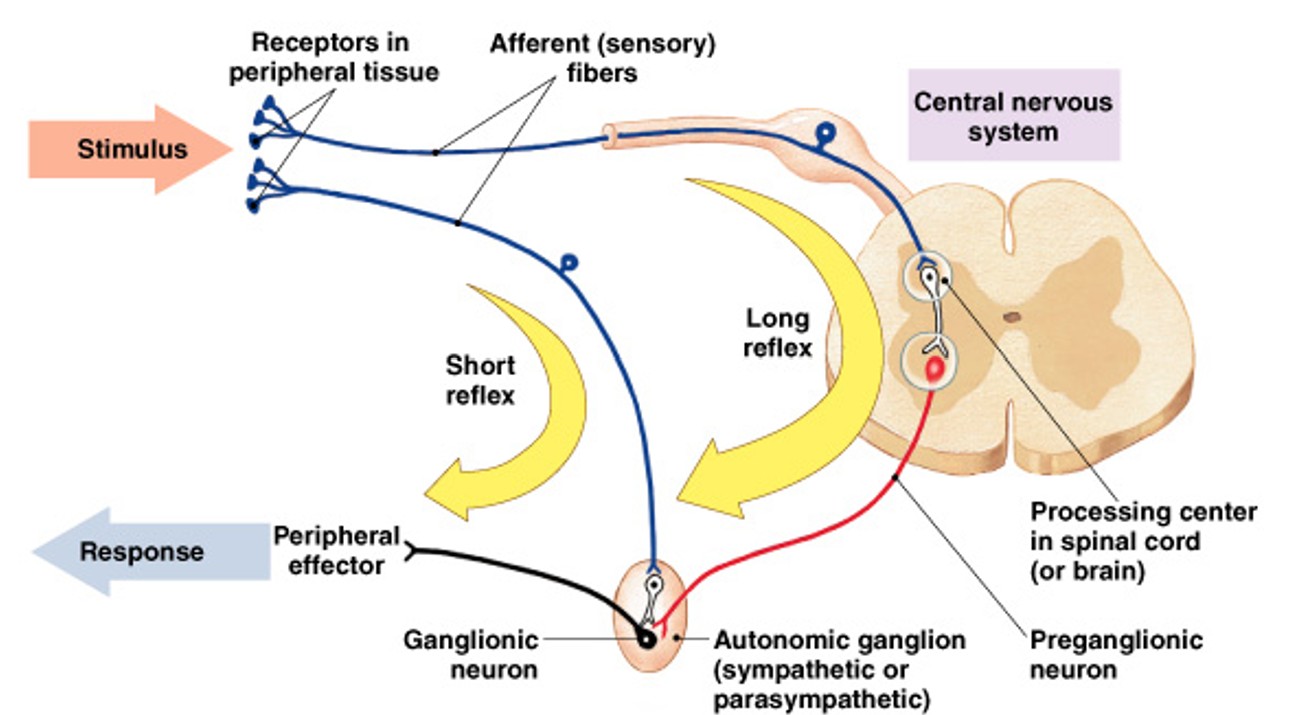
What is the pathway for visceral reflex arc?
What is this the pathway for:
Receptor → sensory neuron → interneuron → visceral motor neuron
What are long reflexes?
Which kind of reflexes:
Involves CNS
What are short reflexes?
Which kind of reflexes:
Bypasses CNS
What are higher-order functions?
What are these functions of:
Cerebral cortex is required
Involves conscious and unconscious information
Subject to adjustment & modification (not a pre-wired reflex)
What are fact memories?
Which type of memory:
Bits of information
What are skill memories?
Which type of memory:
Learned motor behaviors
What are short-term memories?
Which type of memory:
Do not last long
What are long-term memories?
Which type of memory:
Can last a life time
Secondary - need to be reviewed
Tertiary - lasts a life time
What is memory consolidation?
What converts short-term to long-term memory?
Involves amygdaloid body & hippocampus
What is basal nuclei of memory?
Which part of memory:
Storage & retrieval
What is dopamine of brain chemistry?
Which chemical within the brain:
Important in nuclei that control intentional movements
Inadequate dopamine causes motor problems (Parkinson’s)
What is serotonin of brain chemistry?
Which chemical within the brain:
Compounds that enhance effects also produce hallucinations
Compounds that inhibit or block action cause severe depression and anxiety
What are the characteristics of aging and the nervous system?
What are these characteristics of:
Reduction in brain size and weight
Reduction in the number of neurons
Decrease in blood flow to the brain
Changes in the synaptic organization of the brain
Intercellular and extracellular changes in CNS neurons