Comprehensive A-Level Biology: Cell Structure, Function, and Microscopy Techniques
 Call Kai
 Learn
Learn Practice Test
 Spaced Repetition
 Match
Match Flashcards
 Knowt Play
1/334

There's no tags or description
Looks like no tags are added yet.
Name | Mastery | Learn | Test | Matching | Spaced | Call with Kai |
|---|
No analytics yet
Send a link to your students to track their progress
335 Terms
What is resolution?
The minimum distance between two objects where they can still be viewed as separate.The minimum distance is determined by the wavelength of light in a light microscope and the wavelength of the electron beam in an electron microscope.
role of coenzymes in enzyme-catalysed reactions?
Act as substrates for the enzyme
How is the production of mRNA in the eukaryote different from a prokaryote?
In eukaryote
Pre-MRA produced
Splicing
introns removed
Transport of carbohydrates
Sucrose actively transported into phloem
By companion cells
Lowers water potential
Produces higher hydrostatic pressure
Mass flow to respiring cells
Unloaded by active transport
Functions of bile salts
Emulsify lipids
Increase surface area for lipase activity
Form micelles
Describe how you would do cell fractionation and ultracentrifugation to obtain a sample of nuclei from muscle tissue.
Homogenise to break open cells
Filter to remove debris
Cold solution to prevent enzyme activity
Solution with equivalent water potential to prevent osmosis
Buffet solution to stop enzymes denaturing
Centrifuge at a Lower speed so nuclei move to the bottom
Role of single stranded dna fragments
Templates
Determines order of nucleotides
Why is ATP a suitable energy source to use
Releases relatively small amount of energy
Releases energy instantaneously
Furoate are the compounds making them more reactive
Can be rapidly synthesised
Is not loss from cells
Describe the roles of calcium ions and ATP in the contraction of a microfibril
Calcium ions diffuse into myofibrosis from reticulum
Calcium ions cause movement of tropomyosin
Exposure of binding sites on the actin
Has attached a binding sites on actin
Hydrolysis of ATP causes myosin heads to bend
Pulling Acton molecules
Attachment of a new ACP molecule to each mycin head causes mycin heads to attach
Describe the part played by the inner membrane of the mitochondria in producing ATP
Electrons transferred down electron transport chain
Provides energy to take protons into space between membrane
Protons passed back through membrane through ATPAse
Energy used to combine ADP and phosphate to produce ATP
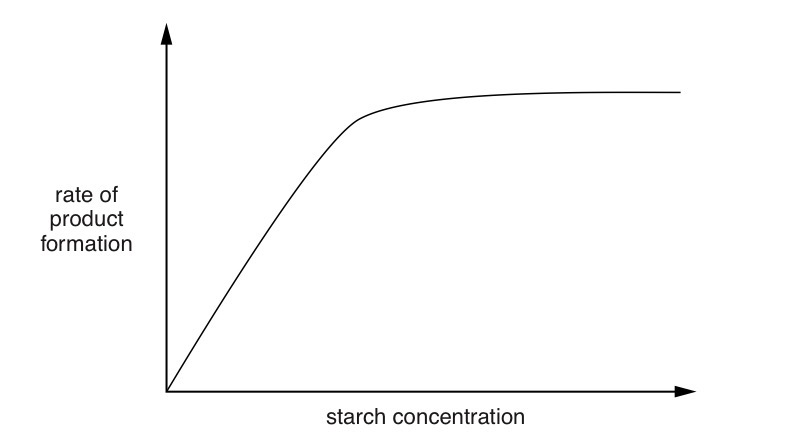
Why is it important that catalase can break down hydrogen peroxide quickly
breakdown of hydrogen
peroxide / H2O2 , minimises /
prevents, damage (to cells) ✓
products of breakdown are,
harmless / water and oxygen
Why is a cooling system necessary in fermentation
temperature affects , rate of
growth / enzyme activity ✓
(fungal) metabolic reactions
generate heat ✓
to inhibit growth of pathogenic
bacteria
How does the lactic acid extend the shelf life of yoghurt
pH below optimum ✓
(for) bacterial enzymes
How could hydrogen peroxide affect the plasma membrane
oxidises / reacts with / AW ,
fatty acids / phospholipids /
cholesterol ✓
damages / denatures (named)
, membrane proteins ✓
disrupts phospholipid bilayer ✓
causes membrane to be more
permeable
Cell surface membrane functions
barrier between cell
(contents) and environment ✓
regulates which substances ,
enter / leave , the cell
site of (chemical) reactions ✓
cell communication / cell
signalling
If a cell that completed the cell clue had more chromosomes than its normal diploid number,what checkpoint failed to work?
M
because...
chromosomes cannot have been,
aligned correctly at the equator /
attached correctly to the spindle
Observations if the cell had stopped dividing at the G2 checkpoint
larger number of (named) organelles ✓
more DNA / larger nucleus ✓
no visible chromosomes ✓
nuclear membrane present
DNA replication v transcription
Similarities
• DNA unwinds and unzips
• Helicase enzymes
• Template DNA
• Complementary base pairing
• Hydrogen bonds
• Free, activated nucleotides
• Polymerase enzymes
Differences
• Only a small section of DNA (where the
gene is located) unzips during
transcription
• Both strands act as templates in
replication
• RNA vs DNA free nucleotides
• RNA vs DNA polymerase
• Different helicase enzymes
• Products are two new daughter strands
of DNA in replication and one mRNA
strand in transcription
• mRNA leaves nucleus whereas the new
DNA strand remains bound to the
template strand
Why is tubulin essential to protein synthesis and secretion in eukaryotic cells?
mechanical strength (to cells) ✓
cell, support / stability /
maintains shape ✓
movement of (named),
molecules / vesicles / organelles
within cell
formation / movement, of, cilia /
flagella ✓
cell movement / endocytosis /
exocytosis / phagocytosis /
cytokinesis / described
holds organelles in position
DNA extraction
Break open cells (lysis)
Use: Detergent
Why: Detergent dissolves the cell membrane and nuclear membrane (phospholipid bilayers), releasing DNA.
Remove proteins
Use: Protease enzyme
Why: Protease breaks down proteins (e.g., histones) that DNA is wrapped around.
Filter the mixture
Use: Filter paper
Why: Removes large cell debris, leaving DNA dissolved in the liquid.
Precipitate the DNA
Use: Ice-cold ethanol (or isopropanol)
Why: DNA is insoluble in cold alcohol, so it clumps together and becomes visible as a white precipitate.
Role of membrane in rough ER
compartmentalisation / maintain different
conditions from cell cytoplasm
separating proteins (synthesised) from cell cytoplasm ✓
3 hold, ribosomes/ enzymes, in
place
Function of the cytoskeleton
provides mechanical strength to
the cell ✓
2 holds organelles in place ✓
aids transport of, (named)
molecules / (named) organelles
(within the cell) ✓
4 cell movement ✓
5 maintains cell, shape / structure
/ integrity / stability
cell division /
Cleavage in cytokinesis / spindle fibres
Function of helicase
Unzips double helix
Breaks h bonds between two strands
How to prepare a blood smear that could then be stained and viewed under a microscope
use pipette to place
blood on slide ✓
2. (place blood) near
one end (of slide) ✓
use (2nd) slide / cover
3.
slip , to spread / AW ,
blood across slide ✓
4. slide / cover slip , at
an angle
How could different objective lenses of a light microscope be used to focus and observe the pond water sample at high power magnification
select low power lens
then higher power ✓
use coarse focus to
2
find, correct field of
view / object
use fine focus for
clear(er) image ✓
ref to x4 / x10 / x40
4
(lens power /
magnification)
How would an image look if a cell was in interphase?
single area of dark (staining
material) ✓
(individual) chromosomes not
visible ✓
(nuclear material) not as dark
Method in chromatography that will separate amino acids in collagen
1 digest / hydrolyse / break down,
collagen into amino acids ✓
and
2 place, sample / AW, on,
chromatography paper /
chromatography plate / stationary
phase ✓
3 dry and repeat ✓
4 place, (chromatography) paper /
(chromatography) plate/
stationary phase, in solvent
why is collagen such a strong molecule
many H bonds
many covalent bonds
polypeptides overlap
how can conc of a reducing sugar be measured using a colorimeter?
1.use standard conc
2.heat with Benedicts solution
3.use same vol of solution
4.use excess Benedict
5.changes to green/yellow/brick red
6.remove ppt/obtain filtrate
7.calibrate/0 colorimeter
8.using a blank/water/unreacted Benedicts
9.use red filter
10.reading of absorbance
11.more transmission=more sugar present
12.calibration curve
13.plot absorbance against sugar conc
13.use reading of unknown and read off graph
what bond is broken in the hydrolysis of a phospholipid molecule
ester
can Hb change shape
yes
how do R groups interact to determine the tertiary structure of a protein
some R groups attract/repel
disulfide bridges between cysteine
H bonds/ionic bonds
lipids:animals v plants
saturated
no double bonds
solid at room temp
roles of lipids
thermal insulation
energy store
protection
membranes
steroid hormones
buoyancy
waterproofing
source of water
production of fat soluable
similarities:collagen v Hb
amino acid chain sequence
peptide bonds
helix
3 bonds
quaternary structure
more than one polypeptide
functions of alpha glucose
respiratory substance
source of energy
formation of ATP
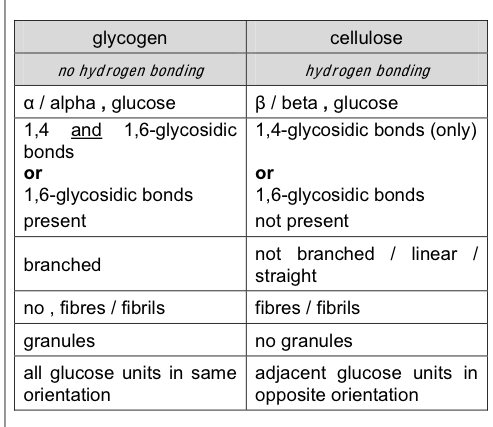
glycogen v cellulose
how do LDLs affect the formation of atheromas
carry cholesterol from liver to tissue
receptors on cells
raise blood cholesterol
increase deposition of fats
form plaques
how do HDLs affect the formation of atheromas
carry cholesterol from tissues to liver
receptors on liver cells
lower blood cholesterol
reduce deposition of fats
form plaques
molecules that combine with cholesterol to form LDLs
saturated fats
protein
where are H bonds found in biological molecules
protein secondary structure
protein tertiary structure
between polypeptide chains in quaternary structure
between chains of cellulose
between strands in DNA
how does a peptide bond form
condensation reaction between amine group of one amino acid and carboxyl group
H from amine combines with OH from carboxyl
structure of collagen
peptide bonds between amino acids
every 3rd amino acid is glycine
coil
left-handed helix
3 polypeptide chains
H bonds between chains
cross-links
fibril
Hb v collagen
Hb:
globular
hydrophobic inside,hydrophilic outside
4 chains
2 alpha subunits,2 beta subunits
describe how a substrate,such as pepsin,breaks down a substrate
substrate shape is complementary to active site
substrate fits into active site
induced fit forms ESC
destabilising bonds in substrate forms enzyme-product complex
products leave active site
how would repeating an experiment improve it?
improves reliability
assesses variability
mean can be calculated
anomalous results can be indentified
how do cells move through their environment?
flagella,cilia,shortening and lengthening of actin filaments
how might the lipid content of mycoprotein differ from food that comes from animals
less overall lipid/fat
less saturated fat
more unsaturated fat
connective tissue
holds other types of tissue together
what effect will inhibiting RNA polymerase have on protein synthesis?
phosphodiesther bonds cannot form between adjacent nucleotides
no translation
difference between template and coding strand in transcription
mRNA strand has a sequence of bases complementary to the template strand
coding strand determines the amino acid sequence
when extracting DNA,how could damage to DNA by enzymes be reduced?
lower temperature to inhibit enzyme
why would it be difficult to calculate a valid mitotic index from an image even if a higher magnification is used
cells may be damaged
not stained enough
layer of cells overlap
fields of view
why does mitotic index not fully explain overall growth
only gives info about cell divison
cells increase in size during growth
growth is a combo of cell division and increase in size
what technique was used to determine the double-helical structure of DNA?
X-ray crystallography
functions of glycoproteins
Cell recognition
Receptors
Antigens
Cell adhesion
Cell signalling
saturated fatty acids
triglycerides containing 3 of them are normally solid at room temperature
can pack closely together
bond that holds alpha glucose and fructose together
1-6 glycosidic bond
How is magnification calculated?
Magnification = size of the image / size of the real object.
What type of microscope uses a beam of electrons to create an image?
Transmission Electron Microscope (TEM) and Scanning Electron Microscope (SEM).
What is the purpose of calibrating a microscope?
To align the stage micrometer and eyepiece graticule for accurate measurement.
What is the scale of a typical eyepiece graticule?
The scale is usually 1mm long with 100 divisions, so each division is 10μm.
What should you do when drawing a specimen under a microscope?
Draw in pencil, title the diagram, and state the magnification used.
What is a technique that uses different chemical stains to color various parts of a cell?
Staining technique.Acetic orsin binds to DNA and stains chromosomes dark red.Eosin stains cytoplasm.Sudan red stains lipids.Iodine in potassium iodide solution stains the cellulose in plant cells yellow and starch granules blue.
How are permanently fixed slides made?
Dehydrate the specimen.Embed the wax to prevent distortion during slicing.Cut them into very thin slices.
How does a Transmission Electron Microscope (TEM) work?
The specimen has to be chemically fixed by being dehydrated.A beam of electrons passes through the sample,which is stained with metal salts, to create an image, focused using electromagnets in a vacuum.
What are the advantages of using a TEM?
Highest resolving power and high magnification.
What are the disadvantages of using a TEM?
Requires extremely thin specimens, complex staining methods, and the specimen must be dead.
What can you see with a TEM?
A 2D image of details within organelles, such as cristae in mitochondria and grana in chloroplasts.
What does a Scanning Electron Microscope (SEM) provide?
A 3D image of the surface of cells and organelles with a magnification from x15 to x200,000.
What are the advantages of using a SEM?
High magnification and the ability to view 3D images.
What are the disadvantages of using a SEM?
Requires extremely thin specimens, complex staining methods, and the specimen must be dead.
What is the role of electromagnets in electron microscopy?
They are used to focus the beam of electrons onto the sample.
What is the significance of using a vacuum in electron microscopy?
A vacuum is required to prevent electron scattering by air molecules.
What is the difference between a light microscope and an electron microscope?
Light microscopes use visible light to magnify specimens, while electron microscopes use electron beams for higher resolution.
metaphase 1
individual chromsomes assemble on the metaphase plate
independent assortment to produce genetic variation
which processes require a membrane:diffusion,active transport,osmosis
active transport,osmosis
what is the function of phospholipids in a cell membrane?
to make a cell membrane more flexible
What is the main limitation of light microscopes compared to electron microscopes?
Light microscopes have lower resolving power due to the longer wavelength of light.
What is the function of a stage micrometer?
It is a microscope slide with a ruler/scaled bar etched into it for calibration purposes.
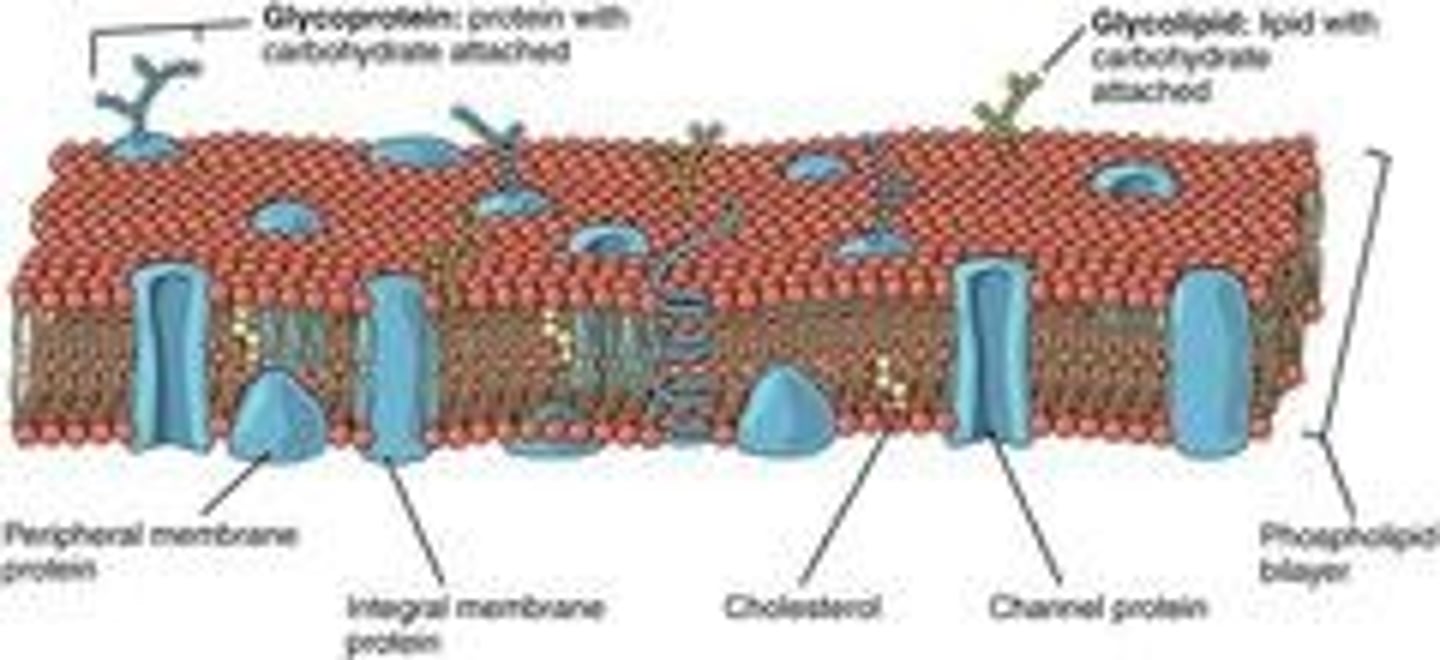
What is the structure of the plasma membrane?
A phospholipid bilayer with embedded intrinsic and extrinsic proteins.
What surrounds the nucleus?
A double membrane called the nuclear envelope with nuclear pores.
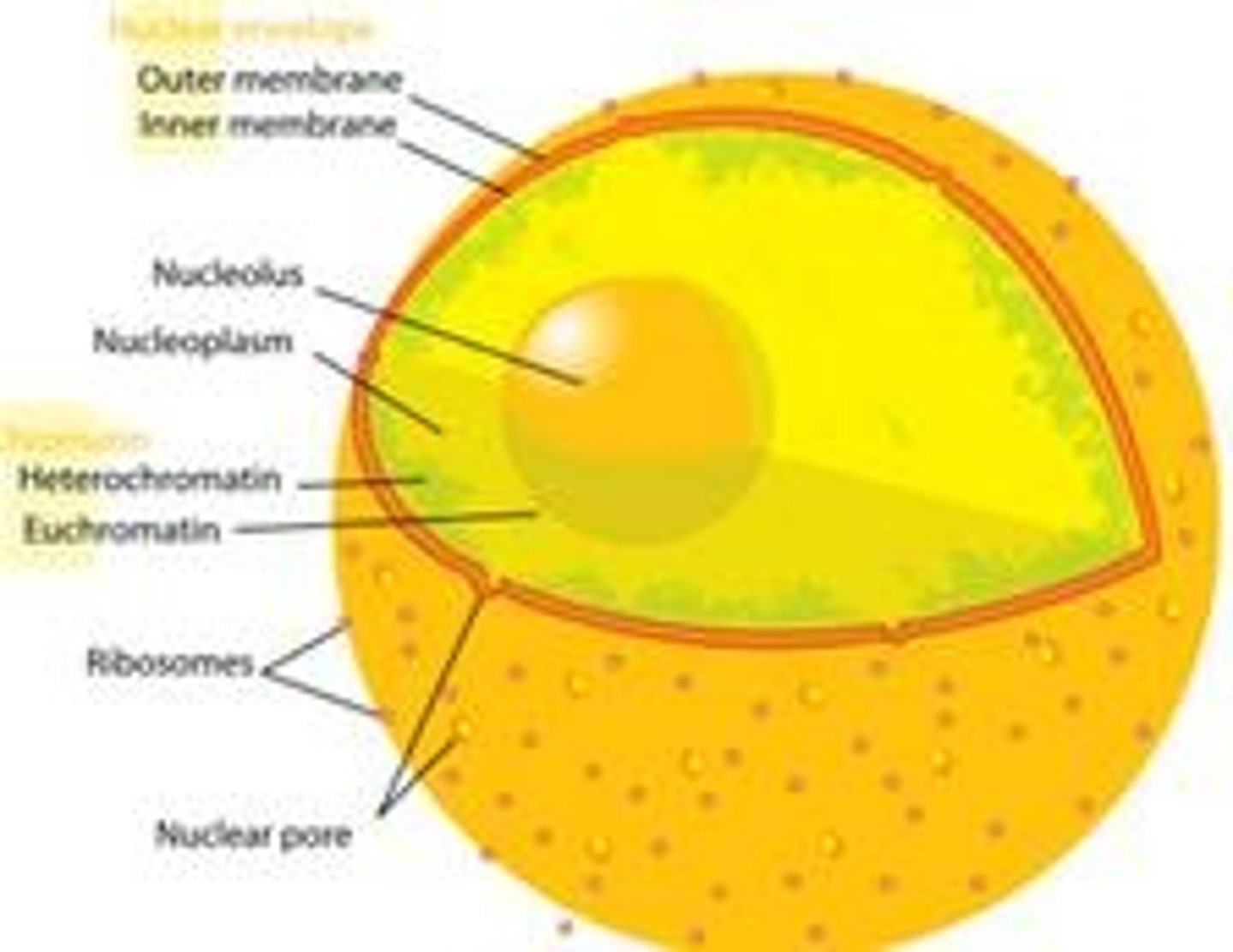
What are functions of the nucleus?
The control centre of the cell
Stores the organism's genome
Transmits genetic information
Provides the instructions for protein synthesis
What is contained within the nucleus?
Chromosomes with proteins bound, linear DNA, and a nucleolus.
What is the function of the nucleolus?
To synthesize ribosomes.It has no membrane and contains RNA
What is chromatin?
Chromatin is the genetic material,consisting of DNA wound around histone proteins.When the cell is not dividing,chromatin is spread out or extended.When the cell is about to divide,chromosomes condenses and coils tightly into chromosomes.These make up nearly all the organism's genome.
What occurs at the site of transcription in the nucleus?
Primary mRNA splicing.
What is the role of nuclear pores?
To allow movement of substances to and from the cytoplasm.
What are cilia?
Hair-like projections out of cells that can be mobile or stationary.
What is the function of mobile cilia?
To help move substances in a sweeping motion.
What is the structure of mitochondria?
Double membrane with inner membrane folded into cristae and a fluid-filled center called the matrix.2-5 micrometres long.
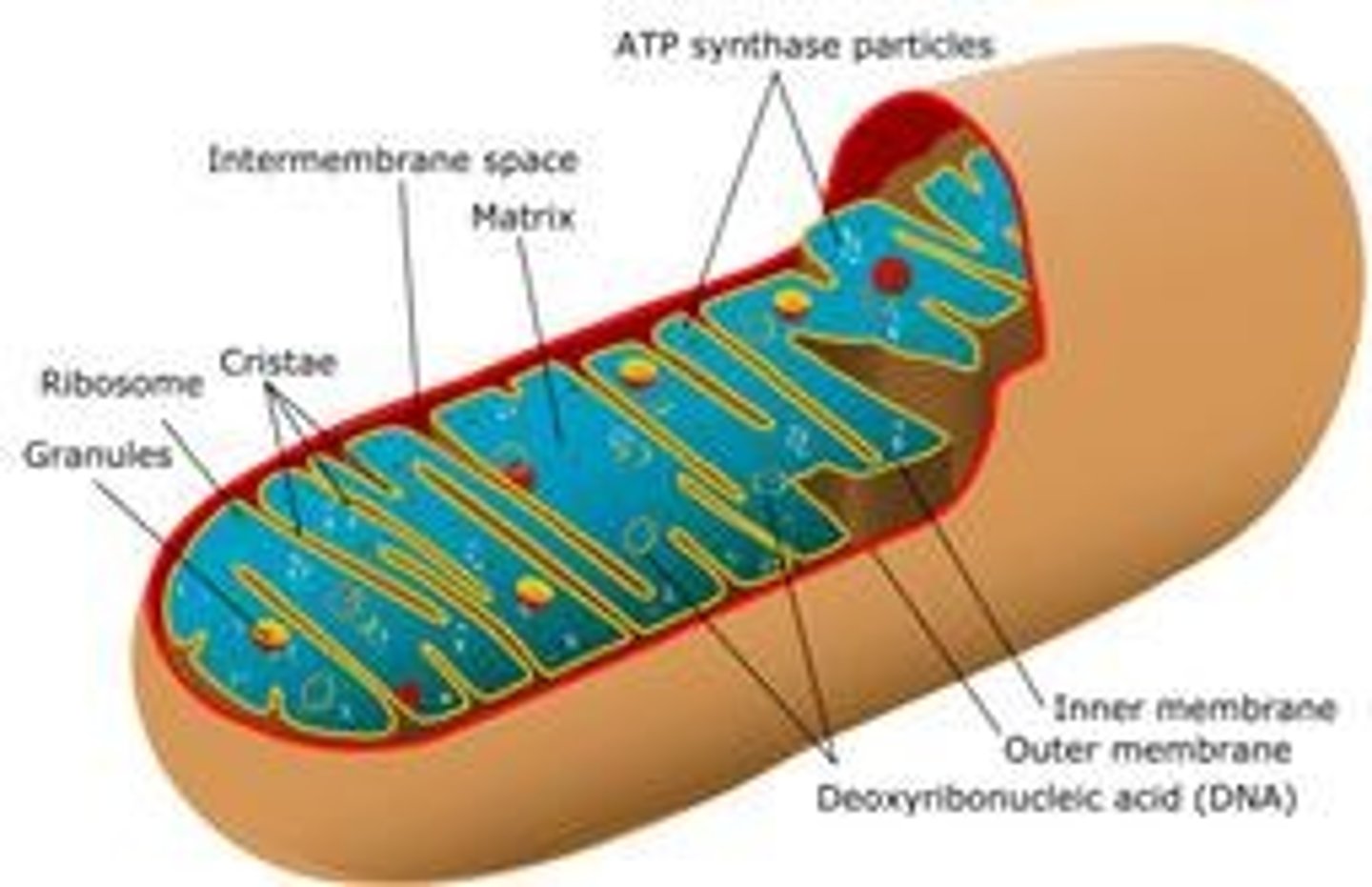
What is the primary function of mitochondria?
Site of ATP during aerobic respiration.Self-replicating
What is the structure of flagella?
Whip-like structures made of microtubules that occur in pairs.
What is the function of flagella?
For mobility,and sometimes as a sensory organ for chemical stimuli.
What is the structure of a centriole?
made of microtubules and occur in pairs to form a centrosome
What is the function of a centriole?
Involved in the production of
spindle fibre and organisation of
chromosomes in cell division
What is the Golgi apparatus made of?
1 membrane bound,Stacks of membranes creating flattened sacs called cisternae, surrounded by vesicles.
How many bases make one genetic code?
4^3=64