Limits Calculus
 Call Kai
 Learn
Learn Practice Test
 Spaced Repetition
 Match
Match Flashcards
 Knowt Play
1/7

There's no tags or description
Looks like no tags are added yet.
Name | Mastery | Learn | Test | Matching | Spaced | Call with Kai |
|---|
No analytics yet
Send a link to your students to track their progress
8 Terms
Difference of cube
a3−b3=(a−b)(a2+ab+b2)
What is a limit in calculus?
A limit is a fundamental concept in calculus that describes the value that a function approaches as the input approaches a specified value.
What does it mean for a limit to exist?
A limit exists if the values of the function approach a specific value as the input approaches a given point, regardless of the direction from which it approaches.
What is the limit of a constant function, f(x)=k?
The limit of a constant function as xx approaches any value is simply the constant itself; that is, limx→ck=k. This means that as the input approaches any value, the output remains constant at that value.
What is the squeeze theorem in relation to limits?
The squeeze theorem states that if for all x in some interval around c (except possibly at c itself) and the limits of f(x) and h(x) as x approaches c are equal, then the limit of g(x) as x approaches c also exists and equals that common limit.
What to do in cases of complex fractions for limits
Multiply the top and bottom by the common denominator
Property of Radicals
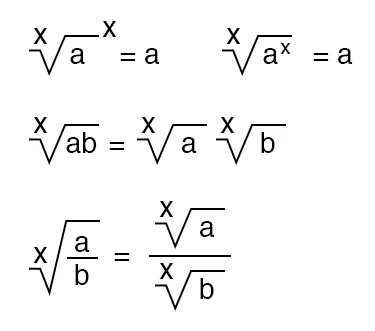
What to do for limits in cases where there are radicals
Multiply the numerator and denominator by the conjugate that has the radical