Motor Systems II: Basal Ganglia:
 Call Kai
 Learn
Learn Practice Test
 Spaced Repetition
 Match
Match Flashcards
 Knowt Play
1/28

There's no tags or description
Looks like no tags are added yet.
Name | Mastery | Learn | Test | Matching | Spaced | Call with Kai |
|---|
No analytics yet
Send a link to your students to track their progress
29 Terms
Describe the Basal Ganglia
What is it?
Location
Associated Structures?
Function?
Basal Ganglia:
What is it?
Collection of telencephalic gray matter nuclei
Location:
deep w/in white matter of cerebral hemipheres
Associated structures:
subthalamus
nigral complex
pedunculopontine tegmental nucleus (PPTN)
Function:
modulate cortical signals for:
General motor control
Eye movements
Cognitive functions
Emotional functions
Describe the Striatal complex
Dorsal Complex:
Composition
Structure
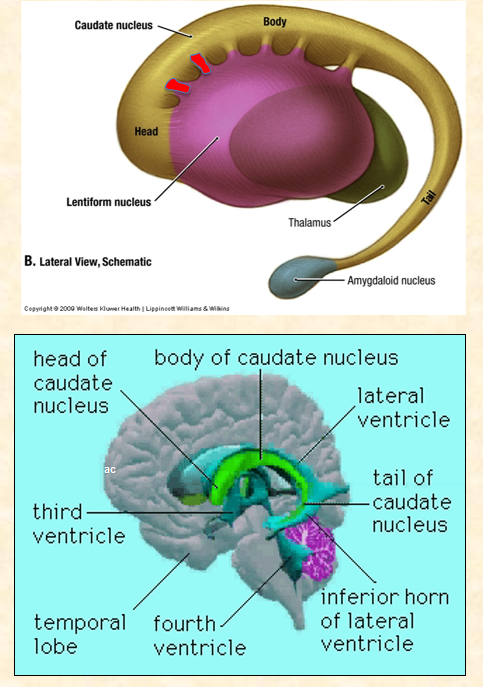
Shape of Caudate
Ventral Complex:
VS
Location?
NA
Main part of?
Location?
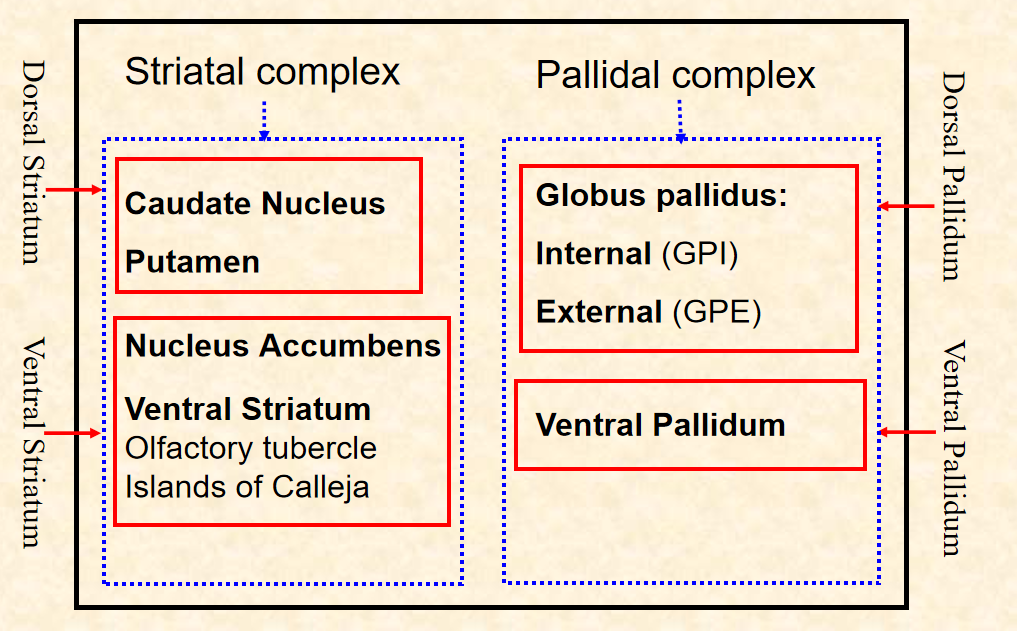
Dorsal Striatal Complex (Neostriatum)
Composition:
Caudate & Putamen
Structure:
Fused rostroventrally
Mostly separated by internal capsule
(except for cellular bridges)
Shape of Caudate:
c-shape,
includes head, body & tail
follows lateral wall of lateral ventricle
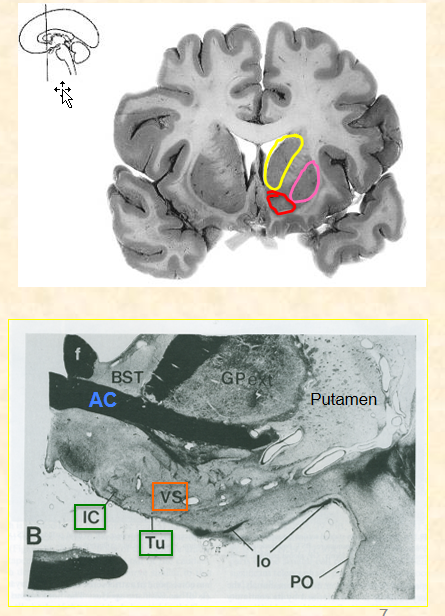
Ventral Striatal Complex:
Ventral Striatum:
Location
ventral extension of caudate & putamen
below anterior commissure (AC) into substantia inominata
Nucleus accumbens (NA):
main part of ventral striatal complex
Location:
rostroventraly
where putamen is cont. w/ caudate head
NOTE:Olfactory tubercle (TIJ) & Islands of Calleja (IC): rostrolateral & caudal portion of anterior perforated substance (not on exam)
Describe the Pallidal Complex
Dorsal Pallidum: Globus Pallidus
2 segments?
What forms lenticular nucleus
What si the external medullary lamina
Ventral Pallidum:
Location?
Dorsal Pallidum: globus pallidus
2 segments:
lateral: external segment
Medial: internal segment
Separated by internal medullary lamina
Putamen + Dorsal Pallidum (GPI/E) = Lenticular nucleus
External Medullary Lamina:
separates putamen from dorsal pallidum
Ventral Pallidum: ventral pallidum
Location:
ventral extention of globus pallidus
below anterior commissure → substantia innominata
Describe the Associated Nuclei
Nigral Complex:
SN: Two parts? Describe them
VTA?
similar to? Contains?
Subthalmic:
Location?
PPTN
Location?
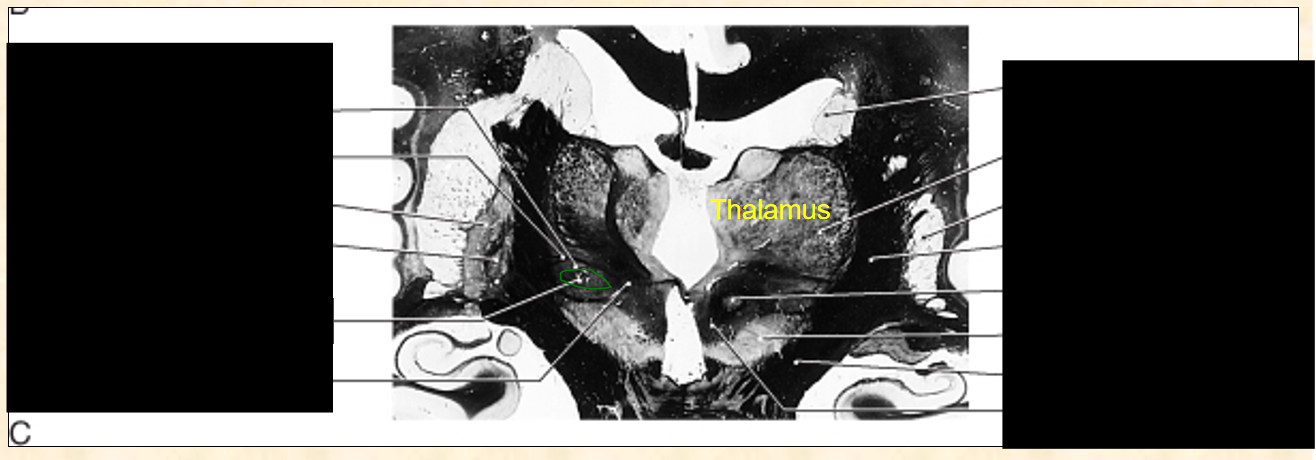
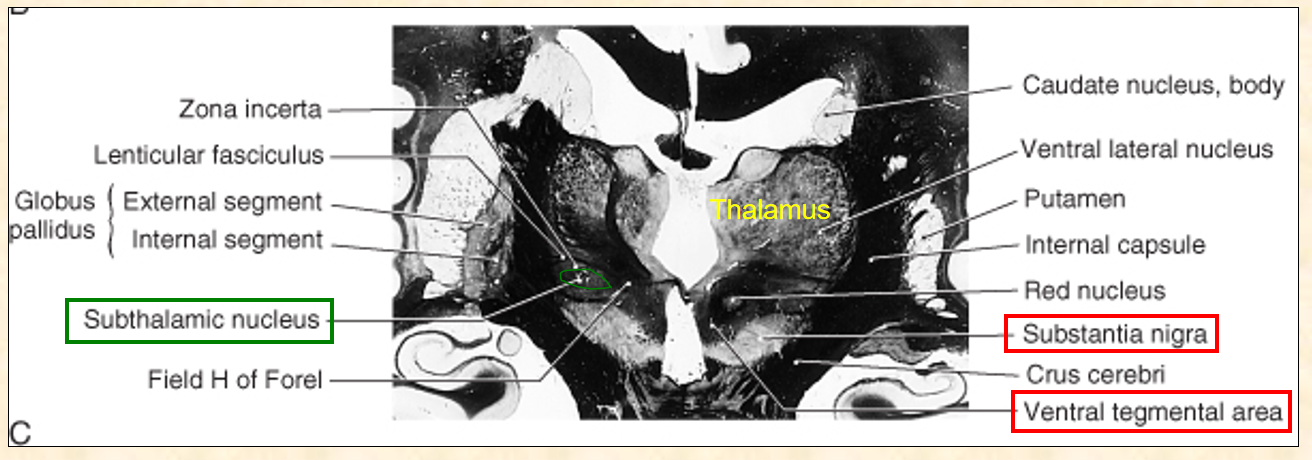
Nigral Complex:
Substantia Nigra (SN):
Two Parts:
Pars Compacta (pc):
blackish appearance,
neurons contains neuromelanine,
product from dopamine (DA) oxidation
Pars Reticulata (pr):
similar to GPI
Ventral tegmental area (VTA):
similar to SNpc
contain DA neurons
Subthalamic Nucleus:
Location:
ventral to Thalamus
above substantia nigra
Pedunculopontine tegmental nucleus (PPTN):
Location:
lateral portion of reticular formation
@ junction btw midbrain and pons
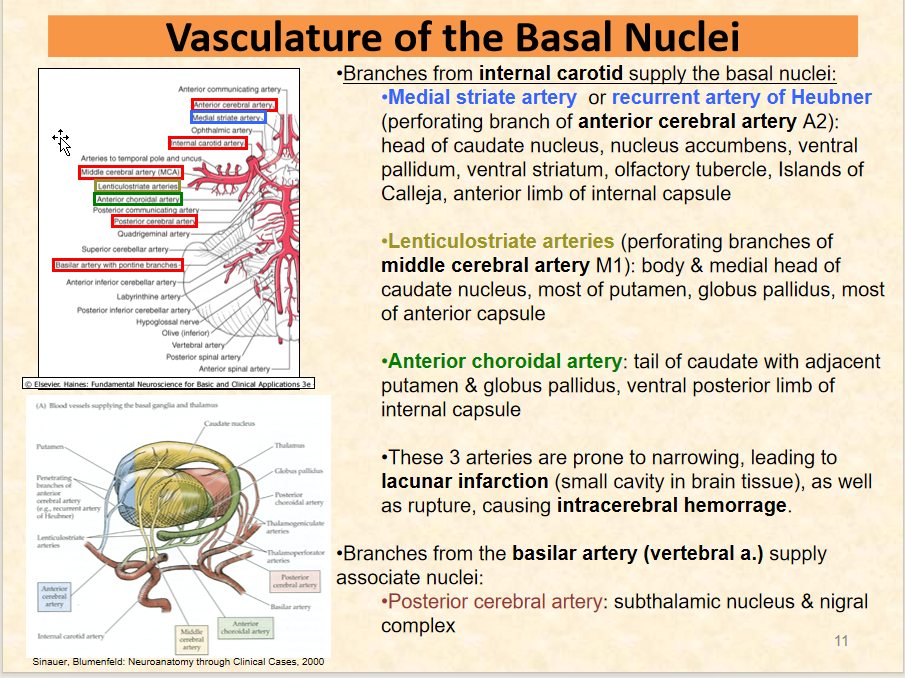
[REVIEW] Vasculature of Basal Nuclei
Describe the Input/outputs of Basal Ganglia:
Input:
Arrive via?
Main input =?
Imp. DA inputs?
Other Inputs
Output:
Leaves via?
Main Targets?
Inputs:
arrive via the Striatum (dorsal/ventral)
Main Input: cerebral cortex
Imp. DA inputs:
dorsal,
SN pc
ventral,
VTA ( both brainstem)
Other Inputs:
thalamus, brainstem (non Da)
Outputs:
Leaves via
medial segment of GPI
ventral pallidum
SNpr
Main targets:
Thalamus
conveys info to cortex
return info to striatum
Brainstem Targets:
PPTN & superior colliculus
from SNpr
List and describe the function of Parallel circuits through basal nuclei, thalamus & cortex
Motor:
cortical & brainstem (PPTN)
control of body movements and posture
Oculomotor:
cortical & brainstem (superior colliculus)
control of eye movements
Prefrontal:
cognitive control of behavior
procedural memory + executive functions
Limbic:
reward system
control of biological drives (sex, food)
Describe the difference between direct/indirect pathways w/in basal ganglia
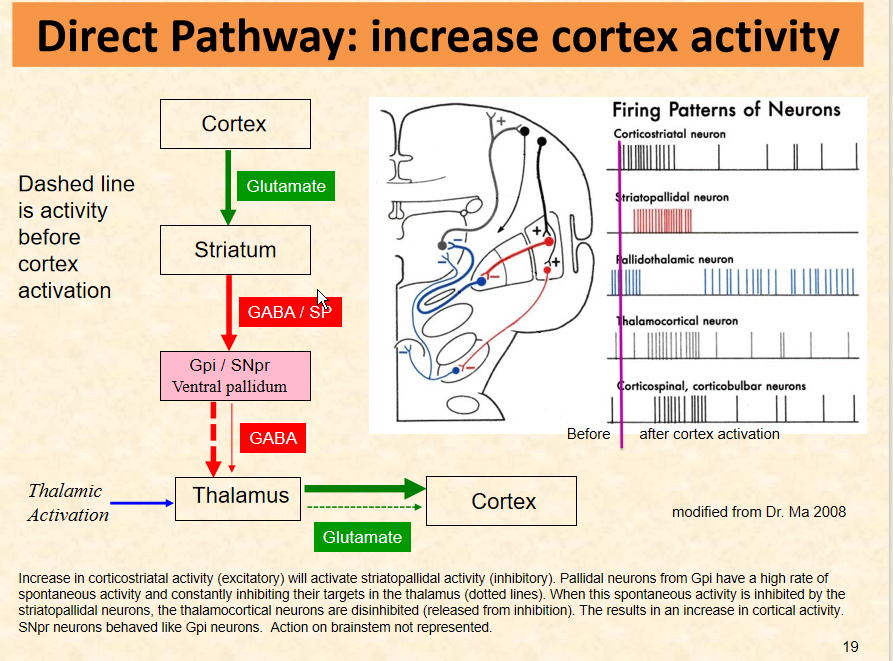
Direct pathway:
Striatum → GPI / SNpr /ventral pallidum → Thalamus-cortex / brainstem
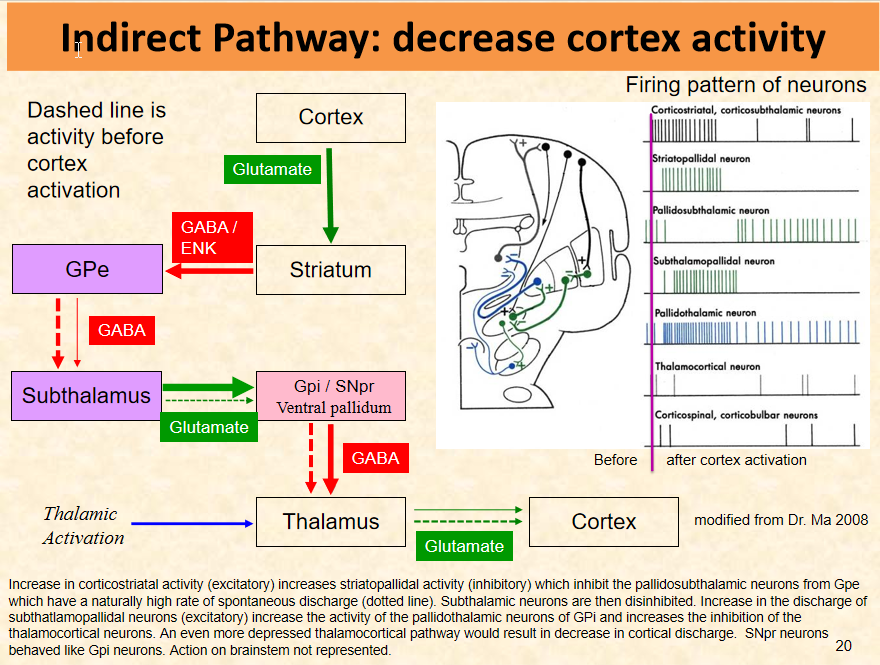
Indirect pathway:
Striatum → GPE → Subthalamus → GPI / SNpr /ventral pallidum → Thalamus-cortex / brainstem
Describe the major tracts through the basal nuclei
Internal Capsule
Thalamic fasciculus
Subthalamic fasciculus
major tracts through the basal nuclei
Internal capsule
Corticofugal fibers (including corticostriatal)
Thalamocortical fibers
Thalamic fasciculus
Pallido-thalamic fibers from:
Lenticular fasciculus
dorsal fibers (medial GPi),
go through internal capsule
Ansa lenticularis
ventral fibers (lateral GPi),
under internal capsule
Subthalamic fasciculus
Pallido-subthalamic fibers (from Gpe)
Subthalamo-pallidal fibers (to Gpi)
Describe the NTs in the basal nuclei
Caudate, putamen, nucleus accumbens, ventral striatum:
Direct path:
Indirect path:
Interneurons:
Olfactory Tubercle & Islands of Calleja:
Globus Pallidus & Ventral Pallidum:
SNpr
Subthalamic nucleus:
SNpc + VTA:
PPTN:
Cortex & Thalamus:
Caudate, putamen, nucleus accumbens, ventral striatum:
Projection neurons:
Direct path:
GABA (inhib)
SP (neuromodulator)
Indirect path:
GABA (inhibitory)
Enkephalin (ENK) (neuromodulator)
Interneurons: AcH (excitatory)
Olfactory Tubercle & Islands of Calleja: GABA (Inhib)
Globus Pallidus & Ventral Pallidum:
GABA (Inhib)
SNpr
GABA (Inhib)
Subthalamic nucleus:
GLU (excit.)
SNpc + VTA:
Da (both)
PPTN:
AcH (Inhib)
Cortex & Thalamus:
GLU (Excit.)
What is Disinhibition?
Disinhibition = two inhibitions in a row → activation (indirectly)
Describe the difference in function of direct vs indirect pathways
Direct pathway:
Function = increase thalamus activity → excitation of the corte
also act. PPTN + superior colliculus (brainstem)
GO PATHWAY
Indirect:
Function = decrease thalamus activity → decrease activity of cortex
Also inhibits PPTN and superior colliculus.
NO GO PATHWAY
Describe the role of Da and AcH in the Brain
AcH:
Function of AcH in:
PPTN & LTN
Basal forebrain
Striatum
Da:
3 pathways: Describe Route/Fucntion:
Nigrostriatal
Mesolimbic
Mesocortical
AcH in Brain:
PPTN & LTN
Action on brainstem + cerebellum + spinal cord
Basal forebrain
Action on cortex
Striatum
Action on basal ganglia function
Da in Brain:
3 Pathways
Nigrostriatal
SNpc → dorsal striatum
Function: motor
Mesolimbic
VTA →
ventral striatum & nucleus accumbens
limbic cortex*
Function: Emotion & drives
Mesocortical
VTA → prefrontal cortex*
Function: cognitive
Describe the Role of Da and AcH in the Basal Ganglia
Da
AcH
Describe the difference in receptors for dopamine in direct/nondirect pathway
Dopamine:
Da Neurons from:
SNpc → caudate & putamen (GABA)
VTA → NA (GABA)
Acetylcholine:
AcH interneuson synapses on GABA projection neurons:
in caudate, putamen & NA
Da Receptors:
Direct:
D1
Excitatory
Indirect:
D2
Inhibitory
Da High vs Low:
Da = High:
net effect = cortical activation
Da = Low:
net effect = cortical inactivation
Describe the Role of Basal Nuclei on Movement
Function
Involved in?
Basal Nuclei’s function
DOES NOT INITIATE MOVEMENT (cortex does)
affects Sub/cortical motor command outflow → change in motor behavior
Involved in:
procedural (habit/skill) learning and memory
planning + execution of movement
facilitate actions that are:
goal-relevant
more appropriate
rewarded at a given time
NOTE: Acetylcholine and dopamine may play a cooperative role in habit learning.
Finally, Draw out the Basal Ganglia Pathway
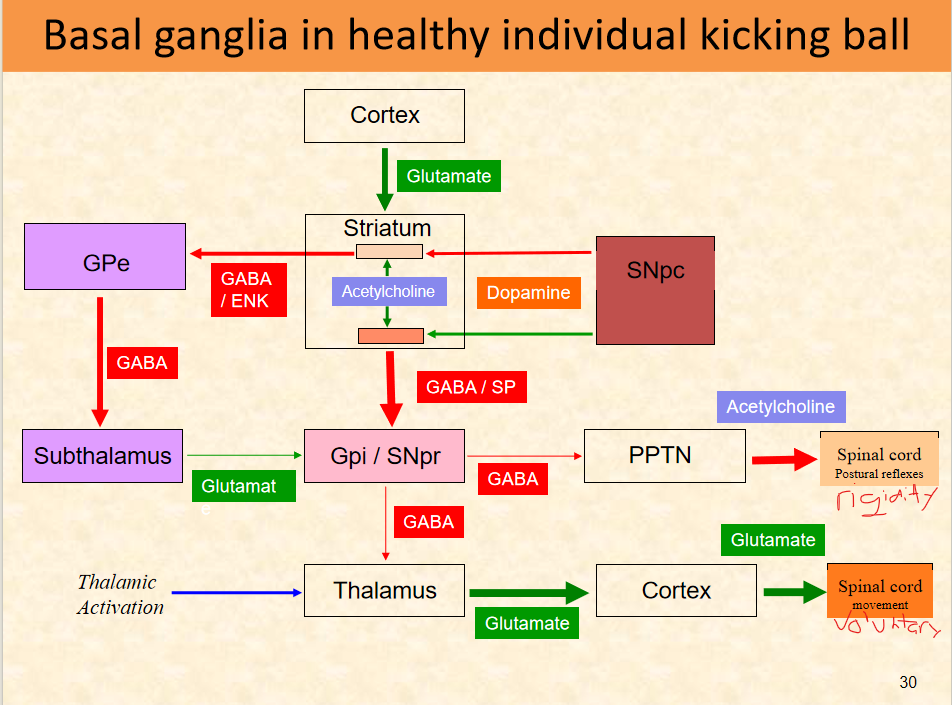
Compare and Contrast Hyper/Hypokinetic disease
Mech
Manifestation
Examples
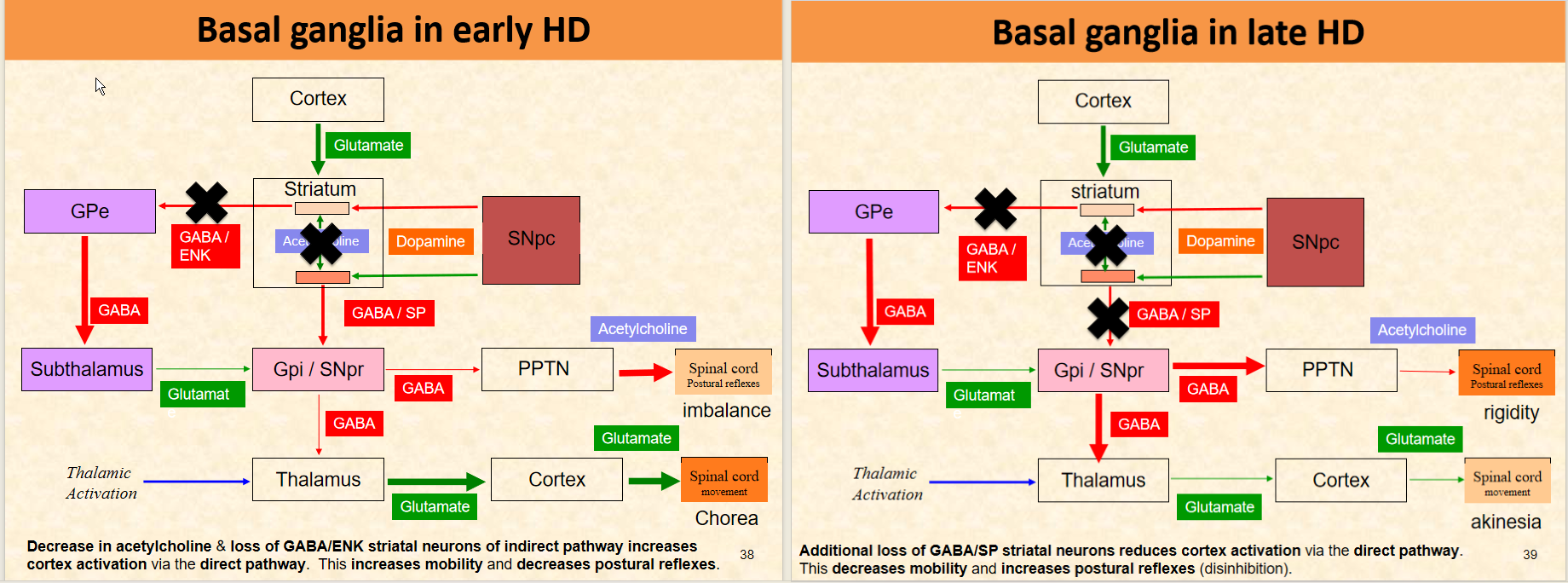
Hyperkinetic Disturbances
Mech:
Overactivity in direct pathway
underactivity in indirect pathway
Manifestation:
→ excessive movement and decreased postural reflexes
Examples: Huntington's disease, hemiballismus
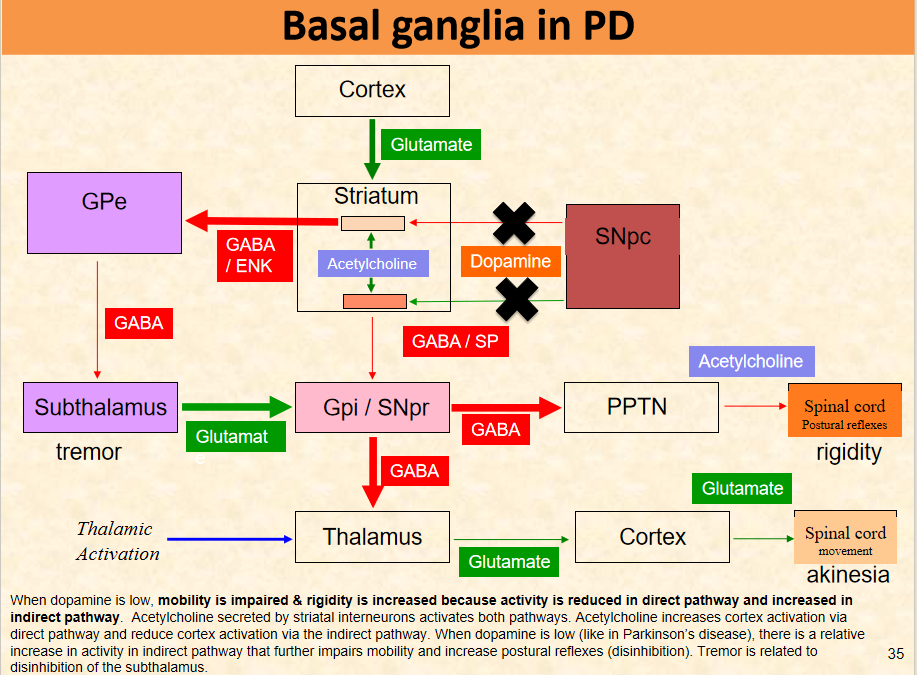
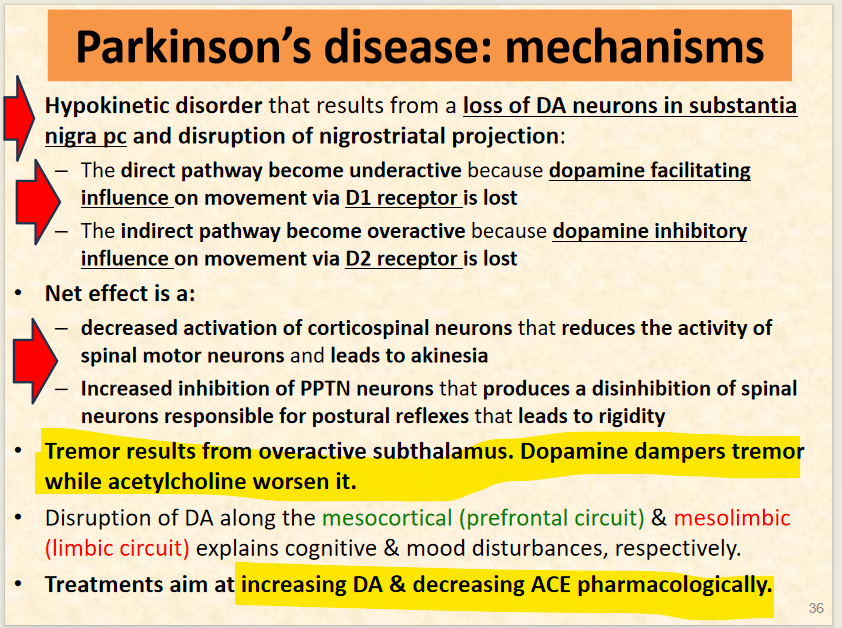
Hypokinetic Disturbances
Mech:
Underactivity in direct pathway
overactivity in indirect pathway
Manifestation:
generation of movement difficult and slow
increase postural reflexes → rigidity
Example: Parkinson's disease
NOTE: Because of the multiple basal ganglia pathways, the clinical manifestations of basal ganglia disorders often include prominent oculomotor, cognitive and psychiatric manifestations in addition to disorders of movement.
Describe Parkinson’s disease
Symptoms:
List and describe the Major motor Symptoms
List the non-motor syndrome
Describe the Neuropathology Findings
Describe genetic Form of Parkinson
Symptoms:
Major Motor Symptoms:
Tremor:
Shaking/trembling of limbs/face at rest
decrease during voluntary movement
Cogwheel Rigidity:
Muscles → contract → stiff, weak, sore
particularly those in limbs in trunk
Bradykinesia/akinesia:
Spontaneous, automatic movement is lost
all movement becomes extremely slow.
Non-Motor Symptoms:
Dementia
Procedural memory loss
Reduced executive dysfunction
Mood, autonomic, sensory and sleep disturbances
Neuropathological Finding
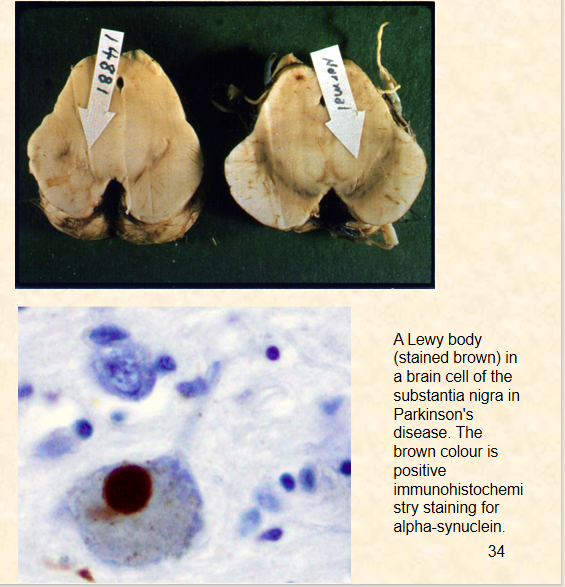
loss of Da neurons in SNpc + VTA
Remaining Da = contains cytoplasmic inclusions called Lewy bodies
Genetic Forms of Parkinsons:
Dominant mutation in gene (SNCA) for alpha- synuclein
protein found in Lewy Bodies
Describe the Mechanism for Parkinsons
Describe Huntington’s Disease
What is it?
Pathophysiology?
Neurophysiology?
Huntington’s disease (Chorea)
What is it?
Progressive + untreatable + 100% penetrance + Dominant Hyperkinetic Disease
Pathophysiology:
40 CAG repeat in HD gene (Chromosome 4) → expansion of polyglutamine tract of Huntingtin protein (htt) →
agglutination & deposits in neuron
glutamate excitotoxicity
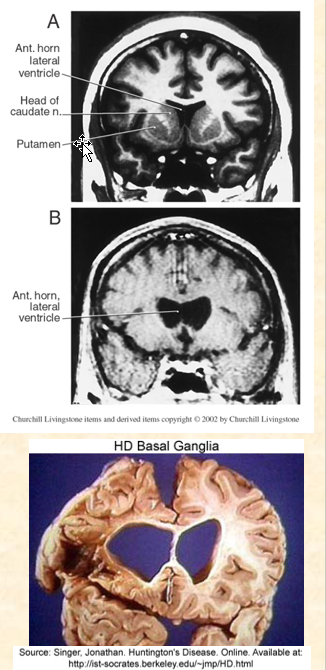
Neuropathology:
Loss of 90%+ of all neurons in striatum
Mostly affects projection neurons
Dysfunction of large AcH interneurons (decreased release)
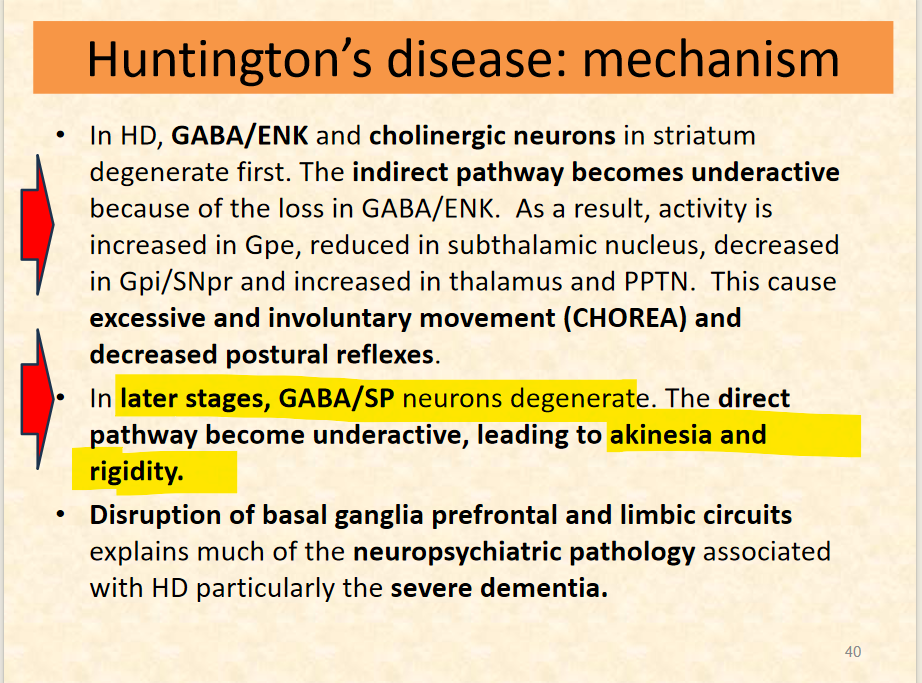
Describe the Mechanism for Huntington’s disease
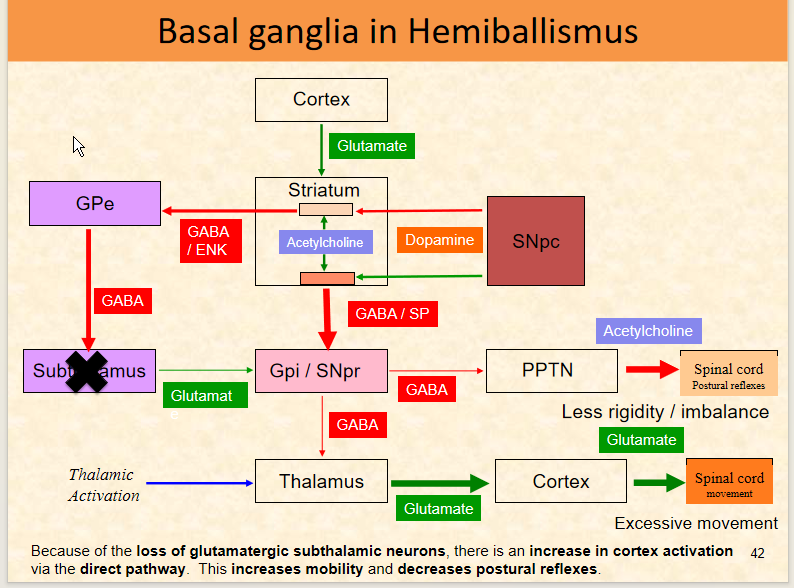
Describe Hemiballismus
What is it?
Pathophysiology
Symptoms
Treatments
Hemiballismus
What is it?
Rare movement disorder
Pathophysiology:
lesion in subthalamic nucleus
Cause:
Most common = stroke
Trauma, tumor, infection, HIV/AIDS
Symptoms:
involuntary flinging movement of the extremities
violent movements of the contralateral limb
reduced postural reflexes
Treatments:
Dopamine blockers (anti-psychotics) to reduce activity of direct pathway
Lesion or deep brain stimulation in globus pallidus
NOTE: Mech for next Card:
Activity is decreased in Gpi/SNpr (decreased activation of GPI by indirect pathway & increased inhibition of GPI by direct pathway) and increased activity in thalamus-cortex & PPTN causing violent movements of the contralateral limb (& reduced postural reflexes)
Explain the mech. of Hemiballismus