Factors Affecting Enzymes: Temperature, pH, substrate & Enzymes concentration and Inhibitors.
 View linked note
 Call Kai
 Learn
Learn Practice Test
 Spaced Repetition
 Match
Match Flashcards
 Knowt Play
1/10

There's no tags or description
Looks like no tags are added yet.
Name | Mastery | Learn | Test | Matching | Spaced | Call with Kai | Chat |
|---|
No analytics yet
Send a link to your students to track their progress
11 Terms
What are enzymes
Enzymes are biological catalysts that speed up chemical reactions in living organisms by lowering the activation energy required for those reactions to occur.
What is the effect of temperature on enzymes?
Low temperatures decrease kinetic energy, leading to fewer successful collisions between enzyme active sites and substrates, resulting in lower rates of reaction. Higher temperatures can increase reaction rates up to a certain point, but extreme heat may denature enzymes, reducing their effectiveness.
What is denaturation in enzymes?
Denaturation refers to the alteration of an enzyme's active site's shape due to high temperatures or extreme pH levels, leading to decreased enzyme-substrate complex formation.
How do pH levels affect enzyme activity?
Extreme pH levels can denature enzymes by disrupting ionic and hydrogen bonds, altering charges on amino acids and reducing reaction rates.
How does substrate concentration affect reaction rates?
At low substrate concentrations, reaction rates are slow; as concentration increases, rates rise until enzymes are saturated. At saturation, all active sites are occupied, and further increases in substrate concentration do not enhance reaction rates.
How does enzyme concentration influence reaction rates?
Low enzyme concentrations lead to slow reactions; increasing enzyme concentration raises reaction rates until all substrate active sites are saturated.
What are non-competitive inhibitors?
Non-competitive inhibitors are molecules that bind to a site other than the active site, altering active site and preventing substrate binding, leading to a consistent lower reaction rate.
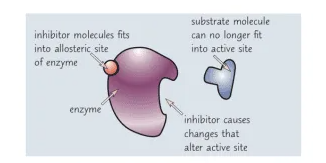
What happens if substrate concentration is increased when there is a non competitive inhibitor
Increasing substrate concentration has no effect. The inhibitor is binding to an alternative site, so adding more substrate is useless.
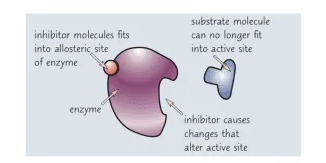
What are competitive inhibitors
Competitive inhibitors have a similar shape to the substrate molecule, and compete with the substrate to bind to the active site of an enzyme. When the inhibitor binds, it occupies the active site without causing a reaction.
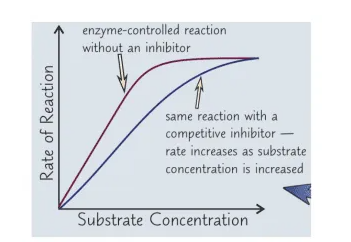
What happens if substrate concentration is increased when there is a competitive inhibitor
If there is a greater concentration of substrate, the substrate will outcompete the inhibitor for the active site, and vice versa. Therefore increasing the substrate concentration will increase the rate of reaction (up to a certain point, after which the inhibitor is outnumbered and has a negligible effect).