Unit 1 - Weathering
 Call Kai
 Learn
Learn Practice Test
 Spaced Repetition
 Match
Match Flashcards
 Knowt Play
1/12

There's no tags or description
Looks like no tags are added yet.
Name | Mastery | Learn | Test | Matching | Spaced | Call with Kai |
|---|
No analytics yet
Send a link to your students to track their progress
13 Terms
Weathering
A group of processes that breaks down rocks, soils and minerals into smaller pieces through contact with the earth’s atmosphere, biota (Fawn & Flora) and waters
Movement of eroded materials does not occur
Process is usually very slow
Can take thousands of years
Responsible for the creation of soil and many other unique features
Like the fish river canyon in southern Namibia
Physical Weathering
The breakdown of rocks into smaller components without changing their chemical composition
Some things that can cause physical weathering:
Changes in temperature
The freezing and thawing of water
Ground Ice (any type of ice that exists within the ground, particularly in permafrost regions)
Wetting and drying of rocks
Three main types of physical weathering:
Granular (Small grain) disintegration
Exfoliation
Block Separation
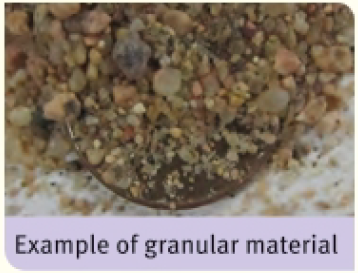
Granular (Small grain) disintegration
Physical Weathering
Occurs when rocks break up into small grains or pieces
Forms sand or very small pieces of gravel
Exfoliation
Physical Weathering
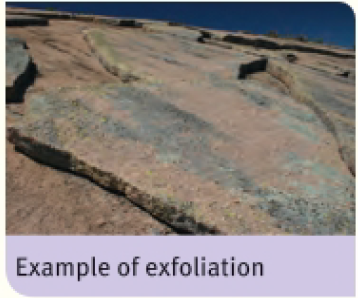
When rocks weather by peeling off in sheets rather than breaking up into small pieces of gravel
This can happen in thin layers on large rocks
Block separation
Physical Weathering
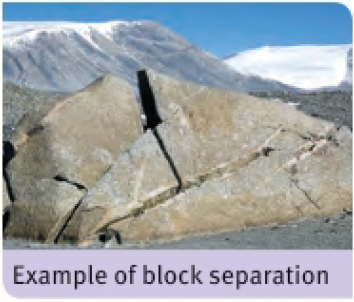
Occurs when rocks break up into large fragments related to rock joins
The main cause of this is frost shattering
Takes place when ice is formed in the joins of rocks
The ice expands and breaks up rocks
Chemical Weathering
The breakdown of rocks into particles with a different mineral composition or make-up than the original rock
Water, oxygen and carbon dioxide are agents of chemical weathering
Common examples of chemical weathering:
Solution
Hydrolysis
Hydration
Oxidation
Carbonation
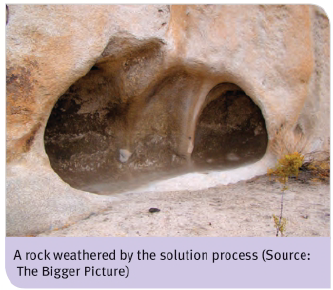
Solution Weathering
Chemical Weathering
When the minerals or soluble chemicals in the rock dissolve directly in water
Hydrolysis Weathering
Chemical Weathering
Occurs when there is a chemical reaction between the minerals in the rock and hydrogen in rainwater
Eg:
During hydrolysis feldspar (a rock-forming mineral) in granite changed to a clay mineral which breaks easily
Hydration Weathering
Chemical Weathering
Occurs when minerals in rocks absorb water and expand
The expansion of minerals causes the rock to break up
Oxidation Weathering
Chemical Weathering
Occurs when rock minerals react with dissolved oxygen to produce red or yellow oxides or hydroxides
Red and yellow soils found in tropical areas are the result of this process
Carbonation Weathering
Chemical Weathering
Occurs when carbon dioxide dissolves in water to form a weak solution of carbonic acid
Carbonic acid can weather carbonate rocks such as chalk and limestone
Biological Weathering
Involves living things
It involves physical actions such as:
The breaking of rocks by plant root growth or animal burrows
It also involves chemical actions such as:
The excretion of acids
Some organisms secrete acids that can chemically weather rocks and minerals
Another form of biological weathering is the decomposition of organic matter such as animals, plants and leaves, which can release corrosive substances into the environment
Impact of human activities on weathering
Humans can increase the rate of weathering on rocks or buildings
Examples:
The burning of fossil fuels or release of chemicals into the air makes the atmosphere acidic
When it rains, acid rain can eat into limestone or buildings made of limestone and break it down by chemical weathering
When making roads people use dynamite to blast and break rocks into smaller pieces
During mining operations people dig up large rocks and break them up
Quarrying is also another activity that contributes to weathering