C.4 Standing Waves & Resonance
 Call Kai
 Learn
Learn Practice Test
 Spaced Repetition
 Match
Match Flashcards
 Knowt Play
1/13

There's no tags or description
Looks like no tags are added yet.
Name | Mastery | Learn | Test | Matching | Spaced | Call with Kai |
|---|
No analytics yet
Send a link to your students to track their progress
14 Terms
How is a standing wave formed?
A standing wave is formed by the superposition of two identical waves traveling in opposite directions.
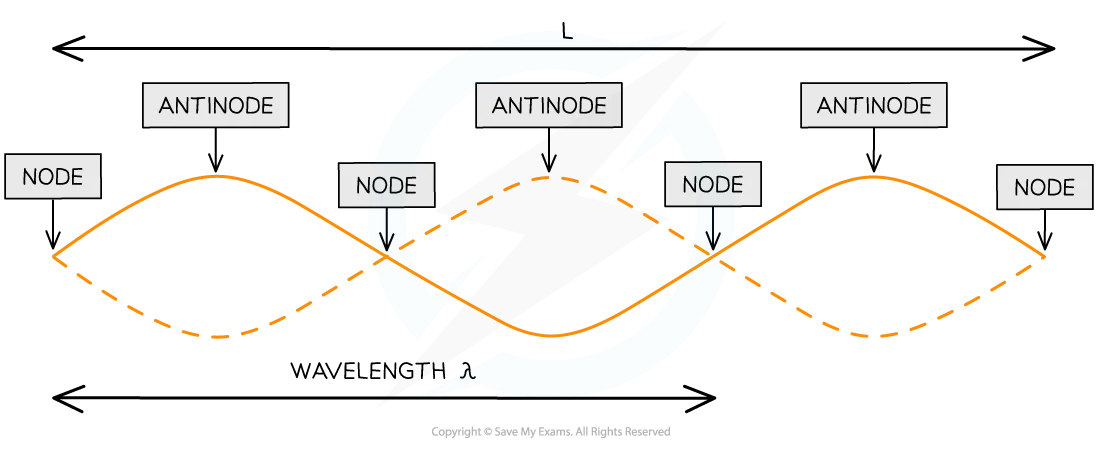
What are nodes and antinodes in a standing wave?
Nodes are points of zero amplitude where total destructive interference occurs, and antinodes are points of maximum amplitude where constructive interference occurs.
How do standing waves differ from traveling waves regarding energy?
Traveling waves transfer energy through a medium, whereas standing waves store energy rather than transferring it.
What is the phase relationship between two points between the same two adjacent nodes?
All points between two adjacent nodes oscillate in phase with each other.
What is the first harmonic?
The first harmonic is the lowest frequency mode of a standing wave that can be formed within a given system.
For a string fixed at both ends, what is the wavelength of the nth harmonic?
Wavelength equals two times the length of the string divided by the harmonic number n.
In a pipe closed at one end and open at the other, which harmonics can be formed?
Only odd-numbered harmonics (first, third, fifth, etc.) can be formed because there must be a node at the closed end and an antinode at the open end.
What is the formula for the wavelength of the first harmonic in a pipe open at both ends?
Wavelength equals two times the length of the pipe.
What is resonance?
Resonance occurs when a system is driven at its natural frequency, resulting in a maximum amplitude of oscillation.
How does damping affect the maximum amplitude of a resonating system?
Damping increases energy dissipation, which reduces the maximum amplitude at resonance.
What is the difference between light damping and critical damping?
Light damping allows the system to oscillate with decreasing amplitude, while critical damping returns the system to equilibrium in the shortest time possible without oscillating.
What happens to the resonant frequency of an oscillator as damping increases?
As damping increases, the peak of the frequency response curve becomes flatter and shifts slightly toward a lower frequency.
What is the definition of heavy damping?
Heavy damping occurs when the resistive forces are so large that the system returns to equilibrium very slowly without any oscillation.
Give an example of a destructive effect of resonance.
Structural failure, such as a bridge collapsing due to wind causing oscillations at the bridge's natural frequency.