Chapter 13
0.0(0)
Studied by 5 people Call Kai
 Learn
Learn Practice Test
 Spaced Repetition
 Match
Match Flashcards
 Knowt Play
Card Sorting
1/53

Earn XP
Last updated 10:52 PM on 2/20/23
Name | Mastery | Learn | Test | Matching | Spaced | Call with Kai | Chat |
|---|
No analytics yet
Send a link to your students to track their progress
54 Terms
1
New cards
**alloy**
A mixture with metallic properties that consists of solid phases of two or more pure elements, a solid-solid solution, or distinct intermediate phases.
2
New cards
**amino acid**
An organic compound \[general formula, H2N─CH(R)─COOH\] with at least one carboxyl and one amine group on the same molecule; the monomer unit of a protein.
3
New cards
**boiling point elevation (ΔTb)**
The increase in the boiling point of a solvent caused by the presence of dissolved solute.
4
New cards
**charge density**
The ratio of the charge of an ion to its volume.
5
New cards
**colligative property**
A property of a solution that depends on the number, not the identity, of solute particles. (See also *boiling point elevation, freezing point depression, osmotic pressure,* and *vapor pressure lowering.*)
6
New cards
**colloid**
A heterogeneous mixture in which a dispersed (solute-like) substance is distributed throughout a dispersive (solvent-like) substance.
7
New cards
**desalination**
A process used to remove large amounts of ions from seawater, usually by reverse osmosis.
8
New cards
**dipole–induced dipole force**
The intermolecular attraction between a polar molecule and the oppositely charged pole it induces in a nearby molecule.
9
New cards
**double helix**
The two intertwined polynucleotide strands held together by H bonds that form the structure of DNA (deoxyribonucleic acid).
10
New cards
**entropy (S)**
A thermodynamic quantity related to the number of ways the energy of a system can be dispersed through the motions of its particles.
11
New cards
**fractional distillation**
A physical process involving numerous vaporization-condensation steps used to separate two or more volatile components.
12
New cards
**freezing point depression (ΔTf)**
The lowering of the freezing point of a solvent caused by the presence of dissolved solute particles.
13
New cards
**hard water**
Water that contains large amounts of divalent cations, especially Ca2+ and Mg2+.
14
New cards
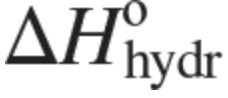
**heat of hydration (ΔHhydr)**
(also *enthalpy of hydration*) The enthalpy change occurring when 1 mol of a gaseous species (often an ion) is hydrated. The sum of the enthalpies from separating water molecules and mixing the gaseous species with them; designated (delta H of hydration) at the standard state.
15
New cards
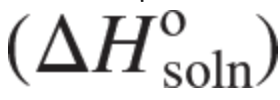
**heat of solution (ΔHsoln)**
(also *enthalpy of solution*) The enthalpy change occurring when a solution forms from solute and solvent. The sum of the enthalpies from separating solute and solvent substances and mixing them; designated ( Delta H of solution) at the standard state.
16
New cards
**Henry’s law**
A law stating that the solubility of a gas in a liquid is directly proportional to the partial pressure of the gas above the liquid: *S* gas = *k* H × *P* gas.
17
New cards
**hydration**
Solvation in water.
18
New cards
**hydration shell**
The oriented cluster of water molecules that surrounds an ion in aqueous solution.
19
New cards
**ideal solution**
A solution that follows Raoult’s law at any concentration.
20
New cards
**immiscible**
Insoluble; usually applied to liquids that do not dissolve in each other.
21
New cards
**ion exchange**
A process of softening water by exchanging one type of ion (usually Ca2+) for another (usually Na+) by binding the ions on a specially designed resin.
22
New cards
**ionic atmosphere**
A cluster of ions of net opposite charge surrounding a given ion in solution.
23
New cards
**ion–induced dipole force**
The attractive force between an ion and the dipole it induces in the electron cloud of a nearby nonpolar molecule.
24
New cards
**like-dissolves-like rule**
An empirical observation stating that substances having similar kinds of intermolecular forces dissolve in each other.
25
New cards
**lipid bilayer**
An extended, sheetlike double layer of phospholipid molecules that forms in water and has the charged heads of the molecules on the surfaces of the bilayer and the nonpolar tails within the interior.
26
New cards
**mass percent [% (w/w)]**
(also *mass %* or *percent by mass*) The fraction by mass expressed as a percentage. A concentration term expressed as the mass of solute dissolved in 100. parts by mass of solution.
27
New cards
**miscible**
Soluble in any proportion.
28
New cards
**molality (m)**
A concentration term expressed as number of moles of solute dissolved in 1000 g (1 kg) of solvent.
29
New cards
**mole fraction (X)**
A concentration term expressed as the ratio of number of moles of solute to the total number of moles (solute plus solvent).
30
New cards
**mononucleotide**
A monomer unit of a nucleic acid, consisting of an N-containing base, a sugar, and a phosphate group.
31
New cards
**nonelectrolyte**
A substance whose aqueous solution does not conduct an electric current.
32
New cards
**nucleic acid**
An unbranched polymer of mononucleotides that occurs as two types, DNA and RNA (deoxyribonucleic and ribonucleic acids), which differ chemically in the nature of the sugar portion of their mononucleotides.
33
New cards
**osmosis**
The process by which solvent flows through a semipermeable membrane from a dilute to a concentrated solution.
34
New cards
**osmotic pressure (Π)**
The pressure that results from the ability of solvent, but not solute, particles to cross a semipermeable membrane. The pressure required to prevent the net movement of solvent across the membrane.
35
New cards
**protein**
A natural, unbranched polymer composed of any of about 20 types of amino acid monomers linked together by peptide bonds.
36
New cards

**Raoult’s law**
A law stating that the vapor pressure of solvent above a solution equals the mole fraction of solvent times the vapor pressure of pure solvent:
37
New cards
**reverse osmosis**
A process for preparing drinkable water that uses an applied pressure greater than the osmotic pressure to remove ions from an aqueous solution, typically seawater.
38
New cards
**saturated solution**
A solution that contains the maximum amount of dissolved solute at a given temperature (prepared with undissolved solute present).
39
New cards
**semipermeable membrane**
A membrane that allows solvent, but not solute, to pass through.
40
New cards
**soap**
The salt formed in a reaction between a fatty acid and a strong base, usually a Group 1A(1) or 2A(2) hydroxide.
41
New cards
**solubility (S)**
The maximum amount of solute that dissolves in a fixed quantity of a particular solvent at a specified temperature.
42
New cards
**solute**
The substance that dissolves in the solvent.
43
New cards
**solvation**
The process of surrounding a solute particle with solvent particles.
44
New cards
**solvent**
The substance in which one or more solutes dissolve.
45
New cards
**strong electrolyte**
A substance that is a good conductor of electric current in solution because it dissociates or ionizes completely.
46
New cards
**supersaturated solution**
An unstable solution in which more solute is dissolved than in a saturated solution.
47
New cards
**suspension**
A heterogeneous mixture containing particles that are visibly distinct from the surrounding fluid.
48
New cards
**Tyndall effect**
The scattering of light by a colloid.
49
New cards
**unsaturated solution**
A solution in which more solute can be dissolved at a given temperature.
50
New cards
**vapor pressure lowering (ΔP)**
The lowering of the vapor pressure of a solvent caused by the presence of dissolved solute particles.
51
New cards
**volume percent [% (v/v)]**
A concentration term defined as the volume of solute in 100. volumes of solution.
52
New cards
**wastewater**
Used water, usually containing industrial and/or residential waste, that is treated before being returned to the environment.
53
New cards
**water softening**
The process of replacing the hard-water ions Ca2+ and Mg2+ with Na+ ions.
54
New cards
**weak electrolyte**
A substance that is a poor conductor of electric current in solution because it only partially dissociates or ionizes.