Gravitational Fields
 Call Kai
 Learn
Learn Practice Test
 Spaced Repetition
 Match
Match Flashcards
 Knowt Play
1/26

There's no tags or description
Looks like no tags are added yet.
Name | Mastery | Learn | Test | Matching | Spaced | Call with Kai |
|---|
No analytics yet
Send a link to your students to track their progress
27 Terms
What is a force field?
Any region where a body will experience a non contact force.They arise from interactions betweens bodies or particles.
What is a gravitational field?
A region of space where a a mass experiences a force due to the gravitational attraction of another mass. The direction of a gravitational field is always to the centre of the mass. They cannot be repulsive.
What is the range of gravity?
Infinite, greater gravitational field around objects with larger mass.
What is the equation for gravitational field strength?
g=F/m
g= gravitational field strength (N/kg)
F= force due to gravity or weight (N)
m= mass (Kg)
What factors effect gravitational field strength?
The radius of the planet, the mass (or density) of the planet.
What are radial fields?
Non-uniform fields where the gravitational field lines around a point mass are radially inwards, gravitational field strength is different considering how far you are from the centre.
What is a uniform field?
Gravitational field lines represented by equally spaced parallel lines, gravitational field strength is same throughout.
What is a uniform sphere?
A sphere where its mass is distributed evenly.
What is a point mass?
An object with an even mass distribution and the distance (?) is considered larger than its size. Gravitational field lines around a uniform sphere are identical to those around a point mass.
What is Newtons law of Gravitation?
F= Gm₁m₂ / r²
F= gravitational force between two masses
G= newtons gravitational constant
m₁ and m₂= two points masses
r= distance between the centre of two masses
the 1/r² relation is called the inverse square law.
What is the equation for gravitational field strength due to a point mass?
g= GM/r²
g= gravitational field strength
G= Newtons gravitational constant
M= mass
r= distance between points source and position in field.
What is the gravitational potential at a point in a gravitational field?
The work done per unit mass in bringing a test mass from infinity to a defined point. Represented by V, measured in J kg-¹
Why is the gravitational potential always a negative value?
It is defined as zero at infinty, since the gravitational force is attractive work must be done on a mass to reach infinity. The gravitational potential is negative on the surface of a mass and increases with distance from that mass.
Is gravitational potential and gravitational potential energy the same thing?
No, potential is a property of the point in space and depends on the source mass, potential energy is the property of the object at a point in space and depends on the objects mass.
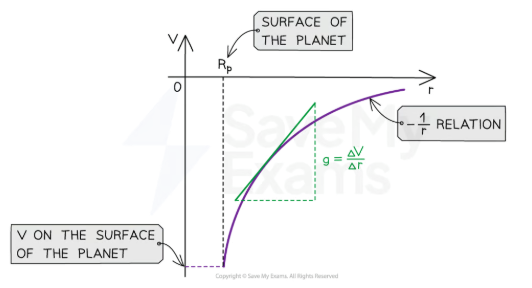
What does the graph of V (gravitational potential) against r (distance from centre of planet) look like?
The values for V are all negative, the gravitational field strength (g) is the negative of the gradient.
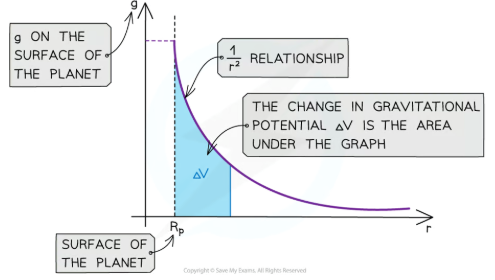
What does the graph of g (gravitational field strength) against r (distance from centre of planet) look like?
As r increases g against r follows an inverse square relation, the area under this graph is the magnitude of the change in gravitational potential
What is the equation for the work done from moving a mass against the force of gravity?
∆w= m* ∆v
change in work done (GPE)= mass * change in gravitational potential
this can be derived using ∆v equation to GPE= GMm (1/r₁- 1/r₂)
What are eqipotential lines?
dotted lines that join together points that have the same gravitational potential, in radial fields they are concentric circles and can become further apart as they move further away from the planet, in a uniform fields they are horizontal evenly spaced lines. no work is done moving along an equipotential line only between them.
What is the equation for linear speed of a mass in orbit?
v²=GM/r
the gravitational force is the centripetal force that keeps the object in orbit, ∴ GMm/r²= mv²/r which the turn into v²= GM/r