Neuro Block 4: The Visual System and Upper Cranial Nerves
 Call Kai
 Learn
Learn Practice Test
 Spaced Repetition
 Match
Match Flashcards
 Knowt Play
1/36

There's no tags or description
Looks like no tags are added yet.
Name | Mastery | Learn | Test | Matching | Spaced | Call with Kai |
|---|
No analytics yet
Send a link to your students to track their progress
37 Terms
List 5 things the Eye socket/Orbital contains:
eyeball
optic nerve
extraocular muscles
lacrinal apparatus
nerves and vessels that innervate these structures
What is an important distinction between the axis of the orbit and the axis of the eyeball?
the axis of the orbit is NOT aligned with the axis of the eyeball
Give the boundaries of the orbit:
roof = frontal and sphenoid bone
floor = palatine bone, maxillary bone, zygomatic bone
medial wall = maxillary bone, lacrimal bone, ethmoid bone and sphenoid bone
lateral wall = sphenoid and zygomatic bone
List the 6 layers of the eyelid:
skin
subcutaneous tissue
voluntary muscle = orbicularis oculi
orbital septum
tarsus
conjunctiva
What cranial nerve innervates the orbicularis oculi?
facial nerve
Which ligaments attach to the medial and lateral sides of the orbit and what muscles follow the same path?
medial and lateral palpebral ligaments
tarsus muscles
What structures ensure foreign objects do not get ‘lost’ in the posterior part of the eyeball?
superior and inferior fornix
List 4 Fissures/foramen of the orbital:
Superior Orbital Fissure
Inferior Orbital Fissure
Optic Canal
Nasolacrimal Canal
List the 4 cranial nerves that enter the orbit through the superior orbital fissure:
Ophthalmic branch of cranial nerve V (trigeminal)
Oculomotor CN III
Trochlear CN IV
Abducens CN VI
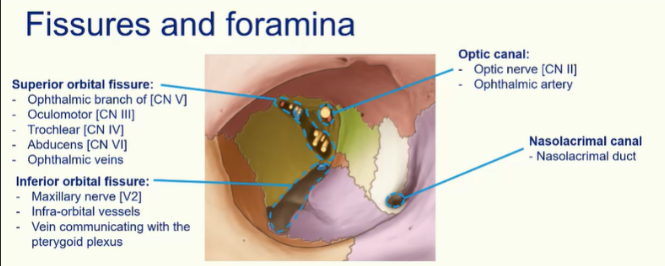
What nerve passes through the inferior orbital fissure?
maxillary nerve
What nerve and what artery pass through the Optic canal?
Optic nerve CNII
Ophthalmic Artery
What passes through the Nasolacrimal canal?
nasolacrimal duct (tear drainage)
What is the function of the Lacrimal Apparatus?
the lacrimal apparatus produces tears (via lacrimal gland) and drains tears
List the drainage pathway of tears:
lacrimal gland produces tears → drain into lacrimal canaliculi → lacrimal sac → nasolacrimal duct → nasal cavity
List the extraocular muscles of the eye:
medial rectus
lateral rectus
superior rectus
inferior rectus
superior oblique
inferior oblique
levator palpebrae superioris
What muscle adducts the eye?
medial rectus
What muscles abducts the eye?
lateral rectus
What muscle elevates the eye?
superior rectus
What muscle depresses the eye?
inferior rectus
What muscle externally rotates the eye?
inferior oblique
What muscle internally rotates the eye?
superior oblique
What eye muscles does the oculomotor nerve innervate:
medial rectus
superior rectus
inferior rectus
inferior oblique
What nerve innervates the levator palebrae superioris?
oculomotor
What innervates the lateral rectus muscle?
abducens nerve (CNVI)
What innervates the superior oblique muscle?
trochlear nerve (CN IV)
When asking a patient to look up and right (without moving their head), what muscles are you testing?
isolates movements for superior rectus (right eye) and inferior oblique (left eye)
When asking a patient to look right what muscles are you testing?
Testing the lateral rectus for right eye
Testing medial rectus for left eye
When asking a patient to look down and right what muscles are you isolating?
This isolates the inferior rectus for right eye
This isolates the superior oblique for the left eye
What artery supplies all structures in the orbit?
ophthalmic artery (a branch of the internal carotid artery)
enters through the optic canal (along with optic nerve)
List 2 veins of the orbit: What do they drain into?
Superior ophthalmic vein
Inferior ophthalmic vein
→ both drain into cavernous sinus either side of pituitary gland
Summarise the optic nerve pathway:
arises in retina → exits orbit via optic canal → some fibres from this nerve form the optic chiasm → optic tract → synapse at thalamus → continue to visual cortex as optic radiation
Where specifically in the thalamus does the optic tract synapse?
Lateral geniculate body
What is the function of the opti nerve?
vision
(special afferent innervation)
Where is the origin of the Oculomotor Nerve (CN III)?
arises at midbrain
Summarise the pathway of the Oculomotor nerve:
oculomotor nerve arises at midbrain → exits the brain stem between midbrain + pons → passes through lateral wall of cavernous sinus → leaves cranial cavity through superior/radial fissure → enters orbit and divides into superior and inferior branches
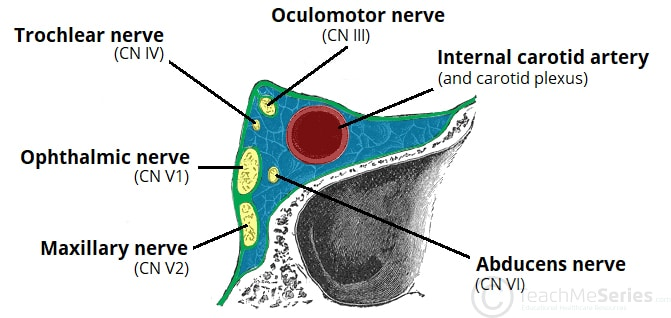
Where does the trochlear nerve arise from?
the midbrain at level of inferior colliculus
Where does the Abducens nerve arise from?
the pons