Lectures In Psychological Science (LIPS)
 Call Kai
 Learn
Learn Practice Test
 Spaced Repetition
 Match
Match Flashcards
 Knowt Play
1/374

There's no tags or description
Looks like no tags are added yet.
Name | Mastery | Learn | Test | Matching | Spaced | Call with Kai |
|---|
No analytics yet
Send a link to your students to track their progress
375 Terms
uncertainty as stressor
no stable predictor (more stressful than knowing something very stressful will happen)
uncertainty
a natural part of life that impacts how we make decisions and experience discomfort
It is the inability to determine the meaning of illness-related events, occurring when the decision maker is unable to assign definite value to objects or events, or is unable to predict outcomes accurately
It’s not simply the lack of information (in psychology)
uncertainty as psychological stressor
Important to know why it’s such a stressor
Multiple outcomes are possible → brain generates multiple predictions
Uncertainty can activate our stress system
Chronic: more often or higher intensity, environment … → increases the risk of developing psychological problems
intolerance of uncertainty (IU)
Dispositional difficulty tolerating ‘not knowing’
Aversive emotional response to missing information
cognitive mechanisms
Can be functional mechanisms, but in the long way, they can contribute to bad outcomes
worry
catastrophizing
threat monitoring
worry
central to IU, managing uncertainty, cognitive avoidance
o Keeps the person in a specific, analytical state
o What if … (one question generates another)
o Less confidence in coping due to this
catastrophizing
worst-case scenario, focus on the most neg option
o Overestimating the neg outcome
o Exaggerating, impossible to resolve the problem
threat monintoring
something is wrong this time, scanning for all neg threats
o Strong focus on all symptoms we feel
o Behavioral inhibition as part of it
o Searching online for information, overplanning …
emotional consequences
amplifies NA
dampens PA
increases emotional dysregulation over time
amplifies NA
a. More anxiety and fear (uncertainty felt as imminent threat)
b. More anger/irritability (uncertainty as an unfair obstacle)
c. More sadness/demoralization (pessimistic certainty)
dampend PA
a. Less excitement and joy, even in potentially pos contexts
b. Less reward anticipation (especially in depression)
c. Difficulty savoring pos moments
increased emotional dysregulation over time
a. Self-regulatory fatigue → chronic stress, burnout (uses a lot of energy and cognitive resources)
b. More rumination and suppression
c. Greater vulnerability to avoidance and withdrawal
behavioral consequences
avoidance
safety behaviors
control behavior
avoidance
avoiding situations with uncertain outcomes
safety behaviors
checking, reassurance-seeking, overplanning (intended to create a sense of safety, but often a false sense)
information seeking
procrastination and perfectionism
information seeking
excessive research (including digital checking) → reduces uncertainty in the moment, but teaches the brain that you can only handle this if you check
procrastination and perfectionism
delaying action to avoid uncertainty
control behavior
over-functioning to prevent mistakes (subtle approach, micromanaging)
psychological correlates
- IU is linked to altered anticipation and salience processing
- Outcomes in the lab (meer gestructureerd, dus opletten met outcomes)
startle
often higher during unpredictable threat
corrugator
more neg valence during anticipation
skin conductance response (SCR)
less consistent in instructed uncertainty tasks
expected uncertainty (aleatory)
predictable variability, known and stable (ex: gambling)
unexpected uncertainty
sudden change, broken expectations (ex bad and unexpected news)
epistemic uncertainty
lack of knowledge (potentially learnable)
perceptual uncertainty
ambiguous sensory input (symptom or sensation)
volatility
rules change frequently over time, changing environment (mostly in chronic illnesses with fluctuations)
deep uncertainty
probabilities unknown
shallow uncertainty
quantifiable risk
objective uncertainty
outcome not yet determined, about the future (ex soccer match)
subjective uncertainty
the outcome already exists, but you don’t know it yet (ex health quiz)
vicious cycle in GAD
1. Message from manager asking of you can come in tomorrow to talk
2. Triggers a threat response, many possible outcomes → what if …
3. Coping (worrying in loops, assurance, checking their work, no longer focusing on other matters …) → worrying feels useful
4. Relief the next day: new possibility
Cycle: their brain learns that worry brings relief
uncertainty in personality disorders
uncertainty is often experienced as a threat to …
self-coherence
attachment-security
control
Leads to emotion dysregulation, impulsivity, rigid coping and interpersonal conflict
IU may act as a transdiagnostic amplifier of NA and threat interpretation (evidence is emerging, mainly indirect pathways)
self-coherence (PD)
identity: the self is stable
if weak: uncertainty becomes a threat for the self
attachment-security (PD)
relationships
will this person stay with me or not? Even low levels can trigger strong reactions (ex a different kind of message than usual)
control (PD)
rules, order, predictability
over-checking everything
amplifier = uncertainty
borderline PD (uncertainty)
o Uncertainty about the self + relationships
o Rapid shifts in goals/values + fear of abandonment
o Impulsivity/self-harm as fast relief from uncertainty distress (with high costs)
OCD (uncertainty)
o Uncertainty managed via control
o Perfectionism, overplanning, rigidity
o Difficulty delegation, intolerance of mistakes
avoidant PD (uncertainty)
o Uncertainty about evaluation
o Avoidance of social/achievement situations
o Safety behaviors: rehearsing, reassurance, withdrawal
paranoid traits (uncertainty)
o Ambiguity interpreted as hostile intent
o Threat certainty replaces uncertainty (“I know they’re against me”)
chronic illness as uncertainty
- In chronic illness, uncertainty isn’t the exception, it’s the context
- You need meaning in order to function properly
workplace uncertainty
- Common behavioral and emotional markers
- Decision paralysis or extreme risk-aversion
- Impulsive decisions (short-term certainty seeking)
- Future-focused worry (job insecurity, organizational pessimism)
- Withdrawal and reduced collaboration
- Lower-quality communication (less sharing, more misunderstandings)
- Increased frustration, anxiety, irritability
- Disengagement (“quiet quitting”) and apathy
- Resistance to change and new initiatives
- Turnover intentions and loss of key talent
- Burnout and chronic exhaustion
psychological impact (workplace uncertainty)
- Rapid economic, technological, and organizational change drives ongoing uncertainty
- Uncertainty erodes focus, increases cognitive load, fuels burnout, and undermines trust
- Prolonged uncertainty causes threat monitoring and anticipatory anxiety
- Workplace uncertainty mirrors psychological mechanisms seen in health and clinical contexts (hypervigilance, reduced cognitive capacity, decision hesitancy)
leading with clarity
ensure people feel valued
be transparant
set clear goals
be predictable
leverage pos emotions
manipulating uncertainty
probability
predictability
ambiguity
volatility
probability
how likely is the outcome? (ex 20% vs 80%)
predictability
can we predict when it happens? (timing)
ambiguity
are probabilities unknown? (missing information)
outcome uncertainty
what will happen?
meaning uncertainty
what does this symptom/event mean?
methods and measures
- Self-report: IUS-12 / IUS-27 (trait IU) state uncertainty, threat appraisal, worry, coping
- Behavior: avoidance choices, information-seeking, decision latency//over-checking, risk-avoidance, persistence under uncertainty
- Psychophysiology (anticipation)
- Startle reflex (defensive responding)
- Corrugator EMG (neg valence)
- HR/HRV (autonomic arousal)
- Respiration (especially relevant in health and breathlessness)
- Neuroimaging: anterior insula, amygdala, ACC, PFC during anticipation
strikes
have to do with conflicts on organizational/collective levels. There’s much change that has taken place from them
intrapersonal conflict
conflict within yourself
interpersonal conflict
conflict between individuals
intragroup conflicts
conflict within a team or group
intergroup conflict
conflict between teams or groups
conflict
between 2 (or more) parties, when at least 1 of the parties feels that the other party is opposing or irritating them
verrottingsstrategie
people that don’t fit well into the firm are ignored until they feel that they don’t belong within and leave (= passive aggressive)
intervention checks
keeping conflicts small by bridging in conflicts instead of talking behind each other’s backs
institutional conflict
with organization/context/system
interorganizational conflict
conflict between larger entities
international conflict
conflict within and between countries
interventions: golden rules
o Prevention is the best intervention
o Early actions: agila, small, clear, light
o Escalation, engage third parties
conflict sensitivity
- People differ strongly to the extent they experience conflict and are impacted
- Conflict experience is the result of interaction
conflict experience
the result of interaction
of person (conflict sensitivity)
and social situation/context
and the fit of both
important to recognize it
styles of conflict behavior
accommodating
problem solving
compromising
avoiding
forcing
conflict behavior
o Connected to our personality
o But also personal style, like culture and family: some of us are avoiding, others accommodating …
o Sometimes you have to make a strategic choice: for example to do something you usually wouldn’t
emotional confusion
tears for anger, blame for guilt…
cultural conflict communication
- Happiness: mostly associated with the fit with the culture and the persons personality
- Sometimes you think you understand each other, but you don’t because of difference in conflict communication style
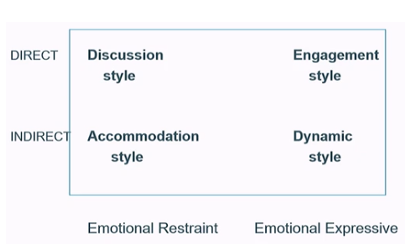
accommodation
Belgium: more restraint + indirect
dynamic
Italy: expressive + indirect
the 7 sins
in conflict, we see all of them come to the front (not all at the same time), important to recognize them
pride, vanity
greed
lust
jealousy
gluttony
wrath (anger)
sloth (laziness)
peacemaking
- Natural behavior in groups
- Aiming to restore harmony
- Extra role behavior of any group member
- Helping 1 or both parties
behaviors are voluntarily actions, by a multi-partial third party, without formal authority, offering (un)solicited help, to their peers in conflict
importance of peacemaking
conflict is stressful also to other group members
conflict is a threat for the group
restoring harmony is essential for surviving as a group
parts of peacemaking
1. Connecting to all parties
2. Emotional support (“I’m so sorry for you”)
3. Help finding solutions (“how would you do it, what would help for you?”) → be supportive and helpful
4. Use humor to ease tension
emotional support
“i’m so sorry for you”
thin line between supporting and siding
support is very important, but the moment you side, you fuel the conflict
humor
can be used to ease tension
haing a peacemaker in the group is great and really helpful
women tend to use this more in times of conflict
usually helps to get perspective → no one is perfect …
don’t be sarcastic, be connective
peacemaking: goal
you want to shift the perspective from the past to the present and the future
invalid post-selection inference
if we conduct classical inference with the same data that was used to select the statistical model
data analysis in the textbook
Step 1: select the statistical model
Step 2: the data set
Step 3: model fitting (fit the model via OLS)
Step 4: hypothesis test
type I error rate
alpha
probability of falsely rejecting H0
data analysis in practice
Step 1: model fitting (fit models across all possible subsets of independent variables via OLS)
Step 2: perform model selection (select the model that minimizes AIC)
Step 3: hypothesis test (for the regression coefficients in the selected model
AIC
to select the model
smallest value = the best
central limit theorem
ensures that the OLS estimator of θ1 is approximately normally distributed around the true value θ1, provided the sample size is sufficiently large
consequences of invalid post-selection inference
- The parameter distribution after model selection is a mixture of multiple distribution conditional on selecting a specific model, weighted by the probability of selecting this model
- Statistical inference after model selection does not take into account the ‘true’ uncertainty when estimating θ1: the standard error rate of the OLS estimator of θ1 is consistently underestimated
- Type I rate inflation does not vanish asymptotically (N to infinity)
parameter distribution (after model selecting)
a mixture of multiple distribution conditional on selecting a specific model, weighted by the probability of selecting this model
statistical inference (after model selecting)
does not take into account the ‘true’ uncertainty when estimating θ1: the standard error rate of the OLS estimator of θ1 is consistently underestimated
type I rate inflation
does not vanish asymptotically (N to infinity)
solutions for invalid post-selection inference
data splitting
simultaneous inference
conditional selective inference
data splitting
easy solution
Dataset is divided into training and test sets
data splitting: limitations
- Loss in efficiency in model selection due to small sample size in the training set (ex favor simple models)
- Loss of statistical power due to small sample size in the testing set
simultaneous inference
- It considers all models explored during selection are relevant for inference, aiming for overall error control (ex to control the probability of making any error)
- Constructs simultaneous (1 - a) confidence intervals based on least-squares estimated for the parameters of all linear regression models that were ever considered
simultaneous inference: problem
can lead to very wide CI’s
conditional selective inference
- It focuses on a selected model and conditions the inference on the selected event (the selection of which hypotheses to test)
- For example the confidence interval of θ1 is constructed if only X1 is selected
conditional selective inference: problem
Depends on the model selecting tools (such as AIC) that are used
wilhelm diltey
natural sciences
humanities
natural sciences
explaining general laws of nature (erklären)
o External forces, invariant principles, repeatable
humanities
understanding humankind and complex phenomena resulting from interactions between humans such as history, culture and religion (verstehen)
o Total experience, not to be reduced to a small number of factors isolated in the lab, essentially non-repeatable
Snow
the 2 cultures”
- Humanities <> sciences and engineering
- Arts <> sciences
- Arts engagement and aesthetic experience <> experimental aesthetics, computational aesthetics, neuro-aesthetics
Arts engagement and aesthetics experience
- Full-blown, rich experience
- First-person perspective
- Unique, subjective
- Influenced by personality, history, context, culture
- Case studies with qualitative methods