AP Gov Media Unit
 Call Kai
 Learn
Learn Practice Test
 Spaced Repetition
 Match
Match Flashcards
 Knowt Play
1/85

There's no tags or description
Looks like no tags are added yet.
Name | Mastery | Learn | Test | Matching | Spaced | Call with Kai |
|---|
No analytics yet
Send a link to your students to track their progress
86 Terms
In the late 18th and 19th centuries…
Newspapers were only accessible by a certain number of people
Mass media
Media designed to reach a larger audience
When did radio become popular
1930s
When did TV become popular
1950s
What happened with media in the 1980s
Media started catering to narrower audiences
When did CNN and other news media rise
1980s and 1990s
What did cable TV do for news intake
It increased the number of options (along with the internet doing that too)
What does deregulation of media lead to
Consolidation
What has happened to confidence in TV shows recently
Confidence has decreased
Bias in media
Increasing amounts of Americans feel there’s an increasing amount of bias in media
What can PACs do vs super PACs
PACs:
Work directly with campaigns
Donate to campaigns
Receive donations (capped at 5,000)
Super PACs:
Unlimited donations
Run independent campaigns
Iron triangles
Long-term, stable, tight alliances between bureaucracy, Congress, and interest groups for certain policy goals
Issue networks
Loose, temporary, and often contentious groups of interest groups, journalists, policymakers, policy advocates, etc. on certain policy issues
Social movements
Often short-lived
Outsider groups surrounding a certain social issue
Difficult for social movements to become interest groups because interest groups have a lot of resources
What technique do groups typically employ if they don’t have a lot of money
Grassroots
Largest category of interest group
Economic
Largest lobbying group
US Chamber of Commerce
Where does much of lobbying power come from
Providing timely, useful information like research or testifying
Lobbying
Interacting with all 3 branches of government on leiglsaiton
Net neutrality
Calling for service providers to not create “fast lanes” for certain people who pay more or deliberately slowing down internet traffic to certain websites to favor their own services
What is true about two senate seats in one seat
No 2 seats are open at the same time
What didi the 1842 apportionment act do
Created single-member districts
how many members are in house
435
Apportionment
Associating representatives to districts/states based on census counts
How often does census happen
10 years
What happens after census
H of R numbers
Redistricting
Trends in house seats by geography
Gain in house seats for South and West
Losses for states in Northeast and Midwest
In most states, who draws district boundaries
Legislatures (other times its nonpartisan commissions)
How many seats in House are competitive
40
Battleground state
Close contest between candidates
Swing states
Similar support for parties and swing back and forth between them
How does caucus vote vs primary
Caucus= public vote
Primary = secret ballot
How do democrats award delegates
Proportional system of sending delegates based on percentage of votes won
How do Republicans award delegates
Elect based on state overall and then based on districts (winner take all)
How is the republican system different from the democratic system
Can be quicker
Also keeps viable candidates from running because it’s quick
What are campaigns centering more on these days
Candidate-centered (national party platforms losing influence)
Who creates schedules for caucuses and primaries
national party leaders
Where are the basics of elections laid out
Article II section I
Requirements to be president
35 years, born in US, and 14 years in country
General trend in candidate nominations
Calling for increased openness→ aligning candidates with regular people
Who controls details on how a candidate gets nominated
Parties
Key differences candidates need to account for in general elections
Need to now persuade nonvoters and independents→ not being too center, not being too leaning
Since the 1980s, more people have identified themselves as…
Democrat
Since mid-1960s, Republican Party base began shifting from
Northeast to South and West
President Carter
Large support from the South, deeply religious beliefs
Reagan
Reinvigorated party, lower taxes, small government, Reagan Democrats
Clinton
Won by convincing his party to be more ideologically center and blaming HW Bush for economic recession
W Bush
Compassionate conservative and gained evangelical christian vote
Since mid-1990s, part control has
Swung back and forth
How do most people feel about negative ads
Think they’re not helpful
How did Obama respond to 2008 recession
Increased spending for government programs
Nearly half of the US electorate self-identifies as what
Independent
Main roles of political parties
Informer
Nominating
Watchdog
Governmental (articulating policy)
Why is it important for parties to have majorities in congress?
They can get leadership positions in all committees and chairman Roels
Realignments
Rare times where supports of a party realign to support a different party→ EX: New Deal Democrats
Party eras
Long amounts of time where one party is in power/control
Marked by critical elections
Since 1968…
Party control has gone back and forth
How do parties interact with candidates in modern campaigning?
Very candidate-focused campaigning process where candidates come first and parties come second
It used to be parties coming first and candidates coming second
How do politicians/parties change platforms to attract support?
They seek to gain favorability from coalitions by talking about key talking points among those coalitions
What are the three ways parties change party structure?
Realignment
Campaign finance laws
Communication and data (project narwhal)
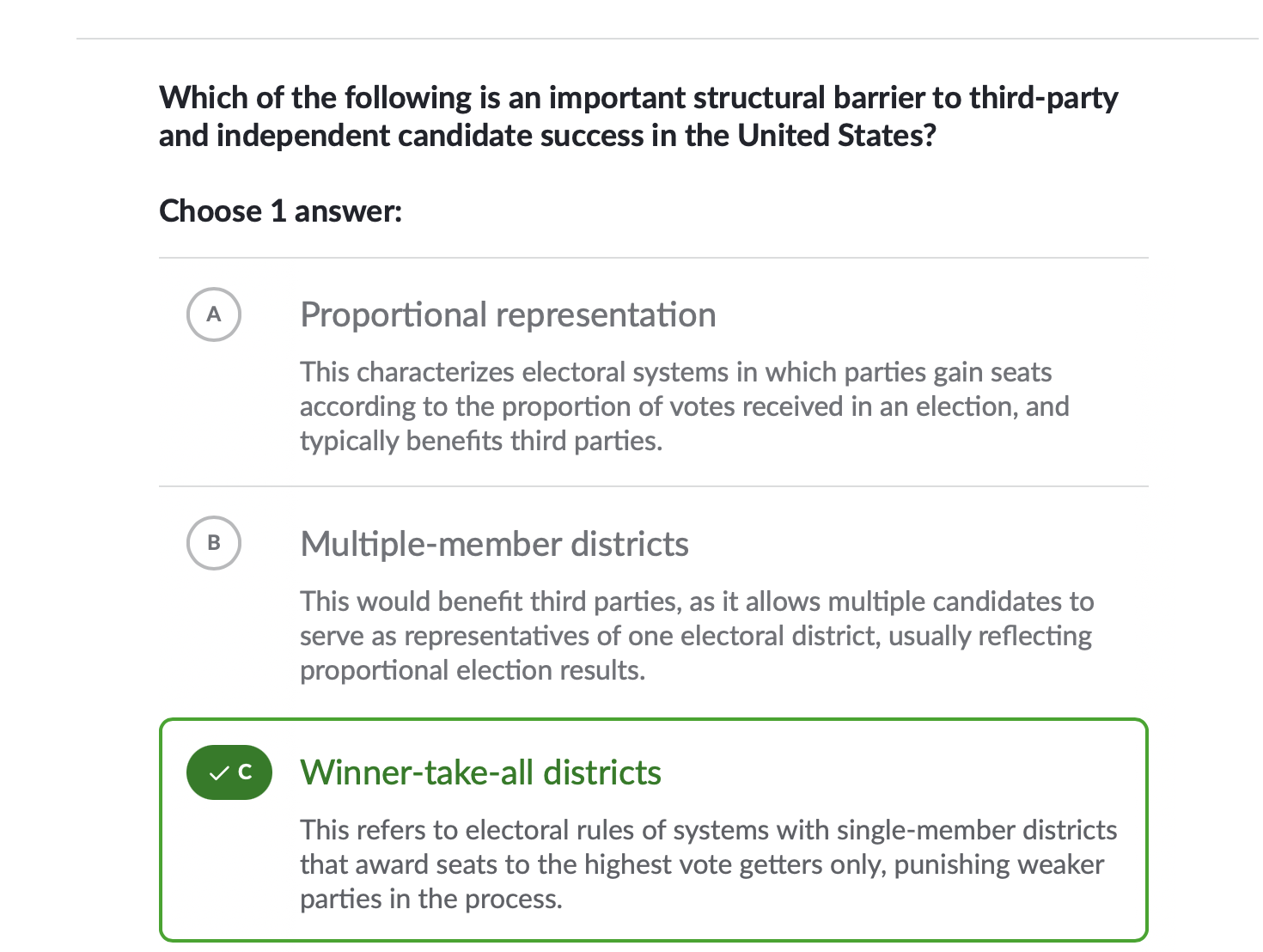
What impacts third parties
Winner take all districts
Key ideologies of Democrats
More spending for public programs, less government intervention in social policy, more government intervention in economic policy, decreased military spending, diplomacy through multinational organizations and IGOs, law is being unequally applied to minorities, society priorities over individual, increase or maintain minimum wage, rehab over punishment
Key ideologies of Republicans
Balanced budget, increased defense spending, peace through strength in IR, decreased spending for public programs, law is being applied equally for all people, tough on crime
Key ideologies of libertarians
Decreased gun control, generally for free market, against taxed, repeal IRS, repeal income tax, generally opposed to welfare, pro gun rights, decreased minimum wage, and against death penalty
When do presidents have the greatest amount of momentum
Beginning of terms
Since the 1860s, presidents have been either…
Republican or Democrat
Shelby County v. Holder general arguments/decisions:
Basically found the formula used in the VRA unconstitutional because it used an old system to calculate which states to specifically target for preclearance→ argued based on 14th amendment of equal protection
Two main trends since Shelby County decision
Decreased mail-in
Stricter voter ID
Which topic generally carries some of the highest debate in the country today
Social security
Does political ideology usually stay stable over time
Yes, your core political values/ideologies will not change with age, even though there may be things that impact certain parts of it
What kinds of ratings ar known to have little stability in the US
Presidential approval ratings
Tracking poll
Usually used by professionals, tracks the opinions of a certain group over a long period of time to gauge public interest
What do moderates view themselves as
Pragmatists who use common sense rather than using philosophical arguments for political problems
Which committee decides what position a party will take on an issue
Platform committee
What election style do most states use to award delegates to a candidate
Primaries
Election order/timeline
Invisible primary, primaries and caucuses, convention, general election
What kind of spending is education
Discretionary
Splinter vs ideological parties
Splinter parties: splinter off from a main party because of internal differences
Ideological parties: centered on a more stable ideology and usually last longer
Key example of party realignment
1968 election shift of democrats to republicans
Impacts of Baker v. Carr
Addressed malapportionment
Most states redistricted in 1960s
TN redistricted so there was equal population
One vote= one person doctrine
Why is it strategic for a candidate to win in an early primary state
Gives them momentum
Who does caucus usually appeal to
Party’s extremists
Since the 1970s
Power between parties in White House has swung back and forth
When are amicus curiae briefs usually used
High profile cases
What do primaries usually do for the power of the party
Usually decreases the power of the party because primaries require candidates to use their own money for campaigns
State powers in elections
Certify election results
Draw congressional districts