Bio Test #3 (Cell Structure and Function)
 Call Kai
 Learn
Learn Practice Test
 Spaced Repetition
 Match
Match Flashcards
 Knowt Play
1/29

There's no tags or description
Looks like no tags are added yet.
Name | Mastery | Learn | Test | Matching | Spaced | Call with Kai |
|---|
No analytics yet
Send a link to your students to track their progress
30 Terms
Overview of Cell respiration
Cellular respiration is the metabolic process by which cells break down glucose and other organic molecules in the presence of oxygen (𝑂2) to produce energy in the form of ATP, releasing carbon dioxide (𝐶𝑂2) and water (𝐻2𝑂) as waste products. It is essentially how cells "breathe" to create usable energy.
𝐶6𝐻12𝑂6+6𝑂2→6𝐶𝑂2+6𝐻2𝑂+Energy(ATP)
Glycolysis
Glycolysis is a 10-step, anaerobic metabolic pathway in the cytoplasm that breaks down one glucose molecule (𝐶6𝐻12𝑂6) into two pyruvate molecules, yielding a net gain of 2 ATP and 2 NADH. As the foundational step of cellular respiration, it functions in both aerobic and anaerobic conditions, playing a crucial role in cellular energy production.
Krebs Cycle (Citric Acid Cycle)
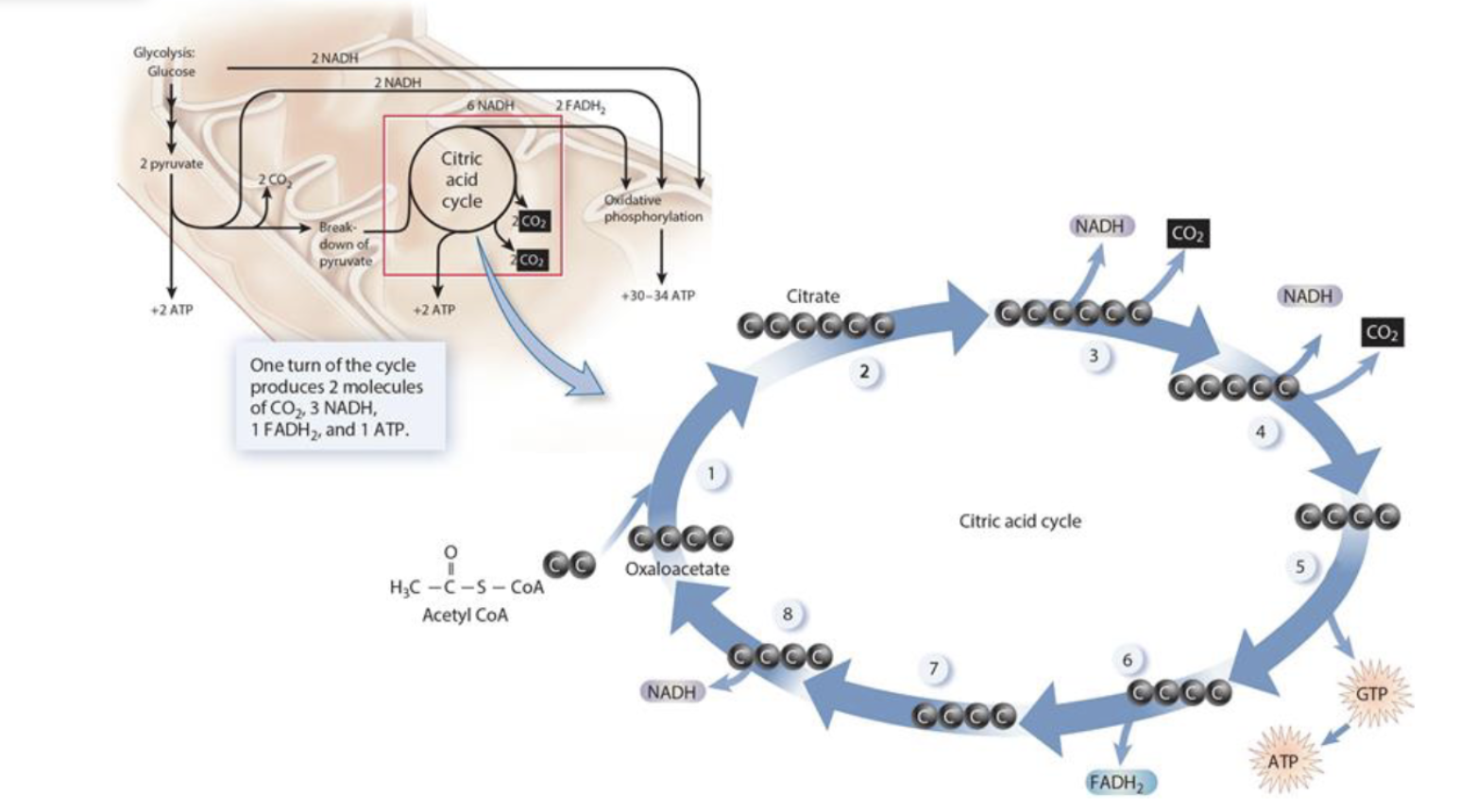
Electron Transport Chain
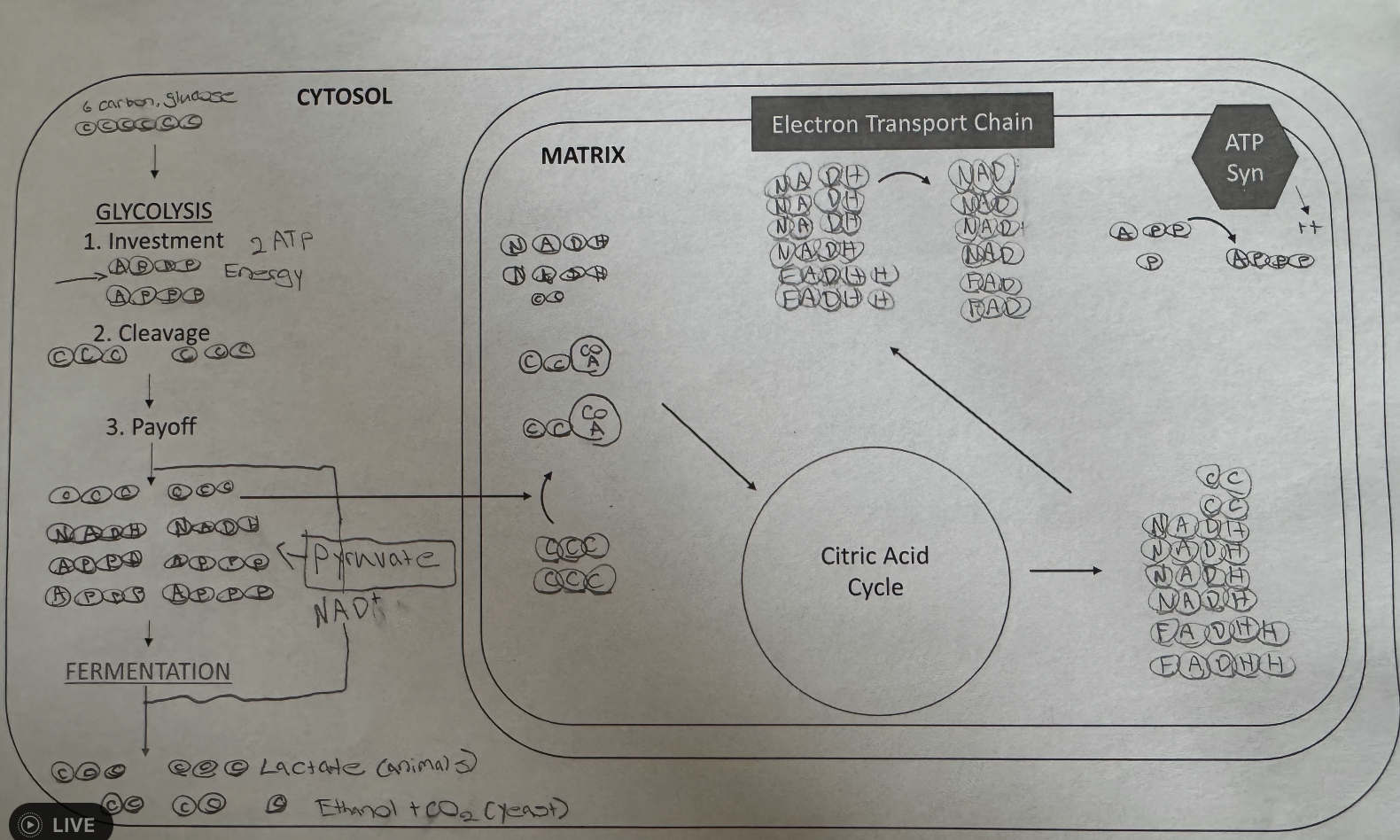
ATP production
the metabolic process of generating the primary energy currency of cells, essential for powering muscular contraction, active transport, and molecular synthesis. It is produced primarily through cellular respiration(glycolysis, citric acid cycle, and oxidative phosphorylation) and photosynthesis in plants, utilizing a molecular turbine called ATP synthase.
Substrate-level phosphorylation vs. oxidative phosphorylation
substrate-level phosphorylation directly transfers a phosphate group from a substrate to ADP, while oxidative phosphorylation uses an electron transport chain and a proton gradient to power ATP synthase.
Feature | Substrate-Level Phosphorylation | Oxidative Phosphorylation |
|---|---|---|
Mechanism | Direct transfer of phosphate from a substrate to ADP. | Proton ( H+ H+ ) gradient powers ATP synthase. |
Electron Transport Chain | No | Yes |
Oxygen Requirement | No (can happen in anaerobic conditions). | Yes (final electron acceptor). |
Location | Cytoplasm (Glycolysis), Mitochondria (Krebs). | Inner Mitochondrial Membrane. |
ATP Yield | Low yield. | High yield ( ∼26 −28 ATP/glucose). |
Examples | Glycolysis (PEP to pyruvate), Krebs cycle. | Electron transport chain + Chemiosmosis. |
Glycolysis Steps
I. Energy Investment Phase (Uses 2 ATP)
Phosphorylation of Glucose: Glucose is converted to Glucose-6-phosphate by hexokinase, trapping it in the cell and consuming 1 ATP.
Isomerization: Glucose-6-phosphate is converted into Fructose-6-phosphate.
Second Phosphorylation: Fructose-6-phosphate is converted to Fructose-1,6-bisphosphate by phosphofructokinase-1 (PFK-1), consuming another ATP. This is a key rate-limiting step.
Cleavage: Fructose-1,6-bisphosphate splits into two 3-carbon molecules: Glyceraldehyde-3-phosphate (G3P) and Dihydroxyacetone phosphate (DHAP).
Isomerization of Triose Phosphates: DHAP is converted into G3P; from this point, the reactions occur twice per original glucose molecule.
Khan Academy +4
II. Payoff Phase (Produces 4 ATP & 2 NADH)
Oxidation and Phosphorylation: G3P is oxidized and phosphorylated to form 1,3-bisphosphoglycerate, producing NADH.
First ATP Generation: 1,3-bisphosphoglycerate converts to 3-phosphoglycerate, creating 1 ATP.
Phosphate Shift: 3-phosphoglycerate converts to 2-phosphoglycerate.
Dehydration: 2-phosphoglycerate becomes Phosphoenolpyruvate (PEP).
Second ATP Generation: PEP is converted to Pyruvate by pyruvate kinase, creating another ATP.
ThoughtCo +4
Electron Transport Chain: Components and function
The electron transport chain (ETC) is a series of four protein complexes (I-IV) and mobile carriers in the inner mitochondrial membrane that transfers electrons from NADH and FADH2 to oxygen, producing water. This process creates a proton gradient that drives ATP synthase (Complex V) to produce the majority of cellular ATP
Chemiosmosis: Process and importance.
Chemiosmosis is the process of generating ATP (adenosine triphosphate) by using the energy stored in a proton (H+) gradient across a biological membrane, which drives the enzyme ATP synthase. This mechanism is central to cellular respiration in mitochondria and photosynthesis in chloroplasts.
Fermentation: Types (lactic acid and alcoholic), significance.
Fermentation is an anaerobic metabolic process that converts sugars into cellular energy (ATP), producing either lactic acid or alcohol and CO₂. It acts as a vital pathway for energy production in the absence of oxygen, used by microorganisms and muscle cells to regenerate NAD+. Key types include lactic acid fermentation (yogurt, muscles) and alcoholic fermentation (bread, wine), significant for food preservation, flavor development, and industrial biofuel production
Mitochondrial Structure: Role in cellular respiration.
The mitochondrion is the "powerhouse" of the eukaryotic cell, specialized for aerobic cellular respiration, which converts nutrients into adenosine triphosphate (𝐴𝑇𝑃). Its unique double-membrane structure is meticulously designed to facilitate the citric acid cycle (Krebs cycle) and electron transport chain (𝐸𝑇𝐶) efficiently.
Regulation of Cellular Respiration: Key regulatory steps and molecules.
Cellular respiration is primarily regulated through allosteric control of key enzymes, ensuring that ATP is produced only when needed (high ADP/AMP) and inhibited when energy is abundant (high ATP/Citrate). The main control points occur at irreversible steps in glycolysis, pyruvate oxidation, and the Citric Acid Cycle.
I. Key Regulatory Steps and Enzymes
Regulation focuses on three major stages to prevent wasting resources:
Glycolysis (Committed Step): Phosphofructokinase-1 (PFK-1)
Action: Converts Fructose-6-phosphate to Fructose-1,6-bisphosphate.
Regulation: The main pace-maker of respiration.
Pyruvate Oxidation: Pyruvate Dehydrogenase Complex (PDC)
Action: Converts pyruvate into Acetyl-CoA.
Regulation: Links glycolysis to the Citric Acid Cycle.
Citric Acid Cycle (Krebs Cycle): Isocitrate Dehydrogenase
Action: Converts isocitrate to
𝛼
-ketoglutarate.
Regulation: Sets the pace of the cycle.
Anaerobic vs. Aerobic Respiration: Differences and implications
Aerobic and anaerobic respiration are the two primary ways cells produce energy (ATP), with the fundamental difference being that aerobic respiration requires oxygen to completely break down fuel, while anaerobic respiration operates without oxygen, breaking down fuel incompletely.
Aerobic respiration is efficient, providing a large amount of energy (36-38
ATP per glucose molecule) for long-term endurance, whereas anaerobic respiration is rapid but inefficient (2 ATP per glucose molecule), suited for short bursts of intens
Photosynthesis Overview: Light-dependent and light-independent reactions.
This process takes place within the chloroplast and is broken down into two main, interconnected stages: Light-dependent reactions (gathering energy) and light-independent reactions (building sugars).
Light-Dependent Reactions (The "Photo" Part)
These reactions occur directly on the thylakoid membranes inside the chloroplast and require sunlight to activate.
Goal: Convert solar energy into chemical energy (𝐴𝑇𝑃 and 𝑁𝐴𝐷𝑃𝐻) and produce oxygen.
Light-Independent Reactions (The "Synthesis" Part / Calvin Cycle)
These reactions occur in the stroma (the fluid space of the chloroplast) and do not directly need light, but depend on the products from the light-dependent stage.
Goal: Use 𝐴𝑇𝑃 and 𝑁𝐴𝐷𝑃𝐻 to fix 𝐶𝑂2 and produce glucose (C6H12O6).
Process (The Calvin Cycle):
Chloroplast Structure: Role in photosynthesis
Chloroplasts are specialized organelles in plant and algal cells that function as the site of photosynthesis, converting light energy into chemical energy (𝑔𝑙𝑢𝑐𝑜𝑠𝑒). Their highly organized internal structure—including a double membrane, thylakoids, grana, and stroma—creates distinct environments specialized for the light-dependent and light-independent reactions.
Pigments: Types (chlorophyll, carotenoids) and roles in capturing light energy.
Photosynthetic pigments are specialized molecules located in chloroplasts that absorb specific wavelengths of light to power photosynthesis, with chlorophylls (green) as the primary energy absorbers and carotenoids (red, yellow, brown) as accessory pigments.
Light Reactions: Steps and significance
Light Absorption (Photoexcitation): Chlorophyll in Photosystem II (PSII) absorbs solar energy, exciting electrons to a higher energy level.
Photolysis of Water: To replace the lost electrons, PSII splits water (𝐻2𝑂) molecules into electrons (e−), protons (𝐻+), and oxygen (O2). Oxygen is released as a byproduct.
Electron Transport Chain (ETC): The high-energy electrons move through a series of electron carriers, losing energy that is used to pump 𝐻+into the thylakoid space.
NADPH Formation: Electrons reach Photosystem I (PSI), are re-excited by light, and travel to NADP+ reductase, reducing NADP+ into NADPH.
ATP Synthesis (Chemiosmosis): The buildup of 𝐻+ inside the thylakoid creates a proton gradient. These protons rush out through the enzyme ATP synthase, creating the energy to turn ADP into ATP.
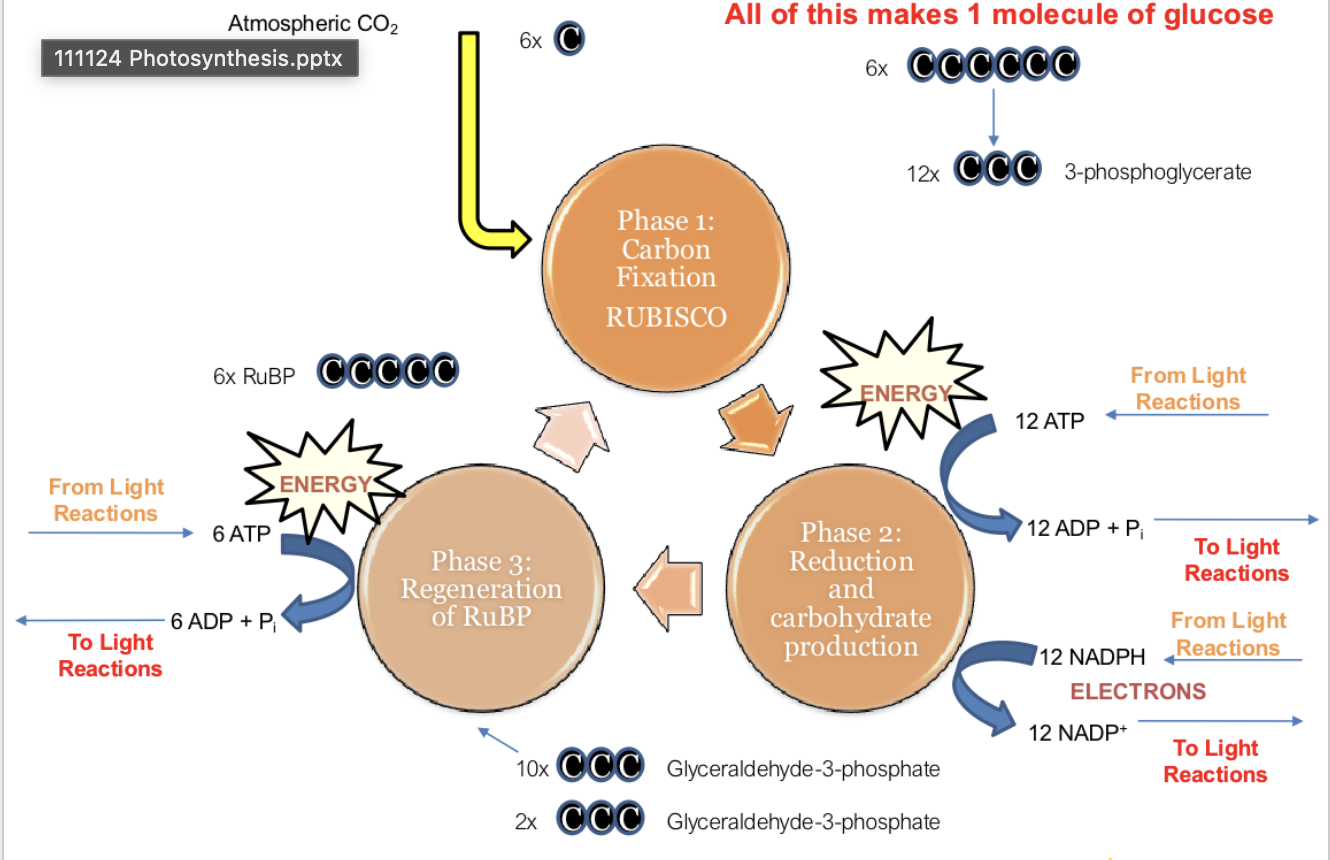
Calvin Cycle: Steps and significance
Phase 1: Carbon Fixation
Phase 2: Reduction and Carbohydrate production
Phase 3: Regeneration of RuBG
Photosystems I and II: Structure and function
Photosystems I (PSI) and II (PSII) are the "solar panels" of plants, located within the thylakoid membranes of chloroplasts, that work together to turn light energy into chemical energy during photosynthesis. Despite their names, PSII acts first, followed by PSI, to move electrons and produce energy molecules (ATP and NADPH).
Both photosystems share a similar structure, consisting of proteins and pigments (chlorophyll) that act as an antenna to catch light.
Electron Transport in Photosynthesis: Components and function
Major Components of the Electron Transport Chain (ETC)
The components are embedded in the thylakoid membrane in the following sequence:
Photosystem II (PSII): The first complex, which absorbs photons (680 nm) to excite electrons and splits water (H2O) to replenish them, releasing O2 and H+ ions.
Plastoquinone (𝑷𝒒): A mobile electron carrier that transfers electrons from PSII to the Cytochrome Complex, moving protons from the stroma to the thylakoid lumen.
Cytochrome 𝒃𝟔𝒇 Complex: Uses the energy of electrons to pump more protons into the lumen, creating a strong proton gradient ([H+]gradient).
Plastocyanin (𝑷𝒄): A mobile, copper-containing protein that transfers electrons from Cytochrome 𝑏6𝑓 to Photosystem I.
Photosystem I (PSI): Absorbs photons (700 nm) to re-energize electrons received from 𝑃𝑐
Ferredoxin (𝑭𝒅): A protein that transfers electrons from PSI to the enzyme NADP+ reductase.
𝑵𝑨𝑫𝑷+ Reductase (FNR): Catalyzes the final reduction of 𝑁𝐴𝐷𝑃+ to 𝑁𝐴𝐷𝑃𝐻
ATP Synthase: An enzyme that uses the proton gradient (proton motive force) created by the transport chain to catalyze the synthesis of 𝐴𝑇𝑃 from 𝐴𝐷𝑃 and inorganic phosphate.
ATP and NADPH Production: Role in photosynthesis
ATP and NADPH are the vital energy carriers produced during the light-dependent reactions of photosynthesis, acting as the fuel that drives the Calvin Cycle (light-independent reactions) to produce glucose. They convert light energy into chemical energy.
Carbon Fixation: Process and Importance
Carbon fixation is the essential biological process where photoautotrophs—like plants, algae, and bacteria—convert inorganic carbon dioxide (CO2) from the atmosphere into organic compounds (sugars) used for energy and growth. It is the cornerstone of life on Earth, acting as the bridge between inorganic carbon and the organic biomass that fuels ecosystems.
Regulation of Photosynthesis: Environmental factors affecting photosynthesis.
The rate of photosynthesis is primarily regulated by environmental factors that either limit or optimize the process, with light intensity, CO𝟐concentration, and temperature being the most critical "limiting factors."
Photosynthesis acts as a balancing act; if any one of these factors is too low or too high, the entire process slows down, often causing the plant to adjust its internal metabolism to protect itself (e.g., closing stomata under water stress).
Rubisco: Role in carbon fixation and photorespiration.
Rubisco (Ribulose-1,5-bisphosphate carboxylase/oxygenase) is the most abundant enzyme on Earth, serving as the pivotal link between inorganic atmospheric carbon dioxide (CO2) and organic carbon in plants. Its dual role allows it to act either as a carboxylase (fixing carbon) or an oxygenase (initiating photorespiration), depending on the relative concentrations of CO2 and O2
Energy Flow in Ecosystems: Role of photosynthesis in energy transfer.
Photosynthesis is the foundational process in ecosystems, acting as the primary entry point for energy transfer by converting solar energy into chemical energy stored in organic molecules. It initiates all trophic energy flow, enabling producers (plants, algae) to create their own food and provide energy for consumers.
Types of cell communication
Major Types of Cell Signaling
Endocrine Signaling: Specialized cells release hormones into the bloodstream, which carry signals to distant target cells throughout the body (e.g., insulin released by the pancreas).
Paracrine Signaling
:
Cells release chemical signals (ligands) to act on nearby target cells, often influencing neighboring cells to behave similarly or coordinating immediate surroundings (e.g., neurotransmitters in a synapse).
Autocrine Signaling: A signaling cell sends a signal to itself or similar cells, releasing a ligand that binds to receptors on its own surface. This is critical for development, immune responses, and cancer cell growth.
Direct Signaling (Juxtacrine): Cells physically connect via gap junctions (animals) or plasmodesmata (plants), allowing small molecules and ions to pass directly between adjacent cells.
Synaptic Signaling: A specific form of paracrine signaling where neurons release neurotransmitters across a synapse to a specific target cell, such as a muscle or another neuron.
Cellular response to signaling molecules
Cellular responses to signaling molecules are specific, mediated actions—such as gene expression changes, metabolic shifts, or cell division—triggered when ligand molecules bind to specific receptors. This process involves three main stages: reception (ligand binding), transduction (signal relay), and the final response, often amplifying the signal to ensure4 a precise, controlled outcome
Ligands, receptor types, and activation
Ligands are chemical messenger molecules (like hormones or neurotransmitters) that bind to specific target proteins called receptors. This binding changes the receptor's shape, activating it to trigger a cell response. Receptors are either on the cell surface for water-soluble signals or inside the cell for fat-soluble
Nutrient Deficiencies
Nutrient deficiencies occur when the body does not absorb or get enough essential nutrients—vitamins, minerals, or macronutrients—from food, leading to health issues like fatigue, weakened immunity, and chronic disease. Common deficiencies include iron, vitamin B12, vitamin D, iodine, and calcium, often causing symptoms like hair loss, skin rashes, and cognitive issues
DNA Replication and PCR
DNA replication is the natural, in vivo process of copying an entire genome before cell division, while Polymerase Chain Reaction (PCR) is an in vitro, artificial technique that rapidly amplifies specific, short DNA segments