Decision Making and Situation Awareness (Wk18)
 Call Kai
 Learn
Learn Practice Test
 Spaced Repetition
 Match
Match Flashcards
 Knowt Play
1/27

There's no tags or description
Looks like no tags are added yet.
Name | Mastery | Learn | Test | Matching | Spaced | Call with Kai |
|---|
No analytics yet
Send a link to your students to track their progress
28 Terms
Rasmussen’s Skills-Rules-Knowledge Model
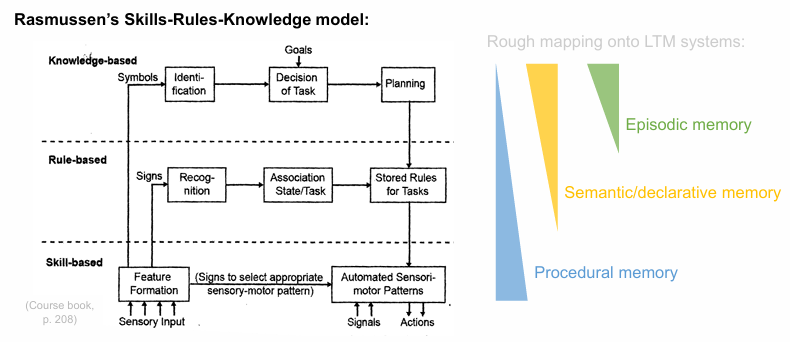
knowledge-based decisions
user analyses environment without prior experience
knowledge-based decisions theories
multiattribute utility, expected value
rule-based decisions
familiarity of situations enforces rule followed response
skill-based decisions
triggered by sensory cues, carried out without concious effort
optimal decision making
making the best decision based on criteria
suboptimal decision making
choices that doesn’t result in the best outcome
normative decision making
how decisions should be made
descriptive decision making
how decisions are actually made
bias
ways in which decision making becomes suboptimal
principles of improving decision making
choice architecture, displays, automation, proceduralisation, training
choice architecture
limit number of options
displays
provides fast and unbiased cues
automation
suggest suitable actions
proceeduralisation
methods of forming decisions
training
how to use procedures and tools
situational awareness (SA)
provides perception for decision making
Endsley’s 3 level model
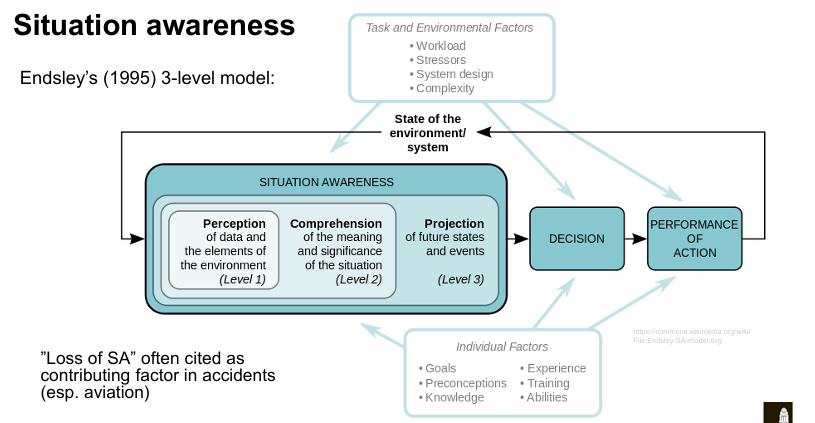
levels of SA
perception, comprehension, projection
perception
observation of environment and its elements
comprehension
meaning and significance of situation
projection
future states and events
SA global assessment technique (SAGAT)
interrupt taks and question probe sa
Situation Present Assessment Method (SPAM)
ask questions during task and measure response time
SA Rating Technique (SART)
subjective rating of situation
perception design priniciples (for improving sa)
make situation changes noticable
comprehension design principles (for improving sa)
organise situation info around goals
projection design principles (for improving sa)
train for sa