ASTR 121 MIDTERM - ALBRIGHT JMU
 Call Kai
 Learn
Learn Practice Test
 Spaced Repetition
 Match
Match Flashcards
 Knowt Play
1/11

There's no tags or description
Looks like no tags are added yet.
Name | Mastery | Learn | Test | Matching | Spaced | Call with Kai |
|---|
No analytics yet
Send a link to your students to track their progress
12 Terms
What is the net nuclear reaction that powers the Sun? How does E=mc2 explain what happens to the missing mass?
4H = 1He
4H is heaver than 1He, and E=mc2 explains that matter is converted into energy, making up for the missing weight.
What is hydrostatic equilibrium? Why is it important in the Sun? How do we know the Sun is in hydrostatic equilibrium? What happens if the Sun is not in hydrostatic equilibrium?
when the internal pressure pushing outwards exactly balances the gravity pushing inward on a star
bc the sun isn't expanding or contracting.
it would either implode or explode.
Why do different types of atoms (elements) give off or absorb different spectral lines? How do astronomers use this to find out what elements are in stars?
bc the spacing of the energy levels is different in different elements
astronomers can determine an objects composition by comparing it to the spectral lines on the periodic table.
What is the inverse square law? What do astronomers use the inverse square law to find out?
the apparent brightness of a star is inversely proportional to the distance squared from the observer to the source.
distances to stars or galaxies
List the following types of radiation in order of increasing wavelength: gamma, infrared, visible light, x-rays, radio, ultraviolet. Label the most and least energetic. What types of radiation make it through the Earth's atmosphere to the ground on Harrisonburg?
gamma, x-ray, ultraviolet, visible, infrared, radio
← increasing energy
→ increasing wavelength
visible, ultraviolet
Describe the spectral classification system, both classes and subclasses.
the Morgan-Keenan system uses the letters O, B, A, F, G, K, M, with O being the hottest and M being the coolest. Then, each letter is subdivided into 0-9, with 0 being the hottest and 9 being the coolest.
Why are neutrinos important for investigating the interior of the Sun?
neutrinos are produced in the core of our sun. they rarely interact with other particles and so can escape the sun easily, bringing us information about the deep solar interior.
How can astronomers use parallax to find the distances to stars?
the parallax angle is the angle between the earth at one time of the year, and the earth six months later, as measured from a nearby star, and astronomers use this angle to find the distance from the earth to that star.
Describe how astronomers measure the diameter of stars?
the diameter of a target star can be determined by measuring the time it takes an object to pass in front of the target star and block its light.
Name and describe three types of binary stars.
visual - star systems where each star can be seen with a telescope
spectroscopic - spectral lines show the doppler shift due to the orbital motion of the stars
eclipsing - two stars moving in orbit and light of one can at times be hidden behind the other
Name the three stars in both the Winter Triangle and Summer Triangle
Winter - Sirius, Procyon, Betelgeuse
Summer - Deneb, Vega, Altair
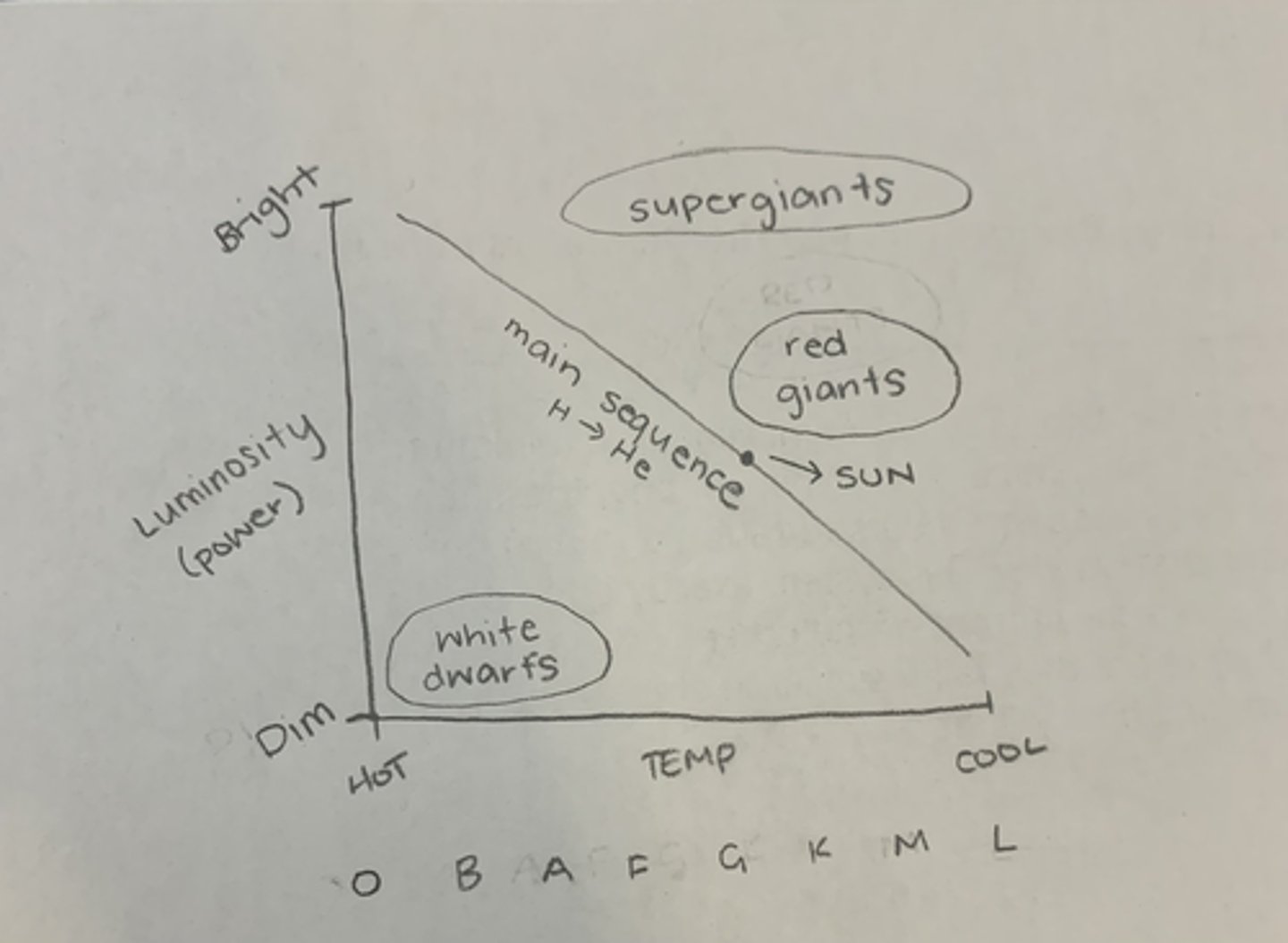
Draw and label a Hertzsprung-Russel diagram. Label both of the axes and indicate the locations of the main sequence, white dwarfs, giants, and super giants.