Comm 111 Flashcards Exam 3
 Call Kai
 Learn
Learn Practice Test
 Spaced Repetition
 Match
Match Flashcards
 Knowt Play
1/49

There's no tags or description
Looks like no tags are added yet.
Name | Mastery | Learn | Test | Matching | Spaced | Call with Kai |
|---|
No analytics yet
Send a link to your students to track their progress
50 Terms
How do betrayal or aggression harm a relationship? What are two misconceptions about forgiveness? Are there benefits to forgiving? (all in reading)
Betrayal and aggression harm relationships because they damage trust, emotional safety, intimacy, and openness. Aggression can create fear, defensiveness, and resentment, while betrayal weakens confidence in the relationship and makes vulnerability harder. Over time, both can reduce cooperation and emotional connection.
Two misconceptions about forgiveness are:
Forgiveness means excusing or approving harmful behavior. In reality, forgiveness does not mean the behavior was acceptable.
Forgiveness automatically means reconciliation. A person can forgive someone without rebuilding the relationship or restoring trust.
Yes. Research and the reading suggest forgiveness can:
reduce anger, resentment, stress, and emotional pain
improve emotional and physical well-being
help people move forward instead of remaining stuck in bitterness
improve communication and relationship healing when reconciliation is appropriate
restore a sense of personal control and peace
Forgiveness is often described as more beneficial for the person forgiving because it releases ongoing emotional burden, even if the relationship itself does not continue.
What is Enlightened Self Interest? Dual Perspective?
Enlightened self-interest: recognizing that cooperation and mutual benefit can help achieve your own goals.
Dual perspective: understanding both your perspective and the other person’s perspective simultaneously.
Describe the mindset that’s entailed in Integrative negotiation
The mindset includes:
valuing relationships
avoiding personal attacks
helping others “save face” and maintain dignity
focusing on cooperation rather than winning
understanding that communication procedure matters
Integrative negotiation is considered a mindset rather than a strict set of steps.
What is behavior flexibility?
Behavior flexibility is the ability to adapt and alter communication and behavior depending on the context or audience.
People with behavioral flexibility:
adjust to different audiences
communicate purposefully instead of reactively
adapt behaviors to fit situations
Behavioral flexibility makes people more effective in conflict.
How does obliging/accommodating differ from avoidance? Explain passive aggressive behavior, avoid/criticize loop
Obliging/accommodating: giving in or sacrificing your needs to please the other person.
Avoidance: withdrawing from or ignoring the conflict altogether.
Passive-aggressive behavior: expressing dissatisfaction indirectly instead of openly, such as through sarcasm, procrastination, or subtle resistance.
The avoid/criticize loop occurs when one person avoids conflict while the other increasingly criticizes to force engagement. The more avoidance occurs, the more criticism escalates, creating a destructive cycle.
How do we develop our conflict styles?
Conflict styles develop from:
our perception of the other person’s intent
the other person’s actions
the relationship and situation
habits, experiences, and learned communication patterns
Styles can change depending on the context and person involved.
Identify skills for Integrative/collaboratives negotiation: paraphrasing, describing behavior, B-C-F, constructively criticizing, sandwich method, focusing on Interests vs. Positions
Paraphrasing: restating another person’s message in your own words to confirm understanding and build solidarity.
Describing behavior: explaining observable actions neutrally without judgment or interpretation.
B-C-F (Behavior-Consequence-Feeling):
describe the behavior
explain the consequence
describe your feelings using “I” statements
Example: “When you interrupt me (B), I feel like my ideas are ignored (C), and I feel frustrated (F).”
Constructive criticism: respectful feedback focused on behavior and improvement rather than attacking the person.
Sandwich method:
positive statement
criticism/concern
positive statement
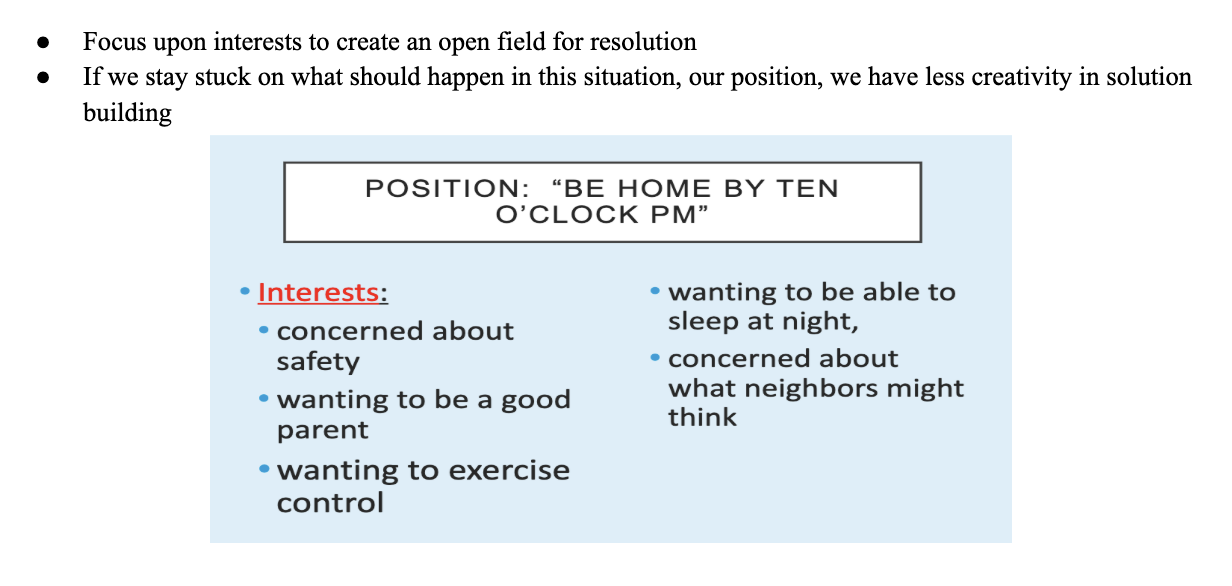
Interests vs. Positions:
Positions: fixed demands (“I want this”).
Interests: underlying needs or motivations.
Focusing on interests encourages creativity and collaboration.
What undermines manipulative behavior?
Assertiveness undermines manipulation because it reinforces your right to judge your own behavior and decisions. Calm confidence and refusal to over-defend yourself weaken manipulation.
What does the research suggest about how we typically see our own conflict style in comparison to others we are in conflict with?
Research shows people are biased toward themselves. We often view our own conflict style more positively while judging others’ behavior more negatively.
How might obliging be linked to co-dependency? What is co-dependency?
Obliging may connect to co-dependency when someone constantly sacrifices their own needs to maintain another person’s approval or dependence.
Co-dependency: a circular relationship in which one person needs another, while the other person needs to be needed.
How might culture (High-context or collectivistic) link to obliging or avoidance or competition?
High-context or collectivistic cultures often prioritize harmony, indirect communication, and group unity, which may encourage obliging or avoidance.
More individualistic cultures may value directness and competition more strongly.
Is postponing a conflict discussion always necessarily avoiding?
No. Postponing can be productive if it allows time for emotions to calm down or for better discussion conditions. Avoidance means refusing to address the issue altogether.
Suggest why we do not engage in negotiation and how we typically respond when a conflict comes up
People often avoid collaborative negotiation because of:
self-centered thinking/lack of dual perspective
negative emotions
automatic habits and reactions
lack of social skills
Typical responses to conflict are:
attacking/aggression
withdrawal/avoidance
What are the types of fogging? What is the first step in using fogging? Why is fogging effective?
Types of fogging:
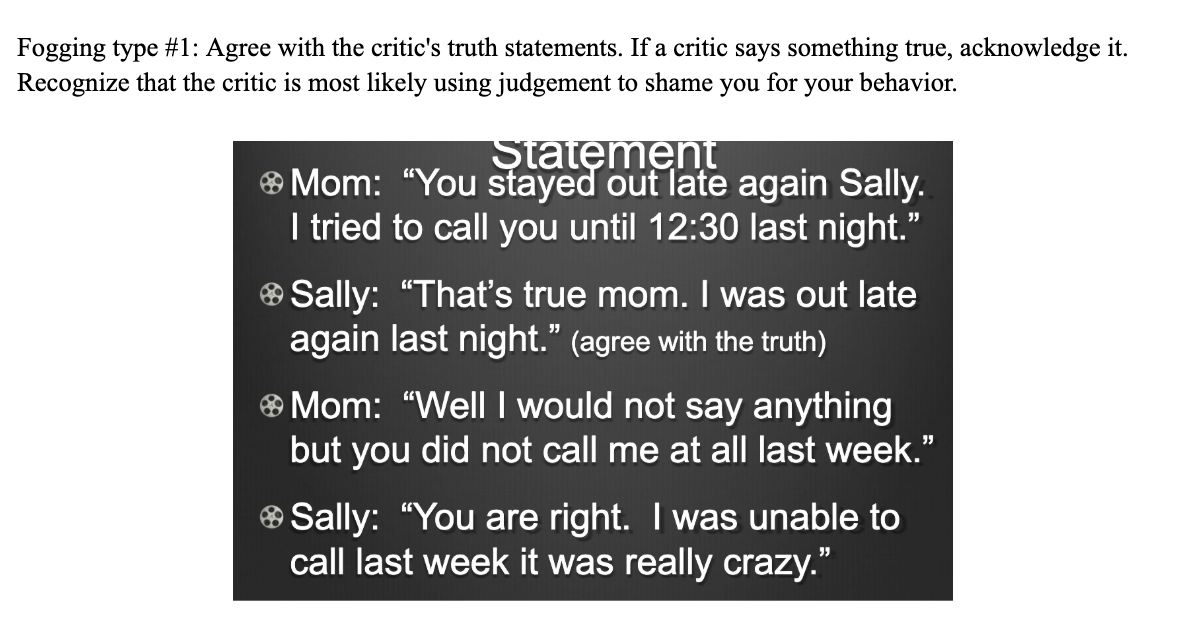
Agree with truth statements
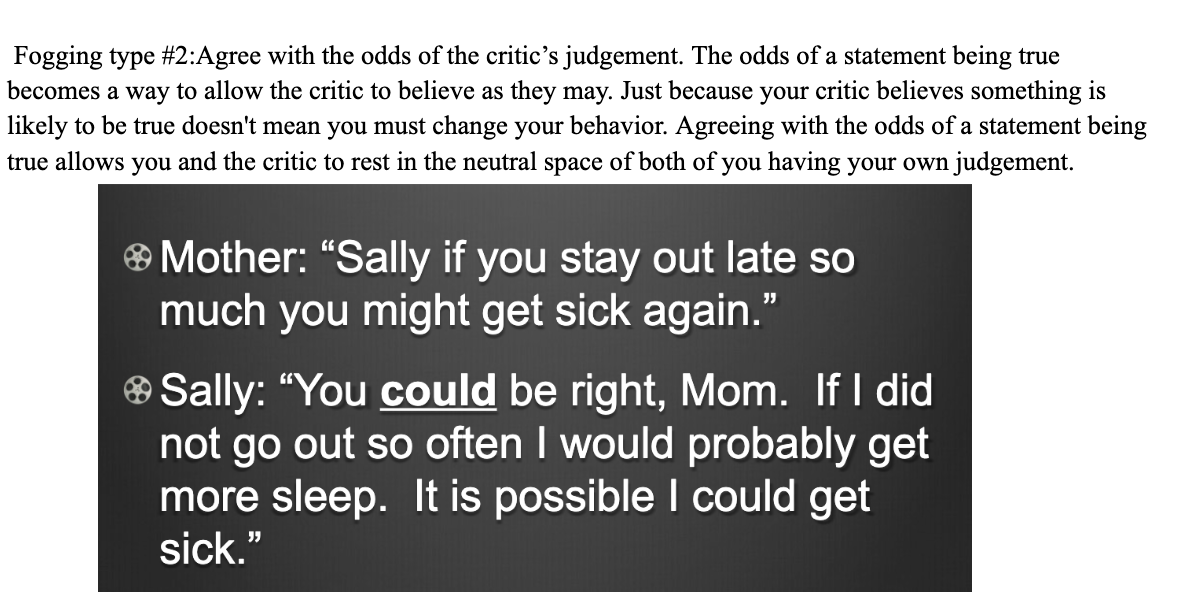
Agree with the odds of the criticism
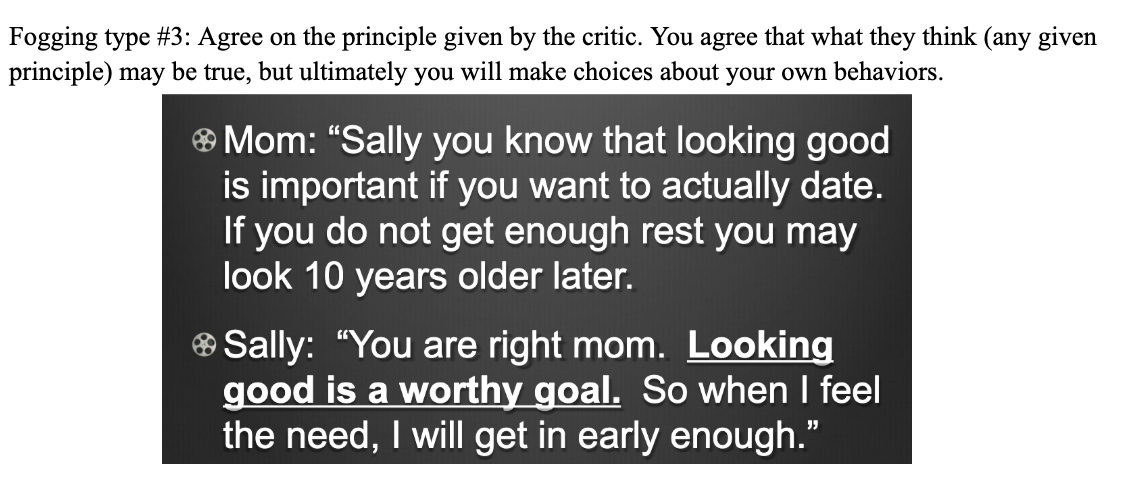
Agree with the principle behind the criticism
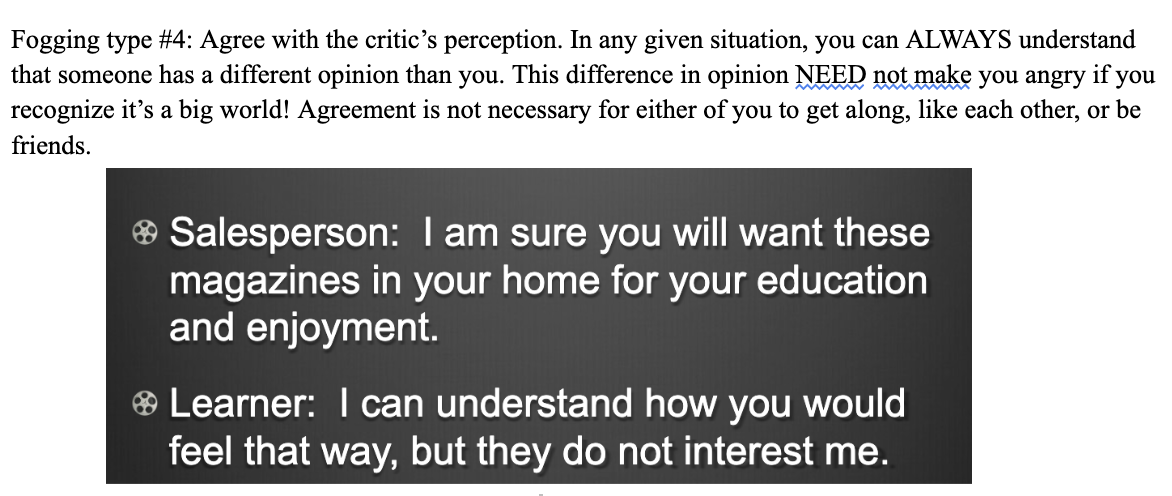
Agree with the other person’s perception
First step in fogging: remain calm and avoid becoming defensive or counterattacking.
Why is fogging effective?
Fogging is effective because it:
reduces escalation and defensiveness
prevents manipulators from gaining emotional control
separates mistakes from self-worth
teaches comfort with judgment
provides calm, non-aggressive responses to criticism
Define Integrative negotiation and its assumptions
Integrative negotiation is an approach where people try to resolve conflict in ways that maximize the interests of both parties.
Assumptions:
cooperation can create mutual gain
relationships matter
conflict can produce positive outcomes
creative solutions are possible
Define assertiveness, manipulation, 10 assertive rights, constructive criticism, fogging
Assertiveness: expressing thoughts, feelings, and rights directly and respectfully.
Manipulation: reducing another person’s ability to judge their own behavior by pressuring them to accept outside judgment.
Constructive criticism: respectful feedback focused on behaviors and improvement.
Fogging: responding to criticism calmly without becoming defensive or counterattacking.
10 Assertive Rights:
Right to judge your own behavior, thoughts, and emotions
Right not to justify your behavior
Right not to solve others’ problems
Right to change your mind
Right to make mistakes
Right to say “I don’t know”
Right to be illogical in decisions
Right to say “I don’t understand”
Right to say “I don’t care”
Right to say “no” without guilt
Be able to explain each conflict style; suggest what may be good/bad about each one
Avoidance Style (“no way”)
Definition: non-assertively ignoring or staying away from conflict through denial, changing the topic, joking, withdrawing, or being noncommittal.
Advantages: useful when emotions are high, when the issue is trivial, or when safety is a concern. Can buy time to think.
Disadvantages: prevents resolution, may make others feel uncared for, and conflicts often return later.
Dominating/Competing Style (“my way”)
Definition: aggressive and uncooperative behavior that prioritizes one person’s concerns over another’s.
Advantages: useful when quick decisions are necessary or when external goals matter more than the relationship.
Disadvantages: harms trust and relationships, creates winners and losers, and may encourage secrecy or hostility.
Compromise (“halfway”)
Definition: both people gain something and lose something.
Advantages: efficient, reinforces fairness, balances power.
Disadvantages: may avoid deeper issues or become a routine “formula solution.”
Obliging/Accommodation (“your way”)
Definition: setting aside your own concerns to satisfy the other person.
Advantages: helpful when the issue matters more to the other person or to reduce overt conflict.
Disadvantages: may create resentment, imbalance, or feelings that one’s needs do not matter.
Integration/Collaboration (“our way”)
Definition: seeking a win-win solution that also strengthens the relationship.
Advantages: creates commitment, respect, creativity, and productive conflict resolution.
Disadvantages: takes significant time, effort, and emotional energy.
Conflict Styles
are patterned responses people use in conflict. Styles may change over time
and with different people. Recognizing your style(s) has benefits
How do styles get chosen—do people or situations have anything to do with our choice of conflict style?
Yes. Conflict styles depend on:
the person involved
the relationship
the situation/context
our perception of the other person’s intent
Different situations may require different styles.
How do you choose your style?
May be triggered by the person you argue with
Recognize your intent and your perception of the other’s intent
Metacommunicate
Interaction Dynamics:
We cannot understand conflict dynamics by looking at individuals proclivities, tactics, or styles in isolation.
Our styles arise from
Our perceived intent of the other person
The other’s actions in the scenario
The relationship and/or the situation
Behavioral Flexibility:
Individuals who can change and adapt are more likely to be effective conflict participants, accomplishing private and group goals better than people who avoid change. Adapt and alter behaviors to fit the context you find yourself within.
What might characterize Behavioral Flex.
Developing skills to deal with different audiences
• Able to monitor talk with others to make it purposive rather than expressive.
• Adapt and alter behaviors to fit the context
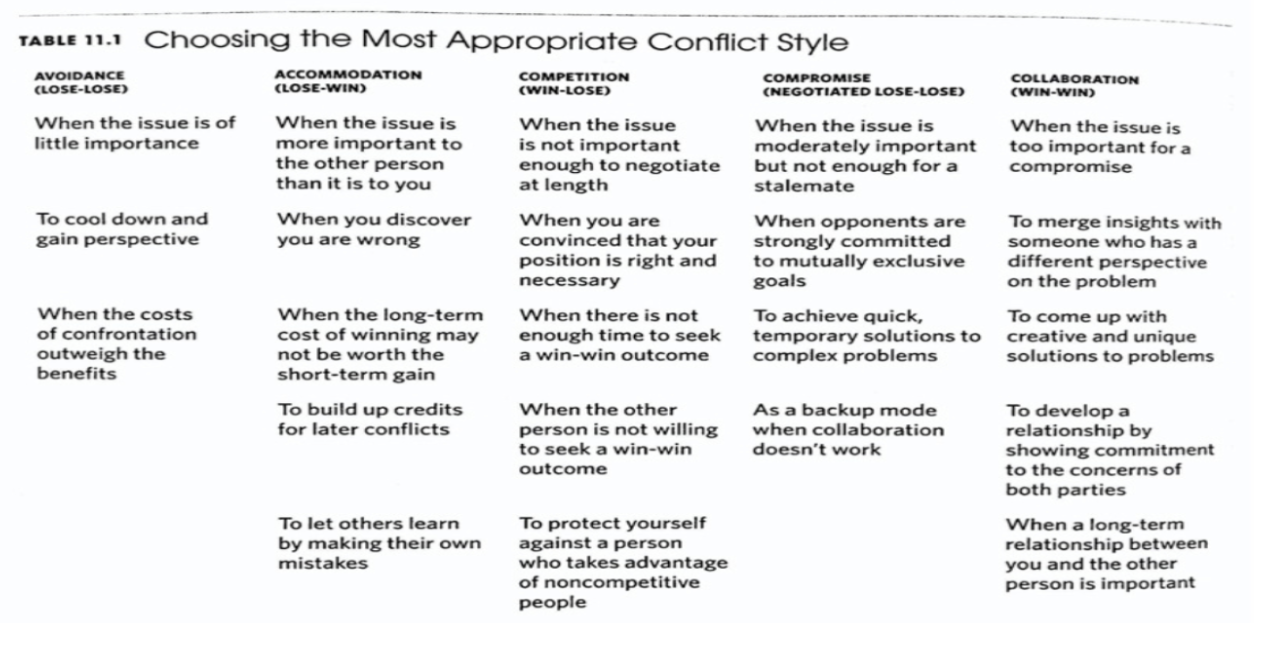
Conflict Styles: Avoidance (pros and cons)
Avoidance style: (no way) When people non-assertively ignore or stay away from conflict. May involve denial of conflict, changing or avoiding topics, being noncommittal, joking to evade or withdrawing
Advantages
Helps us to figure out a different response to conflict
May help if the topic of argument is trivial
Aids in dealing with a conflict in a relationship of lesser importance
May keep one from harm
Disadvantages
May signal you do not care much about the relationship
Disables us from working through a conflict when it is warranted,
Maintains the conflict that may reappear later.
Research on Avoidance style
Marriage
Repression of conflict
Avoid/Criticize Loop
Postponement vs Avoidance
Conflict Styles: Dominating or Competing (pros and cons)
Dominating or Competing Style: (my way) A style characterized by aggressive and uncooperative behavior which puts one person’s concerns above those of the other
Passive Aggressive/Direct Aggression: When one expresses dissatisfaction in a disguised way vs an overt way
Advantages
When we need a quick decisive act, this style is helpful
If an external goal is more important than the relationship with the other person Competition is helpful
When all involved agree that dominating behavior signals strength as in games, sports, or court proceedings.
Disadvantages
May be harmful to the relationship
may influence a partner to be covert in strategy instead of working through the conflict openly
Divides up “players” into winners and losers—a recipe for hostility
Conflict Styles: Compromise (pros and cons)
Compromise: (halfway) both parties gain something and lose something
Fairness: “I gave in before—now it’s your turn.
Splitting the difference: “If you will increase your offer by $10, I will come down by $10—then we’d both be happy”
Mutual Sacrifice: “I will let go of going to Spain if you will let go of Turkey.
Advantages:
Allows parties to accomplish important goals without investing a great deal of time
Reinforces a power balance
Has a moral force
Disadvantages:
May become a “formula solution”
Can revert to a way of avoiding truly talking about something that needs discussing
Conflict Styles: Obliging/Accomodation (pros and cons)
Obliging/Accommodation: (your way) setting aside your own concerns to please others
Obliging style aims to pacify the other in the conflict so as not to rock the boat.
Motive for Accommodation?
SOMETIMES Obliging is linked to codependency (A circular relationship whereby one person (often insecure, alcoholic, or abusive) needs another person, and the other person NEEDS to be needed)
Advantages:
If the issue at hand is really not important to one, but is to the other, accommodation can be helpful.
Can help in decreasing overt conflict or abuse
Disadvantages
Can increase resentment if one or both parties feel the other is not committed to the relationship (because they always simply give in).
Conflict Styles: Integration-collaborating (pros and cons)
Integration-collaborating: (our way) A style which values the successful solution of a problem alongside the enhancement of the relationship.
This style seeks a win-win/cooperative approach to conflict; it requires the most time and creativity of all of the styles.
Relationships are better not worse than when the conflict began—from finding a “new way.”
Advantages
The style generates new ideas, shows respect for those involved, and creates commitment to the solution –since all are involved in discovering it.
Affirms the value of the relationship.
Demonstrates that conflict CAN be productive
Disadvantages
May not always be worth the time and energy it takes to use this style if investment in the relationship is relatively low.
Research on Conflict Styles shows we are biased—toward ourselves! We may use particular styles with particular people or situations. All of the styles are useful; it is the situation that determines the value of any style
Why don’t we typically use collaborative processes?
We’re self centered (we lack dual perspective)
Negative emotions
Automatic ways of thinking/feeling direct a habituated response to conflict
Insufficient social skills
Default Conflict Resolution approaches
Competition: come to my side or else
Compromise:
Ignoring how we could be creative
Integrative negotiation
an approach to negotiation whereby negotiators attempt to settle a dispute in a way which maximizes interests for each party
The act of negotiating is controlled by enlightened self interest
Mindset for collaborative negotiation
Relationships=valuable
Personal attack is wasteful
“Saving Face” is crucial: make it possible for the other person to feel worth/dignity
Cooperative/Competitive ~ Climates self reinforce
Procedure is key
Paraphrase for deliberate forward movement.
Paraphrasing is defined as verifying understanding of a message by putting it in your own words and sharing it with another. It's used to increase listening efficiency; to avoid message confusion; to discover the speaker’s motivation(s), to build solidarity. To do this you:
Listen carefully
Notice what feelings/thoughts are in message
Form a message in your own words conveying these ideas/feelings
Describe Behavior
Defensiveness is so typical in conflict resolution
Describe what you saw, heard, experienced without interpretation or judgement. (just the facts)
Once you get a response, try paraphrasing it for clarity and goodwill.
BEHAVIOR-CONSEQUENCE-FEELINGS (B-C-F):
Use to communicate an issue you have to another person. Procedure:
Use an “I” statement.
Describe the behavior neutrally
Describe the consequences that result from the behavior neutrally
Describe the feelings that result from the behavior
Example: “I have a problem that I need your help with. When I tell you what I am thinking and you do not respond (B), I start thinking you don’t care about what I think (C), and then I feel frustrated and upset (F).
Sandwich method:
Start with a positive statement
Offer a neutral description of the negative
End with a positive statement
Interests vs Positions
Integrative Negotiation:
is a mindset as opposed to an absolute set of steps. It is not for the faint of heart, or those who are just triggered and need a target.
Two most common responses to attack:
1) we attack back 2) we withdraw and shrink
We typically cannot resolve a dispute using either aggression or withdrawal
Listening to someone’s comments does not mean we accept the truth of those comments. Listening increases the chances of being assertive and maintaining our position or changing if we choose.
Manipulation
When someone reduces, by any means, your ability to be your own judge of what you do. Manipulation is prompted by the belief that a source outside yourself is a better judge of your behaviors than you are. The right to be the FINAL judge of yourself is the Prime assertive right which allows NO ONE to manipulate you.
Constructive Criticism:
Begin by asking permission to disclose personal feedback
Whenever possible, preface negative statements with positive ones, use the sandwich method
Describe behavior or action specifically, remember neutral description
If appropriate, suggest how the behavior could be changed.
Bill of Assertive Rights
You have the right to judge your own behavior, thoughts, and emotions and take the responsibility for their initiation and consequences upon yourself.
You have the right to offer no reasons or excuses for justifying your behavior
You have the right to decide if you are responsible for finding solutions for other people’s problems
You have the right to change your mind
You have the right to make mistakes and be responsible for them
You have the right to say I don't know
You have the right to be illogical in making decisions
You have the right to say I don't understand
You have the right to say I don't care
You have the right to say no without feeling guilty
Fogging
a technique that allows you to stand up for yourself without attacking the other. Respond to criticism as if you were a fog bank, offer no resistance, don't fight back, be unaffected and persistent. Dont deny criticism, dont get defensive, dont counter attack with criticism of your own.
Fogging type #1
Fogging type #2
Fogging type #3:
Fogging type #4
Benefits of Fogging:
It helps you to identify the arbitrary “right” & “wrong” others put on your behavior— it teaches you to be comfortable when you are judged. It teaches you to know the difference between a mistake you may have made & your worth as an individual. It also gives you a ready made set of responses that can help you to manage the pressure of others’ judgment.