Sociology
 Call Kai
 Learn
Learn Practice Test
 Spaced Repetition
 Match
Match Flashcards
 Knowt Play
1/24

Earn XP
Description and Tags
Ms. Rados
Name | Mastery | Learn | Test | Matching | Spaced | Call with Kai |
|---|
No analytics yet
Send a link to your students to track their progress
25 Terms
What is sociology?
The study of human behavior and social relationships
Who is the “father of sociology”?
Auguste Comte
What are social norms?
Unwritten rules that govern how an individual acts within a group.
What impact do social norms have on society?
Guide an individual to social approval/fostering cohesion
Examples of primary and secondary agents of socialization + difference
Primary
Family, Parents
Secondary
Peers, Media, School, Workplace
*Primary builds your fundamental self, Secondary helps you adapt to specific roles in the wider world.
4 Main schools of thought
Structural Functionalism
Views society as a comlex, stable system whose pieces work together to promote an equilibrium.
Conflict Theory
Views society as a system where people are in a constant power struggle for limited resources.
Feminist Sociology
Looks at how gender inequality, patriarchy, and power structures affect society.
Symbolic Interactionism
Focuses on how individuals create meaning through daily social interactions.
Types of Societies
Hunter-Gatherer Society
Pastoral Societies & Horticultural Society
Agrarian Society
Industrial Society
Post-industrial Society
Define Hunter-Gatherer Society
Small groups, spend all their time securing food, everyone must find a role and share
Define Pastoral Societies & Horticultural Society
Life revolved around the domestication of animals, moving to where the animals could feed. Horticulture showed the first instance of material surplus allowing for not all people to work. +politics, religion, inequality
Define Agrarian Society
Better farming techniques allow for larger populations, specialization, complex society, institutions become more prevalent.
Define Industrial Society
Shift from human/animals power to machine power, allowed larger populations and globalization. Moved to a capital based economy with centralized power, to control resources.
Define Post-industrial Society
Specialization and increased urbanization. Shift to an economy focused on information, services and technology. Different societies are no longer isolated from each other.
Define Prejudice
An unjustified (often) negative opinion of a person of group because of their participation in a social category.
Define discrimination
The unfair treatment of a person/group because of their participation in a social category.
Define Confirmation Bias
The bias where the affected only look/validate information that is consistent with their view.
Define Stereotype
A widley held but fixed and oversimplified idea of a particular person/group.
How do prejudice, discrimination, confirmation bias, and stereotypes connect?
They interact in a reinforcing cycle, leading one to prove another and so on.
What are cults?
A group or movement with a shared commitment to an extreme ideology typically embodied by a charismatic leader.
Characteristics of Cults?
Charismatic leader, Form of indoctrination and exploitation of it’s members
What is the sociological connection of cults?
Shows group conformity, group pressure and social influence can affect behaviour.
7 elements of a cult
Vulnerable people
Selling cult
Creation new reality
Dear leader
Enemy (segregate)
Peer pressure
Sociopath narcissist
What is 1 sociological experiment? Provide a description, ethical connection, and how it connects to sociology.
George Mead “I” and “Me” theory
*Central to Symbolic Interactionism
The “me” is the self that is defined by how you react within the social environment.
The "I” is the immediate response, your fundamentals, your impulsive response.
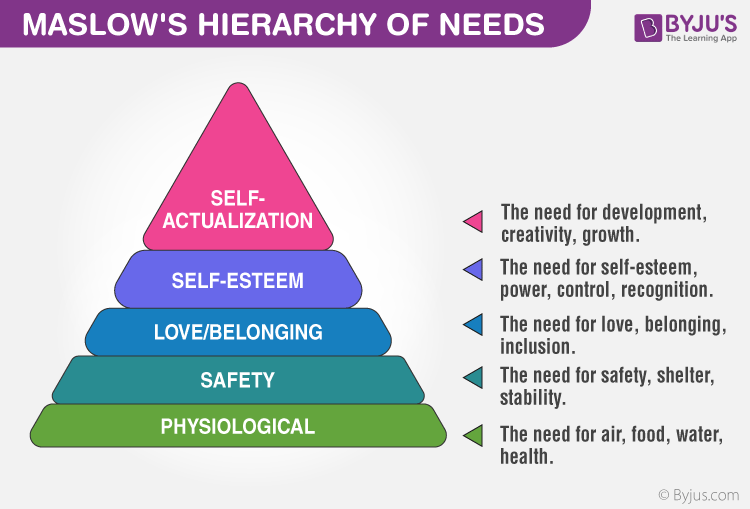
Maslow’s Hierarchy of Needs
The Halo Effect
A bias where the affected latch on to one initial favourable trait of an individual, causing them to completely overlook negative traits.
“this phenomenon causes people to overlook negative characteristics and falsely assume unrelated positive qualities based on a single, favorable impression.”