Lecture 2.6: Treating Mood Disorders
 Call Kai
 Learn
Learn Practice Test
 Spaced Repetition
 Match
Match Flashcards
 Knowt Play
1/7

There's no tags or description
Looks like no tags are added yet.
Name | Mastery | Learn | Test | Matching | Spaced | Call with Kai |
|---|
No analytics yet
Send a link to your students to track their progress
8 Terms
What is the medication used to treat Depression?
Selective Serotonin Reuptake Inhibitor (SSRIs)
Increase the levels of serotonin between neurons
Better for severe depression
Side effects: weight gain, loss of seggual drive, nausea
What is the medication used to treat Bipolar?
Lithium
Stabilizes mood shifts
Toxic in high doses—must be taken as prescribed
Cognitive Behavioral Therapy (CBT)
Focuses on restructuring maladaptive thought patterns through critical reflection
Works for both depression and bipolar disorder
Goal: to restructure negative thinking and internal attributional style.
First phase: recognize and identify automatic thoughts
Second phase: challenge cognitive distortions
Multiple techniques—examples include:
Critically examining the evidence for and against thoughts
Overcoming dichotomous (i.e., all-or-nothing) thinking and acknowledging “shades of gray”
Third phase: challenge deeper beliefs about the self and the world.
Interpersonal Therapy (an offshoot of CBT)
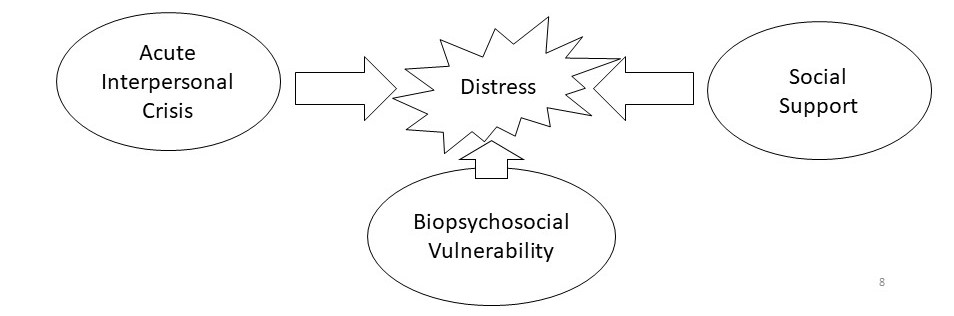
Focuses on interpersonal factors in current relationships that cause and maintain mood disorder symptoms
For depression, goal is to improve social communication and problem-solving skills
For bipolar disorder, goal is to establish a sense of consistency in daily activities
Focuses on:
Interpersonal factors in current relationships that cause and maintain depression
Building communication and social problem-solving skills
Four areas of emphasis:
Grief
Role dispute
Role transition
Interpersonal deficits
Interpersonal Triad
Effectiveness of psychotherapy vs. antidepressants
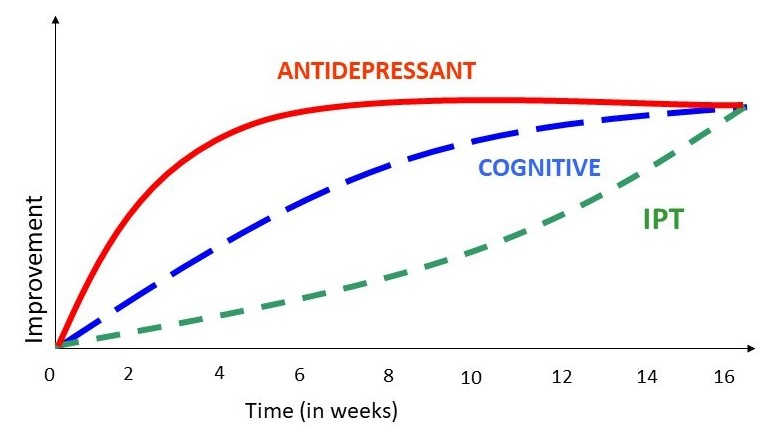
Interpersonal therapy, cognitive therapy, and an antidepressant were all superior to placebo plus clinical management condition for a 16-week treatment.
Therapy was just as effective as medication.
Drug treatment led to a more rapid improvement initially, although effects were equivalent over the 16 weeks.
Type of improvement was independent of type of treatment (e.g., medication changed cognitions just as much as cognitive therapy).
Depression Treatment outcomes
Average age of onset is 32.
Seventy-five percent of people who have major depression will have at least 2 depressive episodes.
Half recover within 6 months; 40% of people who recover relapse within a year.
Bipolar Treatment outcomes
Onset is usually between ages 18-22.
Length of time between episodes varies and is difficult to predict.
Forty to fifty percent of patients are able to achieve a sustained recovery; rapid cycling patients have a worse prognosis