Geology
 Note
Note Call Kai
 Learn
Learn Practice Test
 Spaced Repetition
 Match
Match Flashcards
 Knowt Play
1/152

There's no tags or description
Looks like no tags are added yet.
Name | Mastery | Learn | Test | Matching | Spaced | Call with Kai | Chat |
|---|
No analytics yet
Send a link to your students to track their progress
153 Terms
Science
builds and organizes knowledge in the form of testable explanations and predictions about the universe.
a hypothesis that has been tested many times and has an established body of evidence for support
Scientific Laws
ideas consider absolutely correct and if not, then the universe as we know it would not exist. They are true, universal, simple, absolute, and eternal. Examples: Newton’s law of motion.
Scientific Method
A sequence of steps for systematically analyzing scientific problems in a way that leads to verifiable results
1st Step In the Scientific Method
Recognize the problem
2nd Step in the Scientific Method
Collect Data
3rd Step in the Scientific Method
Hypothesis
4th Step in the Scientific Method
Test Hypothesis
5th Step in the Scientfiic Method
Change hypothesis
6th Step in the Scientific Method
Report/Share Results.
Geocentric model
This model is an ancient astronomical theory that positions Earth at the center of the universe, with all celestial bodies, including the Sun, Moon, planets, and stars, moving in circular orbits around it.
Heliocentric model
This model is an astronomical theory that places the Sun at the center of the solar system, with Earth and other planets orbiting around it.
Circumference of Earth:
Eratosthenes calculated it by comparing the angles of the sun’s rays at two different locations.
Tool for Studying the Universe
Telescope
Element Formation
Nuclear Fusion in stars gives us the first 26 elements, supernovas are required to make the heavier elements
Solar System Formation
Planets are isolated 2. Orbits are elliptical to circular & in nearly the same plane. 3. Planets & moons travel along orbits in same direction, the direction the sun rotates
Dwarf planet
A non-satellite body that lacks certain criteria like clearing its orbit but it orbits around the sun, has a round shape, and has enough mass
Small solar system body (SSSB)
A non-satellite body meeting only the first criteria which orbits around the sun.
Terrestrial planets
Closest to the sun, too hot for light gases, leaves heavy minerals, dense rocky planets.
1st Terrerstrial planet
Mercury
2nd Terrestrial planet
Venus
3rd Terrestrial planet
Earth
4th Terrestrials planet
Mars
Jovian Planets
Farthest from the sun, mostly gas masterial, small rocky cores, mostly H and He, commonly as ice.
1st Jovian Planet
Jupiter
2nd Jovian Planet
Saturn
3rd Jovian Planet
Uranus
4th Jovian Planet
Neptune
Direct Methods For Studying Earth’s Interior
Core, Uplifted Pieces of Earth’s Interior, Meteorites
Indirect Methods For Studying Earths Interior
Density, Seismic Waves, Geothermal gradient
The Separation of (earth) materials based on density. It generates heat and the earth has iron-nickel core surrounded by a magnesium silicate mantle.
Compositional layers
It is based off the composition.
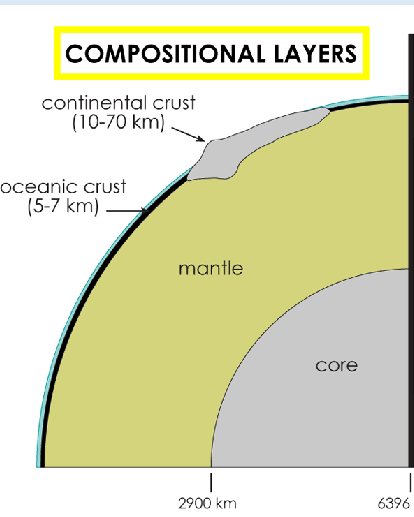
Inner most layer for Compositional
Core
2nd Layer for Compositional
Mantle
Outer Layer for Compositional
Crust
Mechanical layers
It is based on mechanical properties
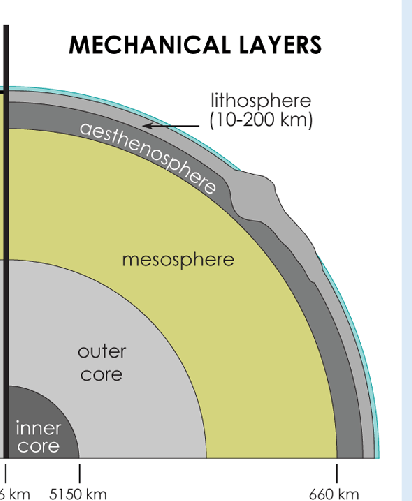
Inner most layer for Mechanical
Inner Core
2nd layer for Mechanical
Outer Core
3rd layer for Mechanical
Mantle
4th layer for Mechanical
Asthenosphere
Outer most layer for Mechanical
Lithosphere
Most abundant element on the whole earth
Iron
2nd most abudant element on the whole earth
Oxygen
3rd most abudant element on the whole earth
Silicon
Rocks of crust layer
Granodiorite, basalt, gabbro
Rocks of mantle
Periodotite, Garnet periodotite
Elements of earth’s core
Iron and nickel
Region affected by the earth’s magnet. It is generated by the rotation of the fluid outer core around the inner core.
Magnetic Direction
The direction the compass points toward magnetic north
Declination
The angle between the direction a compass needle points and true north to
1st Continental Drift Evidence
Obvious fit of continents
2nd Continental Drift Evidence
Climate belts seem to match across continents
3rd Continental Drift Evidence
Distribution of fossils
4th Continental Drift Evidence
Alignment of Ancient Mountain Belts and Rock Types
Hypothesis of Continental Drift
Convection
Paleomagnetism
A record of Earth’s past in Igneous Rocks. Example: Magnetite
Magnetic Declination
Magnetic pole does not equal geographic pole
Magnetic Inclination
The angle between magnetic field and horizontal field = 0 degrees at magnetic equator and 90 degrees at magnetic north pole
Interpreting the Paleomagnetic Record
Continents Drift and the Paleopoles Records line up
Hypothesis for sea floor spreading
Sediment thickens above older crust, earthquakes along the central rift due to the crust splitting at Mid-Ocean ridges, heat flow at mid ocean ridges, ocean crust consumed.
1st observation for Sea Floor spreading
Magnetomter measures strength of total magnetic field
2nd Observation for sea floor spreading
Ocean crust is symmetric
3rd Observation for sea floor spreading
A symmetric pattern of polarity stripes develops and age of oceanic crust varies with location
DSDP 3 Test
Drilled through sediments and into basalt, determined age of oldest sediment at each site using fossils, age vs distance from ridge proved seafloor spreading
Magnetic reversals
Earth’s magnetic field polarity suddenly reverses periodically
Homogeneous, naturally occurring, solid, crystalline structure, definable chemical composition, generally inorganic
Different minerals with the same composition but different atomic arrangement. They exist as the presence of a mineral can tell a lot about the conditions of formation
Polymorphs example
Graphite
Types of mineral formations
The form by freezing of a liquid and precipitation, solid state diffusion and biomineralization
Types of crystals for mineral growth
Euhedral, subhedral, anhedral
Identification of Minerals
Physical properties, optical properties, chemical analysis, x ray diffraction
7 Physical properties to identify minerals
Color, streak, luster, hardness, density, habit, cleavage or fracture
Subclasses of silicates
Nesosilicates, inosilicates, phylosilicates, tectosilicates
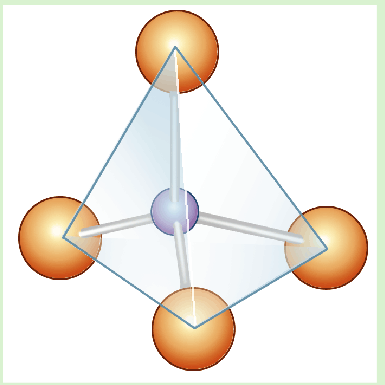
Model of Silica tetrahedron
1 Silicon 4 Oxygen in a pyramid shape
The Theory of Plate Tectonics
a theory explaining Earth's geology, including rock distribution, earthquakes, volcanoes, fossils, and geographic features.
What is buoyancy and how does apply to the lithosphere and asthenosphere?
Buoyancy is the force that allows the lithosphere to float on the asthenosphere due to differences in density.
The lithosphere is less dense and rigid, while the asthenosphere is more ductile and denser, enabling the movement of tectonic plates across the Earth's surface.
Why is oceanic lithosphere less buoyant than continental lithosphere?
The continental lithosphere is about 150 km thick, with a 35-40 km thick granitic crust, making it less dense and more buoyant, so it floats higher. In contrast, the oceanic lithosphere is 7-100 km thick, with a 7-10 km thick basaltic crust, which is denser and less buoyant, causing it to sink lower.
Active Margin
Margins near plate boundaries are "active."
Passive Margin
Margins far from plate boundaries are "passive."
Cratons
A portion of a continental plate that has been relatively undisturbed since the Precambrian Era.
Shield vs. Platform
Shield - exposed part of the craton/ Platform - covered (by sediment)part of the craton
describe how lithosphere is created or destroyed
Mid-Ocean Ridges (MoRs)- Sea-floor spreading opens the axial rift valley
• Rising asthenosphere melts, forming mafic magma.
• Pooled magma solidifies into oceanic crustal rock.
• Pillow basalt—magma quenched at the sea floor.
• Dikes—preserved magma conduits
• Gabbro—deeper magma
Be able to sketch, label, the three different types of plate boundaries
(Extensional, Transform, and Convergent)
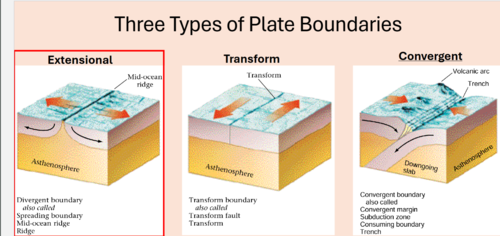
Be ready to draw and label a diagram of a mid-ocean ridge, OR subduction zone. (you can find a subduction zone in " Convergent Boundaries")
mid ocean ridge, (MoRs)
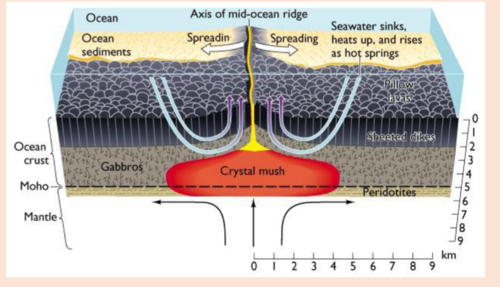
Be able to sketch and label them on your diagrams for the different types of plate boundaries
Divergent/Extensional
Sea-floor spreading, rift valleys, volcanic activity, minor earthquakes
Transform
Faults, earthquakes, no volcanism
Convergent
Subduction zones, mountain building, volcanic arcs, earthquakes
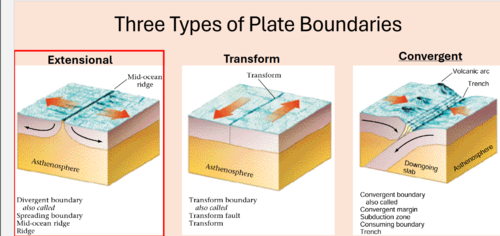
Extensional or Divergent Boundaries
Sea-floor spreading causes plates to move apart./• Magma wells up to fill the gap/.• Magma cools, adding material to each plate./• The ocean basin expands in width.
Be ready to give at least one example of each type of plate boundary
Divergent/Extensional Boundaries
The Red Sea
Transform
San Andreas Fault
Convergent
Himalayas
What are hot spots
Areas of intense volcanic activity from mantle plumes.
Mantle Plumes
Stationary columns of hot mantle rising to surface.
Core-Mantle Boundary
Layer where mantle plumes may originate.
Plate Movement
Tectonic plates shift over stationary hot spots.
What are the three (3) potential mechanisms driving plate tectonics
• Ridge-push—elevated MOR pushes lithosphere away.
• Slab-pull—gravity pulls a subducting plate downward.
• Convection in the asthenosphere adds or subtracts.
Definition of a rock
A coherent, naturally occurring solid that consists of an aggregate of minerals or, less common, a body of glass
Describe and be ready to sketch/label the rock cycle
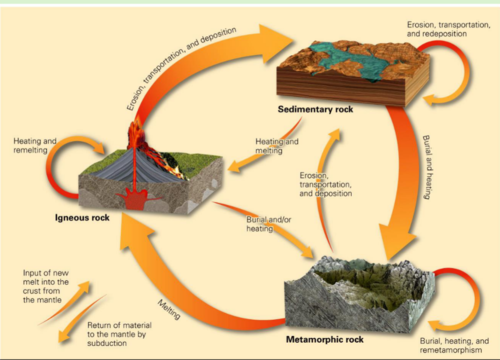
Igneous rock.
• Most COMMON rock type on earth - all mantle, ocean crust, and most of the continental crust/
• Formed from the freezing and consolidation of magma and/or lava