Electronic properties
 Call Kai
 Learn
Learn Practice Test
 Spaced Repetition
 Match
Match Flashcards
 Knowt Play
1/27

Earn XP
Description and Tags
starting from all unknowns from tripos q's + key eqns
Name | Mastery | Learn | Test | Matching | Spaced | Call with Kai |
|---|
No analytics yet
Send a link to your students to track their progress
28 Terms
bravais lattice
translational periodic array of lattice points
all lattice points indisinguishable
each lattice point has motif of atoms/molecules attached
unit cell
parallelogram defined by lattice vectors
tessellates plane - periodic translation covers plane
primitive unit cell
contains 1 lattice point
unit cell volume in 3D
a1⋅(a2×a3)
how is the NaCl structure formed?
fcc
parameter a
motif: Na+ (0, 0, ½ a)
Cl- (0, 0, 0)
Hexagonal net: how to construct
motif: (0,0), (0, 3a)
diamond structure
(41a, 41a, 41a)
lattice energy
Energy to go from solid lattice → widely separated gaseous ions
see derivation
assumptions of 1D FEG
ignore all interactions
no boundaries
“free particle” = no PE
describe as ideal gas (collisions etc)
Wavefunction and energy for FEG.
What is this wavefunction form often called?
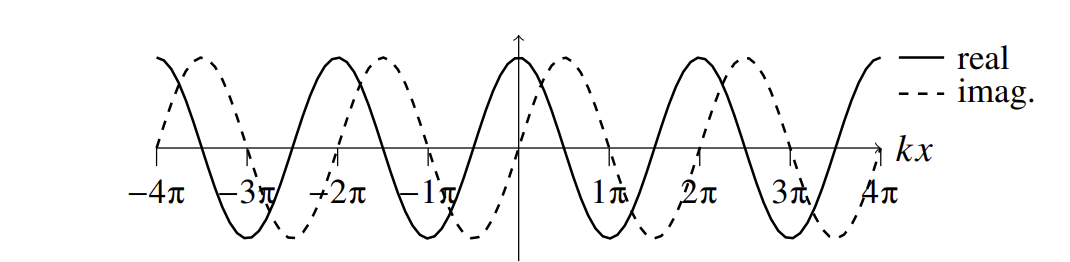
How can the real and imaginary parts of this wavefunction be plotted?
ψ=eikx (PLANE WAVE)
Re = cos(kx)
Im = isin(kx)
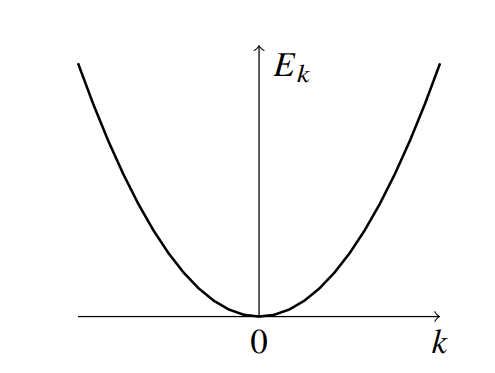
E=2meℏ2k2
k=λ2π
momentum of a plane wave in 1D and 3D
−iℏ∂x∂eikx=kℏeikx
1D: ℏk
3D: ℏ(kx,ky,kz)
how can we easily construct a wavefront in real space?
split into λx and λy
How do we quantise FEG?
BvK boundary conditions: CYCLIC
dispersion curve for FEG
energy NOT QUANTISED!!!
fermi-dirac distribution
f(E)=e(E−EF)/kT+11
Drude model drift velocity + conductivity
vd=meeEτ
Ef
Ef=2meℏ2kf2
eikx+e−ikx
2cos(kx)
eikx−e−ikx
2sin(kx)
1D band energy using Huckel approx. (derive)
α+2βcos(ka)
for −π/a≤k≤+π/a
See supo q 20
2D band energy using Huckel approx
α+2β[cos(kya)+cos(kxa)]
effective mass eqn
me1=ℏ21dk2d2Ek
CURVATURE!!!!
What does an infinite effective mass imply?
e- not accelerated by applied e-field
Reff
RHmeϵr2me∗
En for a donor/acceptor level
En=n2(−)Reff
DONOR: E -ve (E = 0 @ CB bottom).
n = 1 most - ve E
ACCEPTOR: E +ve (E = 0 @ VB top).
n = 1 most + ve E
a0,eff
a0,eff=a0me∗ϵrme