the courts I,II,II and chapter 6-7 SOCI 327 2023
 Call Kai
 Learn
Learn Practice Test
 Spaced Repetition
 Match
Match Flashcards
 Knowt Play
1/116

There's no tags or description
Looks like no tags are added yet.
Name | Mastery | Learn | Test | Matching | Spaced | Call with Kai |
|---|
No analytics yet
Send a link to your students to track their progress
117 Terms
John Oliver - public defenders
public defenders are over burdened, often working over 1000 cases a year when they shouldn't be doing more than 100. hard to prepare a decent case only in 7 mins. some places don't have public defence and some contract out. 90-95% of cases resolved by plea.
Larry thompson
arrested for suspended license and applied for a public defender which requires a $50 application fee. he spent 50 days in jail and was released on time served. $100 pursuant fee for defender and prosecution. arrested again for contempt of court and for not paying court fees. they charged him a $200 administrative fee. He was arrested while undergoing hospice care. he was watched by two guards and chained by the ankles while in jail for not being able to pay money. studies show that the more wealthy you are and the more resources you can bring to your table, the greater the chances of your case working out well for you
self-representation
- often don't perform well against a well educated prosecutor
- often extremely naive
- some access to information online can be helpful but accessing specific information they need may be more difficult.
- it is frequently chosen by Canadians because of the costs associated with hiring legal aid and the belief that free information is available online
- often rely on other people in the courtroom to guide them through operations like entering into a plea
Legal aid
- legal aid is frequently available only in cases where there is a likelihood of imprisonment or the loss of livelihood
- when applications for legal aid fail, people are consigned to assistance from duty counsel, student legal clinics, or community legal clinics
-you have to make under $20,000 a year in Alberta to qualify for legal aid if there is a likelihood of imprisonment or loss of livelihood
"Burden of the court" hypothesis
suggests that Canadians who self-represent place a burden on the court system because:
- the prosecution and the judge are forced to assist the defendant
- self-represented defendants slow down the court process
However research from Hann, Nuffiled, Meredith, and Svoboda did not find a burden placed on the court. rather they claim there is an additional burden on the accused. The accused is more likely to plead guilty earlier, have fewer court appearance, shorter times per appearance
the criminal courts
- in reality, there are 14 different court systems in Canada (13 provincial/ territorial and 1 federal court)
- Nunavut has a unified superior court because of its small population
- provincial and territorial courts are responsible for cases within their boundaries whereas the Supreme Court has jurisdiction over the entire country
- the provinces and territories also have appeal courts
specialized courts
- problem-solving courts focus on underlying problems interagency, accountability
- interagency: not just working on your own, drawing on other things from provincial and federal governments
-problems with non-compliance, conditions imposed by the courts, non-completion of programs
the supreme court of Canada handles about 65-80 cases per year....
- about half are handpicked by the court
- some cases end up there naturally
supreme court judge create criminal justice policy by:
- judicial review (concluding whether a law is constitutional or not)
-their authority to interpret the law
- there is always a chance of corruption
steps in investigation and trial
- investigation
- laying a charge
- deciding whether to prosecute
requiring the accused to attend court, enter a plea, and bail
-types of offences
-choice of trial court and election by the accused (depending on the charges)
-preliminary inquiry or hearing
-plea negotiation
-trial
-verdict
- sentencing
- appeal
Bill C-48 an act to amend the criminal code (bail reform)
-turned the tables in terms of the burden of proof
-used to be that if the government wants to detain you while you are awaiting trial they need to have good reason
- making it so that the person being detained needs to explain why they shouldn't be in prison
-how they are supposed to do it
- too much burden on the defendant
the court system
- before a criminal trial, the only proof required to proceed is probable cause
-give the absolute minimum and hold cards close to chest
- ex: Alex jones
- arguing about the content of his phone.
- prosecutor going after him, trying to disprove him with his text messages
- jones' lawyer sent the prosecution the entire contents of the phone
proof beyond a reasonable doubt is required to convict in court
- whats the difference between probably did it and they did it beyond a doubt
-probably versus certain
- different members of the jury interpret this differently
who are the key actor in the court system
crown prosecutors, the defence lawyer, judge, juries, and victims and witnesses
in most criminal cases the accused pleads....
guilty.
Ericson and Baranek found that 91/131 of accused individuals plead guilty to atleast one criminal charge. 21 pleaded not guilty, 15 were found guilty on at least one charge, 6 were acquitted, 17 had their charge dropped or dismissed, and 2 did not appear in court
the defence lawyer role
- while most people believe that the role of the defence lawyer is to barter the best deal possible for their clients, their key role is to ensure that their rights are protected .
ensure the rights of an abstract Canadian non one person over another.
- they examine evidence to assess the strength of the crown's case, explain to their clients what is happening at each stage, sometimes hire experts to investigate a case, and obtain second opinions in regards to evidence
the crown prosecutor
-the crown prosecutor's main duty is to enforce the law and maintain justice.
- they much follow Stinchcombe (1991)
- crown prosecutors face role conflict because there are pressures to successfully convict
- they want to maintain administrative credibility and keep the acquittal rate low.
- they face case overload
-Gomme and Hall (1995) found that they prosecuted 6-10 trials per day
- they can be held civilly liable if their decisions are deemed malicious or they have abused their authority
Judges
- they are expected to uphold the rights of the accused and arbitrate any disputes between a prosecutor and a defence lawyer.
- at times they are also trier of fact and decide the type and length of the punishment
- their greatest ability is whether to accept evidence or not
Criminal Trial Procedure
-the criminal trial is the start of the adjudication stage
-jury trials are relatively rare in Canada
- Thomas (2004) argued that only 2% of cases were hear at the superior court level
the plea
- during the preliminary hearing of cases involving indictable offences, the accused enters a general plea
- about 90% of accused enter a plea of guilty before trial of when they appear in a lower court for the first time
- for indictable offences, the accused are more likely to plead not guilty and a trial date is set
the preliminary hearing
- is to ascertain whether there exists enough evidence for the case to proceed, an to protect the accused from an unnecessary trial
-the crown does not need to present all of their evidence at this stage
- after the hearing, a trial is scheduled or the charges are dropped and the accused is freed
- many accused forgo the preliminary hearing
prosecutor screening
- crown prosecutors have significant discretion in whether they wish to proceed with a case. they may consider:
-their belief in the guilt of the accused
-the seriousness of the crime
- the record of the accused
- witnesses
-the credibility of victims and witnesses
-whether the accused is involved in a more serious trial
plea bargaining
- it is almost impossible for criminal justice system to try every single case
- a plea bargain is any agreement between the accused to plead guilty in return for some benefit (reduction in sentence)
-plea bargains improve administrative efficiency of the courts, lower the costs of prosecution, and permit the prosecution to spend more time on important cases
charge bargaining
plead guilty to one charge for prosecutors to remove another charge
sentence bargaining
bargaining for the length of sentence
Procedural Bargaining
indictable vs summary or hybrid
fact bargaining
negotiate the facts of the case that will be entered into the court
label bargaining
- labelling someone as dangerous offender has consequence that allow for lots of leverage in trial
- add label to a person that would increase their sentence and would refuse them bail next time they are arrested
- labels matter to people
advantages of plea bargaining
- efficiency gains
-cost reductions
-work load reduction
- reduction in trauma felt by victims
disadvantages of plea bargaining
- unfair and hidden process
- transparency and openness is what distinguishes democratic justice system from non-democratic and unfair systems
-what would make our system different from them if we are doing plea bargains?
-too much leniency
-reduced CJS credibility
-avoids due process standard
-innocent people may feel pressure to bargain
Anne Milgram: why smart statistics are the key to fighting crime?
- she has a risk assessment tool and instead of feeling the vibe of a victim the judge makes decision based on the risk assessment
-the dashboard is a good idea problematic
-she is doing low level stuff and assuming that a computer program can make decisions
in 1993 Lorena Bobbitt cut half her husbands penis off with a knife when he was asleep. She claimed that he was abusive to her.
what questions does this case pose?
- questions of what rights a person had before they go to trial, what does the state have to prove before a person can be convicted of crime, and what defence options are available to those convicted of crime
the charter
the charter of rights was enacted on April 17th, 1982.
- it is a complex negotiation
- the charter has reinforced many of the fundamental principles of the CJS, specifically:
- fair trial
-protection of due process rights
-freedom from cruel and unusual punishment
-charter spells out rights in accordance to your relationship to the state
sections of the charter
- section 7: individual are protected
-section 8: individuals have the right to a reasonable expectation of privacy
- section 9: people cannot be arbitrarily detained
-section 10: rights of the accused when detained (Habeus Corpus- unlawful detention assessment)
-section 11: indicates the rights people have when charged with an offence (R.v. Askov)
- section 12: stipulates fair punishment
-section 13: freedom from self-incrimination
-section 14: the right to an interpreter
-section 15: equality rights
-section 24: remedies for violation of the above rights
R.v. Askov
- how quickly a case should go
- the guy is in the middle of going to shoot someone in the head but the police catch them before they commit the act, the trial takes tool long and the defence says it is unfair and asked for a mistrial and acquittal
Habeus Corpus Act
state has to review whether anyone should be incarcerated or not
-specifies that you have to have a hearing anytime there are interferences with the state
the supreme court on The Charter
- the supreme court has determined that the principles of fundamental justice are broader than the rights defined in the charter
- the highest court in the country is saying that it will take time to flush out how the charter will work in life
- the law will always change because society and values and technology is always changing
- it has ruled in four areas including the right to silence, disclosure, the right to make a full answer and defence, and the detention of those found not guilty by reason of insanity
The "Cannibal Cop" Gilberto Valle
he would go online and talk to others about his dark, violent desires.
eventually he was acquitted because it was just fantasy
the nature of crime
- the CJS defines crime as actions that are harmful, prohibited, can be prosecuted in a formal environment, and for which a punishment can be handed out
-Corpus Delecti -"the body of crime"
- the CJS needs to meet certain standards before they can declare someone guilty
Corpus Delicti
- the state must usually prove each of the following to convict:
1. legality
2. mens rea
3. actus reus
4. concurrence of mens and actus reus
5. harm
6. causation
7. punishment
legality
the act is criminal because it clearly violates a section of the law
mens rea
- having guilty mind
- individual must form intent to violate the law
-different from motive
Actus Reus
guilty act
- to be accused it must be established that the accused actually carried out the act
- when you have carried out the act or when you have failed to act to prevent something from happening
Concurrence of Mens Rea and Actus Reus
- the idea here is simply that the two go together that you have planned it and thought it through and then actually done it.
- not that you have done it first and then backtracked to find motive and intent
harm
- not all crimes cause physical harm
- victimless crime still cause harm
-identify and prove that the person was harmed
causation
cause of harm
- can be difficult
-some cases are open and shut and some are not as clear
- like Robert Dziekanski
punishment
- must be a known punishment
- the accused can choose between two types of defences: excuses and justification defences
- punishment written in the law books before hand before applying the punishment
excuse defences
excuse that say you are not responsible for the act engaged in.
- age
-mental disorder
-automatism
-mistake of fact
-mistake of law
age excuse defence
- 3 different age brackets for age culpability
1. those under 12 are legally unable to form intent in Canada. This called Doli Incapax
2. between 12 and 18 is the youth criminal justice act
3. over 18 is the criminal justice system
mental disorder excuse defence
- suffers disease of mind so they cannot form intent of crime
- if you have a person who has carried out a crime like murder, you can as the court to excuse the case on the basis that the person couldn't form intent on the basis that they had incurred a mental disorder.
if you can prove that this mental disorder had history of several years and witnesses of this affecting you for this to be an effective defence
Automatism (Excuse Defence)
- the accused can expect their behaviour to be excused on the basis of telling in a dissociative state
- lack the intent to carry out a crime but your body is carrying out actions but your body is not really forming intent to carry out the actions
- Ex: Andrea Yates killing her 5 kids ins a postpartum psychosis episode
mistake of fact excuse defence
- when defendants use this they argue that they don't form intent because they are unaware of all facts of the case.
when you can convince a judge or jury that you were not in full possession of the facts and therefore you cannot be held accountable
mistake of law
-ignorance of the law is not an excuse
-people are responsible for their knowledge level of the law
- can be used in limited circumstances:
- the law had not been published
- the defendant relied upon an overturned law or statute
-relied on overruled judicial decision
-relied on interpretation of legal official
justification defences
when we own up to some responsibility to what happened, but justify as to why we did it (partially or entirely excuses behaviour)
- duress
-necessity
-self-defence
-provocation
-entrapment
consent justification defence
□ Consent defences are seldom used and are unlikely to be successful in cases where there were serious injuries, where the assault was accompanied by threats or where the accused was in a position of authority.
□ A defence that is almost always used by defendants accused of assault, where they contend that the victim was a willing party in the offence, such as when a hockey player injures another player.
duress justification defence
- is when you have carried out a crime you wouldnt have normally done because you were under pressure of protecting yourself or family members from harm
-wrongful threat of one person makes anothers person commit a crime they normally would not commit when there is imminent threat of death or bodily harm
necessity justification defence
duress is a type of necessity. the threat to bodily harm can come from another person or nature
- ex: robert latimer mercy killing his daughter
Self-defence (justification defence)
involves defending yourself as well as others and property. only as much force as necessary. R.v. Lavallee. 1990. shot her husband when he told her to or he would shoot her.
Provocation justification defence
partial defence for murder. you can be provoked into murder. an insult or a wrongful act
Entrapment
- Montebello, Quebec. Agent of the state decieves a person into commiting a criminal act. what about undercover officers offering to exchange sexual services?
Entrapment occurs when police or government officials persuade or lure an individual into carrying out an offence that he or she would not otherwise have committed.
this justification can be made only after the accused is found guilty, and the burden is on the defence counsel to prove that entrapment occurred.
criminal offences
- summary conviction offences are generally punishable up to six months and a maximum fine of $2,000
- indictable offences:
-less serious (theft under $5,00 0 are known as absolute jurisdiction indictable offeces
- the most serious are supreme court exclusive indictable offences
-election indictable offences
- a few different types of indictable offences
Hyman Gross - Levels of Culpability
- purposely
- knowingly
-recklessly
-negligently
purposely
A construction worker digs a ditch in a neighborhood where children regularly play and leaves the trench uncovered. One rainy day, children are killed while playing in the trench when its walls cave in on them. If the construction worker dug the ditch and left it uncovered in order to kill the children, their deaths were brought about purposely
Murder 1
knowingly
If the trench was dug and left uncovered not in order to harm the children, but merely with the knowledge that children played in the area. Then their deaths were brought about knowingly
Murder 1
recklessly
If digging the ditch and leaving it uncovered both without the knowing that the children played in the area and without making sure they did not, then their deaths were brought about recklessly. Aware of possible risks Argued in the Michelle carter case that she was reckless
negilgently
If the trench was dug and left uncovered without knowledge that children played in the area and some, but inadequate, precautions were taken to make sure no children were there then their deaths were brought about negligently. Not aware of the risks
David Milgard
was sentenced to life imprisonment for the murder of nursing aid, Gail Miller.
he was innocent.
his appeals were unsuccessful.
spent 21 years in prison.
this case shows how the CJS can fail Canadians
the jury
- in most criminal cases, the accused elected not to be tried by a jury
- when the maximum punishment for a crime carries a five year term of imprisonment or more, the accused has the right to a jury trial.
- the jury generally does not have input into the sentence of the convicted
- it is interesting that in most cases, that the accused chooses not to be tried by a judge and rather than a jury
Jury Selection
- in order to select a jury, a source list is drawn up, those qualified are identified and these people are summoned to appear in court.
this is poorly done.
- both the judge and prosecution can eliminate potential jurors.
-peremtory challenges does not require a reason (eliminated in canada in 2019)
- the number of challenges depends on the type of crime that is being prosecuted
(20 for murder and treason trials)
- this process is not as random as it could be and doesn't always include everyone (indigenous people excluded in Ontario)
The right to be presumed innocent until proven guilty
The state has the burden of establishing guilt. Burden of proof
The right to confront the accuser
Heresay (second-hand information) Generally not allowed.
Child sexual assault cases :Allow children to testify from another room using conference software
The right to a speedy trial
The charter (Section 7) provides for the right to a speedy trial
R.v. Askov (1990) took almost two years to bring to trial Thrown out of court with an acquittal but it was seen from the evidence that he was intending to cause harm
Most cases are now heard within a year
Supreme court and unreasonable delay
1. Length of the delay
2. Explanation for the delay
3. Waiver
4. Prejudiced to the accused
the right to a public trial
There is value is keeping the process transparent
Publication bans may take place in sexual assault cases, youth cases ,and cases where the fairness of trials is put at risk
open courts principle
Gives the media the freedom to publicize court proceedings, although some information, such as the identity of a child victim of sexual abuse, may be subject to a publication ban
the criminal trial
-Criminals are not as sensational as many television series would suggest.
-There are strict rules and procedures to follow.
-Trickery and deceit on the part of prosecutors is not allowed.
-Charges are read.
-Prosecution makes an opening statement
-Must be impartial, no personal opinions allowed, all witnesses mentioned must appear, evidence not included cannot be mentioned.
-Defences may make an opening statement or not.
-For conviction, the standard of guilt is beyond a reasonable doubt
trial evidence
- Usually testimony from sworn witnesses is presented
- The prosecution may call no more than 5 expert witnesses without the approval of the judge
○ Bc potential wealthy defendants could delay trials indefinitely if they have the money
- The defence has the right to cross-examine witnesses
- The judge arbitrates on what evidence may be included and excluded
the defence lawyer
- The defence may produce witnesses or not at a trial
- The defendant may or may not give testimony
It really comes down to the strength of the case and how compelling it is that is put forth by the crown prosecutor
closing arguments
- If the defence presents evidence or the defendant testifies, then the defence must address the jury before the prosecution
If not, then the prosecution will address the jury first
charges the jury
- After closing arguments, the judge charges the jury. This means that the judge instructs them on the relevant principles of law
○ Defintion of the crime
○ Remind the jury of The presumption of innocence
○ The burden of proof
○ If reasonable doubt exists, then the jury must acquit
- The judge must be very careful not to say anything that may prejudice the jury
Precision is important and is demonstrated by the mcann case in alberta
appeals
- Both of the defendant and the prosecution can appeal a verdict
- The defence can appeal the conviction, the sentence, or being found mentally unfit to stand trial
For indictable offences, the accused may appeal the conviction on a point of law, a question of fact, or the length of the sentence
sexting
○ Transmitting sexually explicit images online or via text message
§ To or of minors
Section 162(1) of the Criminal Cod
Adultery
○ Used to be a crime in canada
When a married person has a sexual relationship with a person to whom they are not married
common law
An approach to law that is based on tradition, where judges follow decisions or precedents made by other courts
stare decisis
A legal principle whereby courts are bound by their prior decisions and the decisions of higher courts
What the common law is based on
precedent
The practice of judging basing decisions about current cases on the outcomes of prior judgments
substantive law
Consists of the written rules that define crimes and punishments, and the rights and obligations of citizens and criminal justice personnel
procedural law
Focuses on the rules that determine the enforcement of rights or due process
fundamental justice
A principle of Canadian justice that states that people who acted reasonably may not be punished unless there is proof that they did something wrong.
habeas corpus
The right of a person who is being detained to challenge the legality of his or her detention before a court.
crime of omission
An act where the accused has failed to take some action, such as a school social worker failing to report child abuse to child welfare authorities.
victimless crimes
Acts that are legally defined as crimes even though there is no direct victim (e.g., illegal gambling).
reckless behaviours
Occur when people act in a manner that they know is dangerous or risky
wilful blindness
Occurs when an accused is aware that a crime was likely being committed but chose to ignore the facts.
Stand your ground laws
(also known as the castle doctrine), which gives people the right to protect their lives and property by using force that would be considered excessive in Canada.
hate crimes
Offences intended to intimidate or harm a person or the group to which they belong based on race, ethnicity, gender, sexual orientation, national origin, disability, or other similar factors.
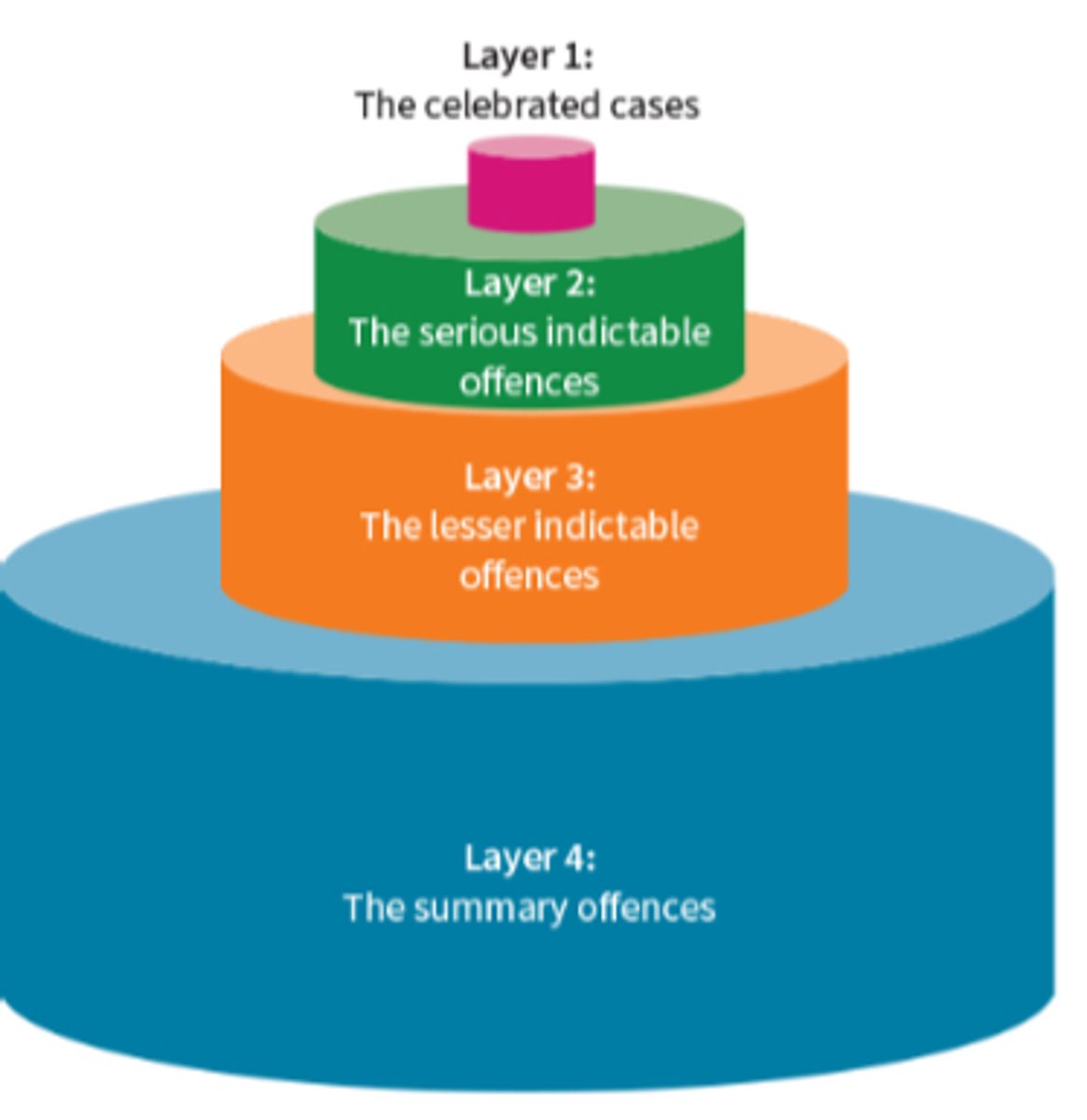
the criminal justice wedding cake model
where the least attention is paid to criminal cases in the base or lowest layer (which is composed of minor summary offences such as property crimes, simple assaults, and public order crimes), while the cases that tend to be the most widely reported are in the top layer—what Walker calls "celebrated cases."
canada
• All courts are part of the same unified system, where the ultimate authority rests with the Supreme Court of Canada.
united states
• There are state and federal courts, and appellate courts exist for both systems; the Supreme Court of the United States is the ultimate court.
publication bans
○ Made by courts in order to protect the identity of some victims or specific information about cases
The conditions on which they can be used are outlined in section 486 of the Criminal code.