Organic 2
0.0(0)
Studied by 3 people Call Kai
 Learn
 Practice Test
 Spaced Repetition
 Match
 Flashcards
 Knowt Play
Card Sorting
1/37

Earn XP
Description and Tags
38 Terms
1
New cards
What is a pi bond?
sideways overlap of adjacent p orbitals above and below the Carbon atoms
* needed for double bonds
* Exposed which is why alkenes are more reactive than alkanes
* Have restricted rotation
* needed for double bonds
* Exposed which is why alkenes are more reactive than alkanes
* Have restricted rotation
2
New cards
Why are pi bonds needed for double bonds?
sigma can only be single bonds as can only have 2 electrons per orbit
3
New cards
What is the shape and bond angle of alkenes?
bond angle of 120 and are trigonal planar shaped
4
New cards
Stereoisomerism
atoms bonded in the same order but arranged differently in space
5
New cards
Geometric stereoisomerism
caused by the restricted rotation around a double bonds and needs 2 different groups attached to the double bonds
6
New cards
How do you tell if its an E or Z isomer?
The location of the 2 highest priority groups (element with highest atomic number) determines if E or Z
* E = opposite
* Z = together
* E = opposite
* Z = together
7
New cards
What is cis-trans isomerism?
type of E/Z isomerism where both groups on each side are the same as on the other side
* Cis if Z and Trans is E
* Cis if Z and Trans is E
8
New cards
What are the rules for curly arrows?
* Tail goes from the center of the covalent bond or lone pair
* If forming a bond pair then the arrow goes above and alongside the atom
* If forms a lone pair then goes next to and into atom
* If forming a bond pair then the arrow goes above and alongside the atom
* If forms a lone pair then goes next to and into atom
9
New cards
What are all alkene reactions?
electrophilic addition
10
New cards
What is hydrogenation?
Unsaturated alkene + hydrogen —> saturated alkane
nickel catalyst and 60C
nickel catalyst and 60C
11
New cards
What is the reaction mechanism for hydrogenation?
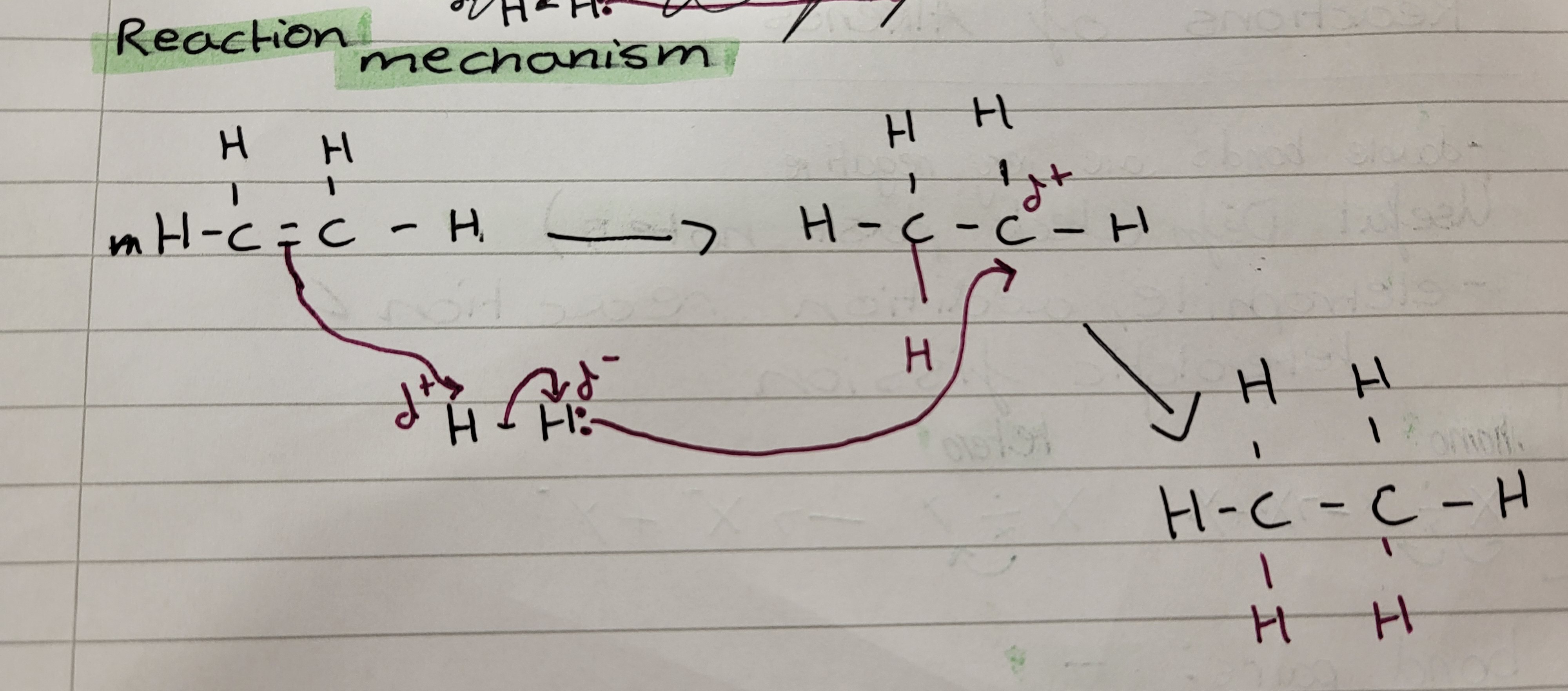
12
New cards
Halogen Addition w/ Alkenes
* halogens only react with unsaturated molecules so can use the reaction to test the degree of saturation by measuring hoe much bromine it can decolourise
1. the double bond is electron rich and so has the X2 moves towards it the electrons are repelled to the far end of the covalent bond
2. electrons are then attracted to the + X2 and a new covalent bond is formed
3. The other carbon is now a cation and so the - X is attracted and forms a new covalent bond
* It is the same mechanism is hydrogenation
13
New cards
Hydrogen Halide Addition w/ Alkenes
* Same as normal if the molecule is symmetrical
* 2 possible products if not symmetrical (major and minor)
* Carbon atoms can be primary, secondary etc depending on how many other hydrogen atoms they’re bonded too
* quaternary is the most stable
* The major product is when the cation forms on the most stable carbon (draw this unless specified minor)
14
New cards
Steam Addition w/ Alkenes
* Same as normal but the steam splits into H+ and OH-
* forms alcohols
* needs a acid catalyst (usually H3PO4)
* forms alcohols
* needs a acid catalyst (usually H3PO4)
15
New cards
What is ozone?
O3 = an allotrope of oxygen that is made naturally in the atmosphere
also made by photocopiers and laser printers
also made by photocopiers and laser printers
16
New cards
What is the ozone cycle?
1. UV from the sun breaks Oxygen gas into oxygen radicals
2. These radicals then react with oxygen gas to form ozone
3. More UV is then absorbed by the Ozone to break it back up into oxygen gas and radicals
4. The oxygen radicals then react together to form oxygen gas and the cycle continues
This cycle continuously absorbs harmful UV and so prevents it from reaching the surface of the earth
17
New cards
What caused the hole in the ozone layer?
CFCs (chlorofluorocarbons) (organic molecules containing chlorine, fluorine and carbon atoms)
Used in aerosols and fridges but now banned
Used in aerosols and fridges but now banned
18
New cards
How do CFCs disrupt the ozone cycle?
absorb UV which causes a chlorine radical to be knocked off
These chlorine radicals then react with ozone to form .OCl
No UV is absorbed in this process
The oxygen is then removed from the process so less ozone is produced
.OCl then reacts with ozone radicals to form oxygen gas and a chlorine radical which can they go on to react with ozone again continuing the cycle which absorbs no UV so it can reach the surface
19
New cards
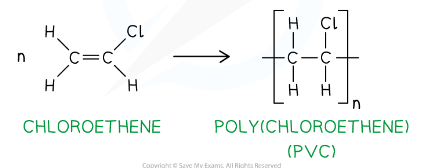
What is addition polymerisation?
* = reaction in which many monomers with C=C bonds from long chains of polymers(only product)
* polymer = long-chain molecule made of repeating units
* polymer = long-chain molecule made of repeating units
20
New cards
How can we dispose of non-biodegradable polymers?
* Are often disposed of via landfill sites however this is not ideal as can cause water pollution, takes up valuable land space and releases methane
* Recycling:
* reduces polymers going to landfill
* reduces use of finite resources like crude oil
* time consuming and therefore expensive as the polymers need to be sorted into different categories
* once sorted they’re melted and cast into pellets to reuse
* Hard to recycle some polymers such as PVC which releases Chlorine gas when melted so alternative methods of recycling it have to be used
* Combustion:
* Have a large amount of energy stored within the polymer chains so can be incinerated
* use the energy to boil water and use the water vapour to turn turbines in power stations
* releases CO2
* Feedstock Recycling:
* break the polymers down into monomers, gases and oils to use as raw materials in the production of new polymers and chemicals
* Works with unsorted and unwashed polymers
21
New cards
What are some alternatives to non-biodegradable polymers?
* Bioplastics:
* polymers made from starch/ cellulose, plant oils and plant proteins
* renewable and sustainable alternative
* Biodegradable Polymers:
* Broken down by microorganisms
* releases CO2, water and other organic compounds
* polyester and polyamide are examples as can be broken down by hydrolysis reactions:
* Compostable Polymers:
* Mainly plant based
* degrade naturally
* Photodegradable Polymers
* contain bonds that are weakened by absorbing light
* many are oil based
22
New cards
What are the properties of alcohol?
* R-OH
* Can be primary (C is attached to 1 other C, end of chain), secondary (C attached to 2 other Cs, not at end) or tertiary (attached to 3 others, not at end and C has a branch as well)
* Have a relatively high boiling point compared to alkanes due to presence of hydrogen bonds
* liquid at RTP
* soluble in water as polar but gets less soluble as the chain gets longer
23
New cards
Dehydration of Alcohol
* elimination of water
* needs an acid catalyst
* needs heat and reflux
* creates an alkene and water
* needs an acid catalyst
* needs heat and reflux
* creates an alkene and water
24
New cards
Oxidation of Alcohol
* \[o\] = oxidising agent
* primary alcohol -\[o\]→ aldehyde -\[o\]→ carboxylic acid
* secondary alcohol -\[o\]→ ketone
* Tertiary alcohols can’t be oxidised
* primary alcohol -\[o\]→ aldehyde -\[o\]→ carboxylic acid
* secondary alcohol -\[o\]→ ketone
* Tertiary alcohols can’t be oxidised
25
New cards
What is reflux?
heating the chemical reaction for a specific amount of time, while continually cooling the vapour produced back into liquid form, using a condenser
26
New cards
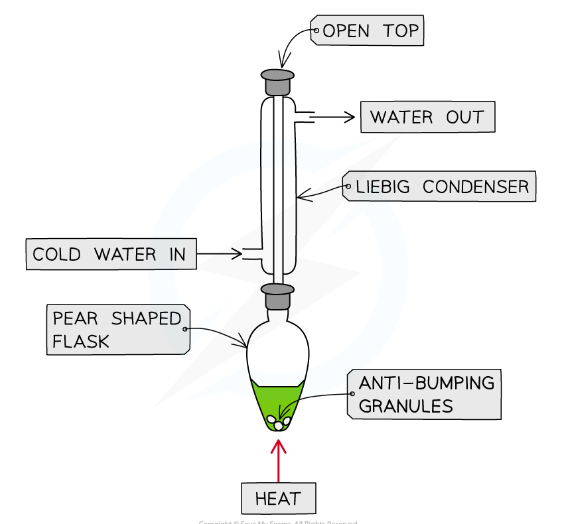
What is the first part of oxidising primary alcohols?
Ethanol —> Ethanal
* Sulphuric acid in a pear shaped flask with some anti-bumping granules
* Add potassium dichromate and gently swirl until dissolved
* add the ethanol from the top of the condenser and heat the solution
* reflux = heating the chemical reaction for a specific amount of time, while continually cooling the vapour produced back into liquid form, using a condenser
* It will turn from orange to green when oxidised
27
New cards
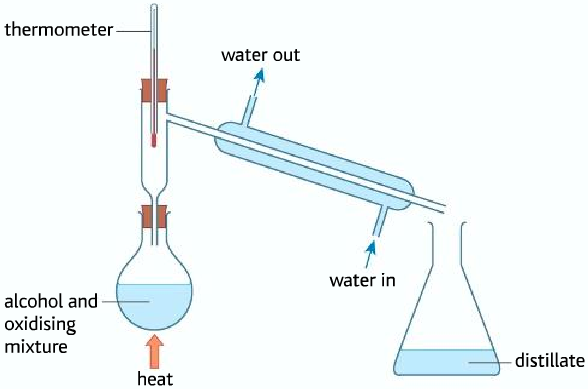
What is the second part of oxidising primary alcohols?
Ethanal —> Ethanoic Acid
* Heat the mixture and leave to simmer for 30mins
* make sure the vapour condenses about half way along the condenser
* Distill the solution to get the ethanoic acid and test the solution with some pH paper
* Heat the mixture and leave to simmer for 30mins
* make sure the vapour condenses about half way along the condenser
* Distill the solution to get the ethanoic acid and test the solution with some pH paper
28
New cards
How do you purify an organic product?
* Use a separating funnel to separate the water layer from the product layer
* ensure tap of funnel is closed and pour mixture into it
* put stopper in and invert to mix before leaving to let the layers settle
* put a conical flask underneath and open tap until lower layer has left, do same for 2nd layer
* Add sodium carbonate to remove acid impurities and then separate as described before
29
New cards
How do you dry an organic product?
* Add a drying agent (inorganic anhydrous salt)
* E.g. calcium chloride (hydrocarbons only), calcium sulfate and magnesium sulfate
* Add to flask and stir then leave for 10mins
* Keep adding powder until it disperses in solution instead of clumping together
* E.g. calcium chloride (hydrocarbons only), calcium sulfate and magnesium sulfate
* Add to flask and stir then leave for 10mins
* Keep adding powder until it disperses in solution instead of clumping together
30
New cards
What are the synthesis routes?
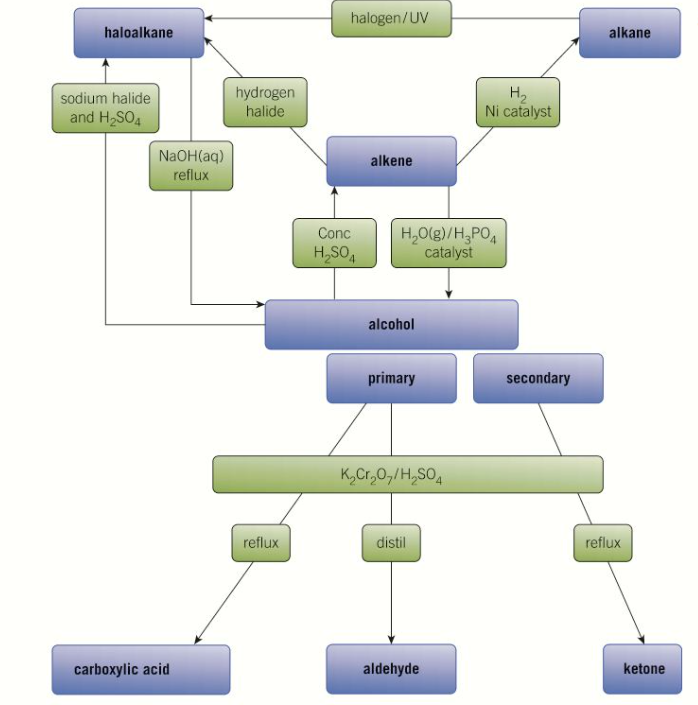
31
New cards
What is mass spectroscopy?
* Place organic compound in mass spectrometer and it loses an electron to form the positive molecular ion
* The spectrometer then detects to mass to charge ratio which gives the molecular mass of the compound
* The peak on the right of the graph is the molecular mass
* may be a small peak just after to account for different allotropes of atoms like carbon
* Some molecular ions break down into fragment ions via fragmentation
* Makes positive ions and radicals, radicals won’t be detected, other peaks will be these fragment ions
* No 2 compounds will have the same mass spectrum
32
New cards
What is IR Spectroscopy?
* Covalent bonds can absorb Infrared which makes them bend/stretch
* 2 types of vibration in bonds:
* stretch or bend
* The amount that the bond bends or stretches depends on the mass of the atoms and strength of the bond
* Can absorb radiation at same frequency as bonds natural frequency
* Longer IR is absorbed by gases in atmosphere however it is eventually rereleased
* Sample is placed in IR Spectrometer and a beam of IR is passed through it, a graph of which frequencies is made by analysing the emerging beam of IR
* Each peak relates to a specific bond
* fingerprint region = unique peaks used to identify molecules
33
New cards
Why are haloalkanes more reactive than alkanes?
due to the electronegative halogens so the C-X bond is polar
34
New cards
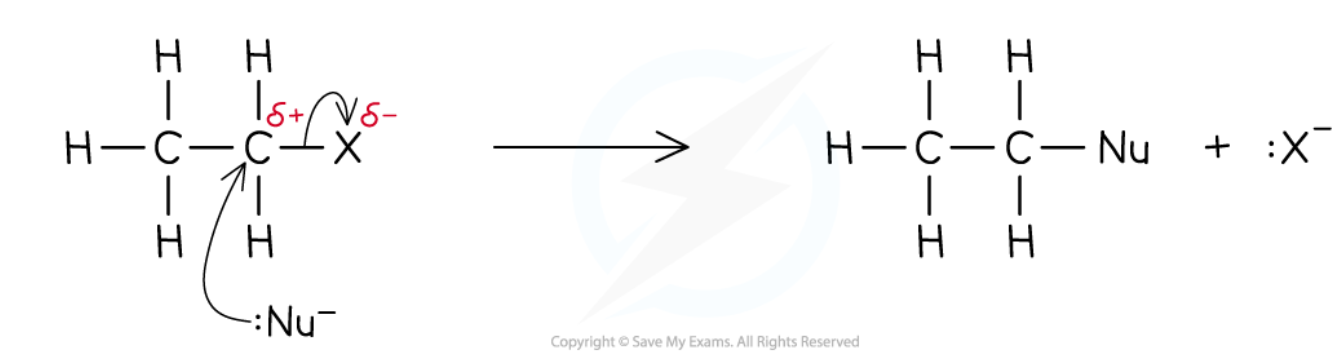
What is nucleophilic substitution?
* halogen is substituted for another group of atoms
* Products formed in this type of reaction are alcohols, amines and nitriles
* a nucleophile attacks a carbon atom which carries a partial positive charge and so an atom with a partial negative charge is replaced by the nucleophile
* Products formed in this type of reaction are alcohols, amines and nitriles
* a nucleophile attacks a carbon atom which carries a partial positive charge and so an atom with a partial negative charge is replaced by the nucleophile
35
New cards
What are elimination reactions(haloalkanes)?
* Hydrogen halide is eliminated
* key product is an alkene
* key product is an alkene
36
New cards
How are alcohols formed from haloalkanes?
* nucleophile is the OH- (replaces the halide in the haloalkane)
* NaOH or KOH both with ethanol is used
* Halogenoalkanes are generally insoluble in water and so there is a layer of the halogenoalkane and a layer of aqueous NaOH
* reaction occurs where the layers meet and so ethanol is used to allow the layers to mix and react
* reaction is warmed as slow at room temperature
* hydrolysis reaction and product is an alcohol
* rate depends of the type of halogen in the haloalkane as the stronger the C-X bond the slower the reaction (Bonds get weaker as go down group)
* Fluroalkanes don’t react
37
New cards
Why is OH- a better nucleophile that oxygen in water?
OH- carries a full negative charge whereas oxygen in water carries a partial negative charge
38
New cards
How do we measure the rate of hydrolysis?
1. set up 3 test tubes in a 50C water bath with a mixture of ethanol and acidified silver nitrate
2. add a few drops of chloroalkane, bromoalkane and iodoalkane to each test tube and start timer
3. time how long it takes for the precipitates to form (silver halides)
4. Yellow precipitate (silver iodine) will form the fastest then cream then white
5. This shows how the bond enthalpy of the halogens decreases down the group