AQA A level philosophy Epistemology 1 - What is knowledge?
 Call Kai
 Learn
Learn Practice Test
 Spaced Repetition
 Match
Match Flashcards
 Knowt Play
1/29

There's no tags or description
Looks like no tags are added yet.
Name | Mastery | Learn | Test | Matching | Spaced | Call with Kai |
|---|
No analytics yet
Send a link to your students to track their progress
30 Terms
Deductive arguments
Those in which the premises are supposed to guarantee the conclusion
Inductive arguments
Those in which the premises are supposed to support but not guarantee the conclusion
Valid
Applied to deductive arguments where the premises do guarantee the conclusion
Sound
Applied to deductive arguments that are valid and have true premises
Strong
Applies to inductive stingrays where the premises do support the conclusion
Cogent
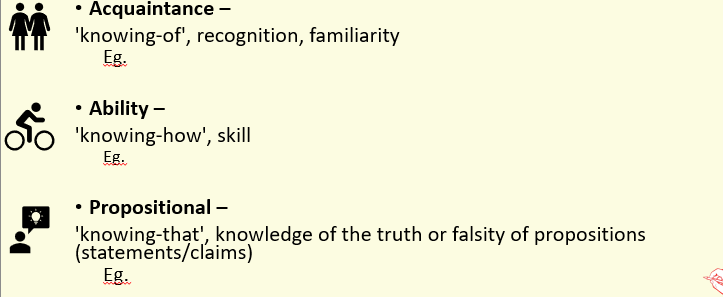
3 types of knowledge
Necessary condition
•A necessary condition is something which has to be true for something else to follow, but may not be enough on it’s own.
Sufficient condition
•A sufficient condition is one which, once it is achieved, is enough for something else to follow.
Real Essence
John Locke - Real definition
Nominal essence
John Locke - No real definition possible.
Attempts at definition will change with time/society.
Zagzebski outlines the things she thinks a good definition should avoid
•Circular – It must not contain the term being defined.
•
•Obscure – The definition should not be more complicated or confusing than the original term, otherwise what’s the point?
•
•Negative – You can’t define a term by what it isn’t.
•
•Ad Hoc – Your definition can’t be tailored to counter specific problems, it should be a general one.
Plato’s definition of knowledge
S knows that P iff (if and only if):
1.S believes that P
2.P is true
3.S’s belief that P is justified
Gettier case 1
Smith and Jones are applying for the same job. Smith has excellent reason to believe that Jones will get the job, e.g. Smith has been told this by the employer. Smith also has excellent reason to believe that Jones has ten coins in his pocket, e.g. Smith has just counted them. Therefore, both of these beliefs are justified.
Smith then puts the two beliefs together (a conjunctive proposition) and deduces that “the man who will get the job has ten coins in his pocket”. This belief is justified, because it is inferred deductively from justified beliefs.
Given what we have argued so far, we could therefore say that Smith believes the man who will get the job has 10 coins in his pocket.
It turns out that Jones doesn’t get the job, Smith does. It also happens that, unknown to him, Smith also has ten coins in his pocket.
So Smith’s belief that the man who will get the job has ten coins in his pocket is true. But it no longer seems like knowledge. Why?
A)Smith was certainly justified (to some extent) for his belief. He had counted the coins in Jones’ pocket and been told by the president Jones would get the job.
B)Smith’s belief was true because the man who got the job did have 10 coins in his pocket.
C)Smith had a real belief that the man who would get the job had 10 coins in his pocket.
Gettier case 2
This one involves Smith having plenty of evidence that his friend Jones owns a Ford car (imagine he has talked about it at length). On the basis of this he believes that a) Jones owns a ford.
Smith has another friend, Brown. He has no evidence of Brown’s whereabouts at the moment, but on the strength of his first belief he is able to form a new disjunctive belief that c) Jones owns a ford or Brown is in Barcelona (Barcelona chosen at random). This belief is justified as Smith had no reason to doubt the first part.
However, unbeknownst to Smith, Jones no longer owns the car, he wrote it off and has been driving a rental all week. Also unbeknownst to Smith, Brown really is in Barcelona.
So his belief that c) Jones owns a ford or Brown is in Barcelona is true! Would we want to say this is knowledge? If so, why? If not, why not?
A)Smith was certainly justified for his belief. He had heard Jones talking extensively about the car all week.
B)Smith’s belief was true, Jones did not own a ford and Brown was in Barcelona.
C)Smith had a belief that either Jones owned a Ford or Brown was in Barcelona.
Gettier issue for tripartite
•Smith inferred his belief from a false belief, (Jones would get the job / Jones owns a Ford).
•
•So the reason Smith has for his belief is false.
•
•What makes his belief true has come apart from what justifies his belief
•
•There is no connection between what justifies his belief and his belief’s being true.
•
•We might say that it is only by luck that his belief is true ("Lucky true belief")
•
•Gettier has tried to demonstrate that JTB is not jointly sufficient for knowledge
Question trigger - Outline
Outline means succinctly set out what it is/says/argues. Usually this refers to theories or arguments. E.g. Outline one of Gettier's counter-examples
Question trigger - Explain
Explain means describe WHY something is the case, for instance why something is a strength/weakness/ challenge. E.g. Explain how Gettier examples challenge the tripartite definition of knowledge
Infallibilism
Descartes - S knows that p iff:
S believes that p
p is true
S's belief that p is INFALLIBLY justified
Overall approaches to Gettier cases
Clarify/strengthen the justification condition, so K=JTB
Add to the justification condition, so K=JTB+X
Replace the justification condition, so K=XTB
No False Lemmas
S knows that p iff:
S believes that p
p is true
S's belief that p is justified
S's belief that p is not based on a false lemma
Reliabilism
S knows that p if and only if:
B. S believes that p
T. p is true
R. S’s belief that p is reliably formed
Defining reliable
A process is reliable if it produces a high proportion of true beliefs.
Having a clear definition of what we mean by reliable will help this approach.
But there is still a question of deciding exactly which process was being used to acquire each belief...
Goldmans causal account of knowledge
Alvin Goldman's causal account of knowledge states that a person knows a fact if and only if their belief is causally connected in an "appropriate way" to that fact.
This theory, developed to address Gettier problems, posits that the fact itself must be the cause of the belief, such as seeing water directly leading to the belief that there is water.
It distinguishes knowledge from justified true belief by making a direct causal link between the belief and reality a necessary condition, and dropping the justification condition.
Nozick’s truths tracking account
Nozick’s 4 conditions for knowledge are as follows:
1.S believes that P.
2.P is true.
3.If P were false, S would not believe that P (Sensitivity Condition).
In nearby possible worlds where P is false, S would not believe that P. This ensures that the belief is sensitive to the truth.
4.If P were true, S would believe that P (Adherence Condition).
In nearby possible worlds where P is true, S would still believe that P. This ensures that the belief is adherent to the truth.
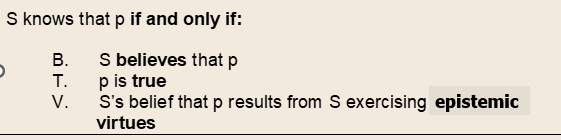
Epistemic virtues
Aristotle - particular skills, abilities or traits that contribute to someone getting to the truth.
They are the processes and qualities that are more likely to yield a higher rate of true belief.
Epistemic virtues Response
Sosa’s archery
Accuracy - did the arrow hit the target? Adroitness - was the arrow shot well? Aptness - Did the arrow hit the target because it was shot well?
Sosas criteria
1.Accuracy: is the belief true?
2.Adroitness: did the person form their belief by using their epistemic virtues?
3.Aptness: is the belief true because they formed it by using their epistemic virtues?
Sosa’s definition of knowledge is an apt true belief.
Gettier - style case - Fake barn county
•Henry is driving along the road full of fake barns and looks up just in time to see the only real barn. Looking at the barn, he forms the belief "there is a barn".
•
•This is a true belief, but it doesn't seem like knowledge because it is pure luck that he looked up at that moment.
If he had looked up at any other time along the road, he would have done the same things with the same result but it wouldn't have been true.