Interactive Part: Looking Back on Lecture 3
 Call Kai
 Learn
Learn Practice Test
 Spaced Repetition
 Match
Match Flashcards
 Knowt Play
1/12

There's no tags or description
Looks like no tags are added yet.
Name | Mastery | Learn | Test | Matching | Spaced | Call with Kai |
|---|
No analytics yet
Send a link to your students to track their progress
13 Terms
Main purpose of the interactive lecture
This session was mainly about learning how to apply affective persuasion theory to real campaigns. The key question was not just “is this emotional?”, but:
Is the campaign using affect, cognition, or both?
If affect is used, what specific emotion is created?
Is the affect incidental or integral?
Does the affect work as a cue or as an argument?
Does the affect motivate people to process the message more deeply?
This is very exam-relevant because exam questions often show an ad and ask you to classify and explain the persuasion mechanism.
Affect vs. cognition: not every emotional ad is “just affective”
The session starts by reminding us that affect means how people feel, while cognition means what people think. Affect includes both moods and emotions.
A mood is diffuse and low intensity, often without a clear source.
An emotion is more specific and linked to a situation or appraisal.
The Snickers/Godzilla-type examples show that campaigns may look emotional or humorous, but you still need to ask whether the affect actually supports the brand message or is just used as entertainment.
Exam tip: do not simply write “this is affective persuasion because it is funny/sad/shocking.” Explain whether the emotion is relevant to the product or just creates a positive/negative feeling around it.
Integral vs. incidental affect examples
The interactive session repeatedly tested the difference between integral and incidental affect.
Incidental affect is unrelated to the product itself. The feeling comes from the ad, music, humor, atmosphere, weather, or context, and may be transferred to the brand.
Integral affect is related to the product, consumption experience, or consequences of using/not using the product.
Examples discussed:
The Burger King “still burning” ad likely uses more integral affect because the feeling is connected to the product claim: flame-grilling and long brand history. The emotion supports the product meaning.
Supermarket tastings are a strong example of integral affect. The pleasure comes from actually tasting the product, so the affect is directly part of the consumption experience.
The Specsavers campaign likely uses affect in relation to the service problem: poor vision or the consequences of not seeing well. Depending on the exact execution, it can combine humor/fear with a product-relevant message.
The NZTA road-safety campaign is clearly integral affect. The fear, sadness, guilt, or anticipated regret is directly linked to unsafe driving and its consequences.
Appraisal theory in practice
The NZTA example connects to Roseman’s appraisal theory. The interactive lecture emphasized that you should not only say “negative emotion.” You should identify the specific emotion and appraisal pattern.
For example:
Fear = a goal is threatened, outcome is uncertain, and control is low.
Guilt = harm is caused by the self, and repair may be possible.
Sadness = a loss has occurred.
Relief = a threat has been removed.
Pride = success is caused by the self.
For road-safety ads, several emotions may be relevant. Fear may arise because an accident could happen. Guilt may arise if the driver imagines causing harm. Sadness may arise if the ad shows irreversible loss.
Exam tip: name the emotion and explain why the appraisal fits the campaign.
Cue vs. argument: the most important practical distinction
The interactive lecture strongly reinforced this idea:
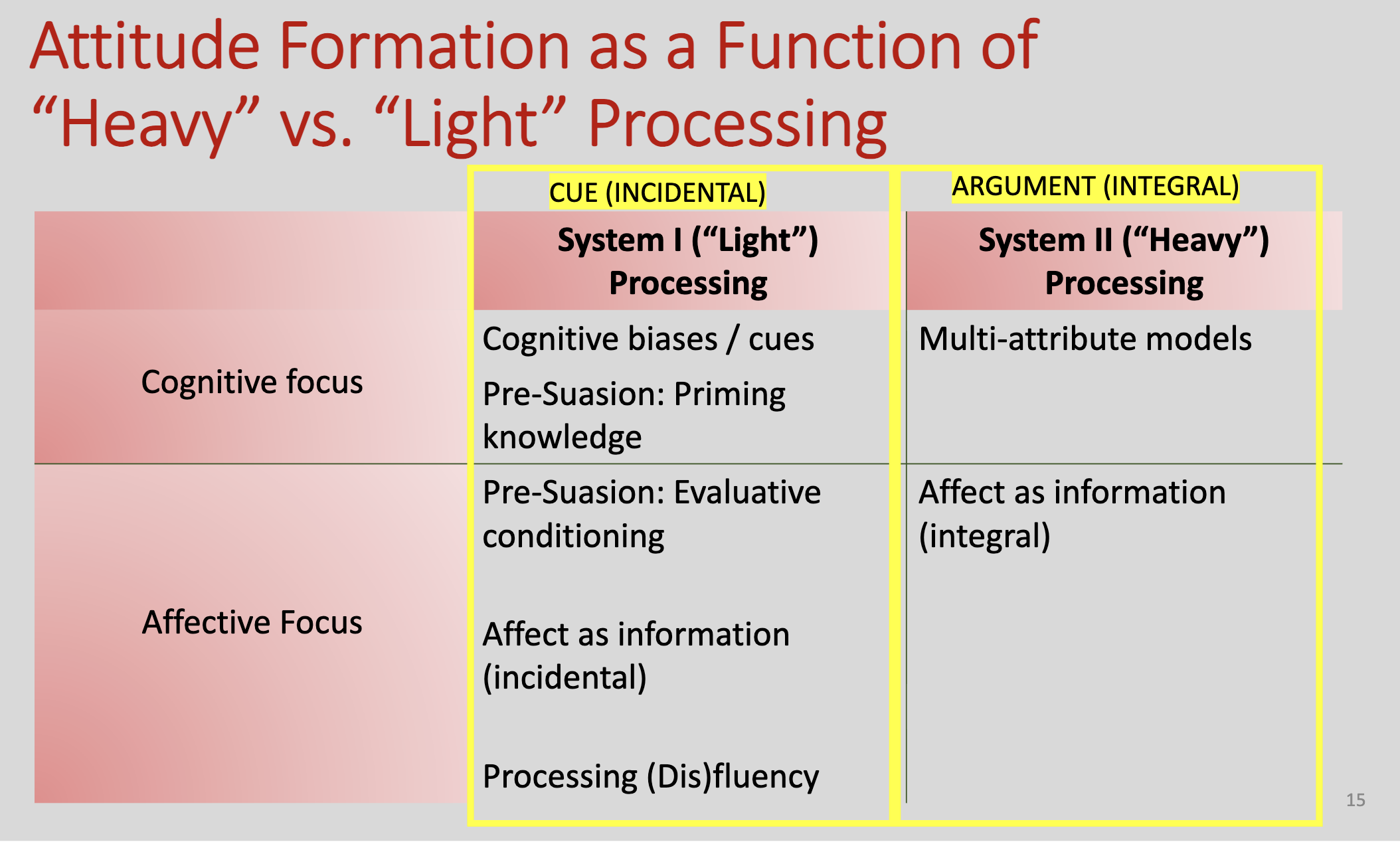
Incidental affect = usually a cue.
It works through System 1 / light processing.
Integral affect = can be an argument.
It can work under System 2 / heavy processing because the feeling is relevant to the product or behavior.
The slide with the attitude-formation table places affective persuasion in the wider framework:
Affective System 1 includes evaluative conditioning, incidental affect as information, and processing fluency.
Affective System 2 includes integral affect as information, where emotion becomes part of the argument.
So in exam answers, always ask: is the emotion merely making the ad feel nice, or is it actually evidence for the product/behavioral claim?
Axe Effect: cue, argument, or both?
The Axe examples ask whether the commercials use cues or arguments.
They can be interpreted as both, depending on the execution.
As a cue, attractive people and sexual imagery create positive affect that transfers to the brand. That is incidental/peripheral.
As an argument, the campaign suggests a product-relevant consumption outcome: using Axe makes you more attractive or desirable. In that sense, the affect is related to the consumer’s goal and can become integral.
A good exam answer would say: Axe uses affective persuasion through sexual attraction and liking. It often works as a peripheral cue, but because attractiveness is positioned as the product benefit, it can also function as an integral argument.
Store atmospherics: Rituals and supermarket smells
The Rituals store example asks whether smell, lighting, and music are affective cues, arguments, or both.
For many stores, atmospherics are incidental affective cues: they put consumers in a good mood, which can increase liking.
But for Rituals, atmospherics can also be integral, because the brand sells relaxation, sensory pleasure, self-care, and ritualized experiences. The store atmosphere demonstrates what the brand promises.
So Rituals is a good example of both cue and argument.
The smell of freshly baked bread in supermarkets can also be both:
As an affective cue, the smell creates warmth, appetite, and positive mood.
As a cognitive cue, it may signal freshness or quality: “this bread is freshly baked.”
This is a useful nuance: some cues can be affective and cognitive at the same time.
Good vs. bad practice in affective persuasion
The session then discussed whether affective campaigns are good or bad practice.
A key example is the Burger King Moldy Whopper exam question from 2023. The ad shows a Whopper decomposing to communicate no artificial preservatives.
This is a risky but interesting mix of affective and cognitive persuasion.
Affective side: it evokes disgust, shock, and maybe disliking. That can be dangerous because negative affect may transfer to the brand or product.
Cognitive side: the decay demonstrates the argument that the burger contains no artificial preservatives. So the negative emotion is not random; it supports the product claim.
A strong exam answer would say: it can be good practice if the communication objective is to prove naturalness/no preservatives, because the disgust is integral to the argument. But it is risky because the unpleasant affect may harm appetite and brand liking.
Evaluative conditioning examples: M&M’s and Red Bull
The M&M’s example applies evaluative conditioning.
M&M’s is the conditioned stimulus.
The funny, cute, entertaining characters are the unconditioned stimulus.
The natural positive feeling from humor/cuteness is the unconditioned response.
The intended conditioned response is feeling good toward M&M’s.
Important: the intended conditioned response is not directly “buying M&M’s.” Buying is a later behavioral outcome. The immediate conditioned response is positive affect toward the brand.
The Red Bull extreme sports example is similar:
Red Bull = conditioned stimulus.
Extreme sports/excitement/adrenaline = unconditioned stimulus.
Excitement/arousal = unconditioned response.
Feeling that Red Bull is exciting, energetic, extreme = conditioned response.
This is why Red Bull’s sponsorship strategy is so consistent: repeated pairing creates strong brand associations.
Processing fluency and disfluency examples
The session then revisits processing fluency.
Usually, easy processing creates a positive feeling and increases liking. But the interactive examples show that disfluency can also work when it fits the product.
For example, IKEA ads may use disfluency or “hidden price/value” ideas to make people infer that products are better than expected for the price. The message may require a bit of effort, but that effort can make the point more memorable.
Luxury or high-brow brands like Rolex or Aesop often use more complex, minimal, artistic, or less straightforward communication. This can make the brand feel more exclusive, premium, or culturally sophisticated.
Exam rule:
For everyday convenience products, fluency is usually better.
For premium, artistic, luxury, or high-brow products, some disfluency can signal specialness.
Affect as motivator and cognitive tuning
This part includes one of the newer/additional theory applications: affect regulation / cognitive tuning.
Affect does not only influence whether people like something. It can also influence how much they process information.
For incidental affect:
Negative mood usually increases processing. It signals that something may be wrong, so people become more alert and analytical.
Positive mood usually decreases processing. It signals that things are safe, so people rely more on cues and process less deeply.
For integral affect:
The “right” feeling can increase processing because it makes the message personally relevant. For example, fear in a road-safety campaign or guilt in a charity campaign can increase voluntary attention and deeper thinking.
Exam tip: cognitive tuning mainly applies to incidental affect. For integral affect, explain personal relevance instead.
Creativity as a final extra concept
The last slides introduce advertising creativity.
Creativity is not just originality. It has two core components:
Originality: novelty, unexpectedness, divergence, newness.
Appropriateness: relevance, usefulness, and being “on strategy.”
This is very important. A weird or shocking ad is not automatically good. It must connect to the brand and communication objective.
Creative ads can influence attitudes through several mediators:
Affect: they create enjoyment, surprise, awe, humor, or emotion.
Ad processing: they make people pay attention and think.
Sender effort: people may infer that a creative ad required effort, which can improve brand evaluation.
So if asked what mediates the effect of a creative OOH campaign on attitude, the best answer is likely all of the above: affect, ad processing, and perceived sender effort.
Final exam framework for the interactive session
When analyzing an affective campaign, structure your answer like this:
First, decide whether the campaign is affective, cognitive, or both.
Then identify the exact emotion: joy, fear, guilt, pride, disgust, relief, liking, etc.
Then decide whether the affect is incidental or integral.
Then explain whether it functions as a cue or an argument.
Then identify the mechanism: evaluative conditioning, affect as information, processing fluency/disfluency, affect regulation/cognitive tuning, or creativity.
Finally, judge whether it is good practice by linking it to the communication objective.
A strong exam sentence would be:
“This campaign uses integral affect because the emotion is directly related to the product consequence. Therefore, the affect can function as an argument rather than merely as a peripheral cue. It may also increase processing because the emotion is personally relevant.”