The 1916 Easter Rising
 Call Kai
 Learn
Learn Practice Test
 Spaced Repetition
 Match
Match Flashcards
 Knowt Play
1/25

There's no tags or description
Looks like no tags are added yet.
Name | Mastery | Learn | Test | Matching | Spaced | Call with Kai |
|---|
No analytics yet
Send a link to your students to track their progress
26 Terms
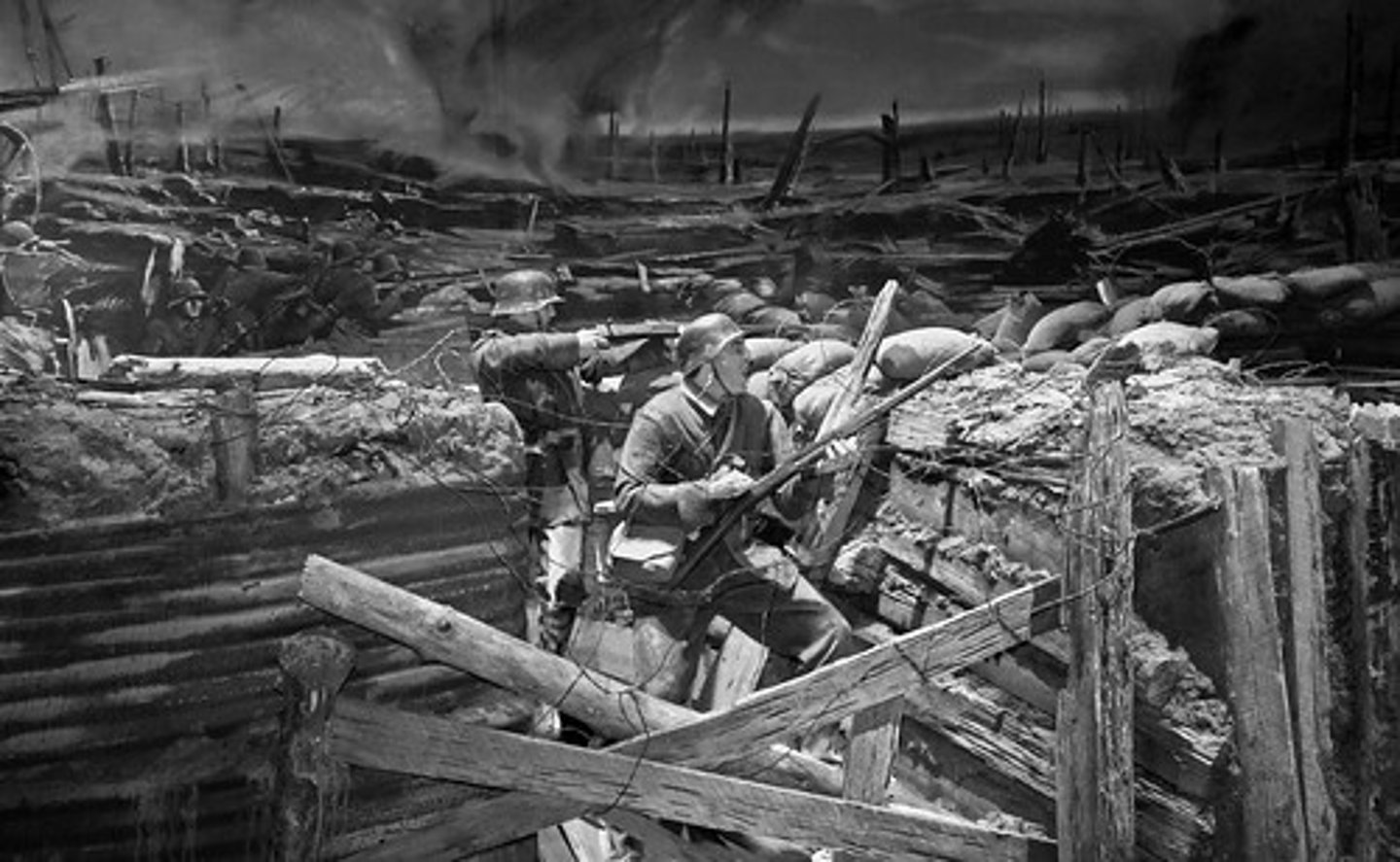
Western Front
Trenches in France that stretched from the English Channel to the Swiss border.
Blood Sacrifice
This was the idea that deaths (the spilling of blood) would inspire the Irish to fight for independence.
Internment
Imprisonment without trial.
Why did Redmond want the volunteers to fight in World War I?
Redmond hoped that this would influence the negotiations for Home Rule after the war.
What effect did this request have on the volunteers?
Redmond's idea caused a split in the Volunteers. 170,000 Volunteers agreed with Redmond. They were known as the National Volunteers. 11,000 Volunteers, led by MacNeill, disagreed. They kept the name Irish volunteers.

Why did the IRB plan a rising during World War I?
"England's difficulty is Ireland's opportunity" Britain's attention was focused on the Western Front so the IRB saw this as an opportunity to win independence for Ireland.
Name three members of the Military Council. Why did they bring in James Connolly?
The Military Council was set up n 1915 to plan the Rising. Its members included Patrick Pearse, Thomas Clarke and Joseph Plunkett. James Connolly was invited to join the council when the IRB discovered that he was planning a rebellion with the Irish Citizen Army. He wanted to set up a socialist republic in Ireland.
Write an account of Casement's role in the preparations for the Rising.
Roger Casement went to Germany to seek German support for an Irish Rebellion and buy guns. The Rising was planned for Sunday, 23 April. The weapons were to arrive off the coast of Kerry. Unfortunately, the ship, called the Aud, which was carrying the arms, was captured by the British navy.
Why did the Military Council deceive MacNeill? How did they deceive him?
They deceived Eoin MacNeill so that he would support the IRB (by the Irish Volunteers helping the IRB) as the IRB had only a few hundred members. Joseph Plunkett forged a document (called the Castle Document) which stated that the government was going to arrest the leaders of the Volunteers. MacNeill then told the Volunteers to get ready to resist.
Why did MacNeill cancel plans for the fighting?
MacNeill found out on Easter Saturday that the Aud had been captured. He also discovered that the Castle Document was a forgery. He cancelled the plans for fighting.
Why did the IRB decide to go ahead, with no hope of success?
They were influenced by the idea of blood sacrifice.
Apart from the GPO, mention three buildings occupied by the rebels during Easter Week, 1916
The Four Courts, Boland's Mills, the College of Surgeons
How did the ordinary people of Dublin react immediately after the Rising?
During the Rising and immediately after it the people were angry with the rebels. This was due to the damage caused to the city and the loss of earnings of many workers. However, the executions - especially that of the seriously wounded Connolly - caused people to sympathise with the rebels.
Why do historians see this event as a turning point in Irish history?
Most people no longer wanted Home Rule, but now demanded total independence from Britain, i.e. an Irish republic.
Write an account of the main events of the Rising.
Easter Monday, 24 April 1916 - Volunteers and the Irish Citizen Army (1,500 in total) seized key buildings around Dublin, including the GPO, the Four Courts, Boland's Mills and the College of Surgeons. Pearse read the Proclamation of the Irish Republic outside the GPO to puzzled onlookers. It was signed by the seven members of the Military Council: Thomas J.Clarke, Sean McDermott, Thomas MacDonagh, P.H. Pearse, Eamonn Ceannt, James Connolly and Joseph Plunkett.
Tuesday - There were 6,000 British soldiers in the city.
Wednesday - The gunship, Helga, came up the Liffey and shelled Liberty Hall. The GPO was shelled by guns in Trinity College.
Friday - Pearse ordered the evacuation of the GPO because it was on fire. They moved to houses in Moore Street.
Saturday - Pearse ordered the Volunteers to surrender. The rebellion was over.
What were the main effects of the Rising?
Around 3,000 people were arrested. Ninety leaders were sentenced to death by secret military courts between 3 and 12 May. Fifteen of the leaders were executed in Kilmainham Gaol. All the signatories of the Proclamation were shot.
Why was the Easter Rising a military failure?
1. There was no countrywide rebellion, which meant that the British could concentrate their forces in Dublin.
2. The decision to take over key buildings in the centre of Dublin made it easy for the British to surround them.
3. The rebels were heavily outnumbered by the British forces, whose soldiers were more experienced and better armed.
Why did Sinn Fein benefit most from the Rising?
Because as public opinion changed and people wanted more independence than Home Rule would give they joined Sinn Fein as they had the same views.
What were the aims of Sinn Fein in 1917?
1. Wanted an Irish Republic.
2. Wanted a Dail Eireann, independent of Westminster.
Who became the president of Sinn Fein in 1917?
Eamon de Valera
What actions of the British government in 1918 increased support for Sinn Fein?
1. The British announced plans to introduce conscription into Ireland. All Irish parties opposed this plan, but Sinn Fein got most of the credit when the British dropped the plan.
2. The British arrested Sinn Fein leaders such as de Valera and Griffith.
3. Sinn Fein won four by-elections.
By-election
When a MP dies or retires an election is held to replace them.
Conscription
Being forced to join an army.
Franchise
The right to vote.
What were the results of the 1918 general election?
Party Before After
Sinn Fein 7MPs 73MPs
Home Rule 78MPs 6MPs
Unionists 18MPs 26MPs
Why did the change in franchise help Sinn Fein?
Sinn Fein was seen as a young and dynamic party.