Lecture 20
 Call Kai
 Learn
Learn Practice Test
 Spaced Repetition
 Match
Match Flashcards
 Knowt Play
1/67

Earn XP
Description and Tags
asdbnklvmbhtrjklfghgfl
Name | Mastery | Learn | Test | Matching | Spaced | Call with Kai | Chat |
|---|
No analytics yet
Send a link to your students to track their progress
68 Terms
What are the first line of defense that block entry to the body?
Physical Barriers, Microbiota Barrier, Chemical Barriers
What are the second line of defense that activates after a microbe has entered the body?
Phagocytosis, Inflammation, Fever, Antimicrobial Products
What are the third line of defense that are specific?
B cells, T cells
[Fill in the Blanks]
First Line of Defense: Anatomical Barriers
(Blank)
Outermost layer (keratin)
Hair follicles
[redacted] glands
(Blank)
Digestive
Urinary
Respiratory
Eye
Skin, Mucous Membrane
The trachea & respiratory tree contain what that traps and propel particles out of the respiratory tract?
Cilia
[Fill in the Blanks]
First Line: Chemical Barriers
Sebaceous secretions - (BLANK) (skin oil)
Eyelid glands - meibomian gland
Tears and Saliva - (BLANK) - hydrolyzes peptidoglycan
(BLANK)
Sweat, stomach, skin, vagina, Semen
Sebum, Lysozyme, Acidic or Basic pH
An example of nonspecific chemical barrier to infection is
Lysozyme in saliva
Which nonspecific host defense is associated with the trachea?
Cilia
What is the term for the study of the development of resistance to infectious agents by the body?
Immunology
[Fill in the Blanks]
The immune system is responsible for
(BLANK) of the body
(BLANK) of foreign material
(BLANK) of foreign material or agent
Surveillance, Recognition, Destruction
What cell is able to recognize self-markers on host cells and nonself (foreign) markers on the invading microbe or foreign agent?
White Blood Cells (WBCs)
Markers on host cells can be made of what 2 things?
Proteins and/or Sugars
What is the term for when WBCs lack self-marker recognition making it respond and attack host cells?
Autoimmune Disorders
[True or False]
Tissues, Organs, and Cells of the Immune system are all integrated.
True
What is the acronym to remember the 4 systems part of our immune system which includes:
Reticuloendothelial system (RES) [aka MPS]
Extracellular fluids system (ECF)
Blood or circulatory system
Lymphatic System
REBL
What system explains that phagocytic cells are located in the network of connective tissue fibers (reticulum) that interconnects cells allowing the immune cells to bind and move outside the blood and lymphatic system?
Reticuloendothelial (RES) Mononuclear Phagocyte System (MPS)
In the Reticuloendothelial (RES) Mononuclear Phagocyte System (MPS), are WBC present in high or low #?
high
[True or False]
The Reticuloendothelial (RES) Mononuclear Phagocyte System (MPS) does not overlap with the lymphatic system and is not considered outdated.
False
What system explains the spaces surrounding tissue cells and RES which enable immune cells to move?
Extracellular Fluid (ECF)
What is the term for the blood cells suspended in plasma?
Whole blood
Which portion of the blood is described:
92% water
Rest is nutrients, hormones, clotting factors, immunochemicals, ions, dissolved gases, & waste products
Slightly yellowish
Plasma
What cells are the precursor to blood?
Stem cells
What is the term for the production of blood?
Hemopoiesis/Hematopoiesis
At which stage of birth does Hemopoiesis/Hematopoiesis start where there is a yolk sac and Liver & Lymphatic organs?
Embryonic Stage
Hemopoiesis/Hematopoiesis continues during the adult stage in what location of the body?
(in) Bone Marrow
[Fill in the Blanks]
Stem Cells
WBC = (BLANK)
RBC = (BLANK)
Platelets = (BLANK)
Leukocytes, Erythrocytes, Thrombocytes
[True or False]
Neutrophils, Basophils, Eosinophils, and Monocytes are hematopoietic stem cells in the bone marrow.
True
Lymphoid stem cells differentiate into what 2 cells?
T cells and B Cells
Are the following Granulocytes or Agranulocytes?
Neutrophils
Basophils
Eosinophils
Granulocytes
Are the following Granulocytes or Agranulocytes?
Monocytes
Lymphocytes
T cells
B cells
Agranulocytes
![<p>Which granulocyte is described:</p><ul><li><p>Polymorphonuclear [redacted] (PMNs)</p></li><li><p>Nuclei</p><ul><li><p>Horse shoe or polymorphic</p></li></ul></li></ul><ul><li><p>Phagocytizes bacteria</p><ul><li><p>Granules with digestive enzymes</p></li></ul></li><li><p>First to arrive during an immune response (inflammation)</p></li></ul><ul><li><p>55-90% of WBC</p></li></ul><p></p>](https://knowt-user-attachments.s3.amazonaws.com/94009b2a-fe2b-49d6-bfc0-4a9786c34de2.png)
Which granulocyte is described:
Polymorphonuclear [redacted] (PMNs)
Nuclei
Horse shoe or polymorphic
Phagocytizes bacteria
Granules with digestive enzymes
First to arrive during an immune response (inflammation)
55-90% of WBC
Neutrophils
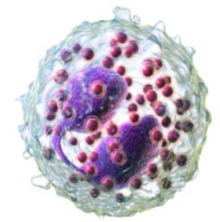
Which granulocyte is described:
Nuclei
Bilobed
Attack and destroy eukaryotic pathogens
Granules with digestive enzymes, toxic proteins, inflammatory chemicals
Associated with inflammation & allergies
1-3% of WBC
Eosinophils
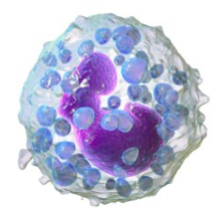
Which granulocyte is described:
Nuclei
Constricted
< 0.5% of WBCs - very low
Functions similar to eosinophils
Motile
Largest granulocyte
Basophils
Which agranulocyte is described:
Nuclei
Kidney-shaped
No large granules
3-7% of WBC
Largest of all WBC
Long-lived
Vacuoles with digestive enzymes
Differentiate into
Macrophages or Dendritic cells
Phagocytosis
Monocytes
[True or False]
The vacuoles of monocytes are filled with digestive enzymes.
True
Monocytes can differentiate to what 2 cells?
Macrophages and Dendritic Cells
Which agranulocyte is described:
Nuclei
circular
Lack granules
Third line of defense
20-35% of WBCs
Specific immunity
B cells
T cells
Null cells (natural killer)
Present throughout the body
Lymphocytes
What is the acronym to help remember the WBC types from most to least common?
NLMEB
What is the role of Red blood cells?
Transport oxygen & CO2
Which blood cell type releases blood clotting agents along and are also:
Hemostasis function (plug up broken blood vessels)
Tag bloodborne bacteria for immune response in spleen
no whole cells
blue-gray with fine red granules
small
Platelets
What is the term for the network of vessels that extend to most body areas connecting to the blood/circulatory system and includes the following:
Fluids
Vessels
Nodes
Spleen
Thymus
Miscellaneous
Lymphatic System
[Fill in the Blanks]
Functions of the Lymphatic System
Provides an auxiliary (BLANK) for the return of extracellular (BLANK) to the circulatory system
“(BLANK) off” system for inflammatory response
Surveillance, recognition, and (BLANK) via lymphocytes, phagocytes and (BLANK)
route, fluid, drain, protection, antibodies
What is the term for the plasma-like fluid of the lymphatic system that is formed from blood components that diffuse into the lymphatic capillaries?
Composed of:
Water, Dissolved salts, Proteins (antibodies, albumin), White blood cells (lymphocytes)
May contain:
Fats, cellular debris, infectious agents
Lymph
[True or False]
Lymph contains red blood cells.
False
What is the term for the vessels that run parallel to the blood system (similar to thin-walled veins) that permeate all parts of the body except central nervous system, bone, placenta, and thymus?
Lymphatic Vessels
[Fill in the Blanks]
The function of the lymphatic vessels is to return (BLANK) to the (BLANK).
lymph, blood system
The movement of lymph in the lymphatic vessels depends on what?
Muscle contractions
Which part of the lymphatic system is described:
Filter for the lymph
Provide environment for immune reactions
Exist in clusters
Located in the
lymphatic channels and blood vesselsthoracic and abdominal cavity regionsarmpit (axillary [redacted])
groin (inguinal [redacted])
neck (cervical [redacted])
Lymph Nodes
Which part of the lymphatic system is described:
Filter for blood
traps and phagocytizes pathogens
Located in the upper left portion of the abdominal cavity
Spleen
[True or False]
Adults cannot survive without a spleen and children without a spleen are not immunocompromised
False
Which part of the lymphatic system is described:
Main function - releases mature T cells
High activity until puberty
Embryotwo lobes in the pharyngeal region
Thymus
[True or False]
Infants rely on the Thymus to differentiate immature T cells into mature T cells.
True
[True or False]
The thymus in adults gradually shrink because the lymph node and spleen are able to supply mature T cells
True
[Other Lymph Tissue]
There are bundles of what that can recognize microbes or foreign agents in food and air?
beneath skin or on mucosal surfaces
lymphocytes
[Other Lymph Tissue]
What is the term for the ring of tissue with lymphocytes?
Tonsils
[Other Lymph Tissue]
What are the 3 acronyms to help remember the lymph tissues which are the following:
Skin-associated lymphoid tissue
Mucosa-associated lymphoid tissue
Gut-associated lymphoid tissue
ex: Appendix, lacteals, Peyer’s patches
SALT, MALT, GALT
The Appendix, lacteals, and Peyer’s patches are a part of which lymph tissues?
GALT
The following are part of which line of defense?
Inflammation (includes fever)
Phagocytosis
Antimicrobial Proteins
Interferon
Complement
Antimicrobial peptides
Restriction factors
Second Line of Defense: Non-Specific Immunity
Which non-specific immunity occurs as a reaction to a traumatic event in the tissues with the following five major symptoms?
Rubor
Calor
Tumor
Dolor
Loss of function
Inflammation
Fill in the following inflammatory signs
(BLANK): redness
(BLANK): warmth/heat
(BLANK): swelling
(BLANK): pain
rubor, calor, tumor, dolor
[Fill in the Blanks]
Causes of Inflammation
(BLANK)
Tissue (BLANK) due to physical or chemical agents
Specific (BLANK) reactions
trauma, injury, immune
[Fill in the Blanks]
Functions of Inflammation
Mobilize and attract (BLANK) components to the site of injury
Aid in the repair of (BLANK) damage
Localize and (BLANK) harmful substances
Destroy microbes and block their (BLANK)
immune, tissue, remove, invasion
Which non-specific immunity inhibits microbe and viral replication, reduces nutrient availability, and increases immune reactions by raising the natural temperature of the body?
Fever
Fevers are caused by what that reset the hypothalamic thermostat and causes vasoconstriction?
Pyrogens
[Fill in the Blanks]
(BLANK) pyrogens
outside body
viruses, bacteria, protozoans, & fungi
Ex: gram-negative LPS on cell wall (endotoxin)
(BLANK) pyrogens
originate internally
Leukocyte products (ex: interleukins)
Exogenous, Endogenous
Which of the following is not a lymphoid tissue?
Thyroid gland
Which of the following inflammatory signs specifies pain?
dolor
Essay Question:
List and briefly describe the four participants in the non-specific immune system.
Reticuloendothelial System (RES): passageway and between tissues and organs; WBCs present, macrophages
Extracellular Fluid: space around tissues and cells; enables immune cells to move
Blood: distributor of WBCs which help fight infectious agents in various ways
Lymphatic System: complex system of Fluids, tissues, & organs; help distribute WBCs that fight infectious agents