Ch. 6 ~ Sensation & Perception
 Call Kai
 Learn
Learn Practice Test
 Spaced Repetition
 Match
Match Flashcards
 Knowt Play
1/59

There's no tags or description
Looks like no tags are added yet.
Name | Mastery | Learn | Test | Matching | Spaced | Call with Kai |
|---|
No analytics yet
Send a link to your students to track their progress
60 Terms
How do we experience the world?
physical energy entering our body/nervous system and converted into a neural signal that can be sent to your brain
What is transduction?
the conversion of the physical energy to neural energy that is sent as a signal for your brain to process
What is the cornea?
clear outer covering, protects our eyes, focuses image
What does the pupil do?
controls the amount of light that gets into the eye
What is the iris?
muscles that allow pupil to change size, the colored part of the eye
What do the lens in our eye do?
focus a sharp image unto the back part of the eye (gets more rigid/less bending as older)
What is the retina and its role?
curved projection screen, thin layer of cells, contains receptors (rods and cones) for light converting it into a neuro signal
What is the blind spot in your eye?
a gap where visual signals leave eye and travel to back of the brain so we can perceive what we’re seeing
What is the fovea?
central part of your visual field, right behind your retina
the images that leave the eye and travel to the back of your brain are inverted images
What are two problems of Focus?
Myopia/Near-sightedness: can get a sharp image up close, farther away is blurry
Hyperopia/Far-sightedness: further image is sharp, closer= blurry
Why do the receptors have to pass the signal onto the ganglion cells?
Because the axons of those ganglion cell form the fibers of the optic nerve
Gets passed on to bipolar cells first because of the big distance
Then the G-cells pass it on to the back of the brain
What does the 0 degrees represent in the distribution of rods and cones?
represents the Fovea, the central image, moving away is moving into the periphery
Are there more rods or cones?
wayyyy more rods
*there are no rodes in the Fovea but are located along the periphery
What are the rods sensitive to?
motion; allow us to detect motion in our visual field
allow us to see in dimly lit conditions
What is the role of the cones?
*they are also in the periphery but line it
to make images very sharp
why is why when you want to see something clearly you look at it closely and directly, ensuring its in your central point of view
allow us to process color
What is the point where the two optic nerves from each eye cross over?
optic chiasm
from there they travel to the thalamus, then the back of the brain
How do we see color?
physical energy in the environment does not have perceptual qualities
light waves are not colored but our nervous system is interpreting these colors
Light being reflected off some object
How is a chameleon able to change it’s color?
he has control over the pigments within his skin, so he can control the wavelengths that are reflected, vs the ones that are absorbed
What’s the most impressive animal that can change the color of their skin?
the cuttlefish
What is trichromatic vision?
the fact that we have three different types of cones in our retina and each respond to a diff range of wavelengths
Long = upper spectrum, red
Medium = middle, green
Short = lower, blue
What does it mean if someone has dichromatism?
they only have two types of cones of the wavelengths, limiting their access to the long//red and making them “color blind”
even the greens they see are dull
What can’t trichromaticism explain about how we see images?
color afterimages
What is opponent process?
processing of the color signals within the visual cortex
when you’re staring at the color it’s being exhausted, so when you remove it and look at white then it’s opposing color has a chance to be used and you see an opposite color
What are the two systems in which we see colors?
Trichromatic (receptors in retina)
Opponent-process (beyond the retina to brain)
How does the opposing-process allows us to do?
make fine discrimination in colors that are very close to each other within a wavelength spectrum
e.g different shades of red
What are the two ways we perceive complex visuals?
(Bottom Up): we build a perception from the sum individual parts, “sensations”
(Top Down): Gestalt; see the entire image then look at it’s parts
proved that we see this way more
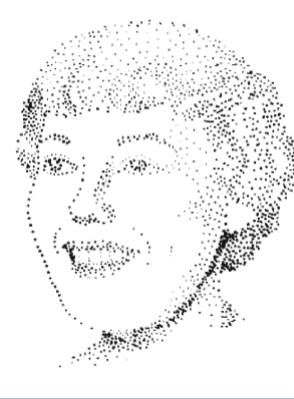
What was the one overall guiding principle that Gestalt used?
simplicity
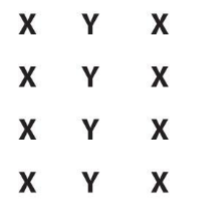
Principle of similarity?
grouping things that look similar together
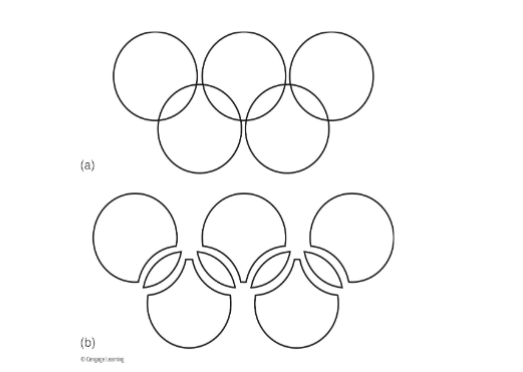
Principle of continuity?
not four branches but two continuing from each side
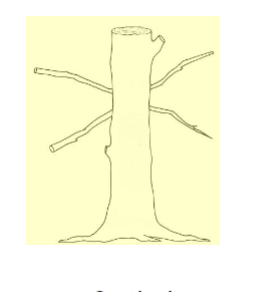
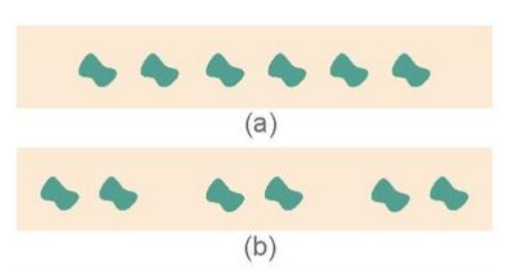
Principle of Proximity?
when images are closer together we group them as one
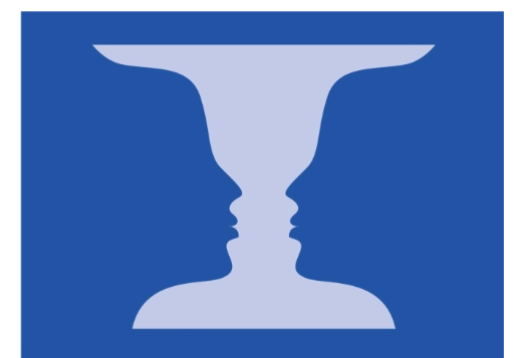
What is figure-ground segregation?
when we look at an image we try to extract the object from it’s background
*figure ground images don’t allow us to do this easily
What is binocular depth cues?
result from binocular disparity
the fact that when we’re looking at something the image that enters our right eye is slightly diff from the one that enters our left
our brain can now process these diff images and extracts depth cues
Whats the best way to understand this depth perception?
stereoscopes and 3d Movies
two images displaced slightly going into one eye each only, creating the image to pop out
use two cameras side by side
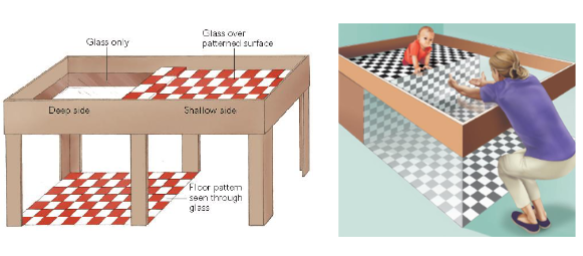
What was the visual cliff experiment?
*purpose was to see if babies noticed a diff in height
placed on glass table: half checkerboard and half transparent glass
very young babies actually can’t detect, their depth perception wasn’t fully developed
What are monocular depth cues?
don’t require interaction between both used
used to perceive depth from a 2D image
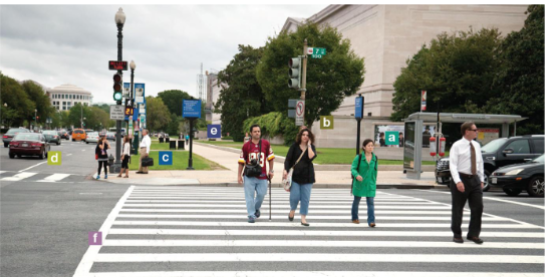
What is relative height?
the fact that we use the relative height of images to determine how far away they are
the higher the image is the further away (on ground)
lower = further away (in the sky)
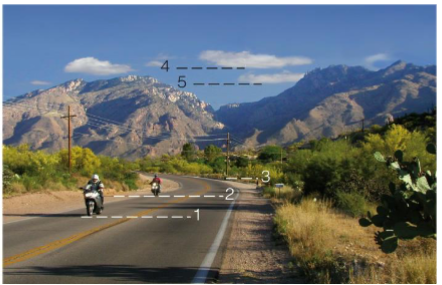
What is relative size vs familiar size?
relative = bigger is closer and smaller is farther
but it can be deceiving so we’ve go to know the familiar size of what we’re viewing
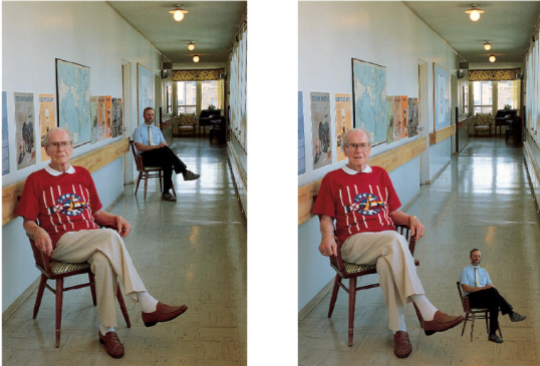
What is size constancy?
a cognitive function of the visual system that allows us to perceive an object as its actual, constant size, even as its distance from us changes and the size of its image on our retinas shrinks or grows
playing on our understanding that the farther away something is the smaller it is
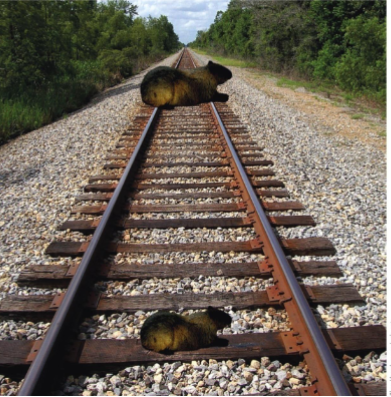
What is the ames room?
other visual illusions rely on restricted viewing angle and manipulation of depth cues
How do sounds travel?
in waves
What are the two physical aspects of sound?
physical = volume, perception = loudness
physical = frequency, perception = pitch
What are the different sections of our ears?
Outside, folds, groove: called pinna
Eardrum: tympanic membrane (eardrum)
vibrates when sound reaches it
What are the three ossicles/bones in our ear?
Malleus
Incus
Stapes
bangs against cochlea
*smallest bones in the human body
Why are the ossicles bone and not muscle or soft tissue?
they have to transfer the sound from air, to fluid that is inside the cochlea
What is the basilar membrane?
houses receptors for sound that are located on top of the membrane
transmit signals to nerve fibers
base = narrow, thick for high frequencies
upper = wide, thin apex for low frequencies
What needs to happen for a sound to be perceived?
must travel to the brain
from cochlea to thalamus to auditory complex
What are the two hearing problems?
Conductive: sound signals are not being transmitted properly
Sensorineural: involves an issue with the neural processing of the sound waves (more serious)
What does a cochlear implant do?
artificially sends neural signals that aren’t being transmitted themselves
hearing SOME sounds and speech, but not all
one of a thing we need to speak is to hear ourselves
How are we able to taste food?
the chemical contents of our food reacts with taste receptors located in our mouths
where there are a lot of bumps, indicated that there are a lot of receptors there
What is umami?
foods that are savory/meat
beef or steak
Supertaster vs non-taster?
Super, more taste buds: picky eater
extra sensitive in spice
Non-taster
No difference in bitter foods
What is olfaction?
we have to extract the chemicals from the air that we breathe into our nose, then they’re converted
Olfactory receptors and bulbs?
sent from the receptors, to the bulb to the brain
Why do we also react to certain smells of food?
the signal is also sent to two parts of our frontal lobe
Orbitofrontal cortex: decision making
Amygdala: affects our emotional state, giving an emotional reaction
How do we touch?
receptors (mechanoreceptors) located in our skin
can respond to changes in pressure or temp against skin and transfer it to the brain
What carries our touch signals to the brain?
cranial and spinal nerves
What is the somatosensory cortex?
has a map of areas of the body where the, diff regions of cortex respond to sections of the body where the signals are originating in
Which receptors allow us to distinguish everyday touch vs pain?
Nociceptors
Fast fiber; reserved for very sharp immediate pain
Slow fiber; lingering, a slow aching
How do we recognize pain signals inside our body?
Complicated explained by gate control body
can be influenced by our cognitive state
opening gate = more pain, closed = reduced to no pain
What can the gate control model explain?
How we perceive placebo effects
why a person can be injured but doesn’t feel the pain, because they’re focusing on other things
Also why meditation, acupuncture and hypnosis effectively works when its really simple