Tablet Coating and Drug Release
 Call Kai
 Learn
Learn Practice Test
 Spaced Repetition
 Match
Match Flashcards
 Knowt Play
1/20

There's no tags or description
Looks like no tags are added yet.
Name | Mastery | Learn | Test | Matching | Spaced | Call with Kai |
|---|
No analytics yet
Send a link to your students to track their progress
21 Terms
Are gastric resistance and enteric coating the same thing?
Yes
What are the 3 types of coating?
Film coating
Sugar coating
Press coating
Why do we coat tablets?
To protect ingredients from environment (light and moisture)
Taste masking
Make the tablet easier to swallow
Coloured coating allow for rapid identification of product by the pharmacist and the patient
Film coatings have enteric or controlled release properties
What are the stages of sugar coating a tablet?
Sealing – prevents water entry (e.g. shellac, CAP)
Sub-coating – builds size/rounds tablet (CaCO₃ or talc + sucrose)
Smoothing – smooth surface (sucrose syrup)
Colouring – adds colour to tablet
Polishing – gives shine (beeswax, carnauba wax)
Printing – adds logo or code
What is film coating and how is it applied to tablets?
Most modern tablets are film coated rather than sugar coated
Involves spraying a thin polymer film onto the tablet core
Coating liquid = polymer + solvent + additives (e.g. pigments, plasticisers)
Forms a thin, uniform layer around the tablet
Sugar coating Vs Film coating
Film coating is faster
The weight increase due to film coating is only 2-3%, whereas sugar coating adds like 30-50%
What are the issues with coating?
Picking/chipping
Roughness
Sticking
Film cracking/peeling
What are drugs enterically coated?
Protects the tablet core from disintegration in the acid environment of the stomach
Prevents acid attack on a drug unstable at low pH
Protects stomach from the irritant effect of certain drugs
Facilitates absorption of a drug that is preferentially absorbed further down the GI tract
Taste masking
What is enteric coating?
Coating that is insoluble at low pH (stomach) but dissolves at higher pH (intestine)
Enteric means intestine
Why are pH-sensitive polymers are used in enteric coating?
pH in the small intestine
The drug with enteric coating will reach the small intestine
The polymer in the enteric coating dissolves in specific pH.
When it reaches the small intestine, the pH is now suitable and the coating will dissolve
Why can’t you eat food when you take an enteric coated drug?
The food raises the pH in the stomach, leading to the drug to be dissolved in the stomach rather than the small intestine where it would be absorbed
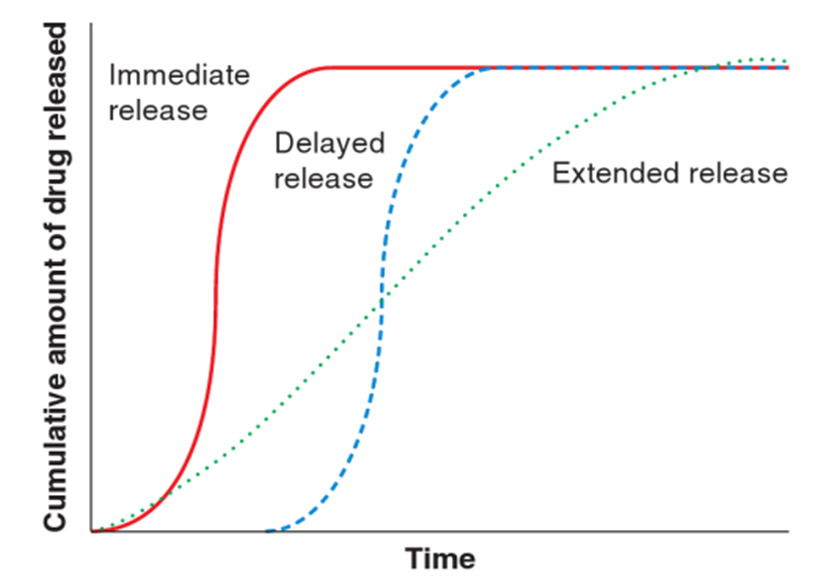
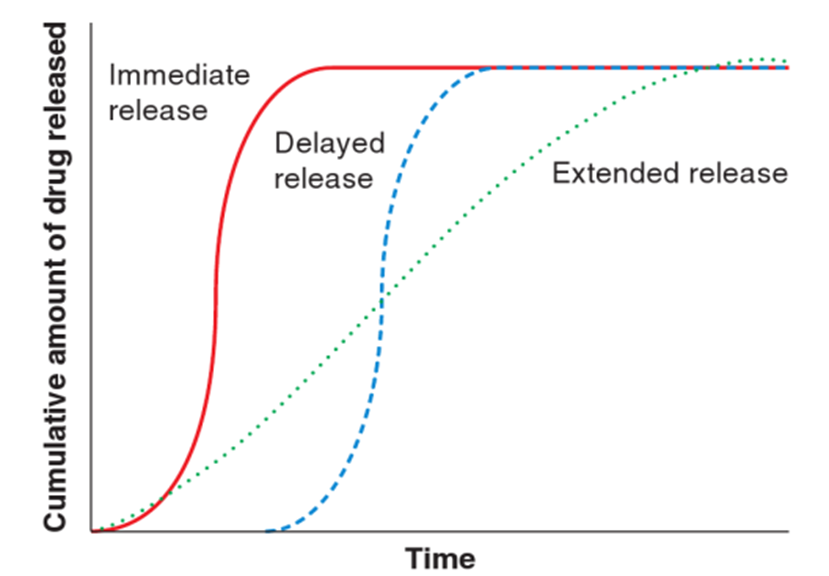
Delayed-released tablet
Enteric coated drugs will only be absorbed in the small intestine
There is a lag time
What are multi-particulate coatings?
Drug is divided into many small particles (pellets/beads)
Typically 0.5–2.0 mm diameter
Can be filled into sachets, capsules, or compressed into tablets
Why are multi-particulates used?
Easier to swallow
You can control dosings easier
When are multi-particulate coatings used?
Controlled release
Gastro-resistant (enteric) release
Extended release
Site-specific drug delivery
What are the advantages of multi-particulates?
More consistent GI transit than single dose monolithic tablet
Less likely to suffer from dose dumping
What are the disadvantages of multi-particulates?
Control of membrane characteristics using film coating can be difficult
Multi-particulates are difficult to retain in the upper GI tract
What are the types of multi-particulates?
Extruded/spheronized granulates
Produced in modified granulating equipment
Drug granulate extruded through a mesh under pressure to form small particles for spheronization
What are the drug release mechanisms from multi-particulates?
Diffusion: On contact with aqueous fluids of GI tract, water enters interior of particle by diffusion. Dissolution occurs and drug diffuses across controlled release coat.
Osmosis: In allowing water to enter, osmotic pressure builds up within pellet interior forcing drug solution out.
Erosion: Some coatings are designed to degrade gradually with time, thereby releasing drug contained within pellet.
What is MUPS?
Multiple-unit pellet systems
Enteric coated particles are compressed into a tablet
The polymer coat must be more flexible because of compression forces that are applied in the tabletting process
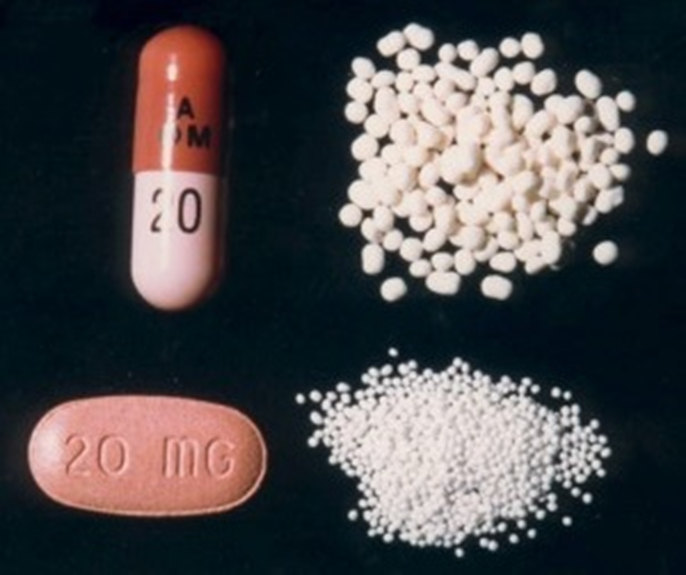
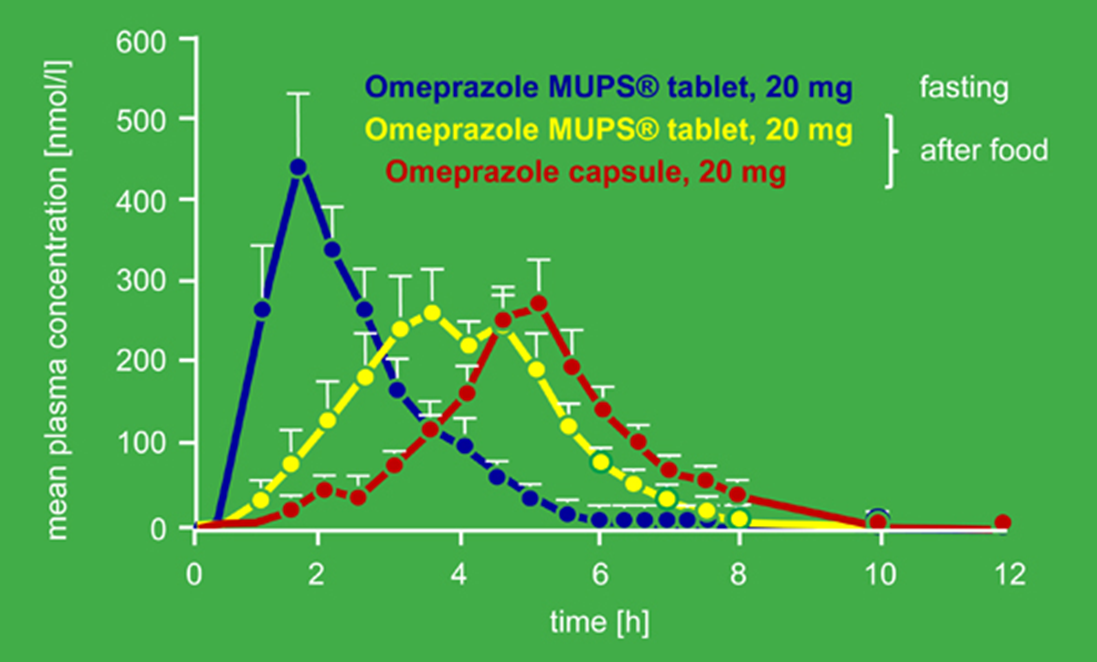
Capsule
MUPS
MUPS dissolves faster. It has a smaller particle size.
Fasting state. Lower pH
Fed state. Higher pH.