12. Threats on Breeding Grounds
 Call Kai
 Learn
Learn Practice Test
 Spaced Repetition
 Match
Match Flashcards
 Knowt Play
1/20

There's no tags or description
Looks like no tags are added yet.
Name | Mastery | Learn | Test | Matching | Spaced | Call with Kai |
|---|
No analytics yet
Send a link to your students to track their progress
21 Terms
ALAN impacting timing of daily activity at breeding ground
if theres more light, would extend hours they sang at
on average, birds sang an hour/day
Larger eyes, migrants starting earlier, ending later with more ALAN (big eyes is adaptation for lower light levels, so ALAN would have stronger effects)
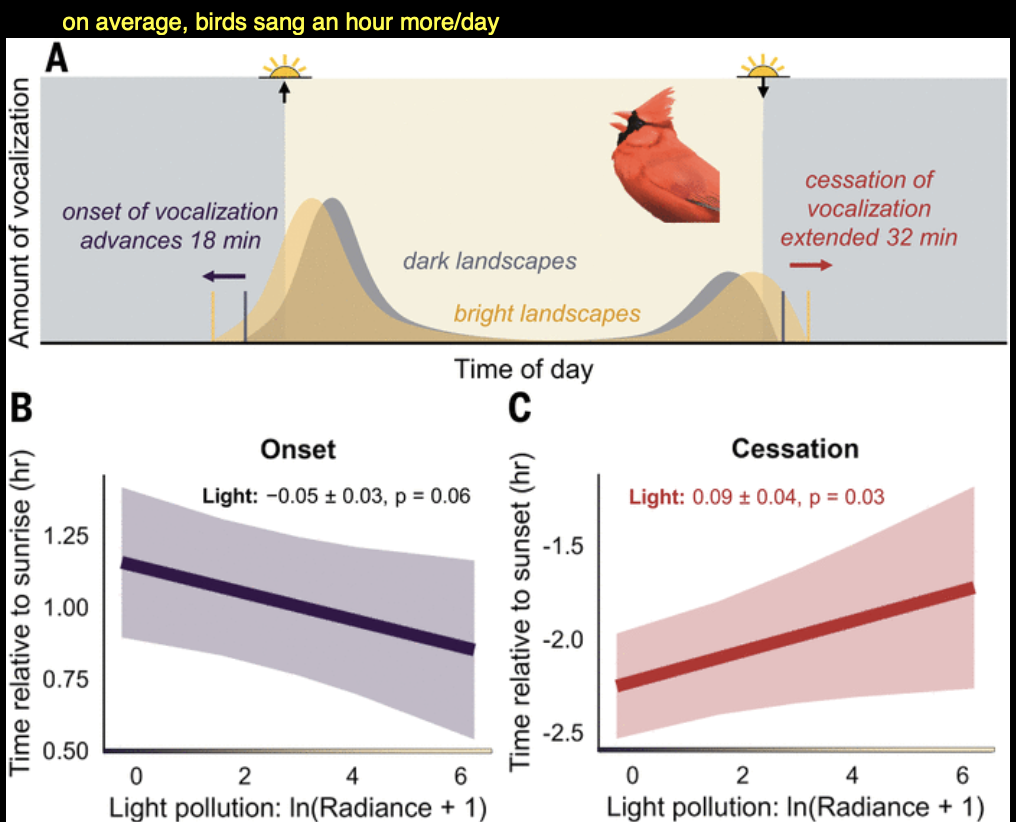
Possible effects of birds singing more due to ALAN
if birds sing longer/earlier/later may affect reproductive output (spending more time on this as trade off to something else which could reduce output)
Why birds don’t have defences against cowbirds
native birds have not evolved recognition or counter-strategies
Cowbird impact on forest birds
• Cowbirds find host nests in the forest, but feed in adjacent agricultural fields
• In small forest fragments it is common for > 50% of songbird nests to contain cowbird eggs
• Many nests contain 2-3 cowbirds eggs and only 1-2 host eggs
3 levels of evidence that cowbirds are linked to songbird population declines
1) Nest level
2) Population level (correlation)
3) Population level (experiment)
1) Nest level description
parasitized nests have far lower reproductive success than non-parasitized nests
cowbird parasitism causes a drop of ~ 50% in reproductive success
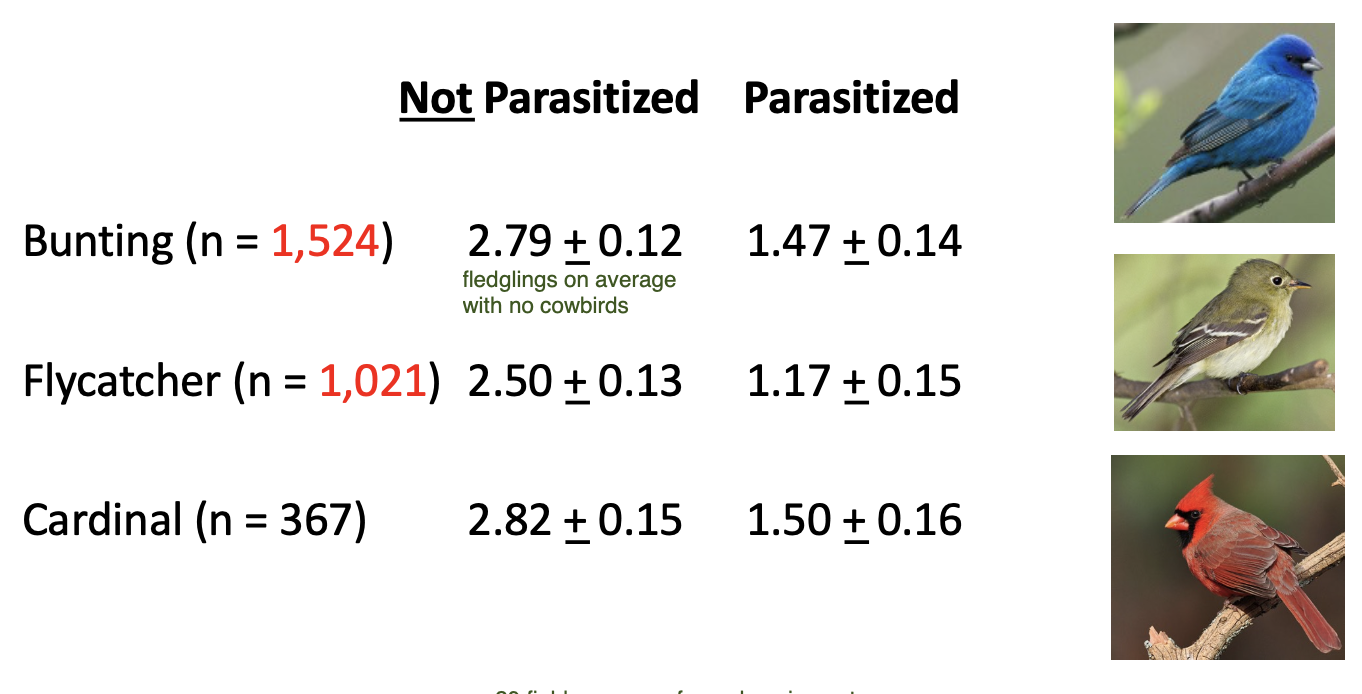
2) Population-level (correlation)
when cowbird populations decline, reproductive success of host populations increases
Cowbirds have declined in northern Missouri since the 1970s because forest cover has increased. Southern Missouri is control
number of cowbird eggs per nest (intensity) also decreased sharply over time as cowbird pop decreased in north
in south, as cowbirds decreased, fledglings increased
3) Population level (experiment)
removed cowbirds and observed vireo recovery increased
Fragmentation and nest predators
• Agricultural matrix provides artificial source of food and increases population sizes of mice, chipmunks, raccoons, skunks, crows, blue jays, etc.
• In small forest fragments it is common for over 60% of nests to be eaten by predators
Edge effect and nest predation
Small fragments have a higher proportion of edge habitat than large fragments.
Overall predation rate decreases strongly as distance of the nest to the edge of the forest increases
edge habitats had more predation by snakes and raptors
Source definition
Average female produces more young than necessary to replace herself when she dies
Sink definition
Average female produces fewer young than necessary to replace herself when she dies
survival bottleneck of fledglings
if get to be about 10, survivorship is very high super vulnerable at young age (0-5)
Estimated of cats in U.S.A
• In the U.S. there are an estimated 84 million pet cats and an additional 30-80 million un-owned (ie stray/feral) cats
Name of cat monitoring program
The National Geographic & University of Georgia Kitty Cams (Crittercam) Project
Methodology and Results of Kitty cams to measure kill rate/cat
• Ask home owners to report dead animals that their cats bring home
• Put Kitty-cams on pet cats (n = 55) to monitor their behaviour; found that only 44% of these cats hunted wild prey
• Hunting cats brought back only 25% of their prey to owner’s house - so owners greatly underestimated kill rate
cat kill rate results and diversity in what they hunt
Kill Rate was 0.3 birds/hunting cat per week or about 12 birds/hunting cat/year
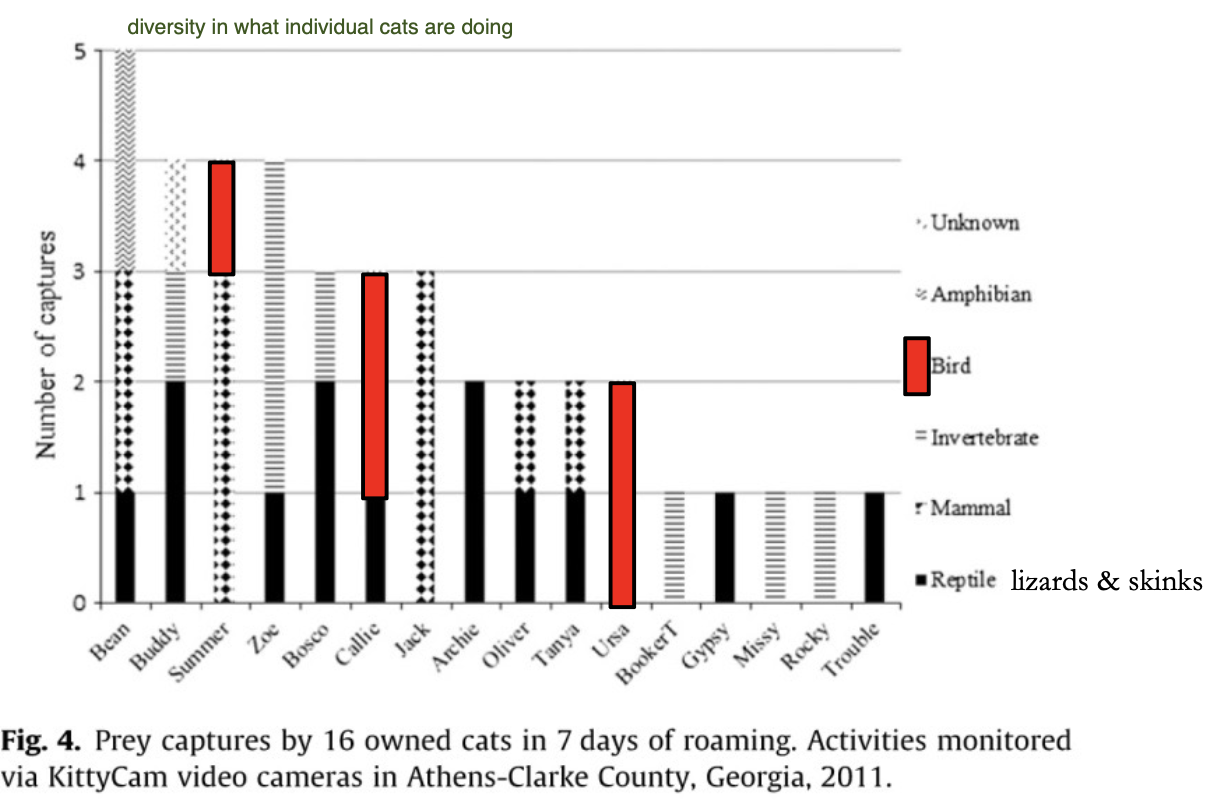
calculating US-wide bird mortality by cats
• 84 million pet cats in US, of which 50-80% hunt wild animals (according to owners)
• 30-80 million un-owned cats, of which 80-100% hunt wild animals
• Kill rate of birds varies greatly among studies due to different prey base & methods
• 1-34 birds killed/pet cat/year
• 24-51 birds killed/un-owned cat/year
Model number of birds killed by cats each year
• Ran the model thousands of times by randomly selecting different values for all the variables, within the observed range
• Most models predict 2-3 billion birds are killed by cats in the US alone
• Number of small mammals killed even higher
Total Bird mortalities by cats in Canada
200-300 million birds/year
Overall bird mortality stats
• Cats : 200-300 million birds/year
• Window Collisions: 25 million birds/year
• Wind Turbines: 24,000 birds/year