CH3
 Call Kai
 Learn
 Practice Test
 Spaced Repetition
 Match
 Flashcards
 Knowt Play
1/49

Earn XP
Description and Tags
source: https://gaia.cs.umass.edu/kurose_ross/videos/3/
50 Terms
3.1 Where is transport-layer functionality primarily implemented?
Transport layer functions are implemented primarily at the hosts at the “edge” of the network.
3.1 True or False: The transport layer provides for host-to-host delivery service?
True
3.1 Check all of the services below that are provided by the TCP protocol.
A byte stream abstraction, that does not preserve boundaries between message data sent in different socket send calls at the sender.
In-order data delivery
A congestion control service to ensure that multiple senders do not overload network links.
A flow-control service that ensures that a sender will not send at such a high rate so as to overflow receiving host buffers.
Reliable data delivery.
3.1 Check all of the services below that are provided by the UDP protocol.
A message abstraction, that preserves boundaries between message data sent in different socket send calls at the sender.
3.1 The transport layer sits on top of the network layer, and provides its services using the services provided to it by the network layer. Thus it’s important that we know what is meant by the network layer’s “best effort” delivery service. True or False:
The network layer’s best-effort delivery service means that IP makes its “best effort” to deliver segments between communicating hosts, but it makes no guarantees. In particular, it does not guarantee segment delivery, it does not guarantee orderly delivery of segments, and it does not guarantee the integrity of the data in the segments.
Correct! The network layer’s best effort service doesn’t really provide much service at all, does it?
3.2 What is meant by transport-layer demultiplexing?
Receiving a transport-layer segment from the network layer, extracting the payload (data) and delivering the data to the correct socket.
3.2 What is meant by transport-layer multiplexing?
Taking data from one socket (one of possibly many sockets), encapsulating a data chuck with header information – thereby creating a transport layer segment – and eventually passing this segment to the network layer.
3.2 True or False: When multiple UDP clients send UDP segments to the same destination port number at a receiving host, those segments (from different senders) will always be directed to the same socket at the receiving host.
True
3.2 True or False: When multiple TCP clients send TCP segments to the same destination port number at a receiving host, those segments (from different senders) will always be directed to the same socket at the receiving host.
True
3.2 True or False: It is possible for two UDP segments to be sent from the same socket with source port 5723 at a server to two different clients.
True
3.2 True or False: It is possible for two TCP segments with source port 80 to be sent by the sending host to different clients.
True
3.3 True or False: On the sending side, the UDP sender will take each application-layer chunk of data written into a UDP socket and send it in a distinct UDP datagram. And then on the receiving side, UDP will deliver a segment’s payload into the appropriate socket, preserving the application-defined message boundary.
True
3.3 Which of the fields below are in a UDP segment header? [Hint: note the use of the word "header" in this question statement.]
Destination port number
Length (of UDP header plus payload)
Internet checksum
Source port number
3.3 Why is the UDP header length field needed?
Because the payload section can be of variable length, and this lets UDP know where the segment ends.
Why is the UDP header length field needed?
Because the payload section can be of variable length, and this lets UDP know where the segment ends.
3.3 Over what set of bytes is the checksum field in the UDP header computed over?
The entire UDP segment, except the checksum field itself, and the IP sender and receive address fields
3.3 Which of the following statements are true about a checksum? Hint: more than one statement is true.
The sender-computed checksum value is often included in a checksum field within a packet header.
A checksum is computed at a sender by considering each byte within a packet as a number, and then adding these numbers (each number representing a bytes) together to compute a sum (which is known as a checksum).
The receiver of a packet with a checksum field will add up the received bytes, just as the sender did, and compare this locally-computed checksum with the checksum value in the packet header. If these two values are different then the receiverknows that one of the bits in the received packet has been changed during transmission from sender to receiver.
3.3 Compute the Internet checksum value for these two 16-bit words: 11110101 11010011 and 10110011 01000100
01010110 11100111
3.3 Compute the Internet checksum value for these two 16-bit words: 01000001 11000100 and 00100000 00101011
10011110 00010000
3.3 True or False: When computing the Internet checksum for two numbers, a single flipped bit (i.e., in just one of the two numbers) will always result in a changed checksum.
True

3.4
The source port number of the UDP segment (B) sent in reply is:
The source IP address of the IP datagram containing the UDP segment (B) sent in reply is:
The destination port number of the UDP segment (B) sent in reply is:
The destination IP address of the IP datagram containing the UDP segment (B) sent in reply is:
3546
128.119.40.186
4829
60.54.75.24
3.4
Lets the sender know that a packet was NOT received correctly at the receiver.
Used by sender or receiver to detect bits flipped during a packet’s transmission.
Allows for duplicate detection at receiver.
Lets the sender know that a packet was received correctly at the receiver.
Allows the receiver to eventually receive a packet that was corrupted or lost in an earlier transmission.
NAK
Checksum
Sequence numbers
ACK
Retransmission

3.4
Consider the rdt 2.0 sender and receiver shown below, with FSM transitions at the sender labeled S1, S2, and S3; and receiver transitions labeled R1 and R2.
Which of the following sequences of transitions could possibly occur as a result of an initial rdt_send() call at the sender, and possible later message corruption and subsequent error recovery.
S1, R1, S2
S1, R1, S2, R2,S3
S1, R2, S3
3.4
What is meant by a cumulative acknowledgment, ACK(n)?
A cumulative ACK(n) acks all packets with a sequence number up to and including n as being received.
3.4
Suppose a packet is 10K bits long, the channel transmission rate connecting a sender and receiver is 10 Mbps, and the round-trip propagation delay is 10 ms. What is the maximum channel utilization of a stop-and-wait protocol for this channel?
0.1
Suppose a packet is 10K bits long, the channel transmission rate connecting a sender and receiver is 10 Mbps, and the round-trip propagation delay is 10 ms. What is the channel utilization of a pipelined protocol with an arbitrarily high level of pipelining for this channel?
1.0
3.4
Suppose a packet is 10K bits long, the channel transmission rate connecting a sender and receiver is 10 Mbps, and the round-trip propagation delay is 10 ms. How many packets can the sender transmit before it starts receiving acknowledgments back?
10
3.4
Which of the following statements about pipelining are true? One or more statements may be true.
A pipelined sender can have transmitted multiple packets for which the sender has yet to receive an ACK from the receiver.
With a pipelined sender, there may be transmitted packets “in flight” – propagating through the channel – packets that the sender has sent but that the receiver has not yet received.
3.4
What are some reasons for discarding received-but- out-of-sequence packets at the receiver in GBN? Indicate one or more of the following statements that are correct.
The implementation at the receiver is simpler.
The sender will resend that packet in any case.
3.4
What are some reasons for not discarding received-but- out-of-sequence packets at the receiver in GBN? Indicate one or more of the following statements that are correct.
Even though that packet will be retransmitted, its next retransmission could be corrupted, so don’t discard a perfectly well-received packet, silly!
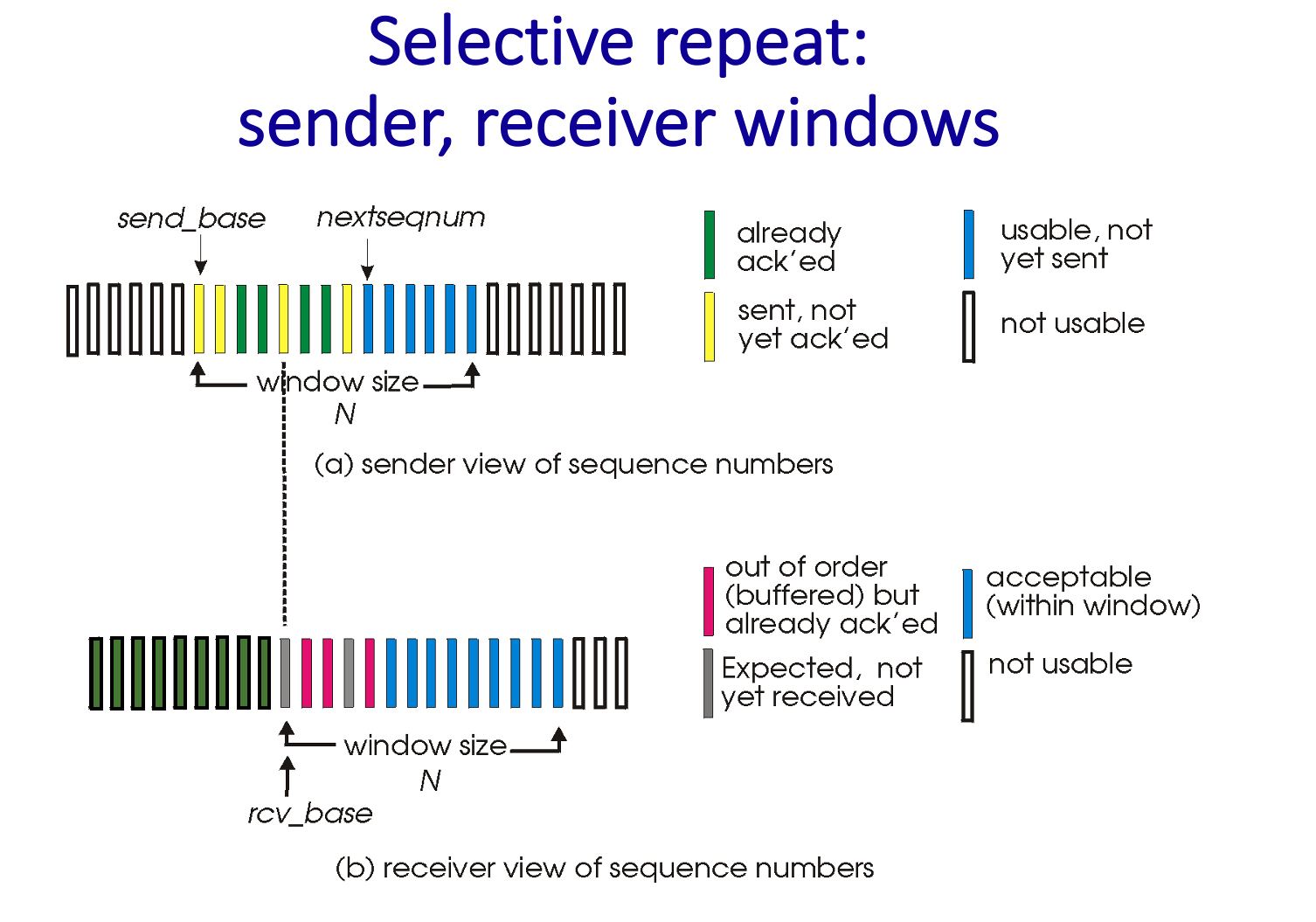
3.4
In the SR receiver window (see diagram below, taken from PPT slides and video), why haven’t the red packets been delivered yet? Check the one or more reasons below that apply.
There is a packet with a lower sequence number than any of the red packets that has yet to be received, so in-order delivery of data in the red packets up to the application layer is not possible.
3.5
True or False: On the sending side, the TCP sender will take each application-layer chunk of data written into a TCP socket and send it in a distinct TCP segment. And then on the receiving side, TCP will deliver a segment’s payload into the appropriate socket, preserving the application-defined message boundary.
True

3.5
Consider the TCP Telnet scenario below (from Fig. 3.31 in text). Why is it that the receiver sends an ACK that is one larger than the sequence number in the received datagram?
Because the send-to receiver segment carries only one byte of data, and after that segment is received, the next expected byte of data is just the next byte (i.e., has an index that is one larger) in the data stream.

3.5
False

3.5
Cancels any running timers.
3.5
True or False: with TCP’s flow control mechanism, where the receiver tells the sender how much free buffer space it has (and the sender always limits the amount of outstanding, unACKed, in-flight data to less than this amount), it is not possible for the sender to send more data than the receiver has room to buffer.
True
3.5
A message from client to server initiating a connection request.
A message from server to client ACKing receipt of a SYN message and indicating the willingness of the server to establish a TCP connection with the client.
A message indicating that the sending side is initiating the protocol to terminate a connection.
A message sent in response to a request to terminate a connection, ACKing that the side receiving this message is also willing to terminate the connection
A general purpose error message used during connection set up or tear down to let the other side know that an error has occurred, and that the referenced connection should be shut down.
SYN mesage
SYNACK message
FIN message
FINACK message
RESET message

3.5
Consider TCP’s Fast Retransmit optimization (see Figure 3.37 from the text, below). Of course, the sender doesn't know for sure that the segment with sequence # 100 is actually lost (it can’t see into the channel). Can a sender get three duplicate ACKs for a segment that in fact has not been lost? Which of the following statements are true? Suppose a channel can lose, but will not corrupt, messages.
If the channel can reorder messages, a triple duplicate ACK can occur even though a message is not lost; since it's possible that a message has just been reordered and has not yet arrived when the three duplicate ACKs were generated.
If the channel cannot reorder messages, a triple duplicate ACK indicates to the sender that a segment loss has happened for sure. Actually (again assuming the channel cannot corrupt or reorder messages), even a single duplicate ACK would indicate that a segment loss has happed for sure

3.6
20
3.6
Which of the following actions are used in network-assisted congestion control (say versus end-end congestion control) to signal congestion. Check all that apply.
A router sends an ICMP message to a host telling it to slow down its sending rate.
A router marks a field in the datagram header at a congested router.
3.6
Which of the following actions are associated with end-end congestion control (say versus network-assisted congestion control). Check all that apply.
The transport-layer sender decreases its sending rate in response to a measured increase in the RTT.
A sender decreases its sending rate in response to packet loss detected via its transport-layer ACKing.
A router drops a packet at a congested router, which causes the transport-layer sender to infer that there is congestion due to the missing ACK for the lost packet.
A datagram experiences delay at a congested network router, which is then measured by the sender and used to decrease the sending rate.
3.6
The sender infers segment loss from the absence of an ACK from the receiver.
Bits are set at a congested router in a sender-to-receiver datagram, and bits are in the returned to the sender in a receiver-to sender ACK, to indicate congestion to the sender.
The sender measures RTTs and uses the current RTT measurement to infer the level of congestion.
end-end
network-assisted
delay-based
3.7
Which of the following statements about TCP’s Additive-increase-multiplicative-decrease (AIMD) algorithm are true? Check all that are true.
AIMD cuts the congestion window size, cwnd, in half whenever loss is detected by a triple duplicate ACK.
AIMD cuts the congestion window size,cwnd, i to 1 whenever a timeout occurs.
AIMD is a end-end approach to congestion control.
3.7
How is the sending rate typically regulated in a TCP implementation?
By keeping a window of size cwnd over the sequence number space, and making sure that no more than cwnd bytes of data are outstanding (i.e, unACKnowledged). The size of cwnd is regulated by AIMD.
3.7
Which of the following best completes this sentence: "In the absence of loss, TCP slow start increases the sending rate ... "
" ... faster than AIMD. In fact, slow start increases the sending rate exponentially fast per RTT."
3.7
Consider the transport-layer flows interacting at a congested link. In the face of such congestion, what happens at this link to a transport-layer flow that does not cut back on its sending rate?
Nothing different from the other flows crossing the congested link.
3.7
Assuming that the congestion window size,cwnd, has not yet reached Wmax, TCP CUBIC will ... (check all that apply)
.. always have a window size, cwnd, and hence a sending rate, higher than that of AIMD (assuming a given window size, Wmax, at which loss would occur).
... increase its sending rate faster than AIMD when cwnd is far away from Wmax, but increase slower than AIMD when cwnd is closer to Wmax
3.7
The currently measured throughput is greater than cwnd/RTTmin
The currently measured throughput is equal to or a bit less than than cwnd/RTTmin
The currently measured throughput is much less that than cwnd/RTTmin
This should never happen
increase the sending rate
decrease the sending rate
3.8
What are advantages of the streams concept in QUIC? Select all that apply.
Streams allow concurrent retrieval of web objects, while avoiding Head of the Line (HOL) blocking.
Since each stream has its own error control, if one stream experiences an error (e.g., lost or damaged segment), the other streams are unaffected
3.8
What are advantages of implementing transport-layer functionality in QUIC at the application layer? Select all that apply.
As an application-layer protocol, QUIC can be updated/modified at “app frequency” rather than at the frequency of operating system updates.
QUIC can establish all connection parameters (security, reliability, flow and congestion control)in just one handshake rather than separately in two.