total ethics
 Call Kai
 Learn
Learn Practice Test
 Spaced Repetition
 Match
Match Flashcards
 Knowt Play
1/389

There's no tags or description
Looks like no tags are added yet.
Name | Mastery | Learn | Test | Matching | Spaced | Call with Kai |
|---|
No analytics yet
Send a link to your students to track their progress
390 Terms
critical thinking
thinking about thinking
considering if our thinking abides by the criteria of good sense and logic
critical thinking requires
evaluating arguments that support the claims we are considering and weighing them against those that support alternative views
expressing a belief in a declarative sentence
is when the belief becomes a claim/assesrtion or statement
objective claim
whether its true or false is dependent on whether people think it’s true or false
subjective claim
relative claim
relativism
truth is realtive to a standard set by a given culture, meaning there is no universal truth
moral relativism
issue
whenever a claim is called into question then an issue has been raised
when you think critically about a claim
you make it an issue
Biases
common reasons for bad reasoning/conclusion
result of external/internal influence
logic vs emotions
belief bias
evaluating reasoning by how believable its conclusion is
confirmation bias
a tendency to attach more weight to considerations that support our views
availability heuristic
assigning a probability to an event based on how easily or frequently it is thought of
false consensus effect
assuming our opinion and those held by people around us are shared by society at large
Bandwagon effect
the tendency to align our beliefs with those of other peoples
negativity bias
attaching more weight to negative information than to positive info
Loss aversion
being more strongly motivated to avoid a loss than to accrue a gain
in-group bias
agreeing with the opinions of ppl we associate with
Fundamental attribution error
having one understanding of the behaviour of people in the in group and another for poeple not in the in group
obedience to authority
a tendency to comply with instructions from an authority
Overconfidence effect
a cognitive bias that leads us to overestimate what percentage of our answers on a subject are correct
better than average illusion
a self deception cognitive bias that leads us to overestimate our own ability relative to those of others
truth
has no universally accepted answer
a claim is true if it is free from error
knowledge
if you believe something is so, have an argument taht is beyond a reasonable doubt, and have no reason to think you are mistaken = it is known
ethics meaning
ethos
character, concerns, questions of good, right, duty obligation and virtue
a question of how life should be, not what it is
a ethical decision is justified if
if it is supported by the best available reasons impartially applied
messy morality
conflict between principles
conflict between ppl
uncertainty of application
requirement of judgement
Aristotelian Virtue ethics
type of virtue ethics that is based on the teachings of artistotle
focused on virtues
virtues (according to aristotle)
habits or dispositions that lead to good and flourishing life.
formed through practice and repeition
ultimate goal of life : aristotle
reaching eudaimonia (happiness) through the interrelated virtues
deontology
kant
believes that rule and laws dictate the rightness and wrongness of behaviour as long as they are dealt in good faith and treats ppl as ends, not means
utilitarianism
mills
Believes that the right decision is the one that maximizes happiness (utility) and reduces suffering
existentialism
believes that there is no unverisal meaning to reality beyond the meaning that each one of us projects, and thus one’s mortalityis a reflection of one’s authentic self while acting in good faith by accepting the truth of absolute freedom
values of authenticity and good faith
the four principles of biomedical ethics
respect for autonomy
non maleficience
beneficence
justice
Respect for autonomy
a norm of respecting the decision making capacities of autonomous persons
non maleficience
a norm of avoiding the causation of harm
*?
benefience
a group of norms for providing benefits and balancing benefits against risks and costs
justice
a group of norms for distributing benefits, risks and costs fairly
Formalism
the rules are what make it the sport.
Broad Internalism (interpretivism)
sporting competition is a mutually acceptable quest for excellence through challenge
definition
arguments consists of two parts
the premise and the conclusion
the premise
is intended to provide a reason for accepting the conclusion
a statement by itself is
not an argument
an emphasis statement is
not an argument
proof vs support
deductive argument
a type of argument in which the premise or premises, if true, prove or demonstrate the conclusion
validity
follows the correct form of a deductive argument (the premsise would make the conclusion true, however it may not be true in this case) but if there were true then the conclusion would be true
a good deductive argument
has to be true and valid
two types of deductive reasoning
categorical reasoning
sentential reasoning
Categorical reasoning
all/no.some
validity depends on categorical relationships
Categorical reasoning involves statements about categories (or “sets”) and figuring out what conclusions follow. These statements often look like:
All A are B
No A are B
Some A are B
Some A are not B
sentential (propositional) reasoning
not/and/or/if-then
validity depends on logical form
when is a deductive argument valid
if the premises cannot be true while the conclusion is false
validity depends on form not truth
a valid argument with true premesis is a sound argument
valid but not sound
uValid but not sound (false premise, true conclusion can still happen):
•Premise: All Olympic sports are winter sports. (false)
•Premise: Figure skating is an Olympic sport. (true)
•Conclusion: Figure skating is a winter sport. (true)
→ Form is valid (if all Olympic sports were winter, then figure skating would be winter). But it’s not sound because a premise is false.
invalid
uInvalid (true premises, false conclusion is possible):
•Premise: All sprinters are athletes. (true)
•Premise: Some swimmers are athletes. (true)
•Conclusion: Therefore, some swimmers are sprinters. (doesn’t follow; could be false)
→ Invalid form; premises don’t force the conclusion.
inductive argument
an argument where the premise supports the conclusion but does not demonstrate or prove it
SUpport for the conclusion in inductive argument
can vary in degree and can be described as stronger or weaker.
an argument is stronger if (inductive)
it raises the probability of the conclusion more than a weaker argument
unstated premises
premises that are common and assumed
unstated conclusions
uArguments can also have unstated conclusions.
Example: “Stacy drives a Porsche.”
Unstated conclusion: She is rich or her parents are.
In common law, what is the highest standard of proof?
Beyond a reasonable doubt.
How does "proof beyond a reasonable doubt" compare to deductive demonstration?
It is a lower standard; deductive demonstration corresponds more to "beyond any possible doubt."
In logic, when is a proposition considered demonstrated?
When it is the conclusion of a sound argument with true premises, making it impossible for the conclusion to be false.
Inference to the best explanation (IBE)
an argument that explains the cause of something (seeks the simplest and most likely)
IBE is often used to determine
the cause of something based on the best explanation or evidence available
ibe is considered as
abduction and is a form of inductive reasoning
is used to support a conclusion, not to prove it
example of ibe
•determining that sleeping on a certain mattress caused a backache, or that a philosophy course caused improved test scores.
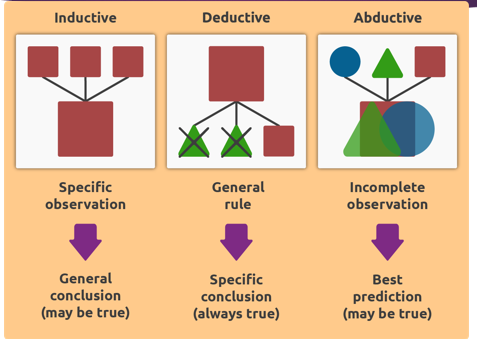
inductive, deductive and abductive in the picture
ethos is
an appeal to the credibility or trustworthiness of the speaker or writer
position the writer as an authority on the subject
Pathos is
an appeal to the audiences emotions to create a connection with the audience and to evoke feelings in order to persuade them
logos is
an appeal to reason or logic
an attempt to use facts, stats and evidence to make a logical argument and to persuade the audience through logical reasoning
how to understand arguments
find the conclusion
locate the reasons (premises) for the conclusion
are they valid, are they true?
Early anti doping efforts
initial concerns in the 1960s led to the IOC’s first prohibited list defining doping broadly as unnatural performance enhancement
escalation and scandal of anti doping
in the 70s and 80s anabolic steriods addition and scandals ike east germany’s doping program begun to raise awareness
Three criteria test
WADA prohibits substances or methods based on performance enhancement, health risk or spirit of sport violations
violations of any two criteria is sufficient
ethical challenges with spirit of sport
ambiguous
intrinsic good in sport
sport possesses intrinsic goods realized through adherence to rules
Ethical Issues of Doping
doping bypasses sport constraints, reducing challenge and compromising the nature of genuine acheivement
integrity and mastery of sports and doping
shortcuts undermine mastery and erode excellence
authentic victories come from effort and skill, not artifical advantages
Naturalness debate
naturalistic fallacy
cultural bias and merit
moderate naturalism approach
integration of values and techbology
Naturalistic fallacy
assuming natural means ethically good
naturalisitic fallacy
culture bias and merit
cultural biases rooted in protestant work ethic emphasize earned merit influencing views on naturalness in sports
Moderate Naturalism approach
moderate naturalism treats naturalness as a heuristic, balancing nature with fairness, health and autonomy
Ambiguity of the spirit of sport
vague clause
historical reactionary origin
ethical dilution
evidence based reform
vague clause critisim
the spirit of sport lacks clear and operation definition leading to inconsistent application and undermined legitamace
Historical Reactionary Origin
The concept arose as a reactive measure during doping crises rather than through deliberate principled framework development
Ethical Dilution Concerns
Simplifying complex ethics into a ‘bag of virtues’ dilutes coherence and weakens the ethical foundation of the clause.
Calls for Evidence-Based Reform
Experts propose replacing or supplementing the clause with explicit, evidence-based standards focusing on fairness and health.
athlete autonomy and doping—privacy
Strict liability and whereabouts monitoring raise ethical concerns by infringing on athletes' privacy and autonomy.
athlete autonomy and doping—Governance and Representation
Lack of athlete representation in policy creation worsens governance deficits and impacts due process fairness.
athlete autonomy and doping—Calls for Proportionality and Transparency
Critics emphasize proportional sanctions, stakeholder input, and transparency to protect rights and fairness in anti-doping.
EVIDENCE GAPS AND PROPORTIONALITY
Lack of Robust Evidence Many substances on the prohibited list lack strong evidence of performance enhancement or health risks, questioning their bans. Proportionality Concerns Only a minority of banned classes show clear efficacy, raising concerns about the proportionality of restrictions. Policy Innovations Innovative policies like sunset clauses and conditional approvals can improve evidence-based anti-doping regulation. Enhancing Legitimacy Evidence-driven approaches promote athlete welfare and integrity, avoiding moralistic or political agendas
Anti doping argument
preserve internal goods
health and safety
Preserving internal goods
protect internal goods: the core values and excellence acheivable only through skill and effort
maintain fair competition: avoiding pharmacological shortcuts ensures victories reflect effort and respect
upholding ethical integrity :Anti-doping sustains sport’s cultural and ethical integrity, fostering virtues like perseverance and fairness.
Anti-Doping : Health and Safety
Health Risk Mitigation: Banning doping substances reduces physiological harm risks and protects athlete health in competitive environments.
Prevention of exploitation: Anti-doping policies prevent exploitation by reducing pressure on athletes to engage in unsafe practices
Ethical Justification :Anti-doping aligns with ethical principles prioritizing nonmaleficence and harm prevention in sports
Pro-doping:
Autonomy and Adult Consent
Safer thorough regulation
Autonomy, consent and doping (pro)
Respect for Autonomy:Advocates argue that informed adults should freely choose performance enhancement accepting associated risks.
Challenge to External Prohibitions: Prohibitions impose external values that undermine athletes' self determination and freedom of choice.
Regulated Legalization Benefits: Legalization under regulations can respect autonomy while minimizing harm and ensuring safety
Aspiration and Excellence Enhancement aligns with sport's ethos, enabling pursuit of excellence by all available means
.
Safer through regulation - prodoping
Risks of Prohibition: Ban on doping pushes enhancement underground, causing unsafe practices and black-market exploitation.
Harm-Reduction Approach : Legalizing certain substances under medical supervision reduces health risks while maintaining fair competition.
Physiological Doping Concept: Controlled enhancement within safety limits balances innovation with athlete welfare and ethical oversight.
Evidence-Based Oversight Managing doping pragmatically emphasizes science and safety over moral absolutism and bans
Anti Anti doping crituques : governance and transperancy
governance flaws: Current anti-doping systems suffer from opaque decisions, inconsistent enforcement, and limited stakeholder inclusion
Critique of ideals and fairness:Reliance on ambiguous ideals like the 'Spirit of Sport' leads to arbitrary bans and fairness issues under strict liability
reform proposals:Reforms suggest publishing justifications, including athlete voices, and applying proportional sanctions for legitimacy
medical necessity vs fairness (TUES)
potential performance enhancement
ensure consistent criteria
some treatments like beta-2 agonists may protect health but provide performance advantage so we need clear standards
BETA-2 and TRT
vital for asthma patients but may increase performance
challenges such as monitoring
need evidence based policies to balance therapeutic needs with integrity