9. sleep
 Call Kai
 Learn
Learn Practice Test
 Spaced Repetition
 Match
Match Flashcards
 Knowt Play
1/70

There's no tags or description
Looks like no tags are added yet.
Name | Mastery | Learn | Test | Matching | Spaced | Call with Kai |
|---|
No analytics yet
Send a link to your students to track their progress
71 Terms
sleep
a behavior and an altered state of consciousness
how much of our lives do we spend sleeping?
1/3
3 things which electrophysiological instruments measure during sleep
muscle tone (EMG)
respiration, HR, blood pressure
summated brain wave activity (EEG)
type of brain waves detected by EEG during wakefulness (synchrony, amplitude, frequency)
beta waves (13-30 Hz) (high arousal)
desynchrony, low amplitude, high frequency
type of brain waves detected by EEG when eyes are closed (synchrony, amplitude, frequency)
alpha waves (8-12 Hz)
synchrony, relatively high amplitude, low frequency
brain waves ordered from low to high arousal
delta < theta < alpha < beta
characteristics of low and high arousal waveforms
low - synchronous, high amplitude, low frequency
high - desynchronous, low amplitude, high frequency
6 sleep stages and what wave form activity characterizes each
wakefulness - alpha and beta activity
stage 1 - alpha and theta waves
stage 2 - alpha and theta waves w sleep spindles (bursts of 12-14 Hz activity, aka beta waves) and K-complexes (bursts of delta waves of low frequency and high amplitude)
stage 3 - 30% delta, 70% theta
stage 4 - 50% delta, 50% theta
REM - theta/alpha/beta activity
what are stages 3 and 4 (delta and theta activity) also called?
slow-wave sleep (SWS)
characteristics of non-REM sleep (stages 1-4)
all EEG waveforms present
light, even respiration
muscle control present
characteristics of REM sleep
presence of beta activity similar to wakefulness
increased respiration and BP
rapid eye mvmts (REM)
loss of muscle tone (paralysis)
VIVID, emotional dreams
sexual arousal
length of basic sleep cycle
90 minutes
difference btwn dreams in stages 3-4 and REM
dreams in stages 3-4 are “cold, rational” dreams that focus on reality
dreams during REM are vivid, emotional, and irrational
infants sleep …% of the time. adults sleep …% of the time
80%, 30%
2 reasons why older ppl are prone to waking up over the course of the night
UTIs increase w age
reduced number of adenosine receptors in the vIPOA
in which 2 kinds of sleep do dreams occur?
SWS and REM sleep
REM sleep is accompanied by high lvls of blood flow in the …
visual association cortex (occipital)
when do nightmares occur?
stage 4 of SWS
2 potential functions of sleep
may be an adaptive response
restoration and repair
does exercise increase SWS or REM?
no
2 effects of sleep deprivation
impaired ability to concentrate
perceptual distortions/hallucinations
rats that are forced to walk on rotating platform lose sleep. what happens to these sleep deprived rats?
they eventually become ill and DIE
fatal familial insomnia is caused by what? what happens to humans w this?
genetic dmg to the hypothalamus
gradually become unable to sleep → eventually lose SWS → DIE
SWS may reflect…
restoration
REM sleep may reflect 2 things
vigilance - alertness to the env (keeps brain alert and ready to awake)
facilitation of brain dev - infants spend more time in REM sleep
SWS improves consolidation of … memories. REM improves consolidation of … memories
declarative/explicit
nondeclarative/implicit
declarative/explicit memories
things that you might need to process to recollect
e.g., test info
nondeclarative/implicit memories
things you don’t need to try to remember
e.g., throwing a ball
sleep rebound + % for stage 1 and 2, REM, and SWS
how much sleep you need to make up
stages 1 and 2 - 10%
REM - 50%
SWS - 70%
2 findings which show that it’s impossible for sleep to only be controlled by hormones
siamese twins share same circulatory system, but sleep independently
bottle-nose dolphins: the two hemispheres sleep independently
what does it mean if the “flipflop” is on? off?
on = alert/awake
off = asleep
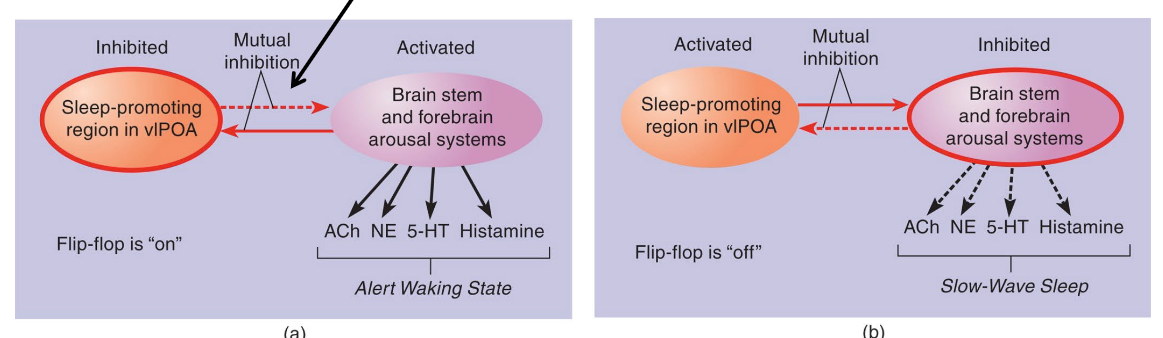
ventrolateral pre-optic area (vlPOA)
if activated, it drives you toward sleep. if inhibited, you stay awake
basal brainstem and forebrain arousal systems
keeps organism awake thru various diffuse pathways. if these systems are inhibited, you fall asleep
what hormones do the basal brainstem and forebrain arousal systems involve?
ACh, NE, 5-HT, histamine
what are vlPOA and basal/forebrain areas both inhibited by?
2 GABA-ergic pathways
where are ACh neurons activated? what does this produce?
activated within ventral pons and basal forebrain
produces behavioral activation and beta waves
ACh agonists … arousal, ACh antagonists … arousal
increase, decrease
where are NE neurons located? when do they show high and low activity?
locus coeruleus in the dorsal pons
high activity during wakefulness
low activity during sleep (0 during REM sleep)
locus coeruleus neurons may play a role in…
vigilance
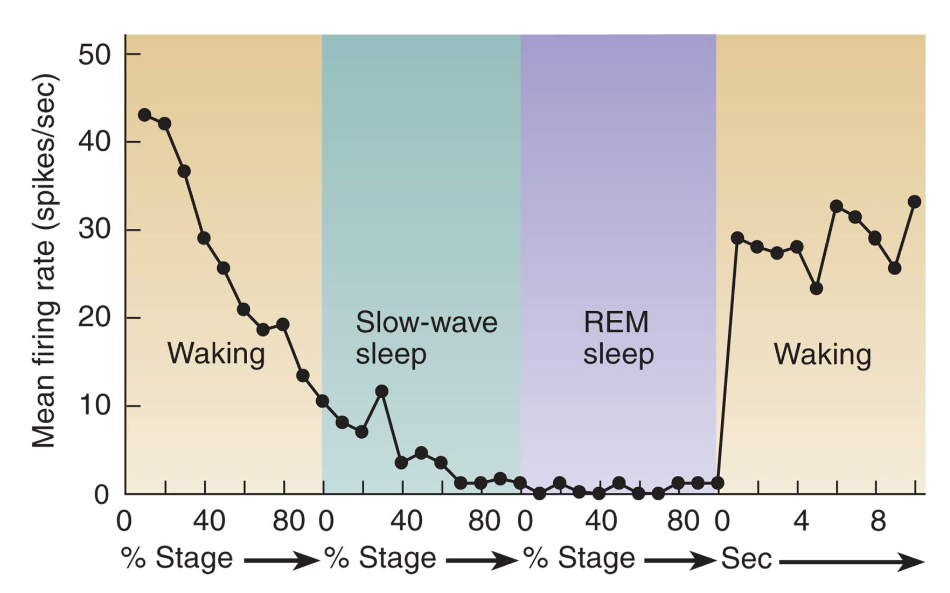
what does this graph show?
NE neuron firing rate
where is histamine located? what 4 parts of the brain does it project to? what does it produce?
located in tuberomamillary nucleus of the hypothalamus
project to the cerebral cortex, thalamus, basal forebrain, basal ganglia
cortical and behavioral arousal
5-HT/serotonin (where is it located/stimulated, what does it induce, what do its antagonists do, what 4 parts of the brain does it effect, when is it most released and not released?)
located in the raphe nuclei (medulla and pons)
induces cortical arousal
antagonists reduce cortical arousal
widespread effects to thalamus, hypothalamus, basal ganglia, hippocampus
most released during waking, no release during REM
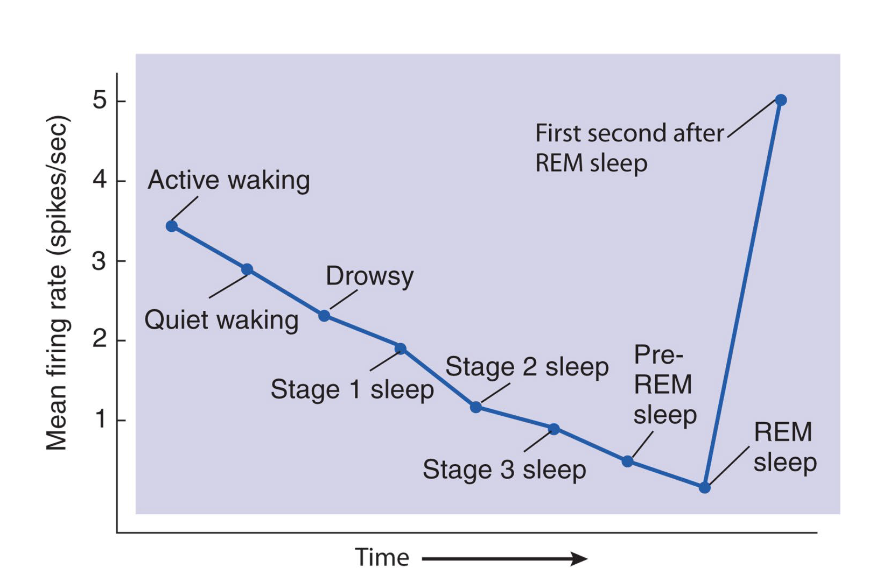
what does this graph show?
mean firing rate of 5-HT
orexin is located where? what does it do?
neurons located in lateral hypothalamus
activate all arousal systems
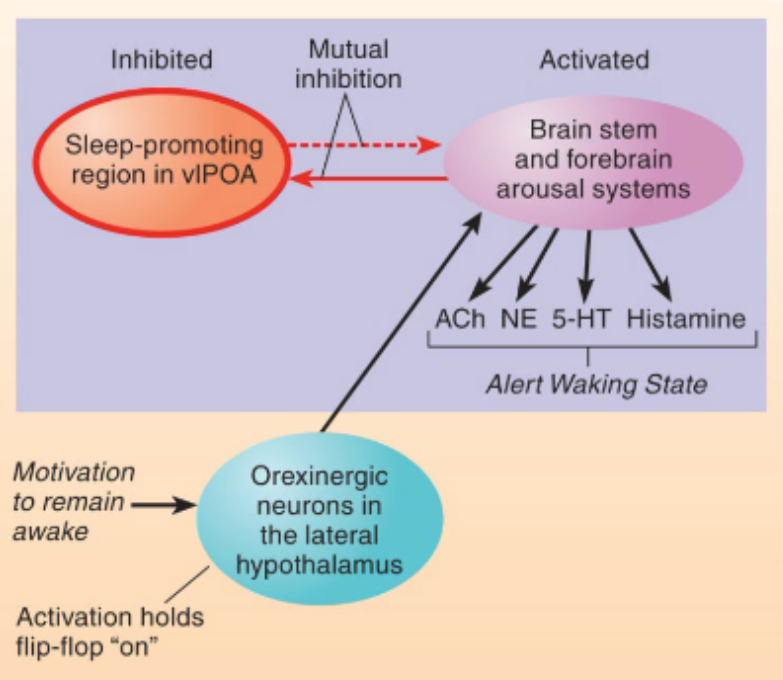
what activates orexin? what decreases orexin?
hunger and the day-night cycle
satiety
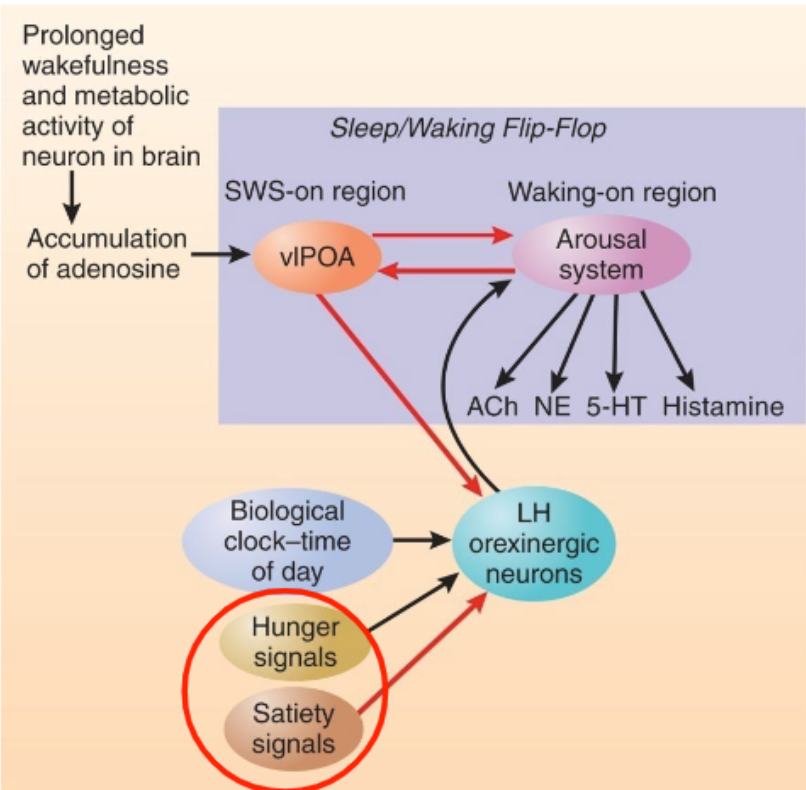
what does the ventrolateral preoptic area (VLPA) induce? how?
SWS
by secreting GABA, which suppresses alertness and induces SWS
lesions of the vlPOA
produce total insomnia, leading to death
electrical stimulation of the vlPOA
induces signs of drowsiness in cats
what chemical initiates vlPOA activity?
ADENOSINE
what is adenosine produced by and when? what does accumulation of adenosine cause and thus allow?
produced by astrocytes when lacking glycogen — essentially when the brain is running out of energy
accumulation of adenosine causes drowsiness → allows for the restoration of glycogen
what are circadian rhythms moderated by? where is it? what is its role?
moderated by the suprachiasmatic nucleus (SCN) of the hypothalamus
just above optic chiasm
role in sleep, eating, behavioral activity
where does the SCN receive info from?
from retina
does the SCN receive info from rods or cones?
NO
what detects light and dark around ganglion cells? which pathway does this info run thru?
melanopsin
retinohypothalamic pathway
caffeine
an adenosine receptor agonist — decreases need for sleep
jet lag
disconnection btwn your SCN’s cycle and climate/time
2 functions of SCN
inhibit the vIPOA, thereby increasing arousal (inhibiting sleep)
excite orexinergic neurons and increase arousal
what brain part is important for the control of REM sleep? where does it sends projections to? what are the first indicators of REM sleep? what kinds of neurons and in where promote REM sleep?
the pons
sends projections to medulla, a pathway which inhibits muscle mvmt
PGO (pons-geniculate-occipital) waves
ACh neurons in the peribrachial pons (dorsal)
what 3 parts of the brain do pontine ACh neurons project to? what do they control? is it excitatory or inhibitory?
thalamus - control of cortical arousal
forebrain - arousal and desynchrony
tectum - rapid eye mvmts
excitatory
when the ventral pons system is activated by ACh, what is affected? what about the dorsal pons (peribrachial area)?
beta arousal and wakefulness
beta arousal and REM
insomnia
refers to a difficulty in getting to sleep or remaining asleep
3 causes of insomnia
situational causes - some need more sleep than others
drug-induced causes - use of sleeping pills can lead to insomnia
sleep apnea
how to solve insomnia
try treating primary causes of it first (stress, etc.)
drug dependency insomnia is caused by
classic rebound effect from using sleeping pills
sleep apnea
person stops breathing and is awakened when blood lvls of carbon dioxide stimulate breathing
narcolepsy + (what chromosome is affected, rate it affects population)
sleeping at odd times
usually genetic on chromosome 6
~1 in 2000 ppl
3 types of narcolepsy
sleep attack
cataplexy
sleep paralysis
sleep attack
urge to sleep during the day (boring times)
narcoleptics have reduced … lvls of the neuropeptide …
CSF, orexin
cataplexy + pathway
REM paralysis occurs, person is still conscious (excitement)
some problem from peribrachial pons → subcoeruleus nucleus → nucleus magnocellularis of the medulla → descending motor neurons
sleep paralysis + what it may sometimes involve
inability to move just prior to sleeping or just after waking
sometimes involve REM-like dreams